
SLS-120 · Lesson 9 of 12 · 20 min
Written follow-up: email and messages
▶ Video coming soon A video version of this lesson is on the way.
After her second meeting with Northfield Family Clinic, Maya sent the office manager, Janet Morrow, a follow-up email that she was proud of. It ran to five paragraphs, thanked Janet for her time, described Ridgeline's history, listed eleven features of the recommended printers and attached three brochures. Janet did not reply. A week later, Darnell asked to see the email. He read it, then asked Maya one question: 'What did you want Janet to do after reading this?' Maya realized she had not said. The email recapped nothing Janet had told her, asked for nothing, and buried the one thing Janet cared about, the contract flexibility, in paragraph four.
In most sales, conversations are followed by writing: a recap after a meeting, a quote, a confirmation of a delivery, a quick text to say an order has arrived. Written follow-up keeps a sale moving between conversations, creates a record of what was agreed and gives buyers something they can forward to the other people involved in the decision. This lesson focuses on follow-up in the sales process. The general principles of clear business writing, such as audience, plain language and structure, are covered in BUS-120 Business Communication, and this lesson builds on them.
What follow-up is for
A follow-up message has four jobs. It confirms understanding: it shows the buyer that the seller heard them, in their own words. It records agreements: what was decided, what each side will do and by when. It moves the sale forward: it asks for or confirms a specific next step. And it travels: in business selling especially, the buyer may forward it to a manager, a colleague or a finance team who were not in the meeting, so it has to make sense to them too.
A follow-up that does all four is usually short. Maya's rewrite of her Northfield email, below, was about a third the length of the original.
The recap email
The most important follow-up in business selling is the recap email sent after a meeting. Darnell asks sellers to send it within one business day, while the conversation is fresh for both sides, and to structure it the same way every time.
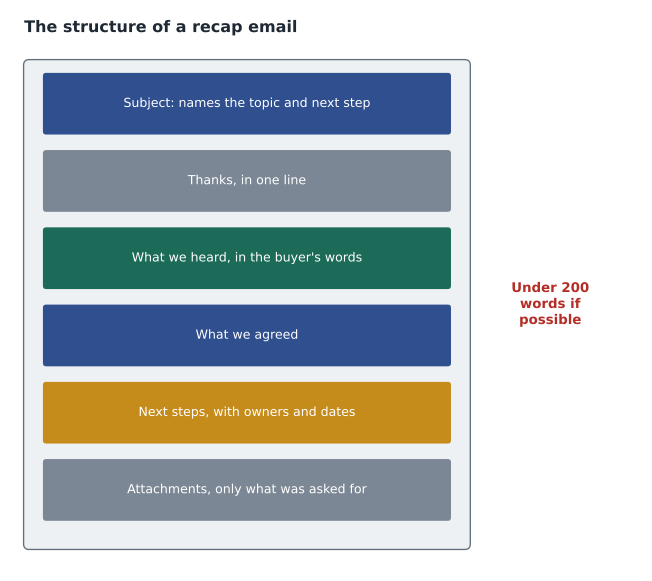
| Part | What it does | Tip |
|---|---|---|
| Subject line | Tells the buyer what the email is and why to open it | Name the topic and next step: "Front desk printing: summary and Tuesday visit" |
| Thanks | Acknowledges the buyer's time | One sentence; skip the paragraph about the company |
| What we heard | Confirms understanding | Two to four points, in the buyer's words; invite correction |
| What we agreed | Records decisions | Only what was actually agreed, not what the seller hoped |
| Next steps | Moves the sale forward | Each step with an owner and a date |
| Attachments | Supports the next step | Only what was asked for or clearly useful |
Worked problem
Rewriting a follow-up email
Rewrite Maya's Northfield follow-up so that it does all four jobs. In the meeting, Janet said the front desk printer jams most mornings, the doctors want scanned documents to go straight into patient files, and the clinic paid to leave its last five-year lease early. They agreed that Maya would come to look at the front desk setup.
Show solution
- Subject: "Front desk printing at Northfield: summary and next visit"
- Opening: "Hi Janet, thanks for the time on Wednesday."
- What we heard: "Here is what I took away. Please correct anything I missed. 1. The front desk printer jams most mornings during check-in. 2. The doctors want scanned documents to go straight into patient files without the front desk re-filing them. 3. After the cost of leaving your last five-year lease, contract flexibility matters as much as price."
- What we agreed and next steps: "We agreed I would come and look at the front desk setup. Would Tuesday the 17th at 2 p.m. or Wednesday the 18th at 10 a.m. work? After the visit, I'll send two options by the following Monday, including one with a shorter term."
- Close: "Thanks again, Maya." No brochures; Janet had not asked for any.
Answer: The rewrite is about 130 words. It puts Janet's concerns first, in her words, and asks for one specific decision: which time works for the visit. Janet replied the same afternoon choosing Tuesday.
The 'what we heard' section is the heart of the email, and it is where active listening from lesson 2 pays off. Using the buyer's own words shows that they were heard, and inviting correction makes it easy for the buyer to fix a misunderstanding before it reaches a proposal. It also helps the people the email is forwarded to: a clinic physician reading Janet's forwarded copy can see in three lines what the problem is and that Ridgeline understands it.
Writing for people who were not there
In business selling, decisions are often made by several people, many of whom never meet the seller. A follow-up email may be read by a finance manager deciding on budget or a director approving the purchase. Sellers should write follow-ups so that someone who was not in the meeting can understand them: avoid internal jargon and unexplained acronyms, state the problem and the proposed next step plainly, and avoid anything the seller would not want a senior person at the buyer's organization to read. Comments about colleagues, competitors or pricing concessions 'just between us' have a way of being forwarded.
Timing and persistence
Follow-up is only useful if it happens. Many sales are lost not because the buyer said no but because the seller stopped following up. On the other hand, too many follow-ups, or follow-ups that add nothing, annoy buyers. Darnell's guideline is that each follow-up should add something: a useful piece of information, an answer to a question, a relevant example, or a clear choice. 'Just checking in' adds nothing.
| Weak follow-up | Stronger follow-up |
|---|---|
| "Just checking in to see if you had any questions." | "You asked how other clinics handled the switchover. Here is a two-paragraph summary from a clinic in the same building." |
| "Did you get a chance to look at my last email?" | "I've put the two options side by side in one table so it's easier to compare." |
| "Following up again on the proposal." | "The price we quoted is held until the 30th. Would it help to talk through it with your finance manager before then?" |
| "Any update?" | "If the timing isn't right this quarter, would it make sense for me to check back in February?" |
The last example in the table matters. A respectful way to end a run of unanswered follow-ups is to offer the buyer an easy way to say not now, or no. Many buyers reply to a message like that when they would not reply to another 'checking in'. Sellers should accept the answer and record it in the CRM.
Text messages and messaging apps
More and more buyers prefer short messages to email, especially for quick logistics. Retail customers often prefer a text to say an order has arrived or a delivery window has been confirmed. Business buyers may use a messaging app for quick questions once a relationship exists. Messages should be shorter and more informal than emails, but still professional: identify yourself the first time, keep to business hours, never send anything sensitive such as pricing concessions or personal information, and move longer or more formal matters to email or a call.
Aiden uses the store's approved texting system, not his personal phone, to message customers about orders. Bev's rule is that texts are for customers who have asked to be contacted that way, and that every text identifies the store: 'Hi Ms. Okafor, it's Aiden from Juniper & Pine. Your dining table has arrived. Delivery is booked for Saturday between 9 and 11 a.m. Reply here or call the store if you need to change it.'
Commercial messages and the law
Emails and texts that promote a product or service are commercial messages, and both countries regulate them. SLS-150 Sales Law and Ethics covers the details; every seller should know the basics before sending a message to someone new.
In Canada, Canada's Anti-Spam Legislation (CASL) applies to commercial electronic messages, including email and text messages, and it applies to messages between businesses as well as to consumers. As a rule, the sender needs the recipient's consent before sending a commercial message. Consent can be express, or implied in some situations, such as an existing business relationship from a purchase within the past two years or an inquiry within the past six months, or when a business person has publicly posted their address without saying they do not want messages and the message is relevant to their role. Every commercial message must identify the sender, include contact information and offer a working unsubscribe mechanism, and unsubscribe requests must be acted on within ten business days. A one-to-one recap email to a buyer about a meeting they took part in is usually not a problem; adding a new contact to a marketing list without consent is.
Accuracy and promises in writing
Written follow-ups become part of the record of a sale. A price quoted in an email, a delivery date confirmed in a text or a feature described in a recap may be treated as a commitment. Sellers should check facts before sending, avoid exaggeration, and correct mistakes quickly and openly, as Maya did with her wrong printer count in lesson 4. If a follow-up describes something the buyer will rely on, such as compatibility with existing equipment, the seller should confirm it with the right person first rather than guessing.
AI writing tools can help draft follow-ups, but they also make it easy to send polished messages that contain errors or claims the seller never checked. Ridgeline's guidance is that any AI-drafted message is reviewed line by line before sending, that it never includes confidential buyer information pasted into a tool the company has not approved, and that the 'what we heard' section is written from the seller's own notes. SLS-140 Sales Technology: CRM and Digital Tools discusses these tools further.
Follow-up on the sales floor
Retail follow-up is usually shorter but no less important. Juniper & Pine asks associates to follow up in three situations: when a customer has left without buying but asked for something to be held or checked, when a special order or delivery is booked, and a week or so after a large purchase. Each message has a clear purpose and a single next step.
| Situation | Purpose | Example |
|---|---|---|
| Item on hold | Remind the customer and offer a choice | "Hi Mr. Tran, it's Aiden at Juniper & Pine. The grey recliner is on hold for you until Saturday at closing. Would you like me to extend it to Monday?" |
| Delivery booked | Confirm details and reduce surprises | "Your dryer arrives Thursday between 1 and 3 p.m. The team will need about a metre of clearance at the door." |
| After a large purchase | Check satisfaction and offer help | "How is the new mattress after the first week? If anything feels off, the comfort exchange runs until the end of January." |
The after-purchase message is not a sales pitch. Bev is firm that it should ask about the customer's experience and offer help, nothing more. If the customer mentions another need, such as a bed frame, the associate can respond to that, but the message itself exists to show that the store cares after the sale.
Every follow-up, in either setting, should also be logged. A note in the CRM or the store system that a message was sent, what it said and what the customer replied means that anyone who picks up the conversation next, whether a colleague covering a day off or a manager handling a complaint, can see the whole story without asking the customer to repeat it.
Common mistakes
MistakeA thorough follow-up email covers everything about the company and the product.
InsteadKeep follow-ups short and focused on what the buyer said, what was agreed and the next step.
MistakeFollow-up emails are only for the people who were in the meeting.
InsteadWrite so that someone who was not there can understand, because follow-ups are often forwarded.
Mistake"Just checking in" keeps the sale alive.
InsteadEach follow-up should add information, an answer, an example or a clear choice.
MistakeTexts can be sent from a personal phone to any customer.
InsteadUse approved systems, message only customers who asked to be contacted that way and identify the business.
MistakeCommercial email rules only apply to mass marketing.
InsteadKnow the CASL basics before sending promotional messages, including to business contacts.
Summary and key terms
- Follow-up confirms understanding, records agreements, moves the sale forward and travels to people who were not there.
- A recap email has a clear subject, a short thanks, what we heard in the buyer's words, what was agreed, next steps with owners and dates, and only useful attachments.
- Send recaps within one business day and write them for readers who were not in the meeting.
- Every follow-up should add something; offering an easy way to say "not now" often gets a reply.
- Texts are short, professional and sent only to customers who want them, through approved systems.
- Commercial messages are regulated in both countries, and written follow-ups can become commitments, so check facts before sending.
- Recap email
- A short message after a meeting summarizing what was heard, agreed and planned.
- Commercial electronic message
- An email or text that promotes a product, service or business.
- Consent
- Permission to send a commercial message, express or, in some cases, implied.
- Opt-out
- A request not to receive further commercial messages, which must be honoured.
Practice problems
Work each problem on paper first, then reveal the answer to check.
What question did Darnell ask about Maya's first Northfield email?
Show answer
What did you want Janet to do after reading this?
List the six parts of a recap email.
Show answer
Subject line, thanks, what we heard, what we agreed, next steps and attachments.
Rewrite "Just checking in" into a follow-up that adds value.
Show answer
For example: "You asked about setup time. Most clinics are running within two days; here is how that worked at one nearby."
Within how many business days must unsubscribe or opt-out requests be honoured?
Show answer
Ten business days.
Lesson quiz · 5 questions
Score 60% or more to complete this lesson.
Create a free account to save your progress, take quizzes and earn a certificate.