
SLS-120 · Lesson 12 of 12 · 19 min
Role-play lab: a full sales conversation
▶ Video coming soon A video version of this lesson is on the way.
On Tuesday, November 10, 2026, the last clinic of the fall, Darnell set up two chairs at the front of the room and a third for an observer. Maya would play herself. Darnell would play a buyer he had invented from three real ones: Priya Nandakumar, office administrator at a 22-person accounting firm, Westgate & Rowe, who had filled in a form on Ridgeline's website asking about 'better printers and maybe a booking system for the boardroom'. Owen would observe with a scorecard. That same evening at Juniper & Pine, after closing, Bev ran a floor role-play for Aiden, playing a customer shopping for a washer and dryer. This lesson walks through both role-plays, the scorecard used to assess them, and what Maya and Aiden learned.
Role-play is one of the most widely used methods for practising sales conversations. It lets sellers try skills in a safe setting, get immediate feedback and repeat a difficult moment until it feels natural. It works best when the scenario is realistic, the person playing the buyer responds the way real buyers do, the observer uses clear criteria, and the debrief focuses on a few specific behaviours rather than a general impression.
Setting up a good role-play
| Element | What it means | In Darnell's clinic |
|---|---|---|
| A realistic brief | The buyer has a situation, needs, constraints and a personality | Priya: 22 staff, two old printers, a boardroom double booked twice a month, a cautious managing partner |
| Hidden information | Some facts only come out if the seller asks well | The firm's current lease ends in March; Priya's manager wants three quotes |
| A clear goal for the seller | What a good outcome looks like | Understand the needs and agree on a specific next step |
| An observer with criteria | Someone scores specific behaviours | Owen uses the clinic scorecard |
| A time limit | Keeps the practice realistic | Fifteen minutes |
| A structured debrief | Seller first, then observer, then buyer | Ten minutes, ending with one thing to keep and one to change |
The scorecard
Darnell's scorecard pulls together the skills from the whole course. Each item is scored from 0 to 2: 0 means not shown, 1 means partly shown and 2 means shown well. With ten items, the maximum is 20.
| Item | What the observer looks for | Course lesson |
|---|---|---|
| 1. Opening and purpose | Greeting, purpose statement, check on time and agenda | Lessons 1 and 4 |
| 2. Rapport | Genuine, relevant connection; respect for the buyer's time | Lesson 4 |
| 3. Open questions | Focused open questions early in each topic | Lesson 3 |
| 4. Probing | Follow-ups that use the buyer's words and go deeper | Lesson 3 |
| 5. Active listening | Attending, paraphrasing, reflecting, no interrupting | Lesson 2 |
| 6. Nonverbal awareness | Notices changes and checks with a question | Lesson 5 |
| 7. Adapting | Adjusts pace, detail and focus to the buyer | Lesson 6 |
| 8. Story or example | A short, relevant, honest example linked back to the buyer | Lesson 10 |
| 9. Handling concern | Stays curious and acknowledges before answering | Lesson 11 |
| 10. Summary and next step | Accurate summary and a specific, agreed next step | Lessons 1 and 9 |
Maya's role-play
Maya opened well. She thanked Priya for filling in the form, said she had about fifteen minutes of questions and might share an idea or two, and asked whether Priya had anything she wanted to cover. Priya said she mostly wanted to know about prices. Maya said she would get to that and asked how printing worked at the firm today. The table below shows key moments from the conversation, with Owen's notes.
| Moment | What was said | Owen's note |
|---|---|---|
| Open question | Maya: "Walk me through what happens when someone needs to print a client package." | Focused and specific. Score item 3. |
| Probe | Priya: "It's fine, mostly. Except at tax time." Maya: "Except at tax time?" | Good echo probe. Priya then described a two-week queue every April. |
| Reflection | Maya: "It sounds like April is stressful enough without the printers." | Accurate reflection. Priya laughed and relaxed. |
| Missed signal | Priya mentioned "my boss wants options". Maya moved on to the boardroom. | Missed probe: who decides, and how? Hidden information stayed hidden for five minutes. |
| Recovery | Maya, later: "You mentioned your boss wants options. How will the decision be made?" | Good recovery. Learned about three quotes and the March lease end. |
| Price question | Priya: "So what does this cost?" Maya: "It depends on volume. Can I ask two more questions so I can give you a real range?" | Acknowledged the question, explained why, kept control honestly. |
| Story | Maya described a dental office that staggered its large print jobs with a second machine at peak season. | Relevant, short, linked back. Could have named the result more clearly. |
| Summary and next step | Maya summarized four points and proposed a 30-minute visit next week to look at the setup and the boardroom. | Clear summary. Next step agreed with a date. |
In the debrief, Maya spoke first, as Darnell requires. She said she was pleased with the April probe and annoyed with herself for missing the comment about Priya's boss. Owen then went through the scorecard. Darnell, still in character for a moment, said that as Priya he would have felt listened to, and that the recovered question about the decision was the moment he started to take Maya seriously as someone who understood how firms buy.
Worked problem
Scoring the role-play
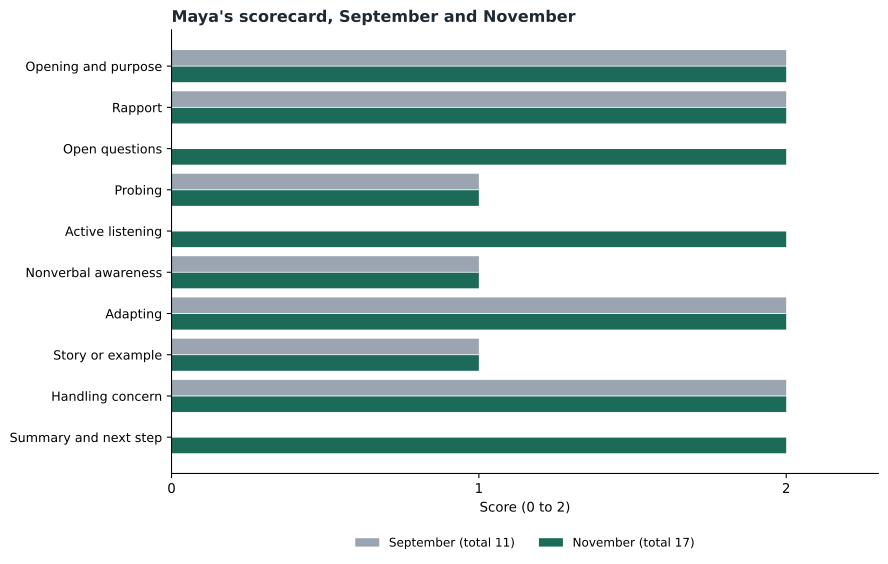
Owen's scores for Maya were: opening 2, rapport 2, open questions 2, probing 1, listening 2, nonverbal 1, adapting 2, story 1, handling concern 2, summary and next step 2. What was her total out of 20, and how does it compare with her first clinic role-play in September, when she scored 11?
Show solution
- Add the ten scores.
- \[2 + 2 + 2 + 1 + 2 + 1 + 2 + 1 + 2 + 2 = 17\]
- Compare with September:
- \[17 - 11 = 6\]
- As a share of the maximum, 17 out of 20 is 0.85, compared with 11 out of 20, or 0.55.
Answer: Maya scored 17 out of 20, six points higher than in September. Her three 1s, on probing, nonverbal awareness and the story, show where to focus next.
Aiden's role-play
Bev's scenario for Aiden was shorter and faster, as retail conversations often are. She played a customer, Mrs. Kowalchuk, who walked straight to the laundry section, looked at the most expensive washer and dryer pair, and said, 'How much are these?' Hidden in the brief: her old washer had flooded the basement last week, she lived alone, she did small loads, and she had a daughter coming to stay with a baby next month.
Aiden gave the price, then asked an open question: 'What's got you shopping for laundry today?' Bev, as Mrs. Kowalchuk, said the old one died. Aiden reflected: 'Oh no. Did it go quietly, or was it dramatic?' She laughed and told him about the flooded basement. He probed: 'That sounds awful. Is the basement OK now?' and then: 'Who's doing laundry in the house?' That question brought out that she lived alone but her daughter and new grandchild were coming. Aiden adapted: he showed a mid-priced pair with a sanitize cycle and a smaller-load setting, explained why he thought it fit better than the expensive pair, and mentioned the store's water-leak sensor accessory, given the flood.
He lost a point on the next step. When Mrs. Kowalchuk said she would think about it, Aiden said, 'No problem, let me know,' and the role-play ended. In the debrief, Bev pointed out that the daughter's visit was a natural deadline and that delivery dates were filling up. A better close would have been honest and specific: 'Delivery is about ten days out right now. If you'd like it in before your daughter arrives, I can hold this pair until tomorrow evening while you decide.'
| Item | Score | Bev's note |
|---|---|---|
| Opening and purpose | 1 | Answered the price question first; then recovered with an open question |
| Rapport | 2 | Warm and natural; the flood question was kind |
| Open questions | 2 | "What's got you shopping for laundry today?" |
| Probing | 2 | "Who's doing laundry in the house?" uncovered the visit |
| Active listening | 2 | Reflected the flood story; remembered it when recommending the sensor |
| Nonverbal awareness | 1 | Did not notice her glance at the price tag on the expensive pair |
| Adapting | 2 | Matched the recommendation to her situation, not the highest price |
| Story or example | 0 | No example used |
| Handling concern | 1 | Accepted "I'll think about it" without exploring it |
| Summary and next step | 1 | No summary; "let me know" is not a next step |
Aiden's total was 14 out of 20. Bev pointed out that the most important thing he did was recommend the cheaper pair because it fit, which is exactly the kind of honesty that brings customers back. His next practice goal is the end of the conversation: summarizing what he heard, and offering a specific, honest next step.
Giving and receiving feedback
Role-play only works if the feedback is useful. Darnell and Bev follow the same rules. The seller speaks first, saying what went well and what they would change, because self-assessment builds the habit of reviewing one's own calls. The observer refers to specific moments and behaviours, not personality: 'When Priya mentioned her boss, you moved on' rather than 'You don't listen.' The person playing the buyer says how the conversation felt from the other side, which is often the most valuable feedback of all. And the debrief ends with one thing to keep doing and one thing to change, written down.
Receiving feedback well is also a skill. Listen without defending, ask questions to understand, thank the observer and pick the one change to work on. Maya's one change was to probe every mention of another person in the buying process. Aiden's was to never end with 'let me know'.
Practising beyond the clinic
Role-play in a training room is a start. Sellers keep improving by reviewing real conversations: listening to recorded calls with permission, scoring themselves with the same scorecard, asking a colleague to observe a store conversation, and noting in the CRM what they would do differently next time. SLS-130 Customer Service and Customer Experience, SLS-140 Sales Technology: CRM and Digital Tools and SLS-150 Sales Law and Ethics continue the first year. In the second year, the B2B courses, starting with SLS-210 Prospecting and Lead Generation and SLS-211 Consultative Selling and Discovery, and the retail courses, starting with SLS-250 Retail Selling and Clienteling, build directly on the conversation skills in this course.
At the end of the clinic, Darnell asked each seller to write down the one sentence from the fall they would keep. Maya wrote the line Darnell had used about her first clinic call: 'You were right, just too early.' Aiden, when Bev asked him the same question that evening, chose hers from his first Saturday: 'Find out what changed, and the rest is easy.'
Darnell also reminds the clinic that the scorecard is a tool, not a script. A conversation that scores well on every item can still miss the buyer, and an unusual conversation that follows the buyer's lead may score lower on one item while being exactly right. The point of the scores is to focus practice, not to replace judgment.
Role-plays also work best when they are repeated. Darnell runs the same Westgate & Rowe brief again a month later with a different seller playing the role, so the clinic can compare how two people handled the same hidden information. Bev keeps a short list of retail briefs, from a customer replacing a broken appliance in a hurry to a couple furnishing a first home, and rotates them so associates face a range of situations.
Common mistakes
MistakeRole-play is just acting.
InsteadWith a realistic brief, hidden information, clear criteria and a structured debrief, role-play is practice of real skills.
MistakeThe observer should give an overall impression.
InsteadFeedback should refer to specific moments and behaviours, scored against clear criteria.
MistakeThe seller should hear the feedback before reflecting.
InsteadThe seller speaks first, then the observer, then the person playing the buyer.
Mistake"Let me know" is a fine way to end a retail conversation.
InsteadSummarize and offer a specific, honest next step, such as a hold until a set time.
MistakeA high score means there is nothing to improve.
InsteadPick one thing to keep and one thing to change after every role-play.
Summary and key terms
- Role-play works when it has a realistic brief, hidden information, a clear goal, an observer with criteria, a time limit and a structured debrief.
- The clinic scorecard rates ten skills from the course from 0 to 2, for a maximum of 20.
- Maya scored 17, up from 11, with gains in questioning, listening and agreeing on a next step; her focus now is probing mentions of other decision makers.
- Aiden scored 14; his honest recommendation was a strength, and his focus now is summarizing and offering a specific next step.
- Good feedback is specific, starts with the seller's self-assessment and ends with one thing to keep and one to change.
- Sellers keep improving by reviewing real conversations with the same criteria.
- Role-play
- A practice conversation in which one person plays the buyer and another the seller.
- Brief
- The background, needs and personality given to the person playing the buyer.
- Scorecard
- A list of observable behaviours scored against clear criteria.
- Debrief
- A structured discussion after a role-play to review what happened and what to change.
Practice problems
Work each problem on paper first, then reveal the answer to check.
What hidden information did Maya uncover late in her role-play?
Show answer
That Priya's boss wanted three quotes and the current lease ends in March.
Add Aiden's ten scores: 1, 2, 2, 2, 2, 1, 2, 0, 1, 1.
Show answer
14 out of 20.
In what order does the debrief go?
Show answer
The seller first, then the observer, then the person who played the buyer.
What could Aiden have said instead of "let me know"?
Show answer
For example: "Delivery is about ten days out. If you'd like it before your daughter arrives, I can hold this pair until tomorrow evening."
Lesson quiz · 5 questions
Score 60% or more to complete this lesson.
Create a free account to save your progress, take quizzes and earn a certificate.