
SLS-120 · Lesson 7 of 12 · 19 min
Selling by telephone
▶ Video coming soon A video version of this lesson is on the way.
Owen Pelletier leads Ridgeline's inside sales team, the four reps who spend most of their day on the phone booking first meetings for the account executives. When Darnell asked him to join the clinic for a session on the telephone, Owen began by playing two recordings of the same rep calling two different schools a month apart. On the first, the rep read a script quickly, in a flat voice, and the school's office administrator ended the call in under forty seconds. On the second, the rep slowed down, said why she was calling that particular school, asked one question and listened to the answer. The call lasted six minutes and ended with a meeting booked. 'Same rep, same product, same kind of school,' Owen said. 'The difference is that the second time, she was having a conversation.'
The telephone remains one of the most important channels in selling. Inside sales teams use it to reach new prospects; account executives use it to follow up, handle questions and keep deals moving; retail associates use it to answer product questions, confirm deliveries and follow up with customers. This lesson covers what makes phone conversations different, how to structure a call, how to handle gatekeepers and voicemail, and the basic rules that apply to sales calls in each country.
What changes on the phone
On a phone call, both people lose almost all visual information. There are no facial expressions, gestures or posture to read, and no product to point at. The voice carries everything, and silence becomes harder to interpret. A two-second pause that feels natural face to face can feel like a dropped call on the phone.
Three consequences follow. First, the seller has to make more of the conversation's structure explicit, by saying what the call is about and how long it will take, and by signposting transitions. Second, the seller has to listen even more closely to the voice: pace, tone, hesitations and background sounds. Third, the seller has to check understanding more often, because there are fewer cues that something has been misunderstood.
| Element | Face to face | By phone |
|---|---|---|
| Reading the buyer | Face, posture, gestures, voice | Voice only: tone, pace, pauses, background |
| Showing attention | Eye contact, nodding, posture | Short spoken encouragers, accurate summaries |
| Silence | Comfortable for a few seconds | Needs a brief signal, such as "Let me think about that" |
| Structure | Often implicit | Make it explicit: purpose, time, next topic |
| Showing the product | Demonstration | Description, or a link or a video call |
| Ending | Natural cues | Clear summary and agreed next step |
The voice
Because the voice carries everything, sellers need to manage it deliberately. Speak a little more slowly than in person; many people speed up on the phone when nervous. Vary pitch and emphasis so that important points stand out. Smile when greeting the caller, because a smile changes the shape of the mouth and can be heard in the voice. Sit up or stand: posture affects breathing and energy. And use the buyer's name occasionally, not in every sentence.
Background noise also communicates. Owen's team uses headsets with noise-cancelling microphones and takes calls from quiet booths, because a prospect who hears other conversations or keyboard clatter assumes they are one call in a long list. On the retail side, Bev asks associates to take customer calls away from the showroom music.
Structuring a call
A sales call, whether it is a first call to a prospect or a follow-up with an existing customer, follows the same arc as any sales conversation, compressed. Owen teaches a structure his team calls the five Ps.
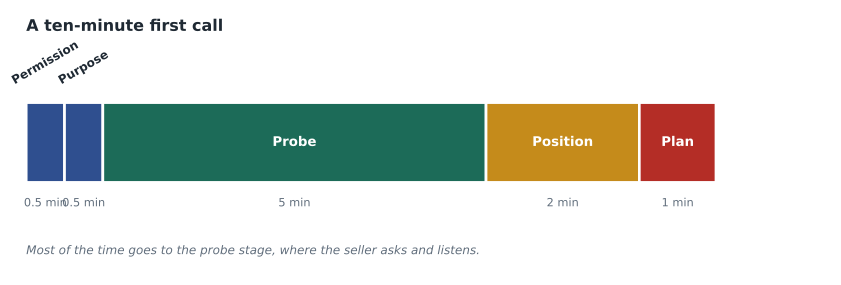
| Step | What the seller does | Example |
|---|---|---|
| Permission | Introduce yourself and check it is a good time | "Hi, Ms. Morrow, it's Maya Chen from Ridgeline. Is now an OK moment for three minutes?" |
| Purpose | Say why you are calling this person, briefly | "You mentioned at the clinic open house that the front desk printer was struggling. I'm following up on that." |
| Probe | Ask open questions and listen | "How has it been since then?" |
| Position | Connect what you heard to what you can offer, briefly | "A couple of clinics we work with had the same morning rush problem. There may be a simple fix." |
| Plan | Agree on a specific next step | "Would a 20-minute visit next Tuesday or Wednesday work to look at the setup?" |
The permission step matters more than many sellers think. Asking whether it is a good time feels risky because the buyer might say no, but a buyer who is driving, in a meeting or dealing with a problem will not listen anyway. A buyer who says yes has given the seller a small commitment to listen for a few minutes. If the answer is no, the seller asks when would be better, and calls back exactly then.
Planned and unplanned calls
A call the buyer is expecting, such as a scheduled follow-up, gives the seller more time and a ready-made purpose. A call the buyer is not expecting, often called a cold call, has to earn attention in the first few seconds. Cold calling in business selling is covered in depth in SLS-210 Prospecting and Lead Generation, and inside sales roles in SLS-221 Inside Sales and Social Selling. The conversational basics are the same as in any call: be clear about who you are and why you are calling this person specifically, ask permission, ask a question that is about the buyer, and listen.
Scripts help new callers, but read scripts sound read. Owen's team uses call guides instead: a short list of the opening line, three or four possible questions, common responses and the next step to ask for. The guide keeps the caller on track while leaving room for a real conversation.
Gatekeepers
In business selling, the first person a seller reaches is often not the buyer. An executive assistant, an office administrator or a receptionist answers calls, manages the decision maker's time and protects them from interruptions. Sales training sometimes treats these people as obstacles to get past. That is a mistake, both ethically and practically. Gatekeepers are often trusted advisers to the decision maker, they know a great deal about how the organization works, and they remember how they were treated.
Owen's guidance for his team is straightforward. Be honest about who you are and why you are calling. Treat the person with the same respect as the buyer. Ask for their help and advice: 'I'm hoping to talk with whoever handles printing contracts for the school. Is that Mr. Delorme, or would it be someone else?' Learn their name and use it next time. And never pretend to be a friend, a customer or someone the buyer is expecting when you are not. Misrepresenting who you are is dishonest, and it can also break telemarketing rules, as the section below explains.
Voicemail
Many sales calls end in voicemail. A good voicemail is short, specific and easy to act on. Say your name and company clearly, give one reason the buyer might want to call back that is about them, leave your number twice, slowly, and say what you will do next.
Worked problem
Rewriting a voicemail
Owen asks a new rep to rewrite this voicemail: "Hi, this is Jordan from Ridgeline Workplace Solutions, we're a leading provider of office equipment, technology and software solutions for businesses of all sizes across the region, I'd love to set up a time to tell you about everything we can do for you, give me a call back at 306-555-0148, thanks."
Show solution
- Cut the company description; the buyer does not need it to decide whether to call back.
- Add a specific reason tied to the buyer: the school recently opened a new wing, and new wings often need printing and meeting room setups.
- Say the number twice, slowly, and give a time-bound next step.
- Rewritten: "Hi, Mr. Delorme, it's Jordan Reyes from Ridgeline. I saw that Westview School opened its new wing this fall, and I'm calling because schools often need to sort out printing for new classrooms. My number is 306-555-0148. Again, 306-555-0148. I'll also send a short email today, and I'll try you again Thursday morning."
Answer: The rewritten message is about 60 words, takes roughly 25 seconds to leave, and gives the buyer a reason to call that is about the school rather than about Ridgeline.
The phone numbers in this course use the 555-01 range, which is set aside for fictional use, so they cannot reach a real person.
Rules for sales calls
Sales calls are regulated in both countries, mainly to protect consumers from unwanted calls. The details are covered in SLS-150 Sales Law and Ethics, but every seller who uses the phone should know the basics.
In Canada, the Canadian Radio-television and Telecommunications Commission (CRTC) sets the Unsolicited Telecommunications Rules and runs the National Do Not Call List. Telemarketers calling consumers must register with the list operator, check numbers against the list and not call numbers registered on it, unless an exemption applies, such as an existing business relationship within set time limits. Calls to businesses are generally exempt from the National Do Not Call List, but the rules on identifying yourself and calling during permitted hours still apply to telemarketing calls, and every business must keep its own internal do-not-call list and honour requests not to be called again. Callers must identify themselves and the organization they represent, and telemarketing calls to consumers are limited to set hours on weekdays and weekends.
The rules for recording calls were covered in lesson 2. The safe habits are the same in both countries: identify yourself truthfully, respect requests not to be called again, record those requests in the CRM, and know your company's policy before you call consumers.
The phone on the sales floor
Retail associates use the phone in different ways. Customers call to ask whether a product is in stock, how delivery works or whether a price is still on. Associates call customers to confirm deliveries, to say a special order has arrived, or to follow up after a big purchase. Bev's standard for Aiden is that every customer call is answered with the store name and his name, that he never guesses at stock or delivery dates, and that he always ends with a clear next step: 'I've put the dresser on hold under your name until Saturday at closing. I'll call you Friday if anything changes.'
Follow-up calls after a purchase are a chance to build loyalty, not to sell more. When Aiden called the couple who bought the sectional to ask how delivery had gone, he learned that one leg had been scratched. He arranged a repair the same week. They mentioned the call in an online review.
Listening on the phone
Phone listening needs extra deliberate signals because the buyer cannot see the seller nodding. Short spoken encouragers such as "mm-hm", "right" and "go on" show attention, but too many sound mechanical. Paraphrasing and summarizing matter even more than face to face, because they prove the seller is still there and still following. Owen's team also writes notes during calls rather than after them, using a simple template in the CRM with the buyer's situation, the problem in their words, who else is involved and the agreed next step, so nothing is lost between calls.
Owen's team reviews one recorded call each week together, with the buyer's consent noted in the CRM. They listen for one thing at a time: the opening, the first question, the summary or the next step. Reviewing a single element keeps the session short and makes the feedback specific.
Common mistakes
MistakeA good phone call sounds like a well-read script.
InsteadUse a call guide and have a conversation; read scripts sound read.
MistakeAsking whether it is a good time gives the buyer an easy way out.
InsteadAsking for permission gets a small commitment to listen; if the answer is no, call back at the time the buyer suggests.
MistakeGatekeepers are obstacles to get past.
InsteadTreat assistants and administrators with respect, be honest about why you are calling and ask for their help.
MistakeLong voicemails give the buyer more reasons to call back.
InsteadKeep voicemails short and specific, and give one reason that is about the buyer.
MistakeCalls to businesses are not regulated.
InsteadBusiness calls are mostly outside the do-not-call lists, but identification, honesty and internal do-not-call requests still apply.
Summary and key terms
- On the phone the voice carries everything, so sellers make structure explicit, listen closely to the voice and check understanding often.
- Speak a little more slowly, vary emphasis, smile on the greeting and control background noise.
- A useful call structure is permission, purpose, probe, position and plan.
- Call guides work better than read scripts.
- Treat gatekeepers with honesty and respect, and leave short, specific voicemails.
- Sales calls are regulated in both countries; identify yourself truthfully and honour do-not-call requests.
- Call guide
- A short list of an opening, possible questions, common responses and the next step, used instead of a script.
- Gatekeeper
- A person who manages access to a decision maker, such as an assistant or administrator.
- Cold call
- A sales call to someone who is not expecting it.
- Do-not-call list
- A national or internal list of numbers that telemarketers must not call.
Practice problems
Work each problem on paper first, then reveal the answer to check.
Name the five Ps of a sales call.
Show answer
Permission, purpose, probe, position and plan.
What should a seller do if the buyer says it is not a good time?
Show answer
Ask when would be better and call back exactly then.
Name three elements of a good voicemail.
Show answer
For example: name and company, one reason that is about the buyer, the number twice slowly, and the next step.
What must every caller do whether calling a consumer or a business?
Show answer
Identify themselves and their organization truthfully and honour requests not to be called again.
Lesson quiz · 5 questions
Score 60% or more to complete this lesson.
Create a free account to save your progress, take quizzes and earn a certificate.