
SLS-120 · Lesson 4 of 12 · 20 min
Building rapport honestly
▶ Video coming soon A video version of this lesson is on the way.
Maya's first meeting with Ruth Halverson, the managing partner of Halverson Law, started badly. Maya had read that rapport begins with finding common ground, so she opened by mentioning that she had seen on a professional networking site that Ruth had gone to the same university. Ruth smiled politely and said, 'I have about twenty minutes. What did you want to show me?' On the drive back to the office Maya told Darnell she had blown it. He disagreed. 'You didn't blow it,' he said. 'You tried to build rapport with a fact. She builds rapport with competence. Next time, show her you understand how a law firm works and that you respect her time. That's her common ground.'
Rapport is a sense of mutual understanding and comfort between two people that makes communication easier. In sales, it is what allows a buyer to speak openly, to share concerns and to trust that the seller is acting in good faith. This lesson explains what research says about rapport, how it is built and how it is damaged, and why manufactured rapport tends to fail.
What rapport is, and what it is not
Rapport is not the same as friendship, and it is not the same as being liked. A buyer can feel strong rapport with a seller they would never spend a weekend with, because the seller listens, understands the problem and can be relied on. Equally, a buyer can like a charming salesperson and still not trust them with a large decision.
Psychologists Linda Tickle-Degnen and Robert Rosenthal, in an influential 1990 paper, described rapport as having three parts: mutual attentiveness, meaning both people are focused on the interaction; positivity, meaning warmth and friendliness; and coordination, meaning the conversation flows smoothly and the two people are in sync. They also observed that the balance changes as a relationship develops. Early on, positivity matters a lot. As the relationship deepens, coordination and attentiveness matter more and friendliness matters less. In sales terms, a pleasant first impression helps, but long-term rapport rests on being genuinely attentive and easy to work with.
Trust: the substance behind rapport
In business selling, rapport usually grows from trust. A widely used model, the trust equation, was set out by David Maister, Charles Green and Robert Galford in their 2000 book The Trusted Advisor. It is a practical framework rather than a measured formula, but it captures what buyers look for.
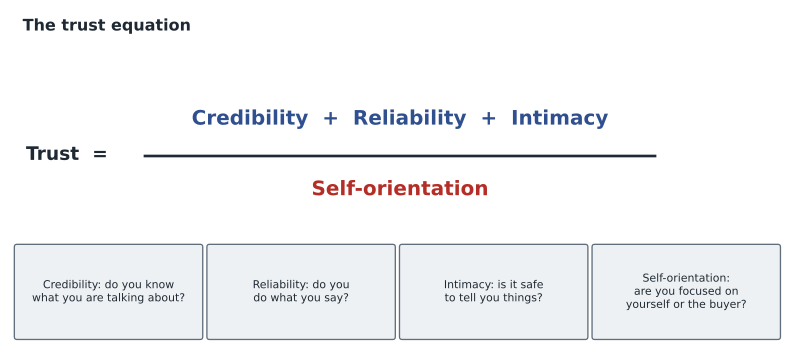
| Part | The buyer's question | How sellers build it | How sellers damage it |
|---|---|---|---|
| Credibility | Do you know what you are talking about? | Accurate knowledge, honest limits, "I'll find out" | Bluffing, exaggerating, vague answers |
| Reliability | Will you do what you say? | Small promises kept, on time | Missed callbacks, late quotes |
| Intimacy | Is it safe to tell you things? | Discretion, listening, no judgment | Gossip about other clients, using disclosures against the buyer |
| Self-orientation | Are you focused on me or on yourself? | Questions about the buyer, patience, willingness to walk away | Pushing, interrupting, talking about quota |
The equation puts self-orientation underneath everything else for a reason. A seller can be knowledgeable, reliable and discreet, but if the buyer senses that the seller cares mainly about the commission, trust collapses. Maya's networking-site opener was not dishonest, but it was about Maya: it showed she had done research on Ruth as a target. Her second meeting, which opened with a question about how the firm handled confidential documents when partners worked from home, was about Ruth's problem.
Reliability starts small
Reliability is the part of trust that sellers can build fastest, because it is built through small, visible promises. Darnell asks new sellers to make, and keep, at least one small promise in every first conversation: 'I'll send you the case study by end of day tomorrow.' 'I'll check whether that model comes in a narrower width and call you by noon.' The promise has to be specific, and it has to be kept. Buyers notice when a seller does exactly what they said, and they notice much more when a seller does not.
Worked problem
Counting kept promises
Darnell reviews the CRM activity for Maya's first six weeks. She made 24 specific promises to prospects, such as sending information or calling back at a set time. She kept 21 on time, 2 late and missed 1 entirely. What share did she keep on time, and what should she change?
Show solution
- Promises kept on time: 21 out of 24.
- \[21 \div 24 = 0.875\]
- That is 87.5 in every 100, or seven in eight.
- The late and missed promises were all made on Fridays and due on Mondays.
Answer: Maya kept seven in eight promises on time. She decides to set a CRM task at the moment she makes each promise and to avoid promising Monday-morning deadlines on Friday afternoons.
Similarity, mirroring and their limits
Research does support some popular rapport advice. People tend to feel more comfortable with others they see as similar to themselves, a pattern psychologists call the similarity-attraction effect. And in a well-known set of 1999 experiments, Tanya Chartrand and John Bargh found that people unconsciously mimic the posture and gestures of those they interact with, which they called the chameleon effect, and that participants whose partner subtly mimicked them liked that partner more and felt the interaction went more smoothly.
These findings are often turned into techniques: find something in common, match the buyer's posture, mirror their words. Used lightly and naturally, they help. A seller who adjusts to a buyer's pace, uses the buyer's own terms and shares a genuine interest is doing what people in good conversations do anyway. Used deliberately and obviously, they backfire. Later research has found that mimicry which people notice tends to reduce liking rather than increase it, and buyers who sense a technique being applied to them feel manipulated. Common ground that is real and relevant helps. Common ground that is dug up and staged, as Maya discovered, can make the buyer feel studied.
Darnell's rule is simple: use similarity you actually have, and only when it is relevant. If a retail customer mentions a hockey game and Aiden plays on a rec league team, saying so is natural. If he has to pretend to care about hockey, it is not rapport.
Rapport in the first minute
First impressions form quickly. Research on what psychologists call thin slices of behaviour has found that people form judgments about others' warmth and competence within seconds, and that these early judgments are often hard to shift. For sellers, that makes the first minute of a conversation important, but it does not mean they should try to perform. The basics carry most of the weight.
| Builds rapport | Damages rapport |
|---|---|
| Being on time, or early, and prepared | Arriving late or fumbling for materials |
| A friendly greeting using the buyer's name correctly | Getting the name wrong or overusing it |
| Respecting the buyer's time: "You said you have twenty minutes" | Long small talk with a busy buyer |
| A short, clear purpose statement | Launching straight into a pitch |
| Following the buyer's lead on how personal to be | Personal questions the buyer did not invite |
| Appropriate dress for the setting | Dressing far above or below the buyer's setting |
The right amount of small talk varies widely. Many buyers enjoy a few minutes of conversation about the weekend or the weather before getting down to business, and in some cultures skipping it would seem rude. Others, like Ruth Halverson, prefer to start at once. The seller's job is to notice which kind of buyer they are dealing with and adjust. A short opener followed by a pause lets the buyer choose: 'Thanks for making the time. How's your week going?' If the buyer answers in a word and looks at the agenda, start the business.
Rapport on the sales floor
Retail rapport has to form in minutes, and it starts before the first word. Bev teaches Aiden that customers decide within moments of walking in whether the store feels welcoming or pushy. A smile and a greeting within the first few moments, without pouncing, signal that help is available. She also teaches him to read the customer's pace. Customers who walk quickly toward a particular department usually know what they want. Customers who wander slowly are usually browsing and want space.
Once a conversation starts, retail rapport grows the same way business rapport does: through attention, honest information and small promises kept. When a customer asked Aiden whether a sofa would fit through a narrow apartment doorway, he did not guess. He said he wasn't sure, checked the frame dimensions and the delivery team's notes on removable legs, and came back with the answer. The customer bought the sofa and asked for him by name when she came back for a chair. 'You told me what you didn't know,' she said. 'That's why I believed what you did know.'
When rapport becomes a problem
Rapport can also cloud judgment, on both sides. A buyer who likes a seller may agree to things that do not serve them, and a seller who likes a buyer may hesitate to raise uncomfortable topics such as price, timing or whether the buyer really has the authority to decide. Good rapport should make difficult conversations easier, not avoid them. Darnell tells sellers that the test of rapport is whether they can say, 'I don't think this is the right product for you,' and keep the relationship.
There is also a line between rapport and manipulation. Techniques that exploit a buyer's liking, such as creating false urgency because 'I want to get you this price before my manager notices', trade on rapport to push a decision. They can win a sale and lose the customer. SLS-150 Sales Law and Ethics explores where these lines fall.
Repairing damaged rapport
Rapport breaks: a delivery is late, a quote has an error, a seller says something clumsy. Repair usually follows the same steps. Acknowledge the problem plainly, without excuses. Take responsibility for your part. Say what you will do to fix it and when. Then do it. Maya's second meeting with Ruth Halverson came after she had sent a quote with the wrong number of printers. She called before Ruth noticed, explained the mistake, sent the corrected quote within the hour and offered a short call to walk through it. Ruth said later that the correction call was the point at which she started to trust Ridgeline.
Rapport across a buying team
In business selling, rapport is rarely with one person. Maya's deals at Ridgeline usually involve several people: an office manager who uses the equipment, a finance person who approves the spending and a partner or director who signs. Each forms their own impression, and a seller who builds strong rapport with one champion while ignoring the others can be surprised when the deal stalls. Darnell asks sellers to note in the CRM who they have actually spoken to, what each person cares about and how warm the relationship is, so that gaps are visible.
Rapport with a whole team is built the same way as with one person, but deliberately and more than once. Greet each person, use names correctly, direct questions to each of them, follow up with each on the point that matters to them, and never speak badly of one team member to another. When Maya learned that Halverson Law's finance manager, Tom Ostrowski, had not been in the first meeting, she asked Ruth whether a short call with him would be welcome before the proposal. Ruth agreed, and Tom later said it was the first time a supplier had asked what the firm's accounting rules needed rather than simply sending a price.
In retail, the buying team is usually a household: a couple, a parent and an adult child, roommates. The same principle applies on a smaller scale. Bev teaches Aiden to make eye contact with and speak to everyone in the group, not only the person holding the credit card, and to notice who is quietly being consulted.
Common mistakes
MistakeRapport means the buyer likes you.
InsteadRapport is mutual understanding and comfort; it rests more on attentiveness and trust than on liking.
MistakeFinding any common ground builds rapport.
InsteadUse similarity that is real and relevant; staged common ground can make the buyer feel studied.
MistakeMirroring the buyer's posture is a reliable technique.
InsteadNatural, unnoticed coordination helps; obvious mimicry tends to reduce liking.
MistakeSmall talk is always needed before business.
InsteadFollow the buyer's lead; some buyers want to start at once.
MistakeGood rapport means avoiding uncomfortable topics.
InsteadGood rapport should make difficult conversations about price, timing and fit easier.
Summary and key terms
- Rapport is mutual understanding and comfort, made up of attentiveness, positivity and coordination.
- In business selling, rapport grows from trust: credibility, reliability and intimacy, divided by self-orientation.
- Reliability is built fastest through small, specific promises kept on time.
- Similarity and natural mimicry help, but staged common ground and obvious mirroring backfire.
- First impressions form fast; preparation, punctuality, a clear purpose and following the buyer's lead carry most of the weight.
- Rapport should make difficult conversations easier, and damaged rapport is repaired by acknowledging, owning, fixing and following through.
- Rapport
- A sense of mutual understanding and comfort that makes communication easier.
- Trust equation
- Credibility plus reliability plus intimacy, divided by self-orientation, from The Trusted Advisor.
- Self-orientation
- The degree to which a seller is focused on their own interests rather than the buyer's.
- Chameleon effect
- The unconscious tendency to mimic the posture and gestures of people we interact with.
Practice problems
Work each problem on paper first, then reveal the answer to check.
Why did Maya's first opener with Ruth Halverson fall flat?
Show answer
It built rapport with a researched fact about Maya's target rather than with competence and respect for Ruth's time.
Name the three parts of rapport described by Tickle-Degnen and Rosenthal.
Show answer
Mutual attentiveness, positivity and coordination.
A seller made 30 promises and kept 27 on time. What share is that?
Show answer
27 divided by 30 is 0.9, or 90 in 100.
What are the four steps in repairing damaged rapport?
Show answer
Acknowledge the problem, take responsibility, say what you will do and when, then do it.
Lesson quiz · 5 questions
Score 60% or more to complete this lesson.
Create a free account to save your progress, take quizzes and earn a certificate.