
SLS-110 · Lesson 7 of 12 · 19 min
Emotion, risk and trust
▶ Video coming soon A video version of this lesson is on the way.
In late October 2026, Keystone Grain Equipment's operations director told Maya that the company liked RoomFlow, liked the meeting-room hardware and liked Ridgeline. Then he said the company would wait until next year. Maya was baffled. The price was within budget, the demonstration had gone well and the IT coordinator was enthusiastic. Darnell asked her to call back and ask one question: 'What would have to be true for you to feel comfortable going ahead this year?' The answer was not about price or features. Two years earlier, Keystone had installed an expensive production-scheduling system that never worked properly, and the operations director had been the one who recommended it. He was not willing to be wrong in front of the owners again.
The decision was being blocked by an emotion, the fear of making a visible mistake, and by perceived risk. This lesson looks at how emotions shape buying, how buyers perceive risk, and how trust between buyer and seller reduces that risk. These ideas explain more stalled sales than any price objection.
Emotion in decisions
Lesson 2 explained that emotion and reason work together. Psychologists use the word affect for the feelings of good or bad that people attach to options, often instantly. Paul Slovic and colleagues described the affect heuristic in the early 2000s: people use these feelings as a shortcut, judging options they feel good about as both more beneficial and less risky. A customer who feels uneasy about a salesperson will rate the product as riskier, whatever the specifications say. A buying committee that feels confident about a supplier will rate its risks as lower.
Emotions in buying are not only positive. Large purchases often bring anxiety about spending, fear of choosing badly, guilt about spending on oneself and anticipated regret, the imagined feeling of having made the wrong choice. Research on regret, including work by Thomas Gilovich and Victoria Medvec in the 1990s, found that people tend to regret actions more than inactions in the short term, which strengthens the pull of the status quo. In the long run, people more often regret what they did not do, but buyers decide in the short run.
Perceived risk
Raymond Bauer introduced the idea of perceived risk to marketing in 1960, arguing that consumer behaviour involves risk because any action may have consequences the buyer cannot predict with certainty, some of which are likely to be unpleasant. Jacob Jacoby and Leon Kaplan later identified several types, and later researchers added time risk. What matters is the risk the buyer perceives, which can be very different from the risk a seller or an engineer would calculate.
| Type of risk | The worry | Juniper & Pine example | Ridgeline example |
|---|---|---|---|
| Performance | It will not work as promised | The sofa cushions will sag within a year | The video system will fail during a client call |
| Financial | It will cost more than it is worth | We will overpay compared with another store | Hidden charges will appear on the print contract |
| Physical | It could cause harm | A tall dresser could tip over onto a child | A poorly installed screen could fall |
| Social | Others will think less of me | Friends will dislike the style | The owners will blame me if it fails |
| Psychological | I will feel bad about myself | I will feel I wasted money | I will lose confidence in my judgment |
| Time | It will take too long or waste effort | Delivery will be delayed or returns will be a hassle | Installation will disrupt the office for weeks |
The Keystone operations director's main risks were social and psychological: he feared blame from the owners and his own loss of confidence after the earlier failure. No discount would have addressed those. In consumer buying, physical risk deserves particular care. Juniper & Pine includes anti-tip hardware with every tall dresser and bookcase and installs it on request, because furniture tip-overs can seriously injure young children, a hazard that Health Canada has warned about repeatedly.
How buyers reduce risk
When buyers perceive risk, they look for ways to reduce it. They seek more information, buy well-known brands, stay loyal to suppliers that have served them well, ask for warranties and guarantees, start small, ask others for advice and delay. Each is reasonable. A seller who understands which risk is driving the buyer can offer the matching reduction, so that the buyer does not have to fall back on delay.
| Risk the buyer perceives | Ways a seller can reduce it honestly |
|---|---|
| Performance | Demonstrations, trials, written specifications, references, warranties |
| Financial | Clear total costs, price comparisons, fixed-price contracts, fair return policies |
| Physical | Safety information, certified products, professional installation |
| Social | References from respected peers, evidence the buyer can share with others, a pilot |
| Psychological | Time to decide, a clear rationale, follow-up support after the sale |
| Time | Firm delivery and installation dates, a project plan, an easy return process |
Juniper & Pine builds risk reduction into its standard offer because its customers face the same worries every day. A price-match policy reduces financial risk for shoppers who fear paying more than at another store. The 90-night mattress comfort exchange and a 30-day return window on most furniture reduce performance risk. A text message with a two-hour delivery window the evening before reduces time risk, and the delivery crew's removal of old furniture saves customers an unpleasant job. Bev trains associates to mention these at the moment a customer hesitates, not as a script at the start, because a safety net means most when the buyer is looking for one.
For Keystone, Darnell suggested a pilot. Instead of equipping all eight meeting rooms at once, Ridgeline would equip two rooms for a 60-day trial, with clear success measures agreed in advance: calls started in under one minute, no failed client calls, and a short survey of the managers who used the rooms. If the pilot met the measures, Keystone would equip the other six rooms; if not, Ridgeline would remove the equipment and Keystone would pay only for installation labour. The operations director could tell the owners that he was testing before committing.
Worked problem
How much risk does a pilot remove?
Equipping one Keystone meeting room costs about 6,200 dollars, including hardware and installation, and the RoomFlow subscription is 45 dollars per room per month. If Keystone equipped all eight rooms and the system failed after three months, how much would it have spent? Under the pilot, if two rooms fail and Ridgeline removes the equipment, Keystone pays installation labour of 900 dollars per room plus two months of subscription. Compare the amounts at risk.
Show solution
- Full rollout: equipment and installation 8 × 6,200 = 49,600 dollars.
- Full rollout subscription for three months: 8 × 45 × 3 = 1,080 dollars.
- Full rollout at risk: 49,600 + 1,080 = 50,680 dollars.
- Pilot: installation labour 2 × 900 = 1,800 dollars.
- Pilot subscription for two months: 2 × 45 × 2 = 180 dollars.
- Pilot at risk: 1,800 + 180 = 1,980 dollars.
Answer: A failed full rollout would put about 50,680 dollars at risk; a failed pilot about 1,980 dollars, roughly 4 in 100 of the full amount. The pilot turns a large, visible risk into a small one the operations director can defend. Ridgeline accepts more risk itself, which is reasonable only because it is confident the system works; offering a pilot on a product the seller doubts would be dishonest.
Indecision and the fear of messing up
Buyers who perceive high risk often do not say no. They say not yet, or they stop responding. Matthew Dixon and Ted McKenna, analysing recordings of more than two and a half million sales conversations for their 2022 book The JOLT Effect, argued that many deals are lost not to competitors but to indecision, and that the buyer's fear of messing up is a bigger obstacle than the fear of missing out. They found that pushing harder on the value of the product often made indecisive buyers more anxious, while reducing the perceived risk of deciding, through recommendations, limited options and safety nets, helped. Their data come from a commercial analytics company and have not been independently reviewed in the way academic studies are, but the pattern matches what experienced sellers report.
For salespeople, the lesson is to notice indecision and treat it as a signal of risk, not of disinterest. Questions such as 'What would make this feel like a safe decision?' or Darnell's 'What would have to be true for you to feel comfortable?' invite the buyer to name the risk, after which the seller can address it.
Trust
Trust is the willingness to rely on another party when you cannot fully check or control what they will do. In their influential 1995 model, Roger Mayer, James Davis and David Schoorman proposed that people judge whether someone is trustworthy on three factors: ability, meaning the skills and knowledge to do what is needed; benevolence, meaning the belief that the other party wants to do good for you, beyond their own profit; and integrity, meaning that they follow principles you find acceptable, such as honesty and keeping promises.
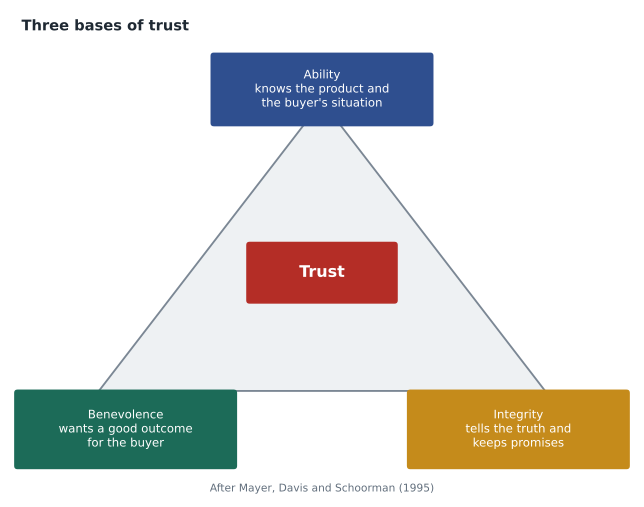
A salesperson builds each factor differently. Ability shows in accurate answers, honest admissions of what the seller does not know and good questions that reveal understanding of the buyer's situation. Benevolence shows when the seller recommends a cheaper option that fits better, points out a limitation or says that a product is not right for the buyer. Integrity shows in small promises kept: calling back when promised, sending the quote by Thursday as agreed, telling the truth about a delivery delay before the customer has to ask.
David Maister, Charles Green and Robert Galford offered a related, practical formula in their 2000 book The Trusted Advisor. They suggested that trustworthiness rises with credibility, reliability and intimacy, meaning how safe the buyer feels sharing concerns, and falls with self-orientation, meaning how much the seller seems focused on their own interests. The formula is not a scientific measurement, but its main point is supported by experience: a seller who seems more interested in closing the deal than in the buyer's problem loses trust, however expert they are.
Trust is built in small moments
Trust rarely arrives in one dramatic gesture. It builds through a series of small promises kept and small honesties offered. When Aiden told a customer that the recliner she liked had a short footrest for tall people and suggested another model, he gave up a quick sale and earned a customer who later bought a bedroom set. When Maya admitted to Keystone that RoomFlow did not yet integrate with their scheduling software and offered to find out when it would, she lost a point on the feature checklist and gained credibility.
Trust is also fragile. A single exaggeration discovered by the buyer, such as a delivery date that was never realistic or a saving calculated on the wrong basis, can undo months of work. Research on trust repair has found that broken trust based on a failure of integrity is harder to restore than trust lost through a failure of ability: buyers forgive honest mistakes more readily than dishonesty. That is a practical reason, beyond the ethical one, never to overpromise.
Emotion on both sides of the sale
Sellers have emotions too. Fear of missing a quota can make a seller push too hard, and frustration with a slow buyer can make the seller sound impatient. Buyers notice. Research on emotional contagion, the tendency to catch the emotions of people we interact with, suggests that a calm, confident seller helps an anxious buyer, while an anxious seller makes the buyer more anxious. Darnell's advice to Maya before the Keystone call was simple: 'Your job today is not to close. It is to find out what he's afraid of. You can relax about that.'
Common mistakes
MistakeA buyer who says "not yet" is not interested.
InsteadDelay is often a way of managing perceived risk; ask what would make the decision feel safe.
MistakeA discount fixes hesitation.
InsteadDiscounts address financial risk only; social, psychological and performance risk need other answers.
MistakeTrust comes from being likable.
InsteadTrust rests on ability, benevolence and integrity, shown through small promises kept.
MistakeA pilot is always a good idea.
InsteadOffer a pilot only when you are confident the product will meet agreed success measures.
Summary and key terms
- Feelings about options act as a shortcut, so buyers who feel uneasy judge options as riskier.
- Perceived risk can be performance, financial, physical, social, psychological or time risk.
- Sellers should identify which risk is driving the buyer and offer the matching honest reduction.
- Pilots, references, guarantees and clear terms can shrink the risk of deciding.
- Many stalled deals are lost to indecision driven by fear of making a mistake.
- Trust rests on ability, benevolence and integrity, and integrity failures are hardest to repair.
- Affect heuristic
- Using feelings of good or bad about an option as a shortcut in judging it.
- Perceived risk
- The buyer's sense that a purchase may have unpleasant consequences.
- Anticipated regret
- Imagining how bad it would feel to have chosen wrongly.
- Pilot
- A small, time-limited trial with agreed success measures before a full purchase.
- Benevolence
- The belief that the other party wants a good outcome for you.
- Self-orientation
- A seller's focus on their own interests, which reduces trust.
Practice problems
Work each problem on paper first, then reveal the answer to check.
What were the Keystone operations director's main perceived risks?
Show answer
Social and psychological risk: fear of blame from the owners and loss of confidence after an earlier failed system.
Equipping 10 rooms costs 5,000 dollars each; a pilot of 2 rooms puts 1,500 dollars at risk. What share of the full cost is at risk in the pilot?
Show answer
1,500 ÷ 50,000 = 0.03, or 3 in 100.
Name the three factors of trustworthiness in Mayer, Davis and Schoorman's model.
Show answer
Ability, benevolence and integrity.
Why is broken integrity harder to repair than a mistake of ability?
Show answer
Buyers forgive honest mistakes more readily than dishonesty.
Lesson quiz · 5 questions
Score 60% or more to complete this lesson.
Create a free account to save your progress, take quizzes and earn a certificate.