
SLS-110 · Lesson 1 of 12 · 21 min
Why buyer behaviour matters to sellers
▶ Video coming soon A video version of this lesson is on the way.
Maya Chen started as an account executive at Ridgeline Workplace Solutions in August 2026, after three years selling appliances on the floor at Juniper & Pine Home under Bev Halvorsen. In her first week she was given a list of forty schools, clinics and offices in Regina, a laptop with the company's customer relationship management (CRM) system and a price book. By the end of the second week she had sent dozens of emails about Ridgeline's managed print contracts and booked exactly one meeting. Darnell Brooks, her regional sales manager, read through her emails on a Friday afternoon and asked her a single question: 'Who were you writing to, and what were they trying to get done that week?' Maya realized she had no answer. She had written about the printers. She had not written about the people.
Across town, Aiden Laroque started at Juniper & Pine Home the same week, at the end of August 2026. On Saturday, September 12, helping out in the sofa gallery, he greeted a couple in the sofa gallery, walked them through every fabric and frame option in the line, and watched them leave without buying. Bev Halvorsen, the store manager, had watched from the mattress department. 'You told them everything about the sofa,' she said, 'and you never found out why they came in today. They mentioned a new baby twice.' The couple came back the following week. This time Carl Jensen greeted them, asked about the baby in his first minute, and an hour later they had bought a performance-fabric sectional with stain protection.
This course is about the question Darnell and Bev asked. Selling is the work of helping a buyer reach a decision, and every buyer, whether a parent choosing a sofa or a school division choosing a print contract, decides in ways that are partly predictable. Buyer behaviour is the study of how people and organizations recognize needs, search for options, judge them, choose, use what they bought and decide whether to buy again. Marketing courses, including BUS-220 Principles of Marketing, study buyer behaviour mostly to plan products, prices and campaigns for whole markets. This course looks at the same ideas from the seller's side of a single conversation: what is going on in this buyer's head, and in this buyer's organization, right now, and what should a salesperson do about it?
Two kinds of buyers, one set of questions
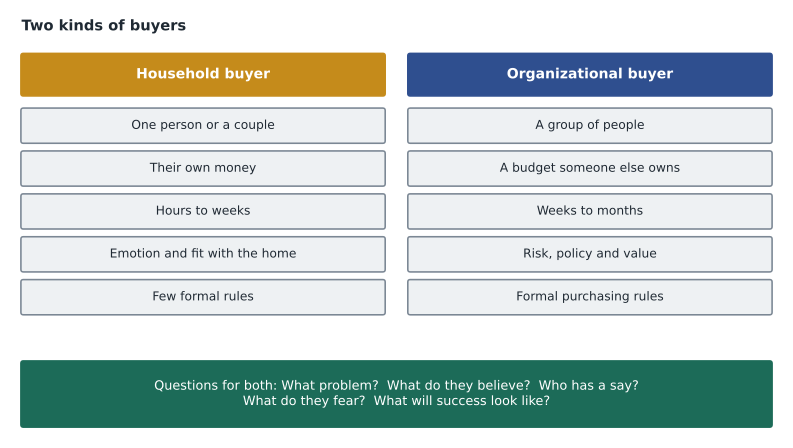
The course follows two fictional companies in the same city. Ridgeline sells to businesses and public bodies: office furniture, multifunction printers with managed print contracts, meeting-room technology and a cloud room-booking subscription called RoomFlow. Its customers include school divisions, clinics, law firms, municipal offices and regional manufacturers. Juniper & Pine sells to households: furniture, mattresses, appliances and décor, in a large store and online, with delivery, financing through a partner lender and protection plans. One company's buyer is usually a committee with a budget and a procurement policy. The other company's buyer is usually a person or a couple with a household budget and a feeling about a room.
The differences are real, and later lessons treat them separately. Yet the same questions apply to both. What problem is the buyer trying to solve? What does the buyer already believe? Who else has a say? What does the buyer fear might go wrong? What will make the buyer feel the decision was a good one six months later? A salesperson who can answer those questions sells more, and, just as important, sells things that customers are glad they bought.
Why buyers, not products, decide sales
Most new salespeople begin as Maya and Aiden did, by leading with the product. It feels natural: the product is what they were trained on, and describing it feels like being helpful. The trouble is that a buyer does not buy a product's features. A buyer buys a better situation. The school division does not want a printer; it wants teachers to stop losing class time to jammed machines, and it wants the business office to stop arguing over toner invoices. The couple does not want a sectional with a kiln-dried hardwood frame; they want a living room where a baby, a dog and two tired adults can all sit without worry.
Research on business buying backs this up. Surveys by the research firm Gartner have found that business buyers spend only a small part of their total buying time, about 17 in 100 hours in a widely cited 2019 study, meeting with potential suppliers, and that time is shared among every supplier they consider. Most of the work happens without any salesperson in the room: reading, comparing, talking with colleagues and building a case inside the organization. In a 2025 Gartner survey, 61 in 100 business buyers said they would prefer a buying experience with no sales representative at all. That does not mean salespeople are unnecessary. It means that the few conversations a buyer does agree to must be worth the buyer's time, and that a seller who understands how the buyer decides can help with the parts of the decision that happen when the seller is not there.
Consumer buying has changed in a similar way. Shoppers at Juniper & Pine arrive having read reviews, compared prices on their phones and often visited a competitor. Bev tells new associates that the customer who walks through the door is usually not starting a decision but finishing one. The associate's job is to find out where in the decision the customer already is.
What understanding buyers lets a seller do
Understanding buyer behaviour is useful because it changes what a salesperson does at each step. It changes who the seller contacts, since the person who signs is rarely the person who first feels the problem. It changes what the seller asks, since good questions follow the buyer's decision process rather than the seller's product list. It changes what the seller says, since evidence and stories are chosen to answer the buyer's real doubts. And it changes when the seller acts, since pushing for a decision before the buyer has finished evaluating usually slows the sale down.
| Seller decision | Product-first approach | Buyer-first approach |
|---|---|---|
| Who to contact | Whoever is listed as the purchaser | The people who feel the problem, judge options and approve spending |
| What to ask | Which model do you want? | What is happening now, and what would better look like? |
| What to say | Every feature and specification | The two or three points that answer this buyer's concerns |
| When to ask for a decision | As soon as the product has been shown | When the buyer has the information and agreement needed to decide |
| What happens after the sale | Move on to the next prospect | Check that the buyer's expected result actually happened |
A model of behaviour you can use in a conversation
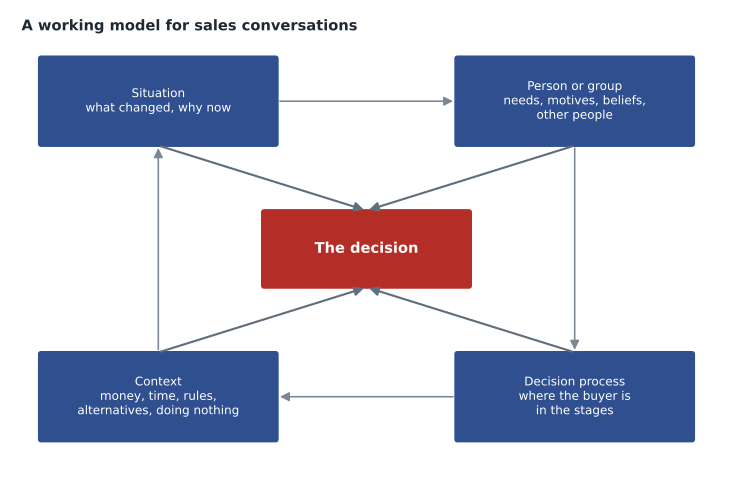
Researchers have built many models of buyer behaviour. BUS-220 introduced the stimulus-response model and the influences on consumers grouped as cultural, social, personal and psychological. For a salesperson in a live conversation, a simpler working model helps. It has four parts. The first is the situation: what has happened, at home or at work, that made this purchase worth thinking about now. The second is the person or group: their needs, motives, beliefs, experience and the people around them. The third is the decision process: the stages the buyer is moving through, from noticing a problem to evaluating results. The fourth is the context: money, time, rules, culture and the alternatives available, including doing nothing.
The working model is a set of things to listen for, not a script. When Aiden learned it, he began noticing that customers almost always revealed the situation in their first few sentences. 'We just moved', 'Our old fridge died on Tuesday', 'My mother is moving in with us' and 'We're expecting' each point to different needs, different urgency and different fears. When Maya learned it, she started her calls by asking what had changed at the school or clinic in the past year. A new principal, a budget cut, a renovation or a failed audit each opens a different conversation.
Doing nothing is always an option
One alternative is present in every sale, and new salespeople forget it more than any other: the buyer can decide not to buy at all. Sales researchers often say that the biggest competitor for most business deals is the status quo. A school division that finds Ridgeline's proposal reasonable may still decide that the old printers will do for another year. A couple who loves a sofa may decide that the money should go toward the baby's room. Understanding buyer behaviour includes understanding why staying put feels safe. Changing something takes effort, carries risk and can be blamed on the person who suggested it. Keeping things as they are rarely gets anyone in trouble, even when it costs more.
A seller who understands this does not respond by pushing harder. Instead, the seller helps the buyer see the real cost of the current situation, and reduces the effort and risk of changing. Lesson 7 returns to this idea when it looks at risk and trust, and lesson 5 explains the biases, including the status quo bias, that make doing nothing so attractive.
Worked problem
Working out what doing nothing costs
The office manager at Eastgate Physiotherapy tells Maya that the clinic's three old printers are 'fine for now'. Each machine jams about four times a week, and each jam takes a staff member about 15 minutes to clear and reprint. Staff time costs the clinic about 32 dollars an hour, including benefits. The clinic is open 50 weeks a year. What does the jamming cost in a year, before counting toner or repairs?
Show solution
- Jams per week across the three machines: 3 × 4 = 12.
- Staff time per week: 12 × 15 minutes = 180 minutes, which is 3 hours.
- Cost per week: 3 hours × 32 dollars = 96 dollars.
- Cost per year: 96 dollars × 50 weeks = 4,800 dollars.
Answer: Doing nothing costs the clinic about 4,800 dollars a year in staff time alone. Maya should confirm each number with the office manager rather than assume it, because a figure the buyer has agreed to is far more persuasive than one the seller supplies.
The example shows a habit that runs through this course: turning a vague feeling into numbers the buyer agrees with. The office manager did not think of jams as costing money, because the cost was spread across many small moments. Once the cost is visible, staying put no longer looks free. The habit works in retail too. When a customer says an old fridge is still working, Aiden can ask how much food was thrown away the last time it warmed up overnight.
Ethics: understanding is not manipulation
Learning how buyers think brings a responsibility. Many of the findings in this course, such as the effects of framing, scarcity and social proof, can be used to help a buyer make a good decision, or to push a buyer into a bad one. A seller who tells a hesitant couple that only one sofa is left, when there are twelve in the warehouse, is using a real effect of human psychology to deceive. That is dishonest, it is often illegal under the Competition Act and provincial consumer protection law, which SLS-150 covers in detail, and it destroys the trust that repeat business depends on.
A useful test is to ask whether the buyer would thank you if they could see exactly what you were doing and why. Helping a buyer notice the real cost of doing nothing passes the test. Inventing a deadline to rush them does not. Ridgeline and Juniper & Pine both hold their salespeople to this standard, and so does this course: every technique is taught alongside the line it must not cross.
How this course is organized
Lessons 2 to 7 look inside the individual buyer. They cover needs, wants and motives; the consumer decision process; perception, attention and memory; biases and shortcuts; social influence and culture; and emotion, risk and trust. Lessons 8 to 10 look at organizations: how businesses decide, the buying centre and its stakeholders, and procurement rules and requests for proposals. Lesson 11 shows how to turn all of this into buyer personas and segments that a sales team can use, and lesson 12 follows one purchase from both sides, the clinic that bought and the salesperson who sold.
Throughout, Maya's work at Ridgeline supplies the business examples, and Aiden's work at Juniper & Pine supplies the consumer ones. Their mistakes are as useful as their successes. By the end of the course, both of them can do what Darnell and Bev asked on their first days: say who the buyer is and what the buyer is trying to get done.
Common mistakes
MistakeBuyer behaviour is a marketing subject; salespeople only need product knowledge.
InsteadSalespeople apply buyer behaviour in every conversation, to choose who to talk to, what to ask and what to say.
MistakeThe main competitor is the other supplier.
InsteadFor many sales the main alternative is doing nothing, which feels safe even when it costs more.
MistakeTelling the buyer everything about the product is the most helpful approach.
InsteadBuyers want the few points that answer their situation and concerns.
MistakeUsing psychology in selling is always manipulative.
InsteadIt is ethical when it helps the buyer decide well and would survive the buyer seeing exactly what was done.
Summary and key terms
- Buyer behaviour is how people and organizations recognize needs, search, evaluate, choose, use and rebuy.
- Sellers apply it to single conversations, while marketers apply it to whole markets.
- Business buyers spend only a small share of their buying time with suppliers, so each conversation must be worth it.
- A working model for conversations has four parts: situation, person or group, decision process and context.
- Doing nothing is always an option, and putting a number on its cost helps the buyer compare fairly.
- Techniques based on psychology must pass the test of whether the buyer would approve if they could see them.
- Buyer behaviour
- The study of how people and organizations recognize needs, search for options, evaluate, choose, use and rebuy.
- Status quo
- The current situation; in sales, the option of not buying or not changing anything.
- Cost of inaction
- The money, time or risk a buyer keeps paying by not solving a problem.
- Working model
- Situation, person or group, decision process and context: four things to listen for in a sales conversation.
Practice problems
Work each problem on paper first, then reveal the answer to check.
What question did Darnell ask Maya about her emails, and why did it matter?
Show answer
Who she was writing to and what they were trying to get done. It showed she had written about the product instead of the buyer.
Give one way a household buyer and an organizational buyer differ.
Show answer
For example, a household spends its own money and decides quickly, while an organization uses a budget owned by someone else and follows formal purchasing rules.
A clinic loses 2 hours of staff time a week to a problem, staff cost 30 dollars an hour and it is open 50 weeks. What does the problem cost each year?
Show answer
2 × 30 × 50 = 3,000 dollars.
What is the ethical test for using a psychological effect in selling?
Show answer
Whether the buyer would thank you if they could see exactly what you were doing and why.
Lesson quiz · 5 questions
Score 60% or more to complete this lesson.
Create a free account to save your progress, take quizzes and earn a certificate.