
SLS-110 · Lesson 11 of 12 · 19 min
Buyer personas and segments for sales
▶ Video coming soon A video version of this lesson is on the way.
In November 2026, Rob Kowalski, Ridgeline's vice-president of sales, asked Grace Liu, the sales operations analyst, a question that had bothered him for a year. Ridgeline's fourteen salespeople each had their own idea of who the company's best customers were. Some chased large manufacturers; some preferred schools; one spent most of his time on law firms because he enjoyed the meetings. Win rates varied widely, and nobody could say which kinds of customers were most worth the team's time. Grace spent three weeks with the CRM, interviewed nine customers and four lost prospects, and came back with two things: a set of segments that showed where Ridgeline won, and four short buyer personas describing the people it sold to.
This lesson shows how sales teams turn everything in the earlier lessons, needs, decision processes, risks, buying groups and procurement, into practical tools. Segments tell a team which organizations or customers to focus on. Personas tell a salesperson what the people in those segments are likely to care about, so that the first conversation starts from understanding rather than guesswork.
Segments for sales
BUS-220 explained market segmentation as dividing a market into groups with similar needs, so that marketers can choose targets and position products. Sales teams use segmentation for a more immediate purpose: deciding where salespeople should spend their time. A sales segment is useful if the customers in it buy for similar reasons, through similar processes, and are worth a similar amount of effort.
In business markets, sales teams often start with firmographics, the organizational equivalent of demographics: industry, size, location, ownership and growth. Firmographics are easy to find, but they do not always predict behaviour. Two clinics of the same size may buy very differently if one is part of a regional network with central purchasing and the other is independent. Needs-based and behavioural segments are often more useful: organizations that buy through formal public procurement, organizations replacing equipment at the end of a lease, organizations expanding into new space, and so on.
Worked problem
Which segments are worth the most selling time?
Grace's CRM analysis for 2024 to 2026 gives, for four segments in Ridgeline's territory, the number of organizations not yet customers, the win rate on opportunities pursued and the average first-year contract value. Schools and school divisions: 18 organizations, win rate 40 in 100, average 58,000 dollars. Clinics: 64 organizations, win rate 35 in 100, average 14,000 dollars. Law and accounting firms: 90 organizations, win rate 20 in 100, average 9,000 dollars. Manufacturers: 40 organizations, win rate 25 in 100, average 31,000 dollars. If the team could pursue every organization in each segment, what first-year revenue would each segment be expected to produce?
Show solution
- Schools: 18 × 0.40 × 58,000 = 417,600 dollars.
- Clinics: 64 × 0.35 × 14,000 = 313,600 dollars.
- Law and accounting firms: 90 × 0.20 × 9,000 = 162,000 dollars.
- Manufacturers: 40 × 0.25 × 31,000 = 310,000 dollars.
Answer: Schools offer the most expected revenue from the fewest organizations, clinics and manufacturers are close to each other, and law and accounting firms offer the least, despite being the most numerous. The calculation ignores the very different effort each segment requires: school contracts go through long public procurements, while clinic deals are faster. Grace therefore combined it with the average sales cycle length before recommending how the team should split its time.
Ideal customer profiles and account tiers
From segment analysis, many sales teams build an ideal customer profile: a description of the kind of organization that gets the most value from the company's offer and is most valuable to the company in return. Ridgeline's ideal customer profile, which Grace drafted, describes organizations with 50 to 500 staff in southern Saskatchewan, several sites or meeting rooms, an existing print lease ending within 18 months and someone responsible for facilities or operations. The profile describes organizations, not individuals; it helps decide whom to approach. SLS-210 shows how prospectors use it.
Teams also tier their accounts, giving more attention to those with the greatest potential. A simple scheme sorts current and target accounts into A, B and C tiers by potential revenue and fit. A-tier accounts get regular in-person contact and account planning, B-tier accounts get scheduled contact, and C-tier accounts are served mainly by inside sales and online ordering. Tiering is not a judgment about the people involved; a C-tier account deserves the same honesty and service as any other. It is a way of matching scarce selling time to opportunity.
What a buyer persona is
A buyer persona is a short, realistic description of a typical buyer in a segment, built from research, that summarizes their goals, concerns, decision criteria and buying behaviour. The idea comes from software design: Alan Cooper introduced personas in his 1999 book The Inmates Are Running the Asylum to help designers keep real users in mind. Marketers and sales teams adopted the idea. Adele Revella, who has written widely on buyer personas, argued that the most useful personas focus less on demographic detail and more on buying insight: what triggers the buyer to act, what success means to them, what barriers worry them, what criteria they use and how they make the decision.
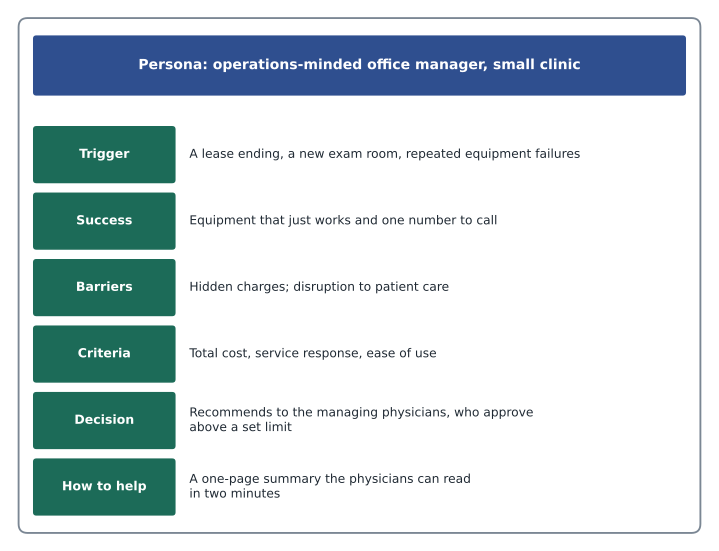
Look at what the card leaves out. It gives the persona no age, no family details and no hobbies. Those details can make a persona feel vivid, but they add little to a seller's understanding and invite stereotypes. A persona is not a person; it is a summary of patterns that many different buyers share. Janet Morrow, the office manager at Northfield, has run clinic offices for more than twenty years; the office manager at another clinic Ridgeline serves started the job last spring. Both fit the persona because they share a role, a set of responsibilities and a way of buying.
Building personas from evidence
Personas are only as good as the research behind them. The most reliable sources are interviews with recent buyers, including ones who chose a competitor or decided not to buy, because they can describe the decision while it is fresh. Grace asked each interviewee the same questions: What made you start looking? Who else was involved? What did you worry about? How did you compare the options? What made you decide? What would you tell another organization in your position? She also reviewed CRM notes, the questions buyers asked during sales calls and the objections recorded in lost opportunities.
Personas built only from salespeople's opinions tend to reflect what salespeople believe, which may not be what buyers experience. Personas built from a single loud customer reflect that customer. Grace looked for patterns that appeared in several interviews and noted where her sample was too small to be confident. She also scheduled a review: personas become out of date as markets change, and Ridgeline will update them each year.
Using personas in conversations
A persona helps a seller prepare, not script. Before calling a school business manager, Maya reviews the persona to remind herself of the likely trigger, concerns and decision process, then adjusts as soon as she learns how this person differs. The persona also helps her choose what to send: a business manager persona suggests a cost summary and a references list, while an IT manager persona suggests a security overview and network requirements.
| Persona | Main concern | What helps |
|---|---|---|
| School business manager | Predictable costs and a defensible process | Total cost comparisons, references from other school bodies, clear contract terms |
| IT or network manager | Security and support workload | Technical documentation, a separate technical meeting, integration details |
| Clinic or office manager | Equipment that works and no surprises | A one-page summary, a single contact, firm service levels |
| Owner or managing partner | Value and the risk of a bad decision | A short business case, a pilot or phased start, peer references |
Personas and the buying group
In business sales, one persona is rarely enough for a deal, because lesson 9 showed that several people with different roles take part. Grace's four personas map onto the buying group: the school business manager and the clinic office manager are often initiators and influencers, the IT manager is a technical buyer, and the owner or managing partner is the economic buyer. When Maya plans an opportunity, she lists which personas are likely to be involved and prepares material for each. A proposal to a manufacturer, for example, now includes a one-page business case for the owner, a technical appendix for the IT coordinator and a short guide for the people who will use the meeting rooms.
Thinking in personas also exposes gaps. If a seller has met only the persona who cares about features and none of the personas who control the budget, the opportunity is weaker than it looks. Darnell now asks in every pipeline review which personas the seller has spoken with directly.
Checking personas against results
A persona is a hypothesis about buyers, and like any hypothesis it should be tested. Grace compares the persona descriptions with what actually happens in deals: whether the triggers named in the personas are the ones recorded at the start of opportunities, whether the concerns predicted for each persona match the objections salespeople log, and whether deals in which sellers prepared material for every persona close more often than those in which they did not. After the first six months, she plans to report the results to the team and revise any persona that does not match the evidence. Personas that are never checked tend to drift toward what the team would like buyers to be.
Personas in retail
Juniper & Pine uses personas too, built by Tessa Yellowbird, the e-commerce and marketing coordinator, from customer surveys, website data and conversations with associates. They include first-home furnishers, families with young children, downsizing retirees and landlords furnishing rental units. Each persona has different triggers, budgets and concerns. Downsizing retirees, for example, often worry about furniture that is too large for a smaller space and value delivery crews who remove old pieces. Landlords care about durability, cost per year and fast delivery between tenants.
Tessa's retail personas also guide what the store shows online. The product pages most visited by families with young children now lead with cleaning instructions and fabric durability ratings, while pages popular with downsizing retirees show dimensions prominently and include a room-planning tool. When associates notice that a persona's concerns have changed, for example landlords asking more about energy-efficient appliances, they tell Tessa, and the persona and the website are updated together.
On the sales floor, personas help associates ask better first questions, but they are never a reason to treat a customer as a type. Bev's rule is that the persona gives you your first question and the customer gives you every question after it. A customer who looks like a retiree may be buying for a grandchild's first apartment; a young customer may be a landlord with six units.
Privacy and fairness
Building segments and personas involves customer data, and that brings legal and ethical duties. Under PIPEDA, Canada's federal private-sector privacy law, organizations must collect personal information only for purposes a reasonable person would consider appropriate, obtain meaningful consent and protect the information they hold. Grace used only data already in the CRM for legitimate sales purposes and anonymized the interview notes she shared with the team.
Fairness matters too. Segmenting by need, behaviour or organization type is good practice. Targeting or excluding consumers based on protected characteristics, such as race, religion, sex or disability, can be discriminatory and unlawful, and offering worse terms to some groups of customers can break human rights and consumer protection laws. Personas should describe buying patterns, not assumptions about kinds of people.
Common mistakes
MistakeFirmographics alone tell you which accounts are worth pursuing.
InsteadCombine size and industry with needs, behaviour, win rates, deal values and sales cycle length.
MistakeA good persona includes age, family and hobbies to make it vivid.
InsteadUseful personas focus on triggers, success, barriers, criteria and decision process.
MistakePersonas can be built from the sales team's experience.
InsteadBuild them from interviews with real buyers, including lost prospects, and review them regularly.
MistakeOnce a customer matches a persona, follow the persona.
InsteadThe persona suggests the first question; the customer guides the rest.
Summary and key terms
- Sales segments group customers who buy for similar reasons and are worth similar effort.
- Expected revenue by segment is organizations × win rate × average deal, adjusted for effort and cycle length.
- An ideal customer profile describes the organizations to target; account tiers match selling time to potential.
- Buyer personas summarize research on triggers, success, barriers, criteria and decision process.
- Personas must be built from evidence, kept current and never used as stereotypes.
- Using customer data for segments and personas must respect privacy and anti-discrimination laws.
- Firmographics
- Organizational characteristics such as industry, size, location and ownership.
- Ideal customer profile
- A description of the kind of organization that gains the most from an offer and is most valuable to the seller.
- Account tier
- A ranking of accounts by potential, used to allocate selling time.
- Buyer persona
- A research-based summary of a typical buyer's goals, concerns, criteria and buying behaviour.
- Win-loss interview
- An interview with a recent buyer or lost prospect about how they decided.
Practice problems
Work each problem on paper first, then reveal the answer to check.
A segment has 50 organizations, a win rate of 30 in 100 and an average deal of 12,000 dollars. What is its expected first-year revenue?
Show answer
50 × 0.30 × 12,000 = 180,000 dollars.
What is the difference between an ideal customer profile and a buyer persona?
Show answer
An ideal customer profile describes target organizations; a persona describes the people who buy within them.
Name the five areas of buying insight a useful persona covers.
Show answer
Triggers, success, barriers, decision criteria and the decision process.
What is Bev's rule for using personas on the sales floor?
Show answer
The persona gives you your first question, and the customer gives you every question after it.
Lesson quiz · 5 questions
Score 60% or more to complete this lesson.
Create a free account to save your progress, take quizzes and earn a certificate.