
SLS-110 · Lesson 4 of 12 · 19 min
Perception, attention and memory
▶ Video coming soon A video version of this lesson is on the way.
In early September 2026, a few days before the request for proposals came out, Maya and Darnell presented to the business office of Prairie Valley School Division. Maya had prepared twenty-two slides covering print volumes at every school, the features of three printer models, the service agreement, the RoomFlow booking software and a five-year cost comparison. The meeting went well, she thought. A week later, she called the business manager to follow up. He remembered that Ridgeline's technicians were local and that one slide had shown a printer jammed with paper. He did not remember the cost comparison at all, which was the part Maya considered most important.
Darnell was not surprised. 'People don't take in everything we show them,' he said, 'and they forget most of what they do take in. Our job is to choose what they remember.' This lesson explains why. It covers how buyers notice information, how they interpret it and how they remember it, and what those processes mean for anyone trying to help them decide.
Perception is selective
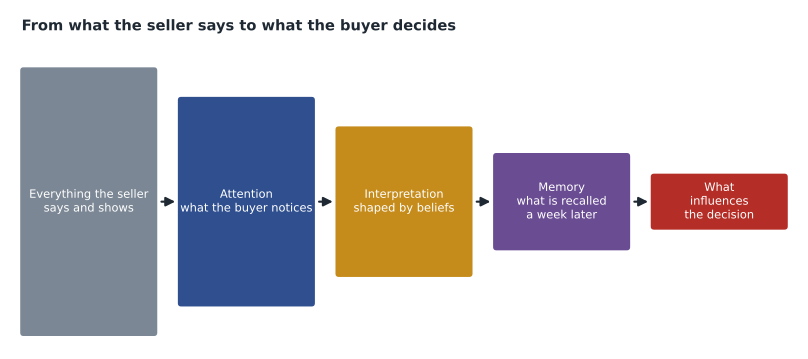
Perception is the process by which people select, organize and interpret information to form a picture of the world. It is not a recording. Every buyer is surrounded by far more information than they could ever process, and the brain filters it constantly. BUS-220 described three filters: selective attention, selective distortion and selective retention. For a salesperson, each filter explains a common frustration.
Selective attention means people notice only a small part of what is in front of them. The most famous demonstration is a 1999 experiment by Daniel Simons and Christopher Chabris, in which viewers counting basketball passes in a short video often failed to notice a person in a gorilla suit walking through the scene. Attention is limited, and it goes to what people are looking for, what is new or surprising, and what relates to their current goals. The business manager at Prairie Valley was looking for one thing, an end to the complaints from schools, so the photograph of a jammed printer caught his attention and the cost table did not.
Selective distortion means people interpret information in ways that fit what they already believe. A shopper who believes that store brands are inferior will read a store-brand mattress's specifications skeptically, while a shopper who trusts the store will read the same sheet favourably. A clinic manager who had a bad experience with a printer company years ago may hear every promise from a new supplier as a sales line. Selective retention means people remember information that supports their views more readily than information that contradicts them.
What captures attention
Research on attention points to a few reliable patterns. People notice contrast and change: a moving display, a bold colour, a sound that stops. They notice information that relates to their goals, which is why a customer who has a dog sees the scratch-resistant fabric tag that other shoppers ignore. They notice faces and stories more than abstract figures. And they notice information that arrives when they are ready for it, which is why a delivery date mentioned during the first minute of a conversation is forgotten, while the same date given when the customer asks is remembered.
In stores, these patterns shape the layout. Retail consultants, including Paco Underhill in his widely read book Why We Buy, have described how shoppers entering a store need a few steps to adjust before they notice displays, and how they tend to drift toward the right in North American stores. Underhill's observations came from years of filming shoppers rather than from controlled experiments, so they are best treated as useful starting points to test in your own store. SLS-251 covers store design in detail. For a salesperson on the floor, the lesson is simpler: approach customers after they have had a moment to settle, and point to the one detail that matters to them, not to everything on the tag.
The senses and the need to touch
Perception is not only visual. Furniture, mattresses and appliances are products that people want to feel. Joann Peck and Terry Childers developed a scale in 2003 to measure the need for touch, and their research found that shoppers who score high on it are more confident and more satisfied when they can handle a product before buying. That finding helps explain why many shoppers still visit stores for these categories even after researching online, and why Juniper & Pine invites customers to lie on mattresses with their shoes off, open every fridge door and sit on every sofa.
For the sales floor, the practical lesson is to let customers experience the product rather than describe it. Aiden learned to stop talking when a customer sat on a sofa and simply ask, after a minute, 'How does that feel compared with what you have now?' In business sales, the equivalent is the demonstration or the trial. Ridgeline lends a RoomFlow-equipped meeting-room kit to prospects for two weeks, because a manager who has started a video call with one button perceives the system very differently from one who has only read about it.
Price perception
Prices are perceived, not just read. Shoppers judge a price against a reference price, the price they expect to pay, which comes from past purchases, competitors' prices and the prices of nearby items. A 1,400-dollar sofa looks expensive next to a 900-dollar one and reasonable next to a 2,600-dollar one. Research on left-digit effects, including studies by Manoj Thomas and Vicki Morwitz published in 2005, found that people judge a price like 2.99 as noticeably lower than 3.00, because they read the left-most digit first and give it more weight than the rest.
Sellers should know these effects exist so that they can help buyers judge price fairly, not so that they can trick them. One honest technique is to express a price in units that relate to use. A large total can be hard to judge, while the cost per day or per use connects the price to the value the buyer will get.
Worked problem
Turning a total price into a cost per use
A couple is hesitating over a 2,190-dollar mattress, compared with a 990-dollar model they also liked. Juniper & Pine's sleep consultants estimate that a quality mattress lasts about eight years, and the couple sleep on it every night. What is the difference in cost per night, and how should Aiden present it?
Show solution
- Nights in eight years: 8 × 365 = 2,920 nights.
- Cost per night of the 2,190-dollar mattress: 2,190 ÷ 2,920 = 0.75 dollars, or 75 cents.
- Cost per night of the 990-dollar mattress: 990 ÷ 2,920 ≈ 0.34 dollars, or about 34 cents.
- Difference: about 41 cents a night.
Answer: The more expensive mattress costs about 41 cents a night more over eight years. Aiden can say so plainly, and then ask whether the difference in comfort they felt is worth that much to them. The comparison is honest only if the eight-year life is realistic for both mattresses; if the cheaper one would wear out sooner, he should say that too, and if not, he should not suggest it.
Memory: what buyers keep
Information that gets through attention and interpretation still has to be remembered. Psychologists distinguish working memory, the small amount of information a person can hold in mind at once, from long-term memory. George Miller's famous 1956 paper suggested that people can hold about seven items, plus or minus two, in immediate memory. Later work by Nelson Cowan and others suggested that the real limit for meaningful chunks of information is closer to about four. Either way, the limit is small. A buyer listening to a presentation of twenty-two slides cannot hold the main points of each one.
Memory also fades. Hermann Ebbinghaus's experiments in the 1880s on memorizing nonsense syllables showed that forgetting is fastest soon after learning, and his forgetting curve is still a useful picture, even though the speed of forgetting depends heavily on the material and how meaningful it is. Repeated exposure and meaningful connections slow the decline. Items at the beginning and end of a list are remembered better than those in the middle, an effect known as the serial position effect, with primacy for the first items and recency for the last.
Darnell's rule for presentations follows from this research. Choose no more than three main points, state them at the start, show evidence for each through a story or a picture, and repeat them at the end. Then send a short written summary the same day, because the summary is what the buyer will share with colleagues who were not in the room. After the Prairie Valley meeting, Maya sent a one-page recap with three points: local technicians within four hours, a fixed cost per page for five years, and an estimated 260 hours of teacher time saved each year from fewer jams. The business manager forwarded it to the superintendent the same afternoon.
Memory matters even more in business buying because the people who decide are often not the people who met the seller. The business manager will describe Ridgeline to the superintendent, the finance committee and perhaps the school principals, and each retelling loses detail. Researchers at Gartner have called the materials that help buyers explain a purchase to colleagues buyer enablement. A clear one-page summary, a simple chart and a short story about a similar school give the buyer something accurate to repeat, so that the seller's main points survive conversations the seller never hears.
Remembering experiences: the peak-end rule
Buyers also remember experiences, and they do not remember them evenly. In a series of studies in the 1990s, Daniel Kahneman and colleagues found that people judge a past experience largely by how it felt at its most intense moment and at its end, rather than by its total length or average. In one study, patients undergoing a colonoscopy who had a slightly longer procedure that ended less painfully later rated the whole experience as less unpleasant. Researchers called this the peak-end rule. Later studies have found that the effect is real but varies in strength across situations.
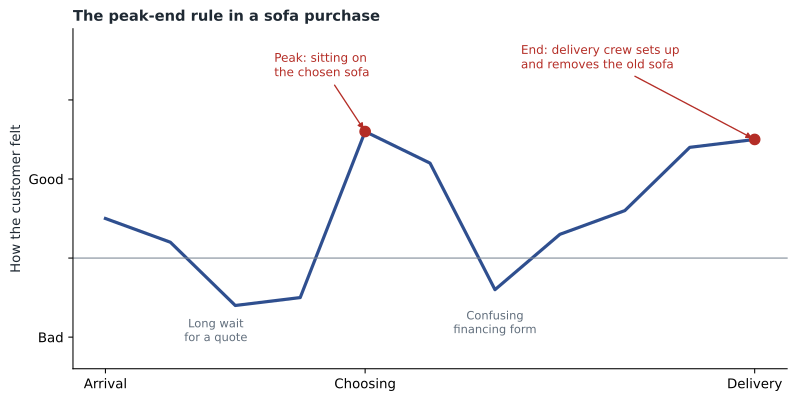
For sellers, the peak-end rule is a reason to pay special attention to the most emotional moments and to the end of every interaction. At Juniper & Pine, the peak is often the moment a customer finds the right piece, and the end is delivery. A delivery crew that arrives late, scrapes a door frame and leaves the packaging behind can undo an excellent sales experience. In business sales, the end of a meeting matters too. A meeting that finishes with a clear, agreed next step feels productive, while one that runs over time and ends in confusion is remembered that way, however good the middle was.
Familiarity and fluency
Two more memory effects matter in selling. The first is the mere exposure effect, described by Robert Zajonc in 1968: people tend to develop a mild preference for things simply because they have seen them before. This partly explains why repeated, helpful contact builds familiarity and why buyers often prefer a supplier whose name they recognize. The second is processing fluency: information that is easy to read and understand tends to be judged as more true and more likable. A clear proposal with plain language and a readable layout is more persuasive than a cluttered one with the same content.
Neither effect justifies spamming buyers. Exposure that is irritating or irrelevant creates annoyance, not familiarity, and Gartner's research suggests many business buyers actively avoid suppliers who send outreach they did not want. The lesson is that consistent, useful contact over time makes a seller familiar, and that clarity is a form of persuasion as well as courtesy.
Common mistakes
MistakeIf you show the buyer all the information, they will take it all in.
InsteadAttention and memory are limited; choose the few points the buyer must remember and repeat them.
MistakeBuyers judge prices objectively.
InsteadPrices are judged against reference prices and are affected by framing and left-digit effects.
MistakeThe middle of a sales experience matters most because it lasts longest.
InsteadPeople remember peaks and endings most, so the close and delivery deserve special care.
MistakeMore contact always builds familiarity.
InsteadUnwanted or irrelevant contact creates annoyance; useful contact builds familiarity.
Summary and key terms
- Perception selects, organizes and interprets information; it is shaped by goals and beliefs.
- Attention goes to contrast, change, goals, faces and stories, and information that arrives when the buyer is ready.
- Many shoppers have a strong need to touch, so experience beats description.
- Prices are judged against reference prices; express them honestly in units that relate to use.
- Working memory holds only a few items and memory fades quickly, so use three points and a written summary.
- The peak-end rule means the best or worst moment and the ending shape how an experience is remembered.
- Selective attention
- Noticing only a small part of the available information.
- Selective distortion
- Interpreting information to fit existing beliefs.
- Reference price
- The price a buyer expects to pay, used to judge whether a price is high or low.
- Serial position effect
- Better memory for items at the beginning and end of a list.
- Peak-end rule
- The tendency to judge an experience by its most intense moment and its end.
- Mere exposure effect
- A mild preference for things simply because they are familiar.
Practice problems
Work each problem on paper first, then reveal the answer to check.
Why did the Prairie Valley business manager remember the jammed-printer slide but not the cost table?
Show answer
Selective attention: the photo related directly to his goal of ending complaints from schools.
A 1,460-dollar mattress will last 8 years. What does it cost per night, to the nearest cent?
Show answer
1,460 ÷ 2,920 = 0.50 dollars, or 50 cents a night.
What is Darnell's rule for presentations?
Show answer
At most three main points, stated at the start, supported with stories or pictures, repeated at the end, then a written summary the same day.
How does the peak-end rule apply to Juniper & Pine's deliveries?
Show answer
Delivery is the end of the experience, so a poor delivery can spoil how the whole purchase is remembered.
Lesson quiz · 5 questions
Score 60% or more to complete this lesson.
Create a free account to save your progress, take quizzes and earn a certificate.