
RAC-430 · Lesson 9 of 12 · 17 min
Theory and calculations review
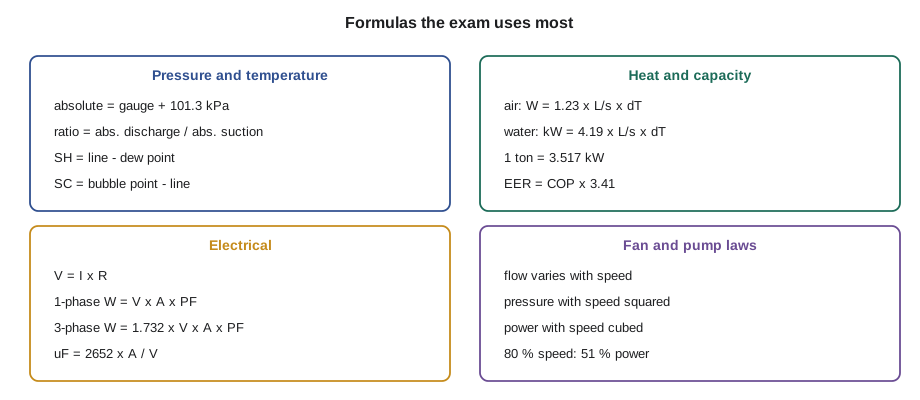
Theo's diagnostic test had shown a pattern Dana had seen in many experienced apprentices: he understood the theory well enough to use it, but he made mistakes when the exam asked him to calculate it. A subcooling question answered with the wrong saturation temperature, a power question with the wrong formula for three-phase, a pressure question in gauge when it asked for absolute. Each mistake cost one mark, and together they had cost him nearly a tenth of his score. This lesson reviews the theory behind the calculations the exam uses most and sets out a short list of formulas worth knowing cold.
The Red Seal exam supplies formulas or reference information where it needs them, but a candidate who has to look up every formula loses time and confidence. More important, the formulas only help a candidate who knows when each one applies. That is what this lesson drills.
Pressure and temperature
Every refrigeration calculation starts from pressure and temperature. Gauge pressure is measured relative to the atmosphere; absolute pressure includes it. At sea level, absolute pressure is gauge pressure plus about 101.3 kPa. Pressure-temperature charts and many formulas use absolute pressure, and compression ratio is always a ratio of absolute pressures, so a candidate who divides gauge pressures gets a ratio that is badly wrong, as RAC-110 and RAC-210 showed. Vacuum is measured from the atmosphere downward in inches of mercury on older gauges, and in microns of mercury or pascals absolute for evacuation.
The pressure-temperature relationship holds only where liquid and vapour are both present: in the evaporator while the refrigerant boils, in the condenser while it condenses, and in a cylinder with liquid in it. Superheated vapour and subcooled liquid are not at saturation, which is why superheat and subcooling are measured as differences from the saturation temperature at the measured pressure. For a single-component refrigerant or an azeotrope, one temperature corresponds to each pressure. For a blend with glide, there are two: the dew point, where the last liquid boils, and the bubble point, where the first vapour forms.
Superheat is the suction line temperature minus the evaporator saturation temperature, using the dew point for a blend. Subcooling is the condenser saturation temperature minus the liquid line temperature, using the bubble point for a blend. The two most common errors on the exam are using the wrong saturation point for a blend and subtracting in the wrong direction; both give answers that appear among the distractors.
Heat, energy and capacity
Sensible heat changes temperature; latent heat changes state. The heat to warm or cool a substance is its mass times its specific heat times the temperature change. The heat to change state is the mass times the latent heat. Refrigeration works because evaporation absorbs a great deal of latent heat at a low temperature and condensation releases it at a higher one, as RAC-110 explained.
For air, the field formulas use the heat capacity of a volume flow. In SI, sensible heat in watts is about 1.23 times the airflow in litres per second times the temperature difference in kelvin; in imperial units, Btu per hour is about 1.08 times cubic feet per minute times the temperature difference in degrees Fahrenheit. For water, the factor is larger: heat in kilowatts is about 4.19 times the flow in litres per second times the temperature difference. The factors include standard air or water density, so they are close but not exact in hot, cold or high places.
Capacity units must be handled carefully. One ton of refrigeration is 12,000 Btu per hour, or about 3.517 kW, so a 3-ton system is about 10.5 kW. One kilowatt is about 3,412 Btu per hour. Efficiency is expressed as coefficient of performance, a ratio of heat moved to work input, or as energy efficiency ratio, Btu per hour per watt, or as seasonal ratings such as SEER2 and HSPF2, as RAC-320 described. EER equals COP times about 3.41.
Electrical calculations
Ohm's law, voltage equals current times resistance, applies to resistive loads and to circuit checks. Power in a resistive circuit is voltage times current. In an AC circuit with motors, real power is voltage times current times power factor for single-phase, and the square root of three, about 1.732, times line voltage times line current times power factor for three-phase. Forgetting the 1.732 is one of the commonest errors on the exam, and the answer that results is always among the options.
Resistances in series add; in parallel, the reciprocal of the total is the sum of the reciprocals, so two equal resistors in parallel have half the resistance of one. Capacitors work the other way: in parallel their capacitance adds; in series it falls. Transformer secondary current is the VA rating divided by the secondary voltage, so a 40 VA transformer at 24 V can supply about 1.7 A. Voltage drop in a conductor is current times the conductor's resistance there and back. Voltage unbalance on three-phase supplies is the largest deviation from the average voltage divided by the average, as RAC-130 showed.
Psychrometrics, loads and fluids
Psychrometric questions on the exam are mostly about reading and interpreting rather than complex calculation: what relative humidity means, why dew point matters, what happens to relative humidity when air is heated without adding moisture, how a cooling coil removes both sensible and latent heat, what sensible heat ratio means. RAC-330 covered the chart. Load questions are about the components of a load: transmission through walls, roof and windows, infiltration and ventilation, solar gain, people, lights and equipment, product loads in refrigeration, and the effect of each on equipment selection.
Fluid flow questions use the fan and pump laws: flow varies with speed, pressure with the square of speed and power with the cube of speed. A fan slowed to 80 % of its speed moves 80 % of the air at 64 % of the pressure with about 51 % of the power. Those laws explain why variable-speed drives save so much energy, and they appear in many forms on the exam.
| Quantity | Formula | Common error |
|---|---|---|
| Absolute pressure | gauge + 101.3 kPa | Using gauge pressure in a compression ratio |
| Superheat | suction line temperature − evaporator saturation (dew) | Using the bubble point for a blend |
| Subcooling | condenser saturation (bubble) − liquid line temperature | Subtracting in the wrong order |
| Sensible heat, air | 1.23 × L/s × ΔT (W) | Using the wrong unit for flow |
| Water-side heat | 4.19 × L/s × ΔT (kW) | Mixing flow units |
| Single-phase power | V × A × PF | Leaving out the power factor |
| Three-phase power | 1.732 × V × A × PF | Leaving out the 1.732 |
| Run capacitance at 60 Hz | 2,652 × start winding A ÷ capacitor V | Using compressor common current |
| Fan and pump laws | flow ∝ speed, pressure ∝ speed², power ∝ speed³ | Treating power as linear with speed |
A daily calculation drill
Dana's remedy for calculation slips was repetition with variety. Every evening session started with six mixed calculations, generated so that the numbers changed but the types did not, with the answers printed at the bottom to check immediately. The script is a seeded version, so the same set appears every time it runs with the same seed, which makes it useful for checking a method. Theo used a new seed each evening.
# A seeded mixed calculation drill with an answer key (same questions every time for seed 430)
import random
rng = random.Random(430)
qs = []
v, a = rng.choice([208, 230, 240]), rng.choice([12.5, 16.0, 18.4])
qs.append((f"Single-phase compressor at {v} V drawing {a} A, power factor 0.85: watts?", f"{v * a * 0.85:,.0f} W"))
amps, volts = rng.choice([3.2, 4.1, 5.0]), rng.choice([370, 389, 410])
qs.append((f"Start winding {amps} A, {volts} V across the run capacitor: microfarads?", f"{2652 * amps / volts:.1f} uF"))
line, sat = rng.choice([8, 10, 12]), rng.choice([-7, -4, 2])
qs.append((f"Suction line {line} C, evaporator saturation {sat} C: superheat?", f"{line - sat} K"))
sat2, liq = rng.choice([38, 42, 46]), rng.choice([31, 34, 36])
qs.append((f"Condensing saturation {sat2} C, liquid line {liq} C: subcooling?", f"{sat2 - liq} K"))
ls, dt = rng.choice([400, 470, 566]), rng.choice([10, 11, 12])
qs.append((f"{ls} L/s across a coil, temperature drop {dt} K: sensible kW (1.23 factor)?", f"{1.23 * ls * dt / 1000:.1f} kW"))
kpa = rng.choice([350, 620, 1400])
qs.append((f"{kpa} kPa gauge: absolute pressure at sea level?", f"{kpa + 101.3:.1f} kPa"))
for i, (q, ans) in enumerate(qs, 1):
    print(f"{i}. {q}")
print("answers:", " | ".join(f"{i}) {a}" for i, (_, a) in enumerate(qs, 1)))1. Single-phase compressor at 230 V drawing 18.4 A, power factor 0.85: watts? 2. Start winding 3.2 A, 370 V across the run capacitor: microfarads? 3. Suction line 8 C, evaporator saturation -7 C: superheat? 4. Condensing saturation 42 C, liquid line 34 C: subcooling? 5. 470 L/s across a coil, temperature drop 10 K: sensible kW (1.23 factor)? 6. 350 kPa gauge: absolute pressure at sea level? answers: 1) 3,597 W | 2) 22.9 uF | 3) 15 K | 4) 8 K | 5) 5.8 kW | 6) 451.3 kPa
The six questions are the six types Theo missed most often: single-phase power with power factor, run capacitance, superheat, subcooling, sensible heat from airflow and absolute pressure. Each takes under a minute when the formula is known and the units are right. After three weeks of daily drills, his calculation errors on practice sets fell from about one in four to about one in fifteen.
Theo also learned to estimate before calculating. A 3-ton system is about 10 kW. A run capacitor for a small compressor is a few tens of microfarads. Superheat on a TXV system is usually a few kelvin. If a calculated answer is wildly different from the estimate, the calculation is probably wrong, and checking it is quicker than defending it. On the exam, an estimate also eliminates options that cannot be right before any arithmetic is done.
Reading charts and tables
Not every calculation on the exam uses a formula. Many use a chart or table: a pressure-temperature chart, a manufacturer's charging chart, a psychrometric chart, a superheat target table, a wire ampacity table or a capacity table. The skill is reading the right row and column, interpolating between values when needed and using the units the chart uses. Interpolation is a simple proportion: if a chart gives one value at 30 and another at 40, the value at 34 is 40 % of the way from the first to the second. Exam questions that give a short excerpt of a chart are testing exactly that skill.
Charts also have conditions printed on them. A charging chart is valid for a stated indoor wet bulb and outdoor dry bulb range; a capacity table for a stated airflow; a psychrometric chart for a stated pressure, usually sea level. A candidate who reads a value from the chart without checking the conditions can get an answer that is off by a wide margin, and the question writer may have included that wrong value as a distractor.
Units and conversions
Canadian practice uses SI units, but the trade still meets imperial units on nameplates, older equipment and imported products. The conversions worth knowing are few: one ton is 3.517 kW and 12,000 Btu per hour; one kilowatt is 3,412 Btu per hour; one psi is 6.895 kPa; one inch of water column is about 249 Pa; one litre per second is about 2.12 cubic feet per minute; and a temperature difference of one kelvin equals 1.8 degrees Fahrenheit. A temperature itself converts as degrees Fahrenheit equal 1.8 times degrees Celsius plus 32, but a difference converts by 1.8 alone, and confusing the two is a common slip.
Writing units at every step of a calculation is the simplest defence against unit errors. It looks slow, but it is faster than finding the error afterwards, and it turns many wrong answers into obviously wrong ones before they are chosen.
Dana added one habit for the exam room: before calculating, glance at the options. If they differ by a factor of ten, a rough estimate is enough to choose; if they differ by a few percent, the full calculation is needed, carefully. The options tell a candidate how precise the answer has to be.
Common mistakes
MistakeCalculating compression ratio from gauge pressures.
InsteadConvert both to absolute first.
MistakeLeaving out the square root of three in three-phase power.
InsteadThree-phase power is 1.732 × V × A × PF.
MistakeUsing the bubble point for superheat on a blend.
InsteadSuperheat uses the dew point; subcooling uses the bubble point.
MistakeTreating fan power as proportional to speed.
InsteadPower varies with the cube of speed.
MistakeAccepting an answer without a rough estimate.
InsteadEstimate first; recheck any answer far from the estimate.
Summary and key terms
- Absolute pressure is gauge plus atmospheric; compression ratios use absolute pressures.
- Superheat and subcooling are differences from the saturation temperature at the measured pressure, using dew and bubble points for blends.
- Air and water heat formulas use flow, a heat capacity factor and the temperature difference.
- Single-phase power is V × A × PF; three-phase adds 1.732.
- Fan and pump laws: flow with speed, pressure with its square, power with its cube.
- Daily mixed drills and rough estimates cut calculation errors.
- Absolute pressure
- Pressure measured from a perfect vacuum, equal to gauge pressure plus atmospheric pressure.
- Compression ratio
- Absolute discharge pressure divided by absolute suction pressure.
- Power factor
- The ratio of real power to apparent power in an AC circuit.
- Sensible heat ratio
- Sensible heat divided by total heat removed by a coil.
- Affinity laws
- The fan and pump laws relating flow, pressure and power to speed.
Practice problems
Work each problem on paper first, then reveal the answer to check.
A system's suction is 300 kPa gauge and discharge 1,500 kPa gauge. What is the compression ratio?
Show answer
(1,500 + 101.3) ÷ (300 + 101.3) = about 4.0.
A three-phase motor draws 12 A at 600 V with a power factor of 0.86. What is its power?
Show answer
1.732 × 600 × 12 × 0.86 = about 10.7 kW.
How many kW is a 4-ton system?
Show answer
4 × 3.517 = about 14.1 kW.
A fan is slowed to 70 % speed. About what share of full power does it use?
Show answer
0.7³ = about 34 %.
Lesson quiz · 5 questions
Score 60% or more to complete this lesson.
Create a free account to save your progress, take quizzes and earn a certificate.