
RAC-430 · Lesson 4 of 12 · 18 min
Refrigeration circuit faults
Refrigeration circuit questions were Theo's strongest area, and Dana's plan gave them fewer hours than most. That made it more important that the hours counted. "You know these on a roof," she said. "On paper you have to know them as patterns. Four numbers, four answers. You should be able to do it in your head." This lesson reviews the refrigerant-side faults of a vapour-compression system as a set of patterns in pressures, superheat, subcooling and amps, and the confirmation test for each.
The patterns hold for any system with a single evaporator and condenser, from a reach-in cooler to a rooftop unit, as long as the readings are taken at stable operation and compared with what is expected for the load and the ambient. They are the same patterns RAC-220 introduced for charging; here they are pulled together for diagnosis and exam review.
The four readings that tell the story
Four readings describe the refrigerant circuit. Suction pressure, converted to the evaporator saturation temperature, says how cold the refrigerant is boiling. Head pressure, converted to the condensing saturation temperature, says how hot it is condensing. Superheat at the evaporator outlet or compressor inlet says how fully the evaporator is fed: high superheat means starved, low superheat means flooded. Subcooling at the condenser outlet says how much liquid is backed up in the condenser: high subcooling means liquid is stacking up, low subcooling means there is little liquid in the condenser. Compressor amps, compared with rated load amps for the conditions, add a fifth clue: how much work the compressor is doing.
Two further readings help: the temperature difference across each heat exchanger, air or water in to out, and the difference between the refrigerant saturation temperature and the entering air or water, called the split or approach. An evaporator whose split is much larger than design is short of air or water; a condenser whose split is much larger than design is dirty, short of air or water, or full of non-condensables.
One caution applies to every pattern. Blends with glide, such as R-448A, R-454B or R-407C, have different dew and bubble points at the same pressure. Superheat is calculated from the dew point and subcooling from the bubble point, as RAC-220 explained. Using the wrong one produces a wrong pattern and a wrong diagnosis, and exam questions sometimes test exactly that.
The nine-symptom table
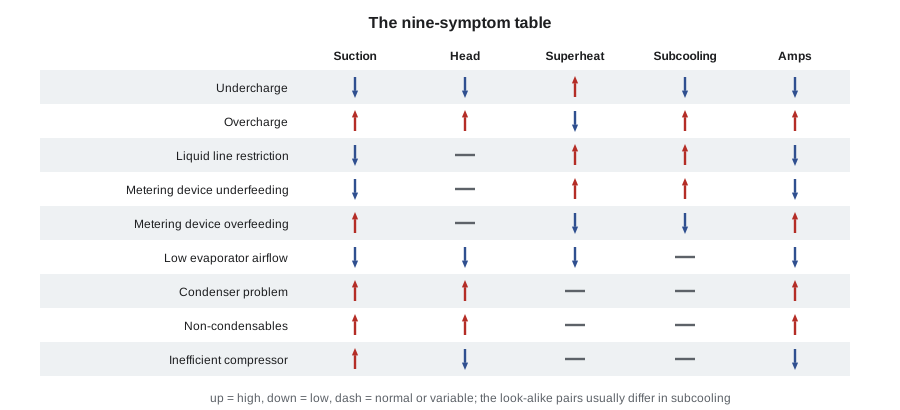
Service texts often present refrigerant-side faults as a table of nine or so problems against the direction each reading moves. Dana had Theo draw it from memory every Thursday for a month until he could do it in two minutes.
| Problem | Suction | Head | Superheat | Subcooling | Amps |
|---|---|---|---|---|---|
| Undercharge | Low | Low | High | Low | Low |
| Overcharge | High | High | Low | High | High |
| Liquid line restriction (drier, filter, kinked line) | Low | Low or normal | High | High | Low |
| Metering device underfeeding (stuck closed, lost bulb charge) | Low | Low or normal | High | High | Low |
| Metering device overfeeding (stuck open, loose bulb) | High | Normal or low | Low | Low | High |
| Low evaporator airflow or load (dirty filter, coil, fan) | Low | Low | Low | Normal or high | Low |
| Condenser problem (dirty coil, fan, recirculation) | High | High | Normal or low | Low or normal | High |
| Non-condensables in the system | High | High | Normal | Low or normal | High |
| Inefficient compressor (worn valves, rings) | High | Low | High or normal | Normal | Low |
The table is a guide, not a law. Real faults move readings in degrees, not just up or down, and two faults together can cancel each other. But nearly every refrigerant-side exam question is answerable with it, as long as the candidate reads which reading the stem says is high or low and compares each option against all of them.
Telling the look-alikes apart
Several pairs of faults look alike in three or four readings and differ in one. Exam questions are built around those pairs, so they deserve particular attention.
Undercharge or restriction? Both starve the evaporator, so both give low suction and high superheat. The difference is subcooling. With an undercharge there is little liquid anywhere, so subcooling is low. With a restriction, liquid backs up behind it in the condenser, so subcooling is high. The confirmation test for a restriction is a temperature drop across the suspected component: a drier with a noticeable drop from inlet to outlet, or frost or sweat at its outlet, is restricted. The clinic rooftop unit's drier in RAC-210 dropped the liquid temperature by several degrees and was full of carbon from an old burnout.
Restriction or underfeeding metering device? Both give low suction, high superheat and high subcooling, because the liquid backs up in the condenser either way. The difference is where the temperature drops. A restricted drier or line drops temperature before the metering device; an underfeeding TXV does not, and its outlet behaves wrongly when its bulb is warmed in the hand or cooled. A TXV whose bulb has lost its charge stays closed regardless; Dana's bench of pulled metering devices in RAC-220 included one.
Overcharge or condenser problem? Both raise head pressure. An overcharge fills the condenser with liquid, so subcooling is high. A dirty condenser, failed fan or hot air recirculating raises the condensing temperature without extra liquid, so subcooling is normal or low and the condenser split is large. The brewery's condensing unit in RAC-210 had a split of about twice design from a dirty coil; cleaning it brought the head pressure back down.
Non-condensables or overcharge? Both raise head pressure with the system off and running. With the system off and the condenser at ambient temperature, a system with non-condensables shows a standing pressure above the saturation pressure for that temperature; a pure refrigerant does not. That standstill test is the confirmation, and the cure is to recover the charge, evacuate and recharge.
Inefficient compressor or undercharge? Both give low head pressure and low amps. An inefficient compressor also gives high suction pressure, because it is not pulling the low side down, while an undercharge gives low suction. The confirmation test for valve or ring wear is a pump-down or isolation test, or for some compressors a comparison of measured capacity with the manufacturer's data, as the restaurant reach-in with the broken suction reed showed in RAC-210.
Running the patterns
The script turns the table into simple rules and applies them to six sets of readings from a medium-temperature walk-in, with the expected values set out in the comments. It is not a substitute for judgement, and real systems need more care than six rules, but it shows how much a disciplined comparison can do.
# The nine-symptom check: compare measured superheat, subcooling and pressures with expected values
def read(name, suction_sat_c, head_sat_c, sh_k, sc_k, amps_pct):
    s = []
    lo = suction_sat_c < -12      # expected evaporator saturation about -7 C for this cooler
    hi = head_sat_c > 46          # expected condensing about 40 C at this ambient
    if sh_k > 10 and sc_k < 3: s.append("undercharge (or low feed with low subcooling)")
    if sh_k > 10 and sc_k > 10: s.append("restriction or metering device underfeeding")
    if sh_k < 3 and sc_k > 10: s.append("overcharge")
    if sh_k < 3 and sc_k < 6 and not lo: s.append("metering device overfeeding")
    if lo and sh_k < 6: s.append("low airflow or load at the evaporator")
    if hi and sc_k < 8 and sh_k < 12: s.append("condenser airflow problem or non-condensables")
    if not lo and not hi and amps_pct < 70: s.append("inefficient compressor")
    print(f"{name}: suction sat {suction_sat_c} C, head sat {head_sat_c} C, SH {sh_k} K, SC {sc_k} K, amps {amps_pct} %")
    print("   ->", "; ".join(s) if s else "readings near normal")
read("A", -16, 37, 18, 1, 85)
read("B", -15, 38, 16, 14, 80)
read("C", -5, 49, 2, 15, 110)
read("D", -14, 39, 2, 5, 90)
read("E", -3, 35, 8, 5, 55)
read("F", -6, 52, 7, 4, 115)A: suction sat -16 C, head sat 37 C, SH 18 K, SC 1 K, amps 85 % -> undercharge (or low feed with low subcooling) B: suction sat -15 C, head sat 38 C, SH 16 K, SC 14 K, amps 80 % -> restriction or metering device underfeeding C: suction sat -5 C, head sat 49 C, SH 2 K, SC 15 K, amps 110 % -> overcharge D: suction sat -14 C, head sat 39 C, SH 2 K, SC 5 K, amps 90 % -> low airflow or load at the evaporator E: suction sat -3 C, head sat 35 C, SH 8 K, SC 5 K, amps 55 % -> inefficient compressor F: suction sat -6 C, head sat 52 C, SH 7 K, SC 4 K, amps 115 % -> condenser airflow problem or non-condensables
Each set of readings is identified by the pattern: A is an undercharge, B a restriction or underfeeding metering device, C an overcharge, D low evaporator airflow, E an inefficient compressor and F a condenser problem or non-condensables. In the field, each would then be confirmed with its own test: a leak search for A, temperature drops for B, the condenser split and a standstill pressure check for C and F, the coil and fans for D, and an isolation test for E.
Fixed orifices and other variations
Systems with capillary tubes or fixed orifices respond differently to some faults, because the metering device cannot adjust. In a fixed-orifice system, superheat changes with charge and with load, so an overcharge shows as low superheat with high subcooling, and an undercharge as high superheat. That is why fixed-orifice systems are charged by superheat with a target from indoor wet bulb and outdoor dry bulb, as RAC-220 described, and TXV systems by subcooling. On the exam, a question that gives a fixed-orifice system with low superheat in mild weather may be pointing at an overcharge, not a metering fault.
Systems with receivers hide charge problems in a different way. A receiver holds surplus liquid, so subcooling stays low across a range of charges, and a sight glass that shows bubbles may mean undercharge or, in a system with head pressure control in cold weather, normal operation. The brewery walk-in's receiver had a winter level mark for exactly that reason. Questions about receiver systems often turn on whether the condition described is a fault at all.
Inverter and variable-speed systems complicate the patterns further, because the compressor speed changes with the load. The readings must be taken with the system locked at a known speed, usually through a test or charge mode, and compared with the manufacturer's tables for that speed, as RAC-220 and RAC-320 described.
Compressor diagnosis
When the patterns point at the compressor, the diagnosis needs care, because replacing a compressor is expensive and the failure often has a cause elsewhere. Dana's boneyard of cut-open compressors from RAC-210 taught the main causes. Floodback, liquid returning to the compressor, washes oil off the bearings and leaves worn bearings and scored cylinders; its cause is usually low evaporator airflow, an overfeeding metering device or a defrost problem. Slugging, liquid entering the cylinders, breaks valves and connecting rods. Overheating, from high compression ratios, low suction pressure or poor motor cooling, breaks down oil and leads to burnouts. Electrical faults damage windings. A compressor replaced without finding which of those killed it will usually die the same way.
The exam asks about compressor failure in two ways: which reading pattern indicates a failing compressor, and what must be done before replacing one. The answer to the second is always the same: find and fix the cause, clean up the system after a burnout with the proper filters and acid tests, evacuate and charge correctly, and verify the operating condition afterwards.
A worked exam question
Dana gave Theo one more question to practise the look-alike pairs on. "A reach-in cooler with a TXV runs continuously and is warm. Suction pressure is low, head pressure is low, superheat is high, subcooling is low and the sight glass shows bubbles. Which is the most likely cause?" The options were a restricted drier, an undercharge, a failed evaporator fan and a dirty condenser. The low subcooling and bubbles ruled out the restriction, which would back liquid up and raise subcooling. The high superheat ruled out the fan, which would lower it. The low head ruled out the dirty condenser. Undercharge fitted every reading, and the next step in the field would be a leak search, not a top-up.
Common mistakes
MistakeCalling every low-suction, high-superheat system an undercharge.
InsteadCheck subcooling: high subcooling points to a restriction or underfeeding device.
MistakeUsing the bubble point to calculate superheat on a blend with glide.
InsteadSuperheat from the dew point, subcooling from the bubble point.
MistakeAdding refrigerant because the sight glass shows bubbles on a receiver system in cold weather.
InsteadCheck head pressure control and the receiver level before concluding it is low.
MistakeDiagnosing an inverter system at whatever speed it happens to be running.
InsteadLock the speed with the test mode and use the manufacturer's tables.
MistakeReplacing a failed compressor without finding why it failed.
InsteadFind and fix the cause first, or the new compressor will fail the same way.
Summary and key terms
- Suction, head, superheat, subcooling and amps, compared with expected values, identify most refrigerant-side faults.
- The nine-symptom table gives the typical direction of each reading for each fault.
- Undercharge and restriction differ in subcooling; restriction and an underfeeding device differ in where the temperature drops.
- Overcharge and a condenser problem differ in subcooling and the condenser split; non-condensables show on a standstill test.
- Fixed-orifice, receiver and inverter systems need their own charging and diagnostic methods.
- A failed compressor has a cause, which must be found before replacing it.
- Split
- The difference between a heat exchanger's refrigerant saturation temperature and the entering air or water temperature.
- Restriction
- A partial blockage in the liquid line or a component, causing a temperature drop and backing liquid into the condenser.
- Non-condensables
- Air or other gases in the system that collect in the condenser and raise head pressure.
- Standstill test
- Comparing a stopped system's pressure with the saturation pressure at ambient temperature.
- Floodback
- Liquid refrigerant returning to the compressor, diluting the oil.
Practice problems
Work each problem on paper first, then reveal the answer to check.
Low suction, high superheat, high subcooling, a 6 K drop across the drier. Diagnosis?
Show answer
A restricted filter-drier.
High head pressure, low subcooling and a condenser split twice design. Diagnosis?
Show answer
A condenser airflow problem, such as a dirty coil.
A stopped system at 22 °C ambient shows a pressure well above saturation at 22 °C. What does that suggest?
Show answer
Non-condensables.
High suction, low head and low amps. Diagnosis?
Show answer
An inefficient compressor.
Lesson quiz · 5 questions
Score 60% or more to complete this lesson.
Create a free account to save your progress, take quizzes and earn a certificate.