
RAC-430 · Lesson 8 of 12 · 17 min
Codes, regulations and safety review
Code and regulation questions had cost Theo more marks on his diagnostic test than any other kind. He knew the rules he used every week, such as recovery, leak testing before charging and lockout, but the exam asked about rules he rarely met: machinery room requirements, the classes of systems and occupancies, the limits on new equipment, the duties of an owner. And the Red Seal exam gives no code book in the room, so the rules must be known, not looked up. Dana's approach was to learn the structure of the rules first, which body makes them, what each covers and who must follow them, then the specific requirements that come up again and again.
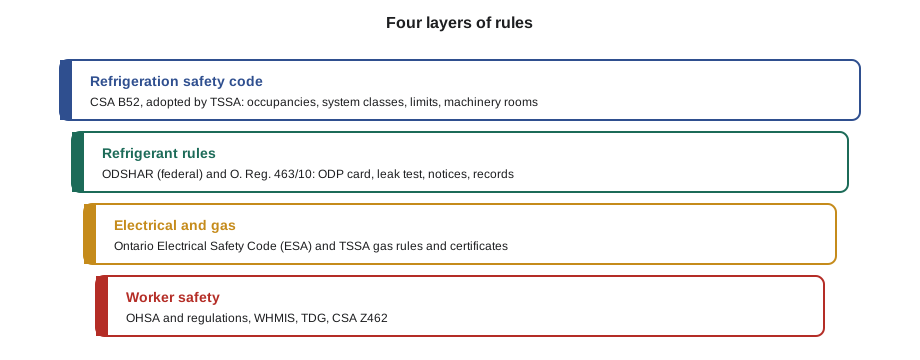
This lesson reviews that structure in four layers: safety codes for the design and installation of refrigerating systems, environmental rules for refrigerants, electrical and gas rules for the equipment that refrigeration mechanics work on, and occupational health and safety rules that protect the people doing the work. It finishes with the code lookup drills Theo used.
Layer 1: the refrigeration safety code
In Ontario, the safety of refrigerating systems is governed by CSA B52, the Mechanical Refrigeration Code, which TSSA adopts under Ontario's technical standards legislation; TSSA adopted the 2023 edition from October 2024. B52 classifies occupancies by the people in them, such as institutional, public assembly, residential, commercial and industrial, and refrigerating systems by how the refrigerant could reach occupied space. It uses the refrigerant safety groups, from A1 for lower toxicity and no flame propagation to B3 for higher toxicity and higher flammability, to set limits on how much refrigerant may be used in a given space and type of system. It sets requirements for machinery rooms, including construction, ventilation, detection and alarms, and for pressure relief, piping, testing and labelling.
The safety groups appear on almost every exam in some form. The letter gives toxicity: A for lower, B for higher. The number gives flammability: 1 for no flame propagation, 2L for lower flammability with a low burning velocity, 2 for flammable, 3 for highly flammable. R-410A and R-134a are A1. R-32 and R-454B are A2L. R-290, propane, is A3. Ammonia is B2L. Carbon dioxide is A1, but its high pressures and asphyxiation hazard need their own rules, as RAC-420 described.
Machinery room questions draw on B52's requirements: when one is required, how it is built and ventilated, what detection it needs, where its emergency controls must be and what signs must be posted. For large ammonia systems, RAC-420 described the code's emergency ventilation formula and detection requirements. Theo built a one-page summary of the machinery room rules and read it every Saturday morning.
Layer 2: refrigerant rules
Refrigerant rules in Canada come from two levels. Federally, the Ozone-depleting Substances and Halocarbon Alternatives Regulations control the import, manufacture and use of ozone-depleting substances and HFCs, including the phase-down of HFC consumption and limits on the global warming potential of refrigerants in new equipment of various types, such as the 750 limit for new chillers from January 2025. The Federal Halocarbon Regulations apply to systems owned by the federal government or on federal lands. Provincially, Ontario's O. Reg. 463/10 governs how refrigerants are handled in the province.
O. Reg. 463/10 is the rule Ontario mechanics live with most. A person who handles refrigerants must hold an ozone depletion prevention card, earned by completing an approved course and exam. Refrigerant must be recovered, not vented. A system must be leak tested before it is charged, and charging a leaking system is not allowed. After a leak test, a leak test notice is attached to the equipment, and a system may only be refilled if the notice shows it has passed a leak test within the time the regulation sets. Large discharges must be reported. Records of service, recovery and charging must be kept. Exam questions on these rules usually ask what must be done before charging, what must be attached to the equipment, or what to do when a leak is found.
| Rule | Who makes it | What it covers |
|---|---|---|
| CSA B52 | CSA, adopted by TSSA in Ontario | Design, installation and machinery rooms of refrigerating systems |
| ODSHAR | Environment and Climate Change Canada | ODS and HFC controls, GWP limits on new equipment |
| O. Reg. 463/10 | Ontario Ministry of the Environment | Handling, leak testing, notices, records, ODP card |
| Ontario Electrical Safety Code | Electrical Safety Authority | Electrical installations, based on the Canadian Electrical Code |
| Gas regulations | TSSA | Gas appliances and the gas technician certificates |
| OHSA and its regulations | Ontario Ministry of Labour | Worker safety: lockout, confined spaces, PPE, WHMIS |
Layer 3: electrical and gas rules
Refrigeration mechanics work on equipment connected to electricity and often to gas. In Ontario, electrical installations follow the Ontario Electrical Safety Code, based on the Canadian Electrical Code, and the Electrical Safety Authority enforces it. Section 28 and the code's rules for motors and air conditioning equipment set how compressors and motors are protected and how their circuits are sized; nameplate values such as minimum circuit ampacity and maximum overcurrent protection come from those rules. Whether a mechanic may do the electrical installation itself depends on the work and the licences held, as RAC-130 explained. Gas appliances, such as furnaces in dual-fuel systems and gas-fired rooftop units, are governed by TSSA's gas regulations, and working on them requires a gas technician certificate of the right class.
The questions in this layer are mostly about reading nameplates and applying simple rules: which breaker size is allowed, what the minimum circuit ampacity means, how much clearance a disconnect needs, how combustion air is provided, why a flue must not be shared with an appliance it was not designed for. Theo practised with nameplates photographed on his calls, writing the circuit and protection each needed before checking it against the rule.
Layer 4: the safety of the person doing the work
Occupational health and safety rules apply to every job. In Ontario, the Occupational Health and Safety Act and its regulations require employers to provide training, equipment and safe procedures and workers to follow them, use the protective equipment required and report hazards. The regulations cover lockout and isolation of energy sources, confined spaces, work at heights and fall protection, ladders and scaffolds, hot work and the hazardous products rules of WHMIS, including labels and safety data sheets. Cylinders transported on public roads fall under the federal Transportation of Dangerous Goods rules. CSA Z462 covers electrical safety in the workplace, including arc flash, as RAC-130 described.
Safety questions are often the easiest marks on the exam, and also the ones most often lost through overthinking. The safe answer is nearly always the right one: lock out and verify zero energy before working on equipment; recover refrigerant rather than release it; use nitrogen, never oxygen or compressed air, to pressure test and purge; never heat a refrigerant cylinder with a flame; never fill a recovery cylinder beyond its safe fill level, usually 80 % of its water capacity; wear eye and hand protection when connecting to a system; test the atmosphere before entering a confined space and never enter a space where a refrigerant leak may have displaced oxygen without the right procedure; keep a fire watch after brazing near combustibles.
Drilling the books
The Red Seal exam does not supply code books, so Theo's drills were recall drills: a deck of cards with a rule on one side and the requirement on the other, shuffled every session, with missed cards going back into the deck for the next day. But he also drilled with the books themselves, because finding the right section quickly is part of the job, and because reading the actual words of B52 and O. Reg. 463/10 corrected several things he had half-remembered. The script logs how long his lookups took over four weeks.
# Code lookup drill: how long does it take to find each answer in the book?
drills = [  # week, list of lookup times in seconds
    (1, [210, 185, 240, 160, 300, 195]),
    (2, [150, 170, 140, 205, 160, 130]),
    (3, [120, 95, 140, 110, 100, 125]),
    (4, [80, 95, 70, 90, 85, 75])]
target = 90
for week, times in drills:
    avg = sum(times) / len(times)
    slow = sum(t > 180 for t in times)
print(f"week {week}: average {avg:5.1f} s, slowest {max(times)} s, over 3 minutes: {slow}, {'on target' if avg <= target else 'keep drilling'}")week 1: average 215.0 s, slowest 300 s, over 3 minutes: 5, keep drilling week 2: average 159.2 s, slowest 205 s, over 3 minutes: 1, keep drilling week 3: average 115.0 s, slowest 140 s, over 3 minutes: 0, keep drilling week 4: average 82.5 s, slowest 95 s, over 3 minutes: 0, on target
In the first week, Theo's average lookup took more than three and a half minutes, and five of six took longer than three minutes, which on a timed exam ruins the pace. By the fourth week the average was under 90 seconds and none took longer than about a minute and a half. The improvement came less from reading faster than from knowing where things are: which chapter covers venting, which table gives clearances, which section sets machinery room ventilation. The same habit, knowing the structure of the book, pays back every time a mechanic needs to check a rule on the job.
How code questions are built
Code questions follow a few patterns. Some ask which rule or body governs a situation: who enforces the electrical code, which regulation sets refrigerant handling rules, which standard sets machinery room requirements. Some ask what a rule requires: what must be done before charging, what must be posted at a machinery room door, what must be recorded. Some give a situation and ask whether it complies: a system charged without a leak test, a cylinder filled past its limit, a technician without the required certification. And some ask what to do when something does not comply. In every pattern, the safe and compliant answer is the key, and the distractors are usually things technicians do under time pressure.
Dana's advice was to learn the purpose of each rule as well as its wording. A rule whose purpose is understood is easier to remember and easier to apply to a situation the candidate has not seen. Leak testing before charging exists because charging a leaking system releases refrigerant. Machinery room ventilation exists because a leak in a closed room can reach dangerous concentrations. Lockout exists because equipment can start unexpectedly. Knowing why makes the answer obvious even when the exact wording is forgotten.
Records and documents
Many questions in this area are about paperwork, which some mechanics treat as an afterthought. Service records, refrigerant logs, leak test results, safety data sheets, permits, lockout records and start-up reports are all required by one rule or another, and each protects someone: the owner, who must show compliance; the next technician, who needs the history; and the mechanic, whose record shows the work was done correctly. A question asking what must be recorded after recovering refrigerant from a system, or what must accompany a cylinder sent for reclamation, is a gift to a candidate who has done the paperwork properly for four years.
Rules change
Codes and regulations are revised on a cycle, and the exam is updated to follow them, though not always immediately. A candidate should study the editions the exam is based on, which the exam information or the apprenticeship office can confirm, and be aware of changes coming into force. In the four years of Theo's apprenticeship, refrigerant rules had changed in both countries, new safety requirements for A2L refrigerants had arrived and electrical codes had been revised. After certification, keeping up with those changes is part of the job, through code update courses, industry associations and the notices regulators publish.
Theo's one-page summaries, one for each layer, were the core of his review in the last weeks: the body that makes the rule, what it covers, the five or six requirements most often tested and the purpose behind each.
Common mistakes
MistakeMemorizing rule numbers instead of what the rules require.
InsteadLearn which body makes each rule, what it covers and what it requires.
MistakeConfusing the safety group letters and numbers.
InsteadLetter is toxicity (A lower, B higher); number is flammability (1, 2L, 2, 3).
MistakeChoosing a fast answer over a safe one on a safety question.
InsteadThe safe answer is nearly always the key.
MistakePressure testing with oxygen or compressed air.
InsteadUse dry nitrogen with a regulator; oxygen with oil can explode.
MistakeSearching a code book page by page.
InsteadLearn the structure and index of each book and drill lookups against the clock.
Summary and key terms
- CSA B52, adopted by TSSA, governs the design and installation of refrigerating systems in Ontario.
- ODSHAR sets federal ODS and HFC controls; O. Reg. 463/10 sets Ontario's handling, leak testing, notice and record rules.
- Safety groups combine toxicity (A or B) and flammability (1, 2L, 2, 3).
- The Ontario Electrical Safety Code and TSSA gas rules apply to the equipment's electrical and gas connections.
- Worker safety rules cover lockout, confined spaces, fall protection, hot work, PPE and hazardous product information.
- Drill rules by recall and code books by timed lookup.
- CSA B52
- The Mechanical Refrigeration Code, adopted in Ontario by TSSA.
- ODP card
- The ozone depletion prevention card required in Ontario to handle refrigerants.
- Leak test notice
- The notice attached to equipment after a leak test under O. Reg. 463/10.
- Safety group
- A refrigerant classification combining toxicity and flammability, such as A1 or A2L.
- Machinery room
- A room built to code to house refrigeration machinery, with ventilation, detection and emergency controls.
Practice problems
Work each problem on paper first, then reveal the answer to check.
What safety group is R-454B?
Show answer
A2L: lower toxicity, lower flammability.
Under O. Reg. 463/10, what must be done before charging a system?
Show answer
A leak test, with any leak repaired; the system may then be charged.
What gas is used to pressure test a system?
Show answer
Dry nitrogen through a regulator, never oxygen or compressed air.
Which body enforces the electrical code in Ontario?
Show answer
The Electrical Safety Authority.
Lesson quiz · 5 questions
Score 60% or more to complete this lesson.
Create a free account to save your progress, take quizzes and earn a certificate.