
RAC-430 · Lesson 7 of 12 · 17 min
Commercial and industrial system faults
Theo's last two years had taken him from Harvest Lane's racks to Riverbend's chiller plant and Grand Valley's ammonia system. Commercial and industrial questions on the exam are rarely as deep as that work, but they range across all of it: walk-ins and reach-ins, display cases, ice machines, rack systems, chillers, cooling towers and, at awareness level, ammonia and carbon dioxide. This lesson reviews the faults most likely to appear, using the same method as lessons 3 to 6, and the patterns that set large systems apart.
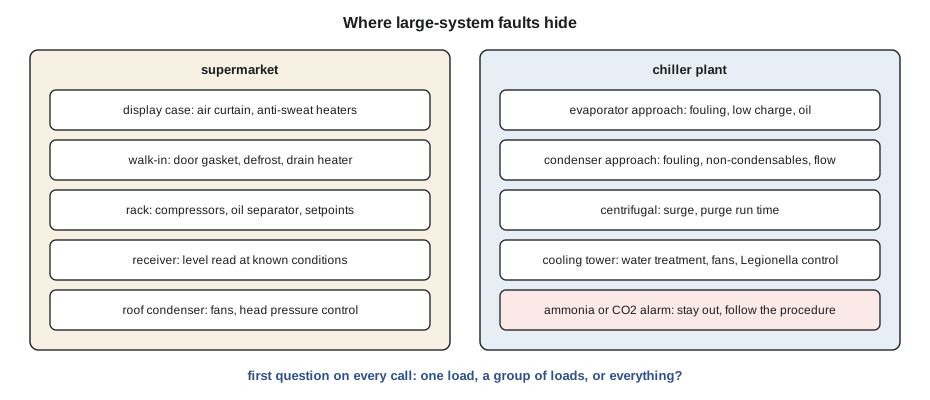
The key difference is that large systems have more components between the problem and the symptom. A warm case on a supermarket floor might be a case fault, a rack fault, a controls fault or a refrigerant problem shared by every case on the circuit. The method's first step, complaint and history, now includes a question small systems do not need: is it one load, a group of loads or everything?
Walk-ins, reach-ins and display cases
Walk-in coolers and freezers fail mostly in the same ways as smaller systems, with a few additions. Door problems are the commonest: worn gaskets, doors left open, failed closers and heaters. A freezer door whose frame heater has failed freezes shut or lets moist air in, and the coil ices. At the restaurant in RAC-210 and RAC-230, a bad gasket and a loose defrost termination thermostat together turned a freezer coil into a block of ice. Defrost faults are the second commonest: heaters that have burned out, termination sensors in the wrong place, drain line heaters that have failed so that defrost water refreezes in the drain and backs up. Box load changes are the third: a customer who starts storing warm product, or adds a second ice cream freezer that dumps heat into the cooler, can overload a system that is working perfectly.
Display cases add air curtains, anti-sweat heaters and case controllers. An open multideck case loses its air curtain when product or signage blocks the return grille or the honeycomb at the discharge, and the case warms while the evaporator stays cold. Glass-door cases fog when anti-sweat heaters are turned down or fail in humid weather. Case controllers with electronic expansion valves report alarms that point to sensor faults, valve faults or a rack problem. In the second week of December, Theo took a call at Harvest Lane for a warm dairy case and found that a stocker's new signage had blocked the return; no refrigeration work was needed.
Ice machines combine refrigeration, water and controls. Their faults include scale and slime that slow harvest and reduce production, water inlet valves and float switches, harvest assist failures, and the usual refrigeration faults. Production rates depend strongly on entering water and air temperatures, so a machine producing less ice in July may be working correctly; the manufacturer's production table answers that question. Water treatment and sanitation are both quality and health issues, and the arena's snack-bar machine had taught Theo both.
Rack systems
A parallel rack serves many cases from a shared suction header and condenser. When the whole rack is in trouble, every case on it warms together; when one circuit is in trouble, only its cases do. That pattern is the first diagnostic split. Rack-wide faults include a compressor that has tripped and not restarted, a suction pressure setpoint changed, a condenser fan or head pressure control problem, a low refrigerant level in the receiver and oil problems. Circuit faults include a solenoid valve that fails to open, an evaporator pressure regulator set wrong or stuck, a case controller fault and a circuit stuck in defrost.
Oil management is particular to racks. Oil leaves each compressor and must return to it. An oil separator returns most oil to a reservoir, which feeds each compressor through an oil level regulator. A compressor that trips on oil failure may have a failed regulator, a starved reservoir or a separator that is not returning oil. Adding oil without finding why it is short leaves the problem and can overfill other compressors.
Refrigerant level is the other rack topic. A rack's receiver holds a varying amount of liquid as head pressure, heat reclaim and defrosts change, so the level must be read under known conditions. A falling level over weeks, at the same conditions, means a leak somewhere in a large system, often in a case or a walk-in rather than the machine room. The receiver trend Theo built for Harvest Lane in RAC-310, corrected for weather, was designed to catch exactly that kind of slow loss long before any customer noticed.
Chillers and cooling towers
Chiller faults show most clearly in the approaches. The evaporator approach, the difference between the leaving chilled water temperature and the evaporator saturation temperature, rises when tubes foul, when refrigerant charge is low and when oil collects in the evaporator. The condenser approach, the difference between the condenser saturation temperature and the leaving condenser water temperature, rises when tubes foul with scale or biological growth, when non-condensables collect and when water flow is low. A rising approach, logged week by week, warns of a problem long before the chiller trips.
The script checks six weeks of logs from a water-cooled chiller like those at Riverbend.
# Chiller and rack log checks: flag trends instead of single readings
log = [  # week, condenser approach K, evaporator approach K, chilled water delta-T K
    (1, 1.6, 1.2, 5.9), (2, 1.8, 1.2, 5.7), (3, 2.1, 1.3, 5.4), (4, 2.5, 1.3, 4.8),
    (5, 2.9, 1.4, 4.2), (6, 3.4, 1.4, 3.9)]
for w, ca, ea, dt in log:
    flags = []
    if ca > 2.5: flags.append("condenser approach high: tubes fouling or non-condensables")
    if ea > 2.0: flags.append("evaporator approach high: fouling or low charge")
    if dt < 4.5: flags.append("low delta-T: coil valves, bypass or setpoints")
    print(f"week {w}: cond {ca} K, evap {ea} K, delta-T {dt} K", "|", "; ".join(flags) if flags else "ok")
slope = (log[-1][1] - log[0][1]) / (log[-1][0] - log[0][0])
print(f"condenser approach rising {slope:.2f} K per week")week 1: cond 1.6 K, evap 1.2 K, delta-T 5.9 K | ok week 2: cond 1.8 K, evap 1.2 K, delta-T 5.7 K | ok week 3: cond 2.1 K, evap 1.3 K, delta-T 5.4 K | ok week 4: cond 2.5 K, evap 1.3 K, delta-T 4.8 K | ok week 5: cond 2.9 K, evap 1.4 K, delta-T 4.2 K | condenser approach high: tubes fouling or non-condensables; low delta-T: coil valves, bypass or setpoints week 6: cond 3.4 K, evap 1.4 K, delta-T 3.9 K | condenser approach high: tubes fouling or non-condensables; low delta-T: coil valves, bypass or setpoints condenser approach rising 0.36 K per week
The condenser approach climbed steadily from the first week, and by week 5 it was over the plant's alert level: a classic fouling trend, which Riverbend's operators confirmed with tube inspection in RAC-410. The evaporator approach stayed steady, so the charge and evaporator were not the problem. The falling chilled water temperature difference was a separate issue, low delta-T, which comes from the building's coils and valves, not from the chiller, and which RAC-410 traced to coil valves and bypasses.
Centrifugal chillers add surge, a flow reversal through the compressor when it cannot develop enough pressure for the lift required, with a loud, repetitive noise and swings in current. Surge comes from high condenser water temperature, fouled condensers, non-condensables, low load at high lift or control faults. Low-pressure chillers add purge units, whose run time rises when air is leaking in. Cooling towers add water treatment, fan and drive faults, and the Legionella control programs that RAC-210 and RAC-410 covered; a tower that has stopped treatment or sat stagnant is a health risk, not just a maintenance item.
Ammonia and carbon dioxide at awareness level
The exam treats industrial ammonia and carbon dioxide systems mainly through safety and recognition, not hands-on repair, and so should a mechanic who has not been trained on them. The questions likely to appear include ammonia's properties and hazards, its safety group, detection and alarm levels, the purpose of machinery room ventilation and emergency controls, and the rule that work on ammonia systems follows written procedures, permits and isolation plans. For carbon dioxide, they include its high pressures, its critical temperature and transcritical operation, the risk of dry ice forming when liquid is admitted below the triple point and the asphyxiation hazard in enclosed spaces, as RAC-420 covered.
Recognition matters because a commercial mechanic may be the first to see something wrong in an industrial setting. Ammonia found in an arena's brine means a chiller tube has failed; the right response is to stop, isolate and call the people responsible, as the Fernie investigation in RAC-420 showed. A carbon dioxide detector alarm in a supermarket machine room means leaving the room and checking readings from outside, not going in to look. On the exam, the answer that keeps the mechanic out of danger and brings in the right people is the key.
| System | Typical fault | Signature | First check |
|---|---|---|---|
| Walk-in freezer | Defrost termination or drain heater fault | Ice on the coil or in the drain pan | Defrost sequence, sensor position, drain heater current |
| Display case | Blocked air curtain | Case warm, coil cold | Return grille and honeycomb clear of product and signage |
| Rack | Rack-wide suction problem | All circuits warm together | Compressor status, setpoints, receiver level |
| Rack circuit | Solenoid or EPR fault | One circuit warm, others fine | Valve coil voltage, EPR setting |
| Water-cooled chiller | Condenser fouling | Condenser approach rising week by week | Logs, tube inspection, water treatment |
| Centrifugal chiller | Surge | Loud repetitive noise, current swings | Condenser water temperature, approach, purge |
| Ammonia system | Leak or tube failure | Detector alarm, ammonia in secondary fluid | Stay out, follow the emergency procedure |
Working on someone else's plant
Commercial and industrial sites add another layer to the method: the owner's own people and procedures. A supermarket manager knows when the cases were last stocked and cleaned; a plant operator knows what the logs looked like last week and what was changed. Their information belongs in step 1. Many sites also have their own rules: permits for hot work, lockout procedures that use the site's locks as well as the technician's, sign-in and escort requirements, and restrictions on when equipment may be shut down. On a hospital campus like Riverbend, shutting down a chiller can affect operating rooms, so every shutdown is planned and approved.
Large systems also make records more important. A rack's alarm history, a chiller's daily logs and a case controller's temperature records are the trend data that a small system never has, and reading them before measuring anything often points straight at the fault. Theo learned to ask for the logs on every large-system call, and to add his own readings to them before leaving, so that the next person would have the same advantage.
A worked question
One of Dana's practice questions read: "A water-cooled screw chiller trips on high discharge pressure on hot afternoons. The condenser water flow is at design, and the condenser approach has risen over the past month. What is the most likely cause?" The options were low refrigerant charge, fouled condenser tubes, a failed evaporator flow switch and a low chilled water setpoint. With design flow, a rising approach points to fouling: the tubes can no longer reject heat at the same temperature difference, and on the hottest days the head pressure reaches the trip setting. Low charge would raise the evaporator approach, not the condenser approach.
Large systems also reward patience. A rack or chiller that has been running badly for weeks will not be fixed in ten minutes, and a technician who changes several settings at once can no longer tell which change did what. One change at a time, with readings before and after, is slower on the day and much faster over the life of the problem.
Common mistakes
MistakeTreating a warm display case as a refrigeration fault without looking at the air curtain.
InsteadCheck the return grille and honeycomb first.
MistakeAdding oil to a rack compressor that tripped on oil failure.
InsteadFind out why the oil is not returning: separator, reservoir or regulator.
MistakeReading a rack receiver level without noting the conditions.
InsteadCompare levels at the same head pressure, reclaim and defrost state.
MistakeIgnoring a slowly rising condenser approach until the chiller trips.
InsteadTrend the logs and act on the trend.
MistakeGoing into a machinery room to find an ammonia or CO₂ leak after an alarm.
InsteadCheck from outside and follow the emergency procedure.
Summary and key terms
- In large systems, first decide whether one load, a group of loads or everything is affected.
- Walk-in faults are mostly doors, defrost and load changes; display cases add air curtains and anti-sweat heaters.
- Rack faults split into rack-wide and circuit faults; oil management and receiver level need their own checks.
- Chiller approaches, logged and trended, warn of fouling, low charge and non-condensables.
- Surge, purge run time and tower water treatment are particular to large chiller plants.
- For ammonia and CO₂, the exam focuses on properties, hazards and safe responses.
- Evaporator approach
- Leaving chilled water temperature minus evaporator saturation temperature.
- Condenser approach
- Condenser saturation temperature minus leaving condenser water temperature.
- Air curtain
- The stream of cold air across the front of an open display case.
- Evaporator pressure regulator
- A valve that keeps an evaporator above a minimum pressure on a shared suction.
- Surge
- Flow reversal in a centrifugal compressor when it cannot develop the pressure required.
Practice problems
Work each problem on paper first, then reveal the answer to check.
Every case on a rack warms at the same time. Where should the search start?
Show answer
At the rack: compressors, suction setpoint, receiver, condenser and controls.
A chiller's condenser approach has risen from 1.5 K to 3.5 K over two months. What is likely?
Show answer
Tube fouling or non-condensables; inspect the tubes and check the purge and water treatment.
Ice is building in a walk-in freezer's drain pan after defrost. What should be checked?
Show answer
The drain line heater and the defrost termination setting and sensor.
An arena's brine smells of ammonia. What is the first action?
Show answer
Stop and isolate as the procedure requires, keep people away and call the responsible person.
Lesson quiz · 5 questions
Score 60% or more to complete this lesson.
Create a free account to save your progress, take quizzes and earn a certificate.