
RAC-310 · Lesson 9 of 12 · 18 min
Refrigerants for commercial systems: HFC blends, propane and CO2
At the first design meeting, Meera had asked a question nobody at the table could answer in one sentence: "Which refrigerant should I use, and will I regret it in ten years?" The old store's rack had run on R-22, which was why it had to be retired. A chain store across town had just opened with a carbon dioxide system. The equipment supplier offered R-448A racks at a lower price, and propane for the self-contained cases. Nadia's answer took a page, and she asked Northfield to check the parts about service. Theo spent an evening reading it, and Dana went through it with him the next morning.
Commercial refrigeration has changed refrigerants more often than any other part of the trade, because its systems hold large charges and leak more than most. This lesson covers the refrigerants a commercial technician meets today, why each is used, how the rules in each country are moving the industry, and what each choice means for service. It builds on RAC-110's introduction to refrigerant families and RAC-120's coverage of the law.
From R-22 to the HFC blends
For decades, grocery racks used R-12 and R-502, then R-22. As the ozone-depleting refrigerants were phased out, stores moved to HFCs, especially R-404A and R-507A for medium- and low-temperature systems. These worked well but have very high global warming potentials, around 4,000, and a store that leaked a quarter of its charge a year, which was not unusual, emitted the climate equivalent of a large fleet of cars. The next generation of blends, such as R-407A, R-448A and R-449A, cut the GWP to roughly a third to a half of R-404A while keeping similar pressures and capacities, and many existing racks were retrofitted to them.
| Refrigerant | Type | Safety group | GWP (approximate) | Typical commercial use |
|---|---|---|---|---|
| R-404A, R-507A | HFC blend | A1 | about 3,900 to 4,000 | Legacy medium- and low-temperature racks and condensing units |
| R-407A | HFC blend | A1 | about 2,100 | Retrofits and some newer racks |
| R-448A, R-449A | HFC/HFO blend | A1 | about 1,400 | New and retrofitted racks and condensing units |
| R-454C, R-455A | HFO/HFC blend | A2L | under 150 | Newer condensing units and small systems |
| R-290 (propane) | Hydrocarbon | A3 | about 3 | Self-contained cases, reach-ins, ice machines |
| R-744 (carbon dioxide) | Natural | A1 | 1 | Transcritical and cascade racks |
| R-717 (ammonia) | Natural | B2L | 0 | Industrial and cold storage, sometimes with CO2 secondary |
R-448A and R-449A are zeotropic blends with a temperature glide of several kelvins, as RAC-220 explained. That affects how they are charged, always as liquid; how superheat and subcooling are measured, from the dew and bubble points; and how EPRs and low-pressure controls are set, from the dew point. When a blend leaks as vapour, the components do not leave in exactly the same proportions, so the remaining charge's composition shifts slightly. For the common blends, manufacturers generally say that topping off after a vapour leak is acceptable, but a system that has lost most of its charge, or has been topped off many times, may perform better recovered and recharged.
Retrofitting R-404A systems
Many existing racks and condensing units were built for R-404A and are being converted to lower-GWP blends to cut leak emissions, to reduce service costs as R-404A becomes scarcer, or because regulations on servicing are tightening. A retrofit is a planned job, not a top-off with a different refrigerant.
- Recover the old charge completely and weigh it, as RAC-120 described.
- Check the oil: R-404A systems already use polyolester oil, which is compatible with R-448A and R-449A, so an oil change is usually not needed.
- Check the expansion valves: thermostatic valves may need adjustment or a different power element; EEVs need the refrigerant selection changed in their controllers.
- Check the discharge temperature, which is usually higher with the newer blends, especially on low-temperature compressors; some need liquid or vapour injection.
- Change the refrigerant setting in every controller, transducer conversion and EPR setting chart, and label the system clearly with the new refrigerant and oil.
- Charge as liquid, by weight where practical, typically to a somewhat smaller charge than the R-404A it replaces, then fine-tune by the receiver level and subcooling.
Capacity after a retrofit is usually similar for medium-temperature systems and a little lower for some low-temperature systems, and manufacturers publish retrofit guides with the details. A retrofit that is not labelled, or whose controllers still think the system is on R-404A, will be misdiagnosed by the next technician.
Carbon dioxide systems
Carbon dioxide, R-744, has a GWP of 1, is non-flammable and has low toxicity at normal exposure levels, and it is cheap and widely available. Its drawbacks are its very high pressures and its low critical temperature, about 31 °C (88 °F), as RAC-110 noted. Above the critical point, carbon dioxide cannot condense; the system's high side becomes a gas cooler instead of a condenser, and the system is called transcritical. Many new supermarkets in Canada and the US, especially for chains, use transcritical CO2 booster systems, and RAC-420 covers CO2 and ammonia in industrial depth. A commercial technician needs to know what a booster system is and why it is different.
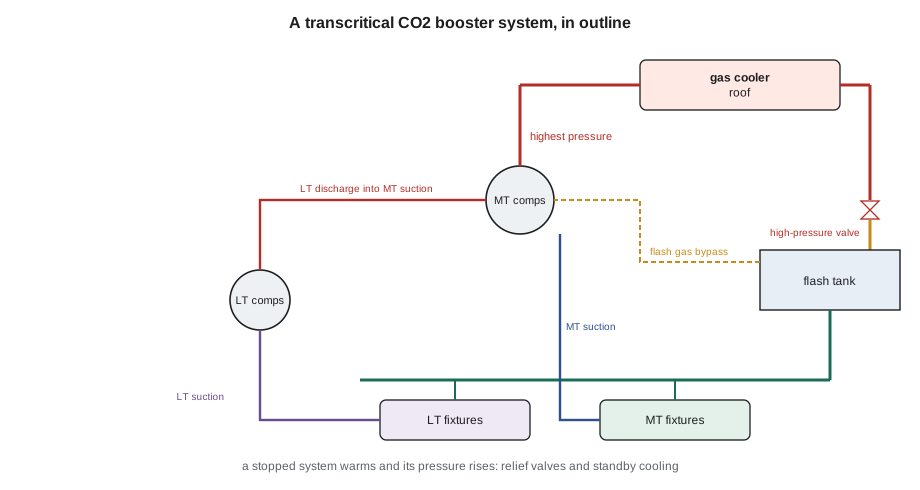
- Low-temperature compressors take suction from the frozen food fixtures and discharge into the medium-temperature suction, so the system boosts in two stages.
- Medium-temperature compressors compress all the gas to the high-side pressure, which can exceed 9 MPa (1,300 psig) in warm weather.
- A gas cooler on the roof cools the high-pressure gas; in cold weather it works as a condenser.
- A high-pressure expansion valve drops the pressure into a flash tank, which separates the liquid that feeds the fixtures from the flash gas, which is bypassed or compressed separately.
- Relief valves, and often a small standby condensing unit that keeps the flash tank cool during a power failure, deal with the pressure rise when the system stops: a stopped CO2 system warms toward room temperature and its pressure rises well above normal operating pressures.
CO2 systems are efficient in cold and mild climates and, with additions such as parallel compression and ejectors, increasingly in warm ones. Their service needs different skills: gauges, hoses and tools rated for the pressures, an understanding of the high-pressure valve and flash tank controls, and care with trapped liquid, which can reach dangerous pressures if isolated between closed valves as it warms. Carbon dioxide is heavier than air and, in high concentrations, causes headaches, unconsciousness and death; machine rooms and walk-ins with CO2 evaporators have detectors set to alarm at levels far below that. Manufacturers' training is essential before working on these systems.
Why Harvest Lane chose R-448A
Nadia's page set out the trade-offs. A CO2 booster rack would have the lowest climate impact and would avoid future rules on HFCs, but it cost more, needed a new machine room layout and gas cooler, and few local technicians had serviced one. R-448A racks cost less, matched the existing machine room and roof structure, and every Northfield technician knew how to service them. The self-contained beverage coolers and ice cream island used propane in any case. Meera chose R-448A racks with good leak monitoring, and asked Nadia to arrange the machine room so a future CO2 rack would fit. The script below shows why leak monitoring was part of the decision.
# What the rack charge means for the climate: CO2-equivalent of the charge and of a year's leaks
# GWP values: 100-year values used for regulation in this program (AR4); charge and leak rate illustrative
CHARGE = 270.0               # kg in the two racks
LEAK = 0.15                  # fraction of the charge lost per year, a typical store figure
gwp = {'R-404A': 3922, 'R-407A': 2107, 'R-448A': 1387, 'R-449A': 1397, 'R-454C': 148, 'R-744 (CO2)': 1}
for name, g in gwp.items():
    bank = CHARGE * g / 1000             # tonnes CO2e in the system
    yearly = bank * LEAK                 # tonnes CO2e emitted per year
    print(f"{name:12s} GWP {g:5d}: charge {bank:6.1f} t CO2e, leaks {yearly:6.1f} t CO2e per year")
# a typical passenger car emits roughly 4 to 5 tonnes of CO2 per yearR-404A GWP 3922: charge 1058.9 t CO2e, leaks 158.8 t CO2e per year R-407A GWP 2107: charge 568.9 t CO2e, leaks 85.3 t CO2e per year R-448A GWP 1387: charge 374.5 t CO2e, leaks 56.2 t CO2e per year R-449A GWP 1397: charge 377.2 t CO2e, leaks 56.6 t CO2e per year R-454C GWP 148: charge 40.0 t CO2e, leaks 6.0 t CO2e per year R-744 (CO2) GWP 1: charge 0.3 t CO2e, leaks 0.0 t CO2e per year
On R-448A, the racks' charge represents roughly 375 tonnes (375 metric tons) of CO2 equivalent, and a typical leak rate would emit more than 55 tonnes (55 metric tons) a year, about the yearly emissions of a dozen cars. The same charge of R-404A would be nearly three times worse. A CO2 system would hold a different charge, but its leaks would barely register. The numbers made the case for keeping leaks low far better than any regulation.
How the rules are moving
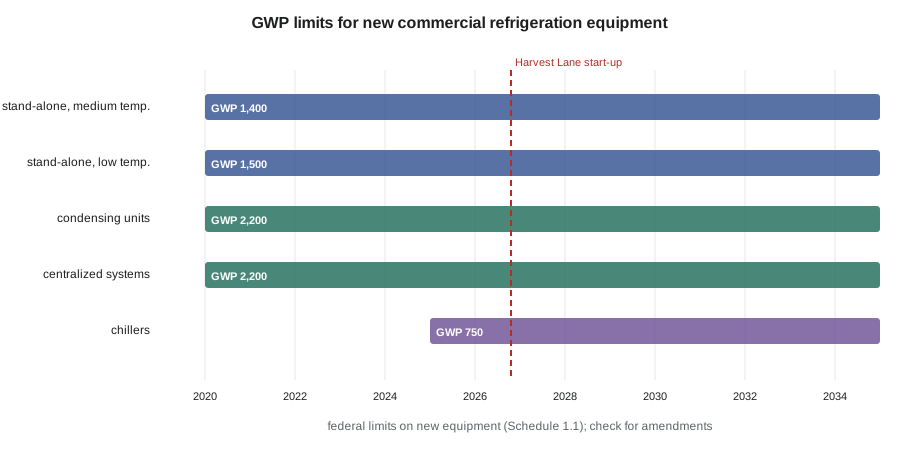
In Canada, the federal Ozone-depleting Substances and Halocarbon Alternatives Regulations set maximum GWP limits for HFCs in new equipment manufactured or imported, by type of system. For commercial refrigeration, Schedule 1.1 of the regulations sets limits from January 1, 2020 of 1,400 for stand-alone medium-temperature systems, 1,500 for stand-alone low-temperature systems, and 2,200 for condensing units and centralized refrigeration systems, with a limit of 750 for chillers from January 1, 2025. R-404A and R-507A therefore cannot be used in new centralized systems or condensing units, while R-448A and R-449A can. Canada's HFC phasedown, described in RAC-120, also limits the HFCs available for servicing over time, and Environment and Climate Change Canada has consulted on further changes. Provincial rules, such as Ontario's O. Reg. 463/10, add requirements for leak testing, records and certification.
Regulations change. These rules have been amended more than once in the last few years, and they will be again. Before quoting a new installation, a major remodel or a refrigerant retrofit, check the current text of the regulations or the equipment manufacturer's compliance guidance.
What this means for service
A commercial technician will work on all of these refrigerants for years to come: legacy R-404A systems still being serviced with recovered and reclaimed refrigerant, R-448A and R-449A racks and condensing units, A2L blends in new condensing units, propane in self-contained equipment and CO2 in new stores. Each needs the right training, tools and recovery equipment. Mixing refrigerants in a system or a recovery cylinder makes them impossible to reclaim, so every system must be labelled and every cylinder dedicated, as RAC-120 described. When in doubt about what is in a system, check the label, the controller's settings and the service records, and if they disagree, test the refrigerant before adding anything.
Replacing a failed condensing unit
Most commercial technicians meet the refrigerant rules first not on a new store but on a failed condensing unit. A few weeks after the Harvest Lane start-up, the first restaurant's walk-in cooler condensing unit, a fifteen-year-old R-404A unit, lost its compressor. The owner wanted the cheapest repair. Dana priced two options. A replacement compressor kept the old system and its R-404A, serviced with reclaimed refrigerant, which the rules still allowed but which was getting more expensive and would only become harder to get. A new condensing unit could not simply be a new R-404A unit, because the rules on new equipment no longer allow that refrigerant in new condensing units; it would come on R-448A or, for some sizes, an A2L blend with a much lower GWP.
Choosing the new unit meant checking the existing evaporator and expansion valve for the new refrigerant, as for a retrofit; checking whether an A2L unit's installation needed anything an A1 unit did not, as RAC-220 described; flushing or replacing the line set if it held burnout contaminants; and labelling the system clearly. The owner chose a new R-448A unit, reusing the existing coil with a new thermostatic valve power element. The job took a day, and the walk-in was back at temperature before the dinner service.
Common mistakes
MistakeTopping off an R-404A system with R-448A.
InsteadNever mix refrigerants; a change of refrigerant is a planned retrofit with full recovery.
MistakeLeaving controllers set for the old refrigerant after a retrofit.
InsteadChange every controller, transducer and setting chart, and label the system.
MistakeIsolating liquid CO2 between closed valves.
InsteadNever trap liquid; CO2 pressure rises dangerously as it warms.
MistakeQuoting a new rack without checking current GWP rules.
InsteadCheck the regulations in force on the installation date.
MistakeCharging a blend as vapour.
InsteadCharge zeotropic blends as liquid, through a metering device or restrictor.
Summary and key terms
- Commercial refrigeration moved from R-22 to R-404A and now to lower-GWP blends, propane and CO2.
- R-448A and R-449A have about a third of R-404A's GWP and a temperature glide.
- Retrofits need full recovery, valve and controller changes, liquid charging and labelling.
- Transcritical CO2 booster systems have very high pressures, a gas cooler and a flash tank.
- GWP limits for new commercial equipment are tightening in both countries; check current rules.
- Every system must be labelled, and refrigerants never mixed.
- Retrofit
- Converting an existing system to a different refrigerant.
- Zeotropic blend
- A refrigerant blend that boils and condenses over a temperature range.
- Transcritical
- A cycle that rejects heat above the refrigerant's critical point.
- Gas cooler
- The high-side heat exchanger of a transcritical CO2 system.
- Flash tank
- A vessel that separates liquid from flash gas after the high-pressure valve in a CO2 system.
- Booster system
- A two-stage system in which low-temperature compressors discharge into the medium-temperature suction.
- CO2 equivalent
- A refrigerant quantity expressed as the mass of carbon dioxide with the same warming effect.
Practice problems
Work each problem on paper first, then reveal the answer to check.
Why must R-448A be charged as liquid?
Show answer
It is a zeotropic blend; vapour charging would change its composition.
Name three things to change in a retrofit from R-404A to R-448A besides the refrigerant.
Show answer
Expansion valve settings, controller refrigerant selections and the system label; also check discharge temperature.
What happens to a stopped CO2 system's pressure as it warms, and how is that handled?
Show answer
It rises well above normal; relief valves and often a standby condensing unit handle it.
A rack holds 270 kg (600 lb) of R-448A and leaks 15 % a year. Roughly how much CO2 equivalent does it emit each year?
Show answer
About 56 tonnes (57 metric tons).
Lesson quiz · 5 questions
Score 60% or more to complete this lesson.
Create a free account to save your progress, take quizzes and earn a certificate.