
RAC-310 · Lesson 2 of 12 · 19 min
Walk-in coolers and freezers: construction, loads and equipment selection
Harvest Lane's back room had space for three walk-ins: a produce and dairy cooler, a meat cooler beside the butcher's cutting room and a freezer. The old store's boxes were thirty years old, with water-logged panels, rotted floors and doors that had been rehung so often their hinges were held with oversized screws. Meera's budget allowed new boxes, and Nadia sent Theo the panel drawings and her load calculations to check before the order was placed. Dana's advice was blunt: "Every walk-in callback I have had in twenty years started on the drawing board or with the installers. Learn how the box is built and how the load is worked out, and you will know where to look when it does not hold temperature."
RAC-110 introduced refrigeration load with a rough estimate for the brewery's walk-in. This lesson does it properly: what a walk-in is made of, what each part of the load is, how the run time and safety factor turn a daily load into a required capacity, and how the evaporator and condensing unit are chosen to match it.
How walk-ins are built
Most walk-ins are built from prefabricated insulated panels. Each panel is a sandwich of two metal skins, usually galvanized or painted steel, aluminum or stainless steel, with a core of foamed-in-place polyurethane or, in some older and budget panels, expanded polystyrene. The panels lock together with cam-lock fasteners cast into the foam, so a box can be assembled, taken apart and moved. Typical cooler panels are 100 mm (4 in) thick; freezer panels are often 100 to 150 mm (4 to 6 in).
- Insulation: foamed polyurethane has a thermal resistance of roughly 4.3 m²·K/W per 100 mm (R-25 to R-28 for 4 in) when new. It ages as the blowing agent slowly diffuses out, and it loses much of its value if it gets wet.
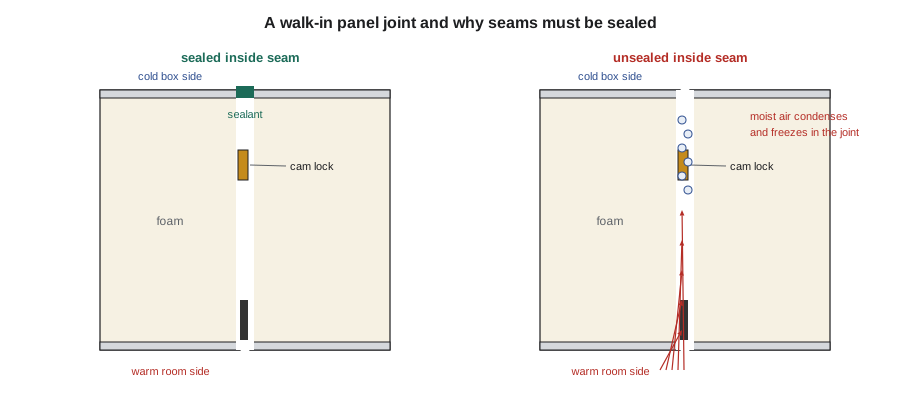
- Skins and seams: the joints between panels are sealed with gaskets and sealant. The inside seams must be continuous, because any gap lets warm, moist room air into the panel joint, where it condenses and freezes.
- Floors: coolers may sit on the building's concrete slab with a vapour barrier and, for heavy carts, a wear surface; freezers need an insulated floor, either floor panels or insulation under a concrete topping, and usually a means of keeping the ground below from freezing, which lesson 3 covers.
- Ceilings: panels span between the walls, and large boxes need hangers to the building structure. Nothing heavy should be mounted on a ceiling panel without the manufacturer's support details.
- Doors: hinged doors with heated frames on freezers, strip curtains or air curtains, self-closers and kick plates. Doors are where most walk-in problems start.
The vapour barrier and why boxes get wet
Water vapour moves from warm, humid air toward cold, dry air, because the warm air holds more water at a higher vapour pressure. Around a walk-in, the warm side is the room or the store and the cold side is the box. The metal skins are a near-perfect vapour barrier, but only if every seam, penetration and fastener hole is sealed, and the seal must be on the warm side. When a technician drills a hole through a panel for a refrigeration line, a drain or a probe cable, and does not seal it, moist air flows into the foam and condenses there. In a freezer it freezes, the ice grows, and over a few years the panel bulges, the skin delaminates and the insulation value collapses. A soft, bulging, frosty patch on the outside of a box, or ice on the inside near a penetration, is a sign of this damage.
The fix for a penetration is a sleeve or a sealed fitting, with the gap filled with expanding foam made for refrigeration panels and sealed on both sides with a sealant compatible with the panel skin. The warm-side seal matters most. Theo learned that the installers would be drilling dozens of holes for the new coils, drains and controller cables, and that checking every one was part of Northfield's job, not just the box installer's.
The four parts of the load
A walk-in's refrigeration load is the heat that has to be removed in a day to keep the box and its contents at temperature. Load calculation methods from ASHRAE and the equipment manufacturers break it into four main parts.
- Transmission: heat conducted through the walls, ceiling and floor, equal to U × A × ΔT for each surface. Surfaces exposed to a hot ceiling space, a sunny wall or a kitchen get the actual temperature on their warm side.
- Infiltration: heat carried in by warm air entering when the door opens, and through leaks. It includes the latent heat of the moisture the air carries, which ends up as frost on the coil. For busy walk-ins it is often the largest part of the load.
- Product: heat removed from product arriving warmer than the box, plus, for fresh produce, the heat of respiration, because fruit and vegetables are alive and release heat as they respire.
- Internal: heat from lights, people working in the box, forklifts or pallet jacks, and the evaporator fan motors themselves, which run all the time and put all their energy into the box.
Defrost adds a fifth part on freezers: the heat of the defrost heaters that ends up in the box rather than in the melted frost. Most manufacturers' methods add it as an allowance, which lesson 3 discusses.
In the infiltration equation, V is the box volume, n is the number of air changes per day, ρ is the air density and Δh is the difference in enthalpy between the entering air and the box air. Load tables give typical air-change rates by box volume and use; small, busy boxes have many more changes per day than large, quiet ones, and a box used as a pass-through can have several times the table value.
Run time and the safety factor
A walk-in's equipment is not sized to run all day. A cooler's evaporator must have time off for the coil to defrost, which on a medium-temperature box often happens during the off cycle with no heaters, as RAC-230 described. The daily load is therefore divided by a design run time, commonly about 16 hours a day for coolers with off-cycle defrost and 18 to 20 hours for freezers with electric or hot-gas defrost. A safety factor, often 10 %, covers the uncertainty in the inputs. Larger factors are tempting but lead to oversized equipment that short cycles, removes less moisture and costs more to buy and run.
The script below works through Nadia's produce and dairy cooler: 6.0 × 4.0 × 3.0 m (20 × 13 × 10 ft) inside, 100 mm (4 in) panels, an insulated slab, a busy door into the receiving area and about 1,500 kg (3,300 lb) of dairy and produce arriving each day a few degrees warmer than the box.
# Walk-in cooler load estimate (simplified ASHRAE-style method; illustrative values)
L, W, H = 6.0, 4.0, 3.0          # inside dimensions, m
U_PANEL = 0.23                   # W/m2K, 100 mm foamed panels
U_FLOOR = 0.50                   # W/m2K, insulated slab
T_BOX, T_ROOM, T_PLENUM, T_GROUND = 2.0, 21.0, 27.0, 12.0
walls = 2 * (L + W) * H
ceiling = floor = L * W
trans_w = U_PANEL * walls * (T_ROOM - T_BOX) + U_PANEL * ceiling * (T_PLENUM - T_BOX) + U_FLOOR * floor * (T_GROUND - T_BOX)
volume = L * W * H
changes = 18                     # air changes per day, heavy use
dh = 30.0                        # kJ/kg, store air minus box air enthalpy
infil_kj = volume * changes * 1.2 * dh
product_kj = 1500 * 3.8 * (7.0 - 2.0)     # 1,500 kg/day arriving at 7 C
resp_kj = 600 * 0.05 * 86400 / 1000       # produce respiration, W/kg
lights_kj = 150 * 10 * 3.6                # 150 W for 10 h
people_kj = 2 * 270 * 3 * 3.6             # 2 people, 3 h each
fans_kj = 2 * 150 * 24 * 3.6              # evaporator fans run all day
parts = {'transmission': trans_w * 86.4, 'infiltration': infil_kj, 'product': product_kj + resp_kj,
         'lights and people': lights_kj + people_kj, 'evaporator fans': fans_kj}
total = sum(parts.values())
for k, v in parts.items():
    print(f"{k:18s} {v / 3600:6.1f} kWh/day  {100 * v / total:4.0f} %")
design = total * 1.10
print(f"total with 10 % safety factor: {design / 3600:.1f} kWh/day")
for hours in (16, 18, 20):
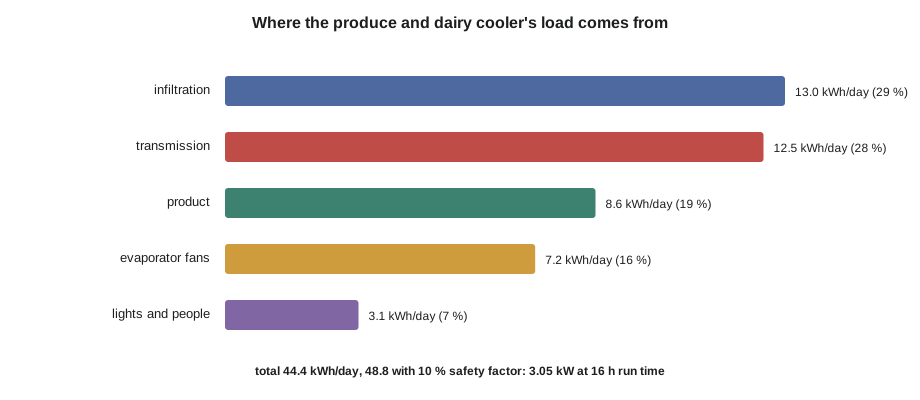
print(f"required capacity at {hours} h run time: {design / 3600 / hours:.2f} kW")transmission 12.5 kWh/day 28 % infiltration 13.0 kWh/day 29 % product 8.6 kWh/day 19 % lights and people 3.1 kWh/day 7 % evaporator fans 7.2 kWh/day 16 % total with 10 % safety factor: 48.8 kWh/day required capacity at 16 h run time: 3.05 kW required capacity at 18 h run time: 2.71 kW required capacity at 20 h run time: 2.44 kW
Transmission and infiltration are roughly equal and together make up more than half the load. The evaporator fans, which many quick estimates forget, are about a sixth of it. At 16 hours of run time the box needs about 3.05 kW (10,300 Btu/h), so Nadia's selection of a coil rated about 3.2 kW at a 6 K TD (11,000 Btu/h at a 10 °F TD) was sound. Theo also noted what the calculation implies for service: anything that increases infiltration, such as a door that does not close or a torn strip curtain, adds directly to the largest part of the load.
Choosing the evaporator
Evaporator coils for walk-ins are rated at a given TD between the entering air and the saturated suction temperature, as RAC-210 described. The design TD is chosen for the product's humidity needs, and the coil is selected to deliver the required capacity at that TD. A coil with too little capacity forces the system to run at a lower suction temperature, increasing the TD, drying the product and frosting the coil faster. A coil with too much capacity can short cycle and remove too little moisture, leaving a clammy box.
- Air throw: the coil must move air across the whole box. Long boxes need a coil whose throw reaches the far wall, or two coils.
- Placement: mount the coil away from the door, so it does not draw warm air straight in, and with clearance behind it for return air and service. Never place it directly over the door.
- Fin spacing: freezers and coolers with heavy frost loads use wider fin spacing so frost does not block the coil between defrosts.
- Drains: coolers need a trapped, sloped drain outside the box; freezers need a heated drain line inside the box, as lesson 3 explains.
Product loading also affects airflow. Product stacked up to the ceiling or pressed against the coil blocks the air path, so parts of the box get warm while the probe in the return air reads fine. Many walk-in calls are solved by moving boxes of product away from the coil.
Choosing the condensing side
On a self-contained or remote condensing unit walk-in, the condensing unit is selected to match the evaporator at the design suction temperature and the condensing temperature expected at the highest outdoor or room temperature. A unit chosen at a mild condition will fall short on the hottest days. On a rack system such as Harvest Lane's, the walk-in coil is one circuit among many, and the rack's compressors are sized for the total of all the circuits, allowing for the fact that they will not all need full capacity at once. Lesson 7 covers rack sizing.
Energy codes and efficiency standards apply to walk-ins in both countries. Canada's federal energy efficiency regulations set requirements for some refrigeration products, and provinces may add their own. For a technician, this means that replacing a walk-in's fan motors, door heaters or controls should keep the box at least as efficient as the standard it was built to, so like-for-like replacement with an inefficient part is not always acceptable.
Installation details that cause callbacks
Dana's list of installation faults that come back as service calls was long. The box must be level, or doors will not close and seal. Door closers and hinges must be adjusted after the box settles. The refrigeration lines and drain must not pass through the box in a way that leaves an unsealed hole. The condensate drain must be sloped and trapped and must not freeze. Lights inside the box must be rated for wet, cold locations. Probes must be in the return air, away from the door, as RAC-230 showed. The coil's fans must not blow across the door opening. And the box must not be placed beside a heat source such as a fryer exhaust or a sunny exterior wall without the load calculation allowing for it.
Commissioning a new walk-in includes a pull-down test from room temperature with the box empty, recording how long it takes to reach setpoint, the suction and discharge pressures and the superheat and subcooling. A box that will not pull down when empty will never hold temperature when full. Lesson 12 uses the pull-down logs from Harvest Lane's start-up.
Common mistakes
MistakeLeaving refrigeration line and cable penetrations unsealed.
InsteadSleeve, foam and seal every penetration, especially on the warm side.
MistakeForgetting evaporator fan heat and product respiration in a load estimate.
InsteadInclude every internal and product load; fans run all day.
MistakeSizing a cooler for 24 hours of run time.
InsteadUse a design run time that leaves time for defrost, about 16 hours for off-cycle coolers.
MistakeAdding large safety factors 'to be safe'.
InsteadUse a modest factor; oversizing causes short cycling and poor humidity control.
MistakeMounting the coil over the door.
InsteadMount it away from the door with clearance for return air and service.
Summary and key terms
- Walk-ins are built from foamed panels whose metal skins are the vapour barrier only if every seam and hole is sealed.
- Moisture that enters a panel condenses and freezes, destroying the insulation over time.
- The load has transmission, infiltration, product and internal parts, plus defrost on freezers.
- Required capacity is the daily load times a safety factor divided by the design run time.
- The evaporator is selected for capacity at a TD suited to the product, with good throw and placement.
- Most walk-in callbacks start with the box, the door, the penetrations or the product loading.
- Insulated panel
- A prefabricated wall, ceiling or floor section with metal skins and a foam core.
- Cam lock
- A fastener cast into a panel that locks it to the next panel.
- Vapour barrier
- A layer that stops water vapour moving into insulation.
- Transmission load
- Heat conducted into a box through its walls, ceiling and floor.
- Infiltration load
- Heat carried into a box by warm air entering through doors and leaks.
- Respiration heat
- Heat released by fresh fruit and vegetables as they respire.
- Run time
- The hours per day the equipment is expected to run at design load.
- Pull-down test
- A test recording how a new box cools from room temperature to setpoint.
Practice problems
Work each problem on paper first, then reveal the answer to check.
Which part of the load is usually largest in a small, busy walk-in?
Show answer
Infiltration through the door.
Why are walk-in coolers sized for about 16 hours of run time rather than 24?
Show answer
To leave off time for the coil to defrost and a margin for peak loads.
A frosty, bulging patch appears on the outside of a freezer panel near a line penetration. What has happened?
Show answer
Moist air entered through an unsealed hole and froze inside the panel.
Boxes of product are stacked against the coil and the back of the box is warm. What is the first fix?
Show answer
Clear the coil and restore the air path.
Lesson quiz · 5 questions
Score 60% or more to complete this lesson.
Create a free account to save your progress, take quizzes and earn a certificate.