
RAC-310 · Lesson 12 of 12 · 17 min
Start-up, turnover and first service calls: the Harvest Lane capstone
Harvest Lane's grand opening was on a Thursday in late October. The refrigeration had been running for ten days by then, the cases had been loaded with water jugs and then with product, and Meera had walked the store with Dana, Raj and Theo the evening before, reading every case display. Theo's last job before opening was to hand Meera a binder and a link to the same documents online: the as-built drawings, the settings of every controller, the charge records, the start-up readings, the alarm call list and the maintenance schedule. Then, over the next six weeks, came the calls that every new store produces. This lesson follows the start-up and three of those calls, drawing on the whole course.
The start-up sequence
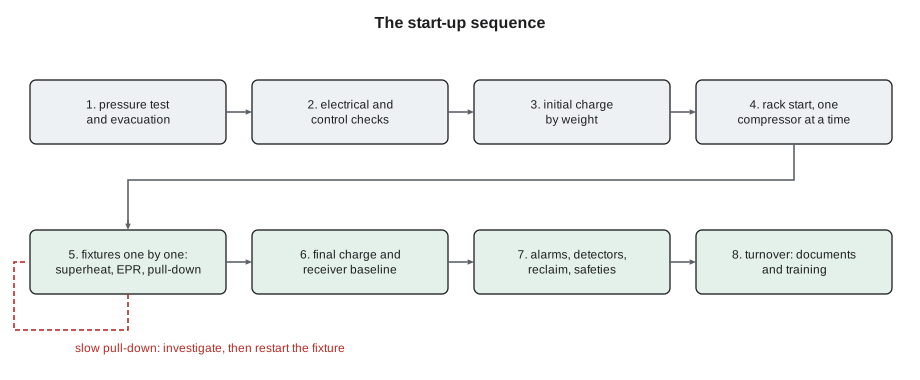
Starting a store's refrigeration is a planned sequence, done in an order that protects the equipment and leaves a record of every step. Nadia's start-up plan, which Northfield followed, had these stages.
- Pressure test and evacuation: every section tested with dry nitrogen to the design test pressure, held and recorded with temperature correction; then evacuated to the vacuum level the manufacturers specify, with a decay test, as RAC-220 described.
- Electrical and control checks before power: wiring, overload settings, phase rotation for three-phase compressors, as RAC-130 and RAC-210 showed, and every controller's network address.
- Initial charge: liquid R-448A weighed into the receivers of both racks, enough for the first circuits, with the rest added as circuits came on.
- Rack start: crankcase heaters on for the time the compressor manufacturer specifies before the first start; compressors started one at a time, checking oil levels, rotation, amps and noise.
- Circuit by circuit: each fixture started in turn, its EEV or TXV superheat checked, its EPR set where it had one, and its pull-down recorded.
- Final charge: by receiver level and subcooling at the conditions of the day, with a note of the receiver level and outdoor temperature as the baseline for leak trending.
- Controls and safety: alarm limits, delays and call-outs tested end to end, as RAC-230 described; refrigerant detectors bump tested and their ventilation interlocks proved; heat reclaim run with the air handler contractor; relief valves and safety controls checked.
- Turnover: documents, training for the store's managers and the alarm response plan.
Reading the pull-down log
Every fixture's pull-down was logged by its controller: the time from start to setpoint. Manufacturers give an expected maximum for an empty fixture under normal store conditions. A fixture that takes much longer than expected has a problem that will only get worse when it is full of product and the store is busy. The script below checks the start-up log for the medium- and low-temperature fixtures.
# Harvest Lane start-up: checking each fixture's pull-down against the manufacturer's expected time
# (start temperature C, setpoint C, hours to reach setpoint, expected maximum hours) from the start-up log
log = {
    'produce multideck 1-4': (20.5, 3.0, 3.5, 6),
    'dairy doors 5-10':      (20.0, 2.0, 2.5, 6),
    'meat service case':     (19.5, 0.0, 9.0, 6),
    'deli service case':     (20.0, 1.0, 4.0, 6),
    'dairy walk-in':         (19.0, 2.0, 5.0, 8),
    'meat walk-in':          (19.0, 0.0, 6.5, 8),
    'frozen food doors':     (20.0, -21.0, 7.0, 12),
    'walk-in freezer':       (19.5, -23.0, 10.5, 16),
}
for name, (start, setp, hours, limit) in log.items():
    rate = (start - setp) / hours                 # average K per hour
    status = 'ok' if hours <= limit else 'SLOW: investigate before loading product'
print(f"{name:22s} {start:5.1f} -> {setp:5.1f} C in {hours:4.1f} h ({rate:4.1f} K/h, limit {limit:2d} h) {status}")produce multideck 1-4 20.5 -> 3.0 C in 3.5 h ( 5.0 K/h, limit 6 h) ok dairy doors 5-10 20.0 -> 2.0 C in 2.5 h ( 7.2 K/h, limit 6 h) ok meat service case 19.5 -> 0.0 C in 9.0 h ( 2.2 K/h, limit 6 h) SLOW: investigate before loading product deli service case 20.0 -> 1.0 C in 4.0 h ( 4.8 K/h, limit 6 h) ok dairy walk-in 19.0 -> 2.0 C in 5.0 h ( 3.4 K/h, limit 8 h) ok meat walk-in 19.0 -> 0.0 C in 6.5 h ( 2.9 K/h, limit 8 h) ok frozen food doors 20.0 -> -21.0 C in 7.0 h ( 5.9 K/h, limit 12 h) ok walk-in freezer 19.5 -> -23.0 C in 10.5 h ( 4.0 K/h, limit 16 h) ok
Every fixture passed except the meat service case, which took nine hours to come close to its setpoint and then would not hold it. That was the case lesson 8 described, with its EPR still set for produce. The pull-down log was how it was found, a week before opening, without a single kilogram of meat at risk. Theo kept the log in the turnover binder; the pull-down rates are a baseline that later comparisons can use, for example after a coil replacement.
Turnover and training
A store's staff will live with the refrigeration long after the contractor leaves. Turnover gives them what they need. Meera's binder included each fixture's name and circuit, its setpoint and alarm limits, how to read its display, what normal looks like, the daily checks from lesson 11, what to do when an alarm sounds, and who to call. The alarm call list gave the store's own contacts and Northfield's on-call number, with the order to try them in. Theo walked the department managers through their own fixtures and showed them the load lines, the return grilles, the night covers and the door closers. Dana went through the rack controller's alarm screens with Meera and her assistant manager. The last page of the binder was a list of what would be checked at the thirty-day visit.
Call 1: the produce case that was warm only on Saturdays
Three weeks after opening, the alarm log showed produce multideck 3 crossing its high limit on two Saturday afternoons, recovering by evening each time. The case was fine on Theo's weekday visit. He asked the produce manager what was different on Saturdays. The answer was a weekend promotion: staff stacked crates of squash and pumpkins on the case's bottom deck and in front of it, and set up a sampling table beside it. Theo visited on the next Saturday. The crates were stacked above the load line, and the sampling table's tablecloth hung over the case's return grille. The discharge air at the honeycomb was at its specified temperature; the product at the front of the shelves was not. He moved the crates back inside the load line with the manager's help, pinned up the tablecloth and showed the tissue test on the air curtain before and after. The case recovered within an hour, and the manager moved the sampling table to the end of the aisle. No refrigeration work was needed, but the report said exactly what had been found and why, as lesson 5 taught.
Call 2: the low-temperature compressor that kept losing its oil
In week five, the low-temperature rack's compressor 2 started tripping on its electronic oil level control, a few times a week. The controller locked it out after the third trip in a day, and the other two compressors carried the load, so no fixture warmed. Theo and Raj found the oil reservoir level normal and the other two compressors' crankcase levels normal. Compressor 2's level was low each time it tripped, recovered slowly after a reset, and fell again. The oil was reaching the reservoir, so the fault was between the reservoir and compressor 2. They locked out compressor 2, isolated its oil feed and opened the inlet strainer of its oil level control: it was packed with fine black scale, brazing oxide from the installation that had travelled with the oil. The other two controls' strainers, checked while the system was open, had smaller amounts.
The repair was more than a cleaned strainer. Oxide in the oil meant oxide in the system, from brazing done without enough nitrogen flowing, as RAC-210 warned against. Raj cleaned all three strainers, changed the rack's oil filter and suction filter cores, took an oil sample for analysis and scheduled a second filter change at the thirty-day visit. Theo traced the installation records to find which crew had brazed the low-temperature suction header and passed the finding to Northfield's installation supervisor, with photographs. The compressor ran without trips from then on, and the oil analysis came back clean at the second change.
Call 3: the ice cream island on a hot afternoon
In week six, on an unseasonably warm day, the self-contained R-290 ice cream island alarmed warm at −18 °C (0 °F). Its controller showed the compressor cycling on its high-pressure safety. Theo found the island's condenser air grille, low on one end, half covered by a decorative merchandising skirt the store had added for a holiday display, and a stack of flattened boxes against the other end. The unit was recirculating its own hot discharge air. He removed the boxes, folded back the skirt and, after the compressor had cooled and the safety had reset, watched it run normally. Because this was a propane unit, he did not connect gauges: nothing pointed to a refrigerant fault, and opening the circuit would have added risk for no benefit, as lesson 4 explained. He recorded the inlet air temperature at the grille before and after, and asked the store's merchandising staff to keep the grilles clear. The island was back at −26 °C (−15 °F) within two hours. Product had stayed below −15 °C (5 °F), which Theo recorded so the store could make its own decision about it.
The first-year picture
At the thirty-day visit, Theo compared the store's numbers with the design. The racks' energy use, from the controller's power monitoring, was a little below Nadia's estimate, helped by the doors on the dairy line and floating head pressure. The medium-temperature rack's receiver baseline, corrected for weather, was steady after the case-base leak repair in lesson 10. Every alarm in the first month had been investigated and recorded, and none had been ignored. The maintenance schedule was running. Meera's only complaint was that she had expected more problems. Dana's reply was the lesson of the whole course: "Most of the problems in a store are decided before it opens, by the design, the installation and the start-up. The rest are found early by people who read the data and talk to the staff."
| Course topic | Where it appeared at Harvest Lane |
|---|---|
| Temperature classes and food safety | Fixture schedule, alarm limits, product temperature records |
| Walk-in construction and loads | Coil selection, penetrations, pull-down tests |
| Freezer details | Floor heater mat and sensor, relief port, drain heaters |
| Self-contained and propane equipment | Beverage coolers, ice cream island, call 3 |
| Display cases | Doors on dairy, open produce, call 1 |
| Parallel racks and oil | Lead compressor sizing, call 2 |
| Rack controls | EPR setting, floating head, heat reclaim |
| Refrigerants and rules | R-448A racks, R-290 self-contained, compliance dates |
| Leak management | Receiver trending, case-base leak, records |
| Service practices | Maintenance schedule, staff checks, reports |
The punch list
Every start-up produces a punch list: small items found during the start-up that must be finished before the job is complete. Harvest Lane's had twenty-three items, from a missing pipe label in the machine room to a door closer on the meat walk-in that needed adjustment, two case-base grommets and a refrigerant detector whose sampling tube had been kinked by the ceiling contractor. Each item had an owner, a date and a sign-off. Theo learned that a punch list is not a sign of a poor job; a job without one usually means nobody looked closely. What matters is that every item is closed and recorded, so the owner, the next technician and the inspector can see that the system was finished as designed.
Common mistakes
MistakeLoading product into a fixture that pulled down slowly.
InsteadInvestigate a slow pull-down before product goes in.
MistakeTreating an alarm that clears by itself as nothing.
InsteadFind out why it happened; patterns such as 'only on Saturdays' point to the cause.
MistakeCleaning a plugged oil strainer and stopping there.
InsteadFind where the debris came from and deal with it throughout the system.
MistakeConnecting gauges to a propane unit when the fault is airflow.
InsteadDiagnose from outside the circuit first; open it only when needed.
MistakeHanding over a store without training its staff.
InsteadTrain managers on normal operation, daily checks and alarms.
Summary and key terms
- A start-up follows a planned sequence from pressure test to turnover, with records at every step.
- Pull-down logs reveal fixture problems before product is at risk and give a baseline for later.
- Turnover includes documents, settings, an alarm plan and training for store staff.
- Many store calls are caused by merchandising and airflow, not refrigeration faults.
- Repeated safety trips have a cause that must be traced to its source.
- Most of a store's problems are decided by its design, installation and start-up.
- Start-up
- The planned sequence of tests and checks that brings a new system into service.
- Turnover
- Handing a completed system to its owner with documents and training.
- Pull-down log
- The record of how long each fixture takes to reach setpoint from start.
- Baseline
- A set of readings taken when a system is new, for later comparison.
- Oil analysis
- A laboratory test of compressor oil for contaminants, acid and wear metals.
- As-built drawings
- Drawings updated to show the system as it was actually installed.
Practice problems
Work each problem on paper first, then reveal the answer to check.
A walk-in freezer takes 22 hours to pull down against an expected 16. What should happen before product is loaded?
Show answer
Investigate the cause, such as charge, valve, defrost, airflow or the box itself.
Why is the receiver level at start-up recorded with the outdoor temperature?
Show answer
It is the baseline for later weather-corrected leak trending.
A case alarms warm only during weekend promotions. Where should the investigation start?
Show answer
With what the staff do differently: merchandising, load lines and the air curtain.
Black scale is found in an oil level control strainer on a new rack. What does it indicate?
Show answer
Brazing oxide from installation; filters should be changed and the source traced.
Lesson quiz · 5 questions
Score 60% or more to complete this lesson.
Create a free account to save your progress, take quizzes and earn a certificate.