
RAC-120 · Lesson 4 of 12 · 20 min
Refrigerant cylinders: types, filling, storage and transport
Northfield's shop has a cylinder cage at the back, chained and labelled, with three separate sections: new refrigerant, recovery cylinders waiting to go to the reclaimer, and empty cylinders. Every Friday afternoon, one technician does the cylinder check: weighing every recovery cylinder, checking test dates, reading every label and moving full cylinders to the shipping pallet. This week it was Theo's turn, and Dana went through it with him. "More technicians are hurt by cylinders than by anything else in refrigeration," she said. "Dropped cylinders, overfilled cylinders, cylinders in a hot van. A cylinder is a pressure vessel. Treat it like one."
This lesson covers the containers refrigerant lives in when it is not in a system: disposable cylinders, refillable cylinders and recovery cylinders. It explains how they are built and marked, how full they may be filled and why, how to inspect, store and secure them, and the basic rules for carrying them in a service vehicle.
Types of cylinders
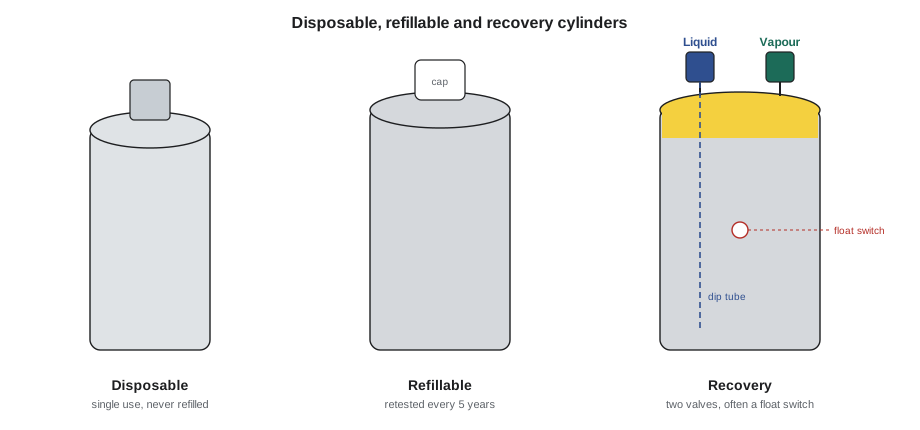
Disposable cylinders, also called non-refillable cylinders, are the familiar small steel cylinders that new refrigerant has often been sold in. They are built to a transport specification for single use, such as TC-39M in Canada or DOT-39 in the United States, and may never be refilled: they are thin-walled, have no provision for retesting, and refilling them is prohibited. Their valves include a pressure relief device and, on newer cylinders, a check device that resists refilling. Ontario's rules require that containers filled with refrigerant by technicians be refillable and recyclable, and several provinces discourage or restrict disposable cylinders, so many suppliers now sell refrigerant in returnable cylinders.
Refillable cylinders are heavier cylinders built to specifications such as TC-4BAM or TC-4BWM, which allow them to be refilled and periodically retested. Suppliers use them for bulk refrigerant and return them for refilling, usually with a deposit. Ontario's rules require a deposit of at least $25 on refillable refrigerant containers, refunded when the container comes back.
Recovery cylinders are refillable cylinders built for recovered refrigerant. They have two valves, one connected to a dip tube that reaches the bottom of the cylinder for liquid, and one at the top for vapour. Many also have a port for a float switch, a level sensor that connects to the recovery machine and shuts it off when the cylinder reaches its safe fill level. Recovery cylinders have traditionally been grey with a yellow top or shoulder, and many cylinders for flammable refrigerants carry a red band. A recovery cylinder must be rated for the pressure of the refrigerant it will hold: high-pressure refrigerants such as R-410A and R-32 need cylinders with a service pressure of at least 2,760 kPa (at least 400 psig).
Large quantities move in ton cylinders and cylinders of several hundred kilograms on supermarket and industrial jobs, and bulk refrigerant ships in tank trucks and rail cars. Those are handled with lifting equipment and procedures of their own.
Reading the stamped markings
The markings stamped into a refillable or recovery cylinder's shoulder or collar identify the cylinder and its status. They normally include:
- the specification, for example TC-4BAM followed by the service pressure, or a DOT specification on older cylinders allowed in Canada;
- the serial number and the manufacturer's mark;
- the date of manufacture, as month and year;
- the water capacity, WC, the mass of water the cylinder holds when completely full, and the tare weight, TW, the empty weight of the cylinder with its valve;
- the date and the mark of each retest, added by the facility that performs it.
Refillable refrigerant cylinders must be requalified, normally by a hydrostatic pressure test or another approved method, at the interval set for their specification, which for common refrigerant cylinders is every five years. Transport Canada regulates these containers, and retesting is done at a facility registered with Transport Canada. A cylinder whose retest date has passed must not be refilled until it has been retested; it may be emptied and shipped for testing.
How full is full? The fill limit
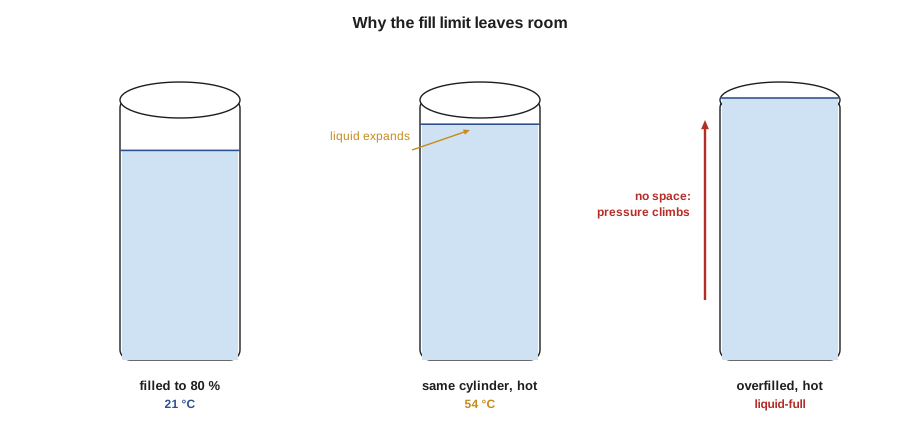
Lesson 3 explained hydrostatic pressure: a cylinder that becomes completely full of liquid can rupture from a small temperature rise because liquid refrigerant expands as it warms. To prevent this, a cylinder is never filled to more than a set fraction of its volume, leaving a vapour space that can absorb the expansion. The widely used rule for recovery cylinders is that they must not be filled to more than 80 per cent of their volume with liquid.
Because cylinders are filled by weight on a scale, the 80 per cent volume limit has to be turned into a mass. The water capacity stamped on the cylinder gives its volume: a cylinder with a WC of 21.6 kg (47.7 lb) holds that mass of water, so its volume is about 21.6 L (5.7 US gallons). The mass of refrigerant that fills 80 per cent of the volume depends on the density of the liquid refrigerant, which is usually expressed as its specific gravity, the ratio of its density to that of water.
The catch is that liquid refrigerant gets less dense as it warms. A cylinder filled to 80 per cent at room temperature will be fuller on a hot day, and for refrigerants whose density falls steeply with temperature, such as R-410A and R-404A, a cylinder filled using room-temperature density can come close to liquid-full at the temperatures a closed van reaches in summer. Many companies therefore use the conservative field rule of filling to no more than 80 per cent of the water capacity by weight, which is the same as assuming a specific gravity of 1. Northfield's policy is that rule, combined with a float switch on every recovery cylinder that has a port for one.
# Maximum fill of a recovery cylinder and how full it becomes when hot
# Approximate liquid specific gravities (density relative to water) for teaching
sg_21c = {"R-22": 1.21, "R-134a": 1.22, "R-410A": 1.08, "R-404A": 1.06, "R-448A": 1.12}
sg_54c = {"R-22": 1.07, "R-134a": 1.09, "R-410A": 0.91, "R-404A": 0.90, "R-448A": 0.98}
wc_kg = 21.6        # water capacity stamped on the cylinder, kg
tare_kg = 12.0      # tare weight stamped on the cylinder, kg

for ref in sg_21c:
    m_density = 0.8 * wc_kg * sg_21c[ref]       # 80 % by volume using room-temperature density
    m_field = 0.8 * wc_kg                       # conservative field rule
    full_hot_density = m_density / (wc_kg * sg_54c[ref]) * 100
    full_hot_field = m_field / (wc_kg * sg_54c[ref]) * 100
    print(f"{ref:7s} density rule {m_density:5.1f} kg -> {full_hot_density:4.0f} % full at 54 C;"
          f" field rule {m_field:5.1f} kg -> {full_hot_field:4.0f} % full at 54 C")
print(f"Gross weight at the field-rule limit: {tare_kg + 0.8 * wc_kg:.1f} kg on the scale")R-22 density rule 20.9 kg -> 90 % full at 54 C; field rule 17.3 kg -> 75 % full at 54 C R-134a density rule 21.1 kg -> 90 % full at 54 C; field rule 17.3 kg -> 73 % full at 54 C R-410A density rule 18.7 kg -> 95 % full at 54 C; field rule 17.3 kg -> 88 % full at 54 C R-404A density rule 18.3 kg -> 94 % full at 54 C; field rule 17.3 kg -> 89 % full at 54 C R-448A density rule 19.4 kg -> 91 % full at 54 C; field rule 17.3 kg -> 82 % full at 54 C Gross weight at the field-rule limit: 29.3 kg on the scale
The output shows why the conservative rule exists. Filled using room-temperature density, a cylinder of R-410A or R-404A would be about 95 per cent full at 54 °C (130 °F), a temperature a van parked in the sun can reach, with little margin left. Filled by the field rule, every refrigerant in the table stays at or below about 90 per cent full when hot.
Worked problem
Setting up the scale for a recovery job
Theo is recovering R-410A into a recovery cylinder stamped WC 21.6 kg, TW 12.0 kg (WC 47.7 lb, TW 26.5 lb). The cylinder already holds some R-410A from an earlier job, and it weighs 17.4 kg (38.4 lb) on the scale. How much more can he put in using Northfield's field rule?
Show solution
- \[m_{\max} = 0.8 \times 21.6 = 17.3\ \text{kg of refrigerant}\]
- \[\text{gross limit} = 12.0 + 17.3 = 29.3\ \text{kg}\]
- \[\text{room left} = 29.3 - 17.4 = 11.9\ \text{kg}\]
Answer: He sets the scale alarm to the gross limit, connects the float switch, and stops recovering into this cylinder when either one trips. If the system holds more than the room left, he brings a second cylinder.
Always weigh: the cylinder's appearance tells you nothing about how full it is, and a gauge on a cylinder shows only the saturation pressure, which is the same whether the cylinder is almost empty or almost full as long as some liquid is present. Write the tare weight and the fill limit on the cylinder tag, and update the contents weight on the tag every time refrigerant goes in or out.
Inspecting a cylinder
Before filling or using any cylinder, inspect it. Reject a cylinder, mark it and set it aside if you find:
- dents, gouges, cuts or bulges in the wall, or any sign of fire or heat damage, such as burnt paint;
- heavy rust or pitting, especially around the foot ring and the bottom, where water collects;
- a damaged, bent or leaking valve, a missing valve guard or cap, or damaged threads;
- missing, worn or unreadable stamped markings, or a retest date that has passed;
- a label that is missing or does not match the refrigerant you intend to put in.
A recovery cylinder that has never been used, or that has been emptied and opened, should be evacuated before use so that air and moisture are not mixed with the recovered refrigerant. Northfield evacuates every empty recovery cylinder in the shop to a deep vacuum, labels it with the refrigerant it is dedicated to, and keeps it closed until it goes on the van.
Storage
Store cylinders in a cool, dry, well-ventilated place, away from heat sources, direct sun, exits and electrical panels. Keep them upright and secured, with chains, straps or racks, so they cannot fall. Keep valve caps or guards in place when the cylinder is not connected. Most refrigerant SDSs say cylinders should not be stored where they can exceed about 52 °C (125 °F). Keep full, empty and recovery cylinders separate and clearly marked, and keep flammable refrigerant cylinders away from ignition sources and in the quantities the fire code allows.
Never store cylinders in living spaces, below grade where leaking vapour could collect, or in a closed vehicle on a hot day. Never use a cylinder as a roller, a support or a hammer, and never alter or repair a cylinder or its valve and relief device.
Carrying cylinders in a service vehicle
Refrigerant cylinders are dangerous goods under the federal Transportation of Dangerous Goods (TDG) Regulations: most refrigerants are in class 2.2, non-flammable, non-toxic gases, while A2L and A3 refrigerants are in class 2.1, flammable gases. The regulations include exemptions for carrying limited quantities of gases in cylinders, such as for a service technician's own work, provided conditions are met: the cylinders must be built and marked to an approved standard, protected against damage to the valve, and secured so they cannot move. Larger quantities and shipments to a reclaimer require full compliance, including safety marks, documentation and a trained person. Northfield's office handles shipments, and every technician holds TDG training for the cylinders they carry.
Inside the van, cylinders ride upright in a rack or strapped to a bulkhead, never loose on the floor and never in the cab with the driver. The cargo area should be ventilated, and the van should not be left in the sun with cylinders inside any longer than necessary. Recovery cylinders are tagged with their contents before they leave the job site.
| Do | Do not |
|---|---|
| Weigh every cylinder and record the contents | Judge fullness by looks or by a gauge |
| Fill recovery cylinders to no more than 80 per cent of water capacity | Fill until the machine stops on its own |
| Use a float switch and a scale alarm | Bypass a float switch to finish a job |
| Check the retest date before filling | Fill a cylinder with an expired test date |
| Keep cylinders upright and secured | Lay cylinders loose in the van |
| Keep cylinders cool and shaded | Heat a cylinder with a torch or leave it in a hot van |
| Dedicate each recovery cylinder to one refrigerant | Mix refrigerants in one cylinder |
Common mistakes
MistakeRefilling a disposable cylinder.
InsteadDisposable cylinders are single-use; refilling them is prohibited and dangerous.
MistakeUsing a cylinder gauge to tell how full the cylinder is.
InsteadPressure shows only temperature while liquid is present; weigh the cylinder.
MistakeRecovering R-410A into a low-pressure-rated cylinder.
InsteadUse a cylinder with a service pressure rating suitable for the refrigerant.
MistakeFilling to the density limit and then leaving the cylinder in a hot van.
InsteadUse the conservative fill rule and keep cylinders cool.
Summary and key terms
- Disposable cylinders are single use; refillable and recovery cylinders are built for refilling and periodic retesting, usually every five years.
- Stamped markings show the specification, service pressure, serial number, water capacity, tare weight and retest dates.
- Recovery cylinders have liquid and vapour valves, often a float switch port, and must be rated for the refrigerant's pressure.
- Never fill beyond 80 per cent of volume; the conservative field rule is 80 per cent of the water capacity by weight.
- Liquid expands when warmed, so overfilled cylinders can become liquid-full and rupture.
- Inspect, store upright and secured, keep cool, and carry cylinders under the dangerous goods rules.
- Disposable cylinder
- A non-refillable cylinder for single use.
- Recovery cylinder
- A refillable cylinder with liquid and vapour valves for recovered refrigerant.
- Water capacity (WC)
- The mass of water a cylinder holds when completely full, stamped on the cylinder.
- Tare weight (TW)
- The weight of the empty cylinder with its valve.
- Specific gravity
- The density of a liquid relative to water.
- Float switch
- A level sensor that stops a recovery machine when the cylinder reaches its fill limit.
- Requalification
- The periodic retest, often hydrostatic, that allows a refillable cylinder to be refilled.
- Heel
- The refrigerant left in a cylinder that is considered empty in use.
Practice problems
Work each problem on paper first, then reveal the answer to check.
A recovery cylinder is stamped WC 21.6 kg, TW 12.0 kg (WC 47.7 lb, TW 26.5 lb). What is the gross weight limit under the field rule?
Show answer
12.0 + 0.8 × 21.6 = 29.3 kg.
Why can a gauge on a cylinder not show how full it is?
Show answer
While liquid is present the pressure is the saturation pressure, set by temperature alone.
Name three defects that mean a cylinder must be taken out of service.
Show answer
Any three of: dents, gouges, bulges, fire damage, heavy rust, damaged valve, unreadable markings, expired retest date.
Why should a new recovery cylinder be evacuated before use?
Show answer
To remove air and moisture that would contaminate the recovered refrigerant.
Lesson quiz · 5 questions
Score 60% or more to complete this lesson.
Create a free account to save your progress, take quizzes and earn a certificate.