
RAC-120 · Lesson 2 of 12 · 23 min
Identifying refrigerants: families, safety groups and labels
Theo's first recovery job of the module was a small one: a retired reach-in cooler at one of Northfield's restaurant customers. He had his recovery machine, an empty recovery cylinder and his gauges ready when Dana stopped him at the door of the van. "What's in it?" she asked. "R-404A, probably. Most of these were," he said. "Probably is not an answer," Dana said. "Find out. If you put an unknown refrigerant into a cylinder of R-404A, you have contaminated the whole cylinder, and the reclaimer will charge us to destroy it."
The nameplate on the cooler said R-404A, but a sticker beside it, added by some earlier technician, said the system had been converted to R-448A. Theo checked the standing pressure against the cooler's temperature, and it matched R-448A, not R-404A. He used a fresh cylinder labelled for R-448A. It was a small decision that saved a great deal of money and kept a cylinder of good refrigerant fit for reclaiming.
This lesson is about knowing what you are handling. It reviews the refrigerant families and safety groups from RAC-110 with a focus on handling, then shows how to identify a refrigerant from the equipment, from the cylinder and its label, from the safety data sheet and, when there is doubt, with measurements and instruments.
Families and what they mean for handling
Each refrigerant family brings its own handling concerns, and recognizing the family from the name is the first step.
| Family | Examples | Contains chlorine? | Main handling concern |
|---|---|---|---|
| CFC | R-11, R-12, R-502 | Yes | Ozone depleting; must be recovered; often old, possibly contaminated equipment |
| HCFC | R-22, R-123 | Yes | Ozone depleting; supply now from recovered and reclaimed stock only |
| HFC | R-134a, R-404A, R-407C, R-410A, R-32 | No | High GWP for most; phased down; leak repair and recovery rules |
| HFO and HFO blends | R-1234yf, R-1234ze(E), R-454B, R-448A | No | Low GWP; many are A2L, mildly flammable |
| Hydrocarbon | R-290, R-600a | No | Highly flammable (A3); small charges; ignition control |
| Natural inorganic | R-717 ammonia, R-744 carbon dioxide | No | Toxicity (ammonia) or very high pressure (carbon dioxide); special training |
Some modern blends cross families. R-448A and R-449A, for example, are mixtures of HFCs and HFOs, and R-454B is a mixture of R-32 and R-1234yf. The A1 or A2L classification of the blend as a whole, not of its components, decides how it is handled, and the blend is named and labelled as a single refrigerant.
Safety groups
ASHRAE Standard 34 and the matching international standard ISO 817 give every refrigerant a safety group. The letter is the toxicity class, A for lower toxicity and B for higher toxicity. The number is the flammability class: 1, no flame propagation in standard tests; 2L, lower flammability with a burning velocity of not more than 10 cm/s (3.9 in/s); 2, flammable; and 3, higher flammability. For handling, the practical messages are simple.
- A1 refrigerants, such as R-410A, R-134a, R-448A and carbon dioxide, will not burn under normal conditions, but they can displace oxygen, cause frostbite and decompose into toxic products in a flame. Lesson 3 covers these hazards.
- A2L refrigerants, such as R-32, R-454B and R-1234yf, are hard to ignite and burn slowly, but they can burn. Recovery machines, vacuum pumps, leak detectors and cylinders must be rated for them, ignition sources must be controlled, and the work area must be ventilated.
- A3 refrigerants, such as propane and isobutane, ignite easily. They are used in small factory-sealed charges, and recovering them requires equipment and procedures rated for flammable refrigerants; some may be vented under strict conditions where the rules allow, which Lesson 5 covers.
- B2L ammonia is toxic and corrosive and has its own codes, training and equipment, covered in RAC-420.
Reading the equipment
The first source of information is the equipment itself. Every factory-built system carries a nameplate that shows the refrigerant type and normally the factory charge, along with electrical data and test pressures. Field-assembled systems, such as split systems with line sets and supermarket racks, should carry a label or tag with the refrigerant and the total charge, which the installer adds after charging.
Look for evidence of a retrofit. When a system is converted to a different refrigerant, the technician who does the work should attach a label showing the new refrigerant, the new oil if it was changed, the charge, the date and the company. Retrofit labels are often applied beside the original nameplate rather than over it, as on Theo's cooler, so read everything on the unit. Service valve caps or access fittings sometimes give clues too: R-410A and R-32 systems normally use different service port sizes from R-22 systems in North America, and A2L equipment may carry red markings or flammability symbols.
When equipment and records disagree, or a system is old and its history is unknown, treat the refrigerant as unknown until it is confirmed. A system that has been topped up over the years with whatever was on the truck can contain a mixture of refrigerants that matches nothing on any label.
Reading a cylinder label
Refrigerant cylinders are identified by their labels, not their colour. For decades, North American cylinders were painted in colours assigned to each refrigerant, light green for R-22 and rose for R-410A, for example. As the number of refrigerants grew and colours became hard to tell apart, the industry guideline for container colours, AHRI Guideline N, was revised so that new cylinders share one light grey colour. The label is now the only reliable identification, and Theo was taught to read it every time, even on a cylinder he took from the van himself.
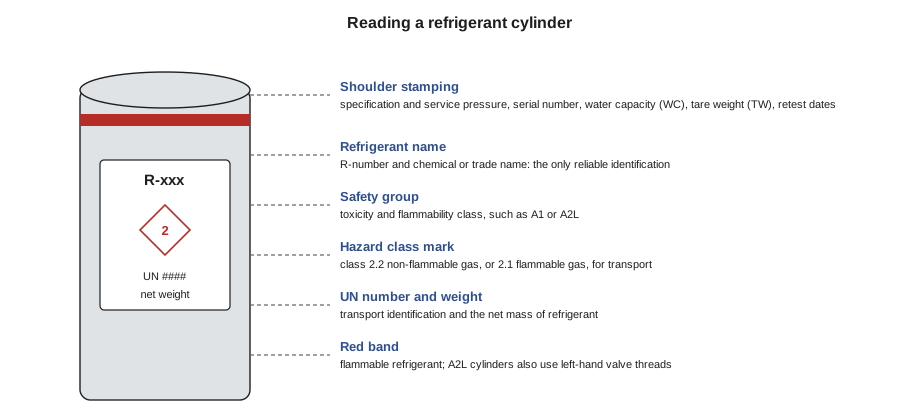
A cylinder label typically shows:
- the refrigerant's R-number and often its chemical or trade name;
- the safety group, such as A1 or A2L;
- the dangerous goods safety mark for its class: class 2.2 non-flammable, non-toxic gas, or class 2.1 flammable gas, under the Transportation of Dangerous Goods Regulations;
- the UN number used for transport, such as UN 1018 for R-22, UN 3159 for R-134a or UN 3252 for R-32, and for many blends a general entry for liquefied gas mixtures;
- the net weight of refrigerant when filled, and the hazard and precaution statements required for workplace chemicals;
- for flammable refrigerants, a red band around the cylinder's shoulder or body, and a left-hand threaded valve outlet on A2L cylinders so that they cannot easily be connected to equipment meant for other refrigerants.
The cylinder's own markings are stamped into the metal on the shoulder or collar: the specification it was built to, the serial number, the manufacturer, the service pressure and, for refillable cylinders, the dates of its pressure retests. Lesson 4 covers these markings and what they mean for refilling and recovery.
Recovery cylinders have their own appearance. They have traditionally been grey with a yellow top or shoulder, and they have two valves, one for liquid and one for vapour. A recovery cylinder's contents are identified by the label or tag the technician attaches when filling it, which must show the refrigerant type. A recovery cylinder that is not labelled is, for all practical purposes, full of an unknown refrigerant.
The safety data sheet
Every refrigerant comes with a safety data sheet, SDS, from its supplier, as required by the workplace hazardous materials rules (WHMIS in Canada). The SDS has sixteen standard sections. For handling, the most useful are section 2, hazards identification; section 4, first-aid measures; section 5, fire-fighting measures, including decomposition products; section 7, handling and storage; section 8, exposure controls and personal protection, including occupational exposure limits; and section 9, physical and chemical properties such as boiling point and vapour density. Northfield keeps SDSs for every refrigerant it stocks in each van and on the company's server.
Read the SDS for any refrigerant you have not handled before, and for any new blend. Two blends with similar names can have different flammability, glide and oil requirements.
Decoding an R-number
The R-number of a single methane- or ethane-based refrigerant encodes its molecule, and decoding it shows at a glance whether it contains chlorine and so whether it is ozone depleting. Read from the right: the last digit is the number of fluorine atoms; the next is the number of hydrogen atoms plus one; the next, if present, is the number of carbon atoms minus one. Any carbon bonds not filled by hydrogen or fluorine are filled by chlorine. A trailing lower-case letter shows a particular arrangement of atoms. Blends in the 400 and 500 series and refrigerants in the 600, 700 and 1000 series do not follow this code.
# Decode a methane- or ethane-based R-number (two or three digits)
def decode(rnum):
    digits = ''.join(ch for ch in rnum if ch.isdigit())
    suffix = ''.join(ch for ch in rnum if ch.isalpha() and ch.islower())
    if len(digits) == 2:
        digits = '0' + digits
    c = int(digits[0]) + 1
    h = int(digits[1]) - 1
    f = int(digits[2])
    bonds = 2 * c + 2                  # bonds available on a saturated carbon chain
    cl = bonds - h - f
    family = 'CFC' if cl > 0 and h == 0 else 'HCFC' if cl > 0 else 'HFC' if f > 0 else 'HC'
    return c, h, f, cl, family, suffix

for r in ['R-11', 'R-12', 'R-22', 'R-32', 'R-123', 'R-125', 'R-134a', 'R-143a', 'R-152a']:
    c, h, f, cl, fam, sfx = decode(r)
    note = f" (isomer '{sfx}')" if sfx else ''
print(f"{r:7s} C{c} H{h} F{f} Cl{cl} {fam:5s} ozone depleting: {'yes' if cl else 'no'}{note}")R-11 C1 H0 F1 Cl3 CFC ozone depleting: yes R-12 C1 H0 F2 Cl2 CFC ozone depleting: yes R-22 C1 H1 F2 Cl1 HCFC ozone depleting: yes R-32 C1 H2 F2 Cl0 HFC ozone depleting: no R-123 C2 H1 F3 Cl2 HCFC ozone depleting: yes R-125 C2 H1 F5 Cl0 HFC ozone depleting: no R-134a C2 H2 F4 Cl0 HFC ozone depleting: no (isomer 'a') R-143a C2 H3 F3 Cl0 HFC ozone depleting: no (isomer 'a') R-152a C2 H4 F2 Cl0 HFC ozone depleting: no (isomer 'a')
The program confirms what the families table says: R-11, R-12, R-22 and R-123 contain chlorine and are ozone depleting, while R-32, R-125, R-134a, R-143a and R-152a do not. R-404A and R-410A are blends of some of these HFCs: R-410A is a mixture of R-32 and R-125, and R-404A of R-125, R-143a and R-134a.
Blends and glide
Most refrigerants in the 400 series are zeotropic blends: their components boil at different temperatures, so the blend boils and condenses over a temperature range called glide. R-410A has a negligible glide and behaves almost like a single substance. R-407C, R-448A and R-449A have glides of several degrees. Glide matters for handling because, if a blend leaks or is drawn off as vapour, the components with the lowest boiling points escape faster, changing the composition left behind. This is called fractionation.
For this reason zeotropic blends are charged as liquid from the cylinder, so that the mixture entering the system has the right composition. Most cylinders of blends either have a dip tube that delivers liquid when the cylinder is upright or must be inverted to deliver liquid; the label says which. During recovery, fractionation is less of a concern because the whole charge goes to the reclaimer, but blends must still go into a cylinder for that exact blend, never mixed with another.
Worked problem
Is the standing pressure consistent with the label?
Theo's cooler had been unplugged overnight in a room at 18 °C (65 °F). The retrofit label said R-448A, the original nameplate R-404A. His gauge read about 830 kPa gauge (about 120 psig). From approximate P-T data, R-404A at that temperature stands at about 840 kPa gauge (about 125 psig), and R-448A at about 720 kPa gauge (about 105 psig) on its dew-point side and higher on its bubble-point side. What can he conclude?
Show solution
- The reading lies between the R-448A dew and bubble pressures, which is where a blend with glide sitting partly as liquid normally reads.
- It is also close to R-404A, so the standing pressure alone cannot settle the question.
- He combines the evidence: the retrofit label, the service record his office found, and the standing pressure all agree with R-448A, and none contradicts it.
Answer: A standing pressure check can rule a refrigerant out when the reading is far from the chart, but similar refrigerants can read alike. Use it together with labels and records, and use a refrigerant identifier when the answer still matters.
The example shows the limit of pressure checks. Several common refrigerants have similar pressures at room temperature, and contamination with air or another refrigerant shifts the reading. A pressure check is a quick screen, not proof.
Refrigerant identifiers
When the identity of a refrigerant matters and the evidence is unclear, technicians use a refrigerant identifier. The instrument draws a small vapour sample through a filter, analyses it, usually by infrared absorption, and reports which refrigerant it is and how pure, or that the sample is a mixture or contains air or hydrocarbons. Identifiers are standard equipment in automotive air conditioning shops, where contaminated refrigerant is common, and increasingly in stationary work, especially before recovering into a cylinder that already holds refrigerant.
An identifier is worth using when the system history is unknown, when a system has been retrofitted, when the refrigerant behaves strangely, or before adding recovered refrigerant to a partly full cylinder. Some identifiers also detect flammable hydrocarbons, which is important for safety: a system that has been topped up with a propane-based product sold as a substitute contains a flammable mixture, and recovering it with equipment not rated for flammables could start a fire.
When the refrigerant is mixed or unknown
Mixed refrigerant cannot be reclaimed economically into a pure product. It must be recovered into a separate cylinder, labelled as mixed or unknown with whatever is known about its contents, and sent to a reclaimer or destruction facility that accepts it. Mixed refrigerant costs more to dispose of than pure refrigerant, and a contaminated cylinder that arrives labelled as pure may be rejected or charged for at the higher rate. Recovering an unknown refrigerant into a cylinder of good refrigerant is one of the costliest mistakes in the trade.
Never mix refrigerants intentionally, and never top up a system with a different refrigerant from the one it holds. Convert a system only with a refrigerant listed as an acceptable replacement for that equipment, following the manufacturer's and supplier's procedures, and relabel it.
| Situation | What to do |
|---|---|
| Nameplate and retrofit label disagree | Trust neither alone; check records, standing pressure and, if needed, use an identifier |
| Old system with unknown history | Treat as unknown; recover into a separate labelled cylinder unless identified |
| Refrigerant identifier reports a mixture | Recover into a cylinder labelled mixed refrigerant; do not reuse |
| Identifier reports hydrocarbons in a non-flammable system | Stop; use flammable-rated equipment and procedures; inform the owner |
| Partly full recovery cylinder of uncertain contents | Do not add to it; identify its contents first |
Common mistakes
MistakeAssuming the refrigerant from the age or type of equipment.
InsteadRead the nameplate and any retrofit labels, check the records, and confirm when in doubt.
MistakeIdentifying cylinders by colour.
InsteadNew cylinders share one grey colour; read the label every time.
MistakeCharging a zeotropic blend as vapour.
InsteadCharge blends as liquid so the mixture keeps its composition.
MistakeAdding recovered refrigerant to a cylinder without knowing what is in it.
InsteadUse a cylinder dedicated to that refrigerant, or identify the contents first.
Summary and key terms
- Each refrigerant family brings its own handling concerns; chlorine content decides whether it is ozone depleting.
- Safety groups combine toxicity (A, B) and flammability (1, 2L, 2, 3) and decide the equipment and procedures needed.
- Read the nameplate, retrofit labels and records before connecting to a system.
- Cylinders are identified by their labels; flammable refrigerants carry a red band, and A2L cylinders use left-hand threads.
- The SDS gives hazards, first aid, decomposition products and exposure limits.
- Zeotropic blends fractionate and are charged as liquid.
- Use standing pressure as a screen and a refrigerant identifier when identity matters; keep mixed refrigerant separate.
- Nameplate
- The factory label on equipment showing the refrigerant, charge and electrical data.
- Retrofit label
- A label added when a system is converted to a different refrigerant, showing the new refrigerant and oil.
- UN number
- The four-digit number identifying a dangerous good for transport.
- SDS
- Safety data sheet: the supplier's sixteen-section document on a product's hazards and safe use.
- Glide
- The temperature range over which a zeotropic blend boils or condenses at constant pressure.
- Fractionation
- A change in a blend's composition when its components leak or evaporate at different rates.
- Refrigerant identifier
- An instrument that analyses a vapour sample and reports the refrigerant and its purity.
- Mixed refrigerant
- A mixture of different refrigerants that cannot be reclaimed economically as a pure product.
Practice problems
Work each problem on paper first, then reveal the answer to check.
Decode R-142b. Does it contain chlorine?
Show answer
Two carbons, three hydrogens, two fluorines, leaving one chlorine: yes, it is an HCFC.
Why is R-454B handled as an A2L refrigerant even though one of its components is the A2L R-32 and the other the A2L R-1234yf?
Show answer
The blend as a whole is classified A2L; the classification of the blend decides handling.
Name three items printed on a refrigerant cylinder label.
Show answer
Any three of: R-number, safety group, hazard class mark, UN number, net weight, hazard statements.
When should a technician use a refrigerant identifier?
Show answer
When history is unknown, after retrofits, when the refrigerant behaves oddly, or before adding to a partly full cylinder.
Lesson quiz · 5 questions
Score 60% or more to complete this lesson.
Create a free account to save your progress, take quizzes and earn a certificate.