
PYTH-290 · Lesson 8 of 12 · 25 min
Testing and quality
▶ Video coming soon A video version of this lesson is on the way.
Quality was not a phase at the end of the Ridgeline Ops project. Tests were written with every story, every change was reviewed by another person, and the pipeline from lesson 4 refused to merge anything that failed. Still, the fourth week of the term, with the main features built, was when the team stepped back and asked harder questions. Are we testing the right things? Would we notice if the SQLite repository and the in-memory fake behaved differently? Are our code reviews catching real problems or just approving? What have the staff found that we have not?
This lesson covers the testing strategy the team settled on, how they kept fakes honest, how they reviewed each other's code, and how a morning of testing with real staff found the bugs that automated tests missed. The exercises are about writing tests that catch real bugs and fixing the problems a good review finds.
A testing strategy for the whole system
PYTH-230 introduced the test pyramid: many fast unit tests at the bottom, fewer integration tests in the middle, and a handful of slow end-to-end tests at the top. The capstone team applied it deliberately. At the bottom, about 220 unit tests covered the domain rules and application services using in-memory fakes; together they ran in under two seconds. In the middle, about 40 integration tests ran the SQLite repositories against a real temporary database, the Flask routes through the test client, and the CLI through its main function. At the top, five end-to-end tests drove the whole system as a user would: create a subscription through the API, run the renewal job for its delivery day, check that the order appears on the packing list and in the daily report.
Each layer answers a different question. Unit tests ask whether a rule is right. Integration tests ask whether the pieces fit: does the SQL match the schema, do the routes return the right status codes, does the CLI parse what the scheduler sends? End-to-end tests ask whether a real user's journey works from start to finish. A team with only unit tests ships code where every piece works and the whole does not. A team with only end-to-end tests has a suite so slow and fragile that nobody runs it.
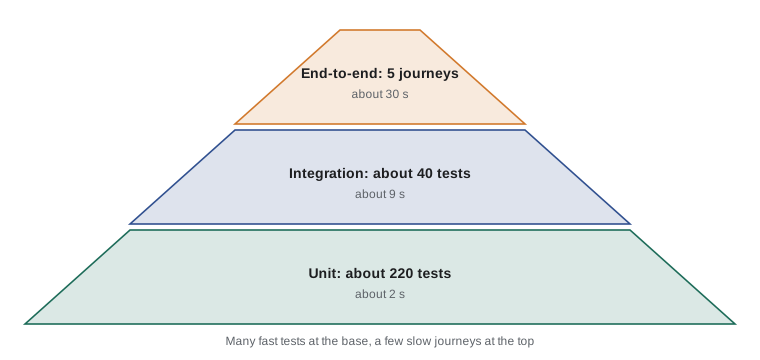
The team also agreed what not to test. They did not test Flask's routing or SQLite's ability to store an integer; those are other people's code, already well tested. They did not write tests that merely repeated the implementation line by line, which break on every refactor while catching nothing. And they did not chase a coverage number. Coverage tells you what code your tests ran, not whether they checked anything; a test that calls a function without asserting its result raises coverage and proves nothing.
Tests that catch bugs
A useful way to judge a test is to ask what bug it would catch. PYTH-230 introduced mutation testing, which makes small deliberate changes to the code, such as turning less-than into less-than-or-equal, and checks whether any test fails. A test suite that still passes after a mutation has a gap. The team ran a mutation tool over the domain layer once a week and treated each surviving mutant as a missing test.
The surviving mutants were instructive. One changed the skip cut-off from one day to zero days, and no test failed, because every skip test used dates weeks away from the delivery. Another removed the reset of the skip counter after a delivery, and again nothing failed. Both were real rules from the acceptance criteria that the tests named but did not actually check at their boundaries. Boundary values, the day before, the exact day, the day after, catch more bugs than any number of comfortable middle values.
Try it yourself
Write tests that catch the bugs
The setup defines a correct next_ship(start, weeks, n), which returns the nth delivery date on a schedule and moves a Sunday to the Monday after, plus three buggy versions. Write check(next_ship), a function of assertions about any implementation passed to it.
Your check must pass silently for the correct version and raise AssertionError for every buggy one. Think about the boundaries: the first delivery (n = 0), four-weekly schedules, and a scheduled date that falls on a Sunday. 6 December 2026 is a Sunday and 30 November 2026 is a Monday.
def check(next_ship):
    start = date(2026, 11, 30)
    assert next_ship(start, 2, 1) == date(2026, 12, 14)
Keeping fakes honest
The in-memory fakes made the unit tests fast, but they carried a risk: what if the fake and the real SQLite repository disagreed? A unit test might pass against the fake while the real application failed. The team removed that risk with contract tests: one set of tests describing how any subscription repository must behave, run against both implementations. If the fake ordered due subscriptions differently from the SQL query, or returned the same object instead of a copy, a contract test failed for one of them.
In pytest this is a fixture with two parameters, so every contract test runs twice, once per implementation. The contract is the specification of the port from lesson 3, written as executable tests. It found two real differences in its first run: the fake returned paused subscriptions that SQLite correctly excluded, and the fake let a test change a subscription without calling save, which hid a missing save call in the pause service.
import pytest

from ridgeline_ops.adapters.sqlite_repo import SqliteSubscriptions
from ridgeline_ops.testing.fakes import InMemorySubscriptions
from ridgeline_ops.testing.db import fresh_database

@pytest.fixture(params=["memory", "sqlite"])
def repo(request):
    if request.param == "memory":
        return InMemorySubscriptions()
    return SqliteSubscriptions(fresh_database())

def test_due_on_excludes_paused(repo, make_sub):
    repo.add(make_sub(next_delivery="2026-12-01", status="paused"))
    assert repo.due_on("2026-12-01") == []

def test_changes_need_save(repo, make_sub):
    sub_id = repo.add(make_sub(next_delivery="2026-12-01"))
    sub = repo.get(sub_id)
    sub.status = "paused"           # changed but not saved
    assert repo.get(sub_id).status == "active"
Static analysis
Some problems are easier for a tool to find than a person. The pipeline ran Ruff, a fast linter that flags unused imports, undefined names, risky patterns such as mutable default arguments and bare except clauses, and style problems, and formats the code so that reviews never discuss spacing. It also ran mypy over the domain and application layers with strict settings, which caught several places where a function could return None and the caller did not handle it. The adapters were checked less strictly, because Flask's dynamic request objects produce noise.
Static analysis is cheap and runs on every push, so its findings arrive while the code is fresh in the author's mind. The team treated warnings as errors in the pipeline: a new warning failed the build. Allowing a few warnings to accumulate is how projects end up with hundreds that everyone ignores, including the one that matters.
Code review
Every change to Ridgeline Ops was read by another person before it was merged. Code review catches bugs, but that is not its only value: it spreads knowledge so that no part of the system is understood by only one person, it keeps the design consistent, and it teaches. Sam learned more about SQL from Jordan's review comments in four weeks than from a whole course, and Jordan learned about accessibility from Nia's.
The team's review guide, a page in the repository, gave reviewers an order to work in. First, does the change do what the story needs? Read the acceptance criteria and the tests before the code. Second, is it correct at the edges: empty lists, the boundary dates, short stock, invalid input? Third, does it fit the design: are the layers respected, is the logic in the right place, does it reuse what exists? Fourth, is it clear: names, function size, comments that explain why rather than what? Style comes last and is mostly the formatter's job.
How comments are written matters as much as what they say. The team used a simple convention borrowed from a practice often called conventional comments: each comment starts with a label that says how seriously to take it. Blocking means the change cannot merge until this is resolved. Suggestion means the reviewer would do it differently but the author decides. Question means the reviewer does not understand and wants an explanation, which often reveals a missing comment or test. Praise means something was done well, which is worth saying out loud. Comments are about the code, never about the person: this function does two things, not you always write long functions.
Reviews were expected within four working hours, and pull requests were kept small enough to review in twenty minutes. A reviewer who could not understand a change in that time said so, and the author split it. Large reviews are where bugs hide, because reviewers tire and start skimming.
Try it yourself
Fix what the review found
Sam's pull request adds add_line(order, sku, bags, price, lines=[]), which appends a line to an order and returns the order's total. Jordan's review left three blocking comments: the mutable default list is shared between calls; prices arrive as text such as "22.00" and must be totalled in integer cents, not floats; and except: pass hides a missing coffee instead of letting a KeyError from the price lookup reach the caller.
Rewrite add_line(order, sku, bags, price_table) so that order is a dictionary with a "lines" list, each line stores (sku, bags, cents) where cents comes from price_table[sku] (a text price), and the function returns the order total in integer cents. An unknown sku must raise KeyError and leave the order unchanged.
def add_line(order, sku, bags, price_table, lines=[]):
    try:
        lines.append((sku, bags, float(price_table[sku])))
    except:
        pass
    order["lines"] = lines
    return sum(b * p for _, b, p in lines)
Tracing tests to requirements
Before the feature freeze, Jordan wanted evidence that every Must and Should story's acceptance criteria were covered by at least one automated test. The team had tagged each test with the criteria it checked, using a pytest marker such as criteria("SKIP-2"), so a short script could list the criteria with no tests. The answer was uncomfortable: four criteria had no test, including the rule that cancelled subscriptions never appear on the packing list. Two of the four turned out to be broken.
Try it yourself
Find untested criteria
Write untested(criteria, tests) where criteria maps each criterion id (such as "SKIP-2") to its story's priority ("must", "should" or "could"), and tests maps each test name to the list of criterion ids it checks. Return a sorted list of the Must and Should criteria that no test checks.
Ignore criteria ids in tests that are not in criteria (they belong to retired stories), and ignore Could criteria entirely.
def untested(criteria, tests):
    checked = set()
    for name, ids in tests.items():
        checked.update(ids)
    return [c for c in criteria if c not in checked]
Testing with real people
Automated tests check what the team thought of. Real users find what nobody thought of. On the Tuesday of the fourth week, the team ran a two-hour testing session in the roastery with Theo, Kai, Mei and Anita, each given a short list of tasks and asked to think aloud while doing them: sign up a regular at the till, pack this morning's orders, check whether next week's roast plan covers subscriptions, reconcile yesterday's report. The developers watched and took notes without helping unless someone was completely stuck.
The session found eleven issues. None was a crash. Mei could not find the sign-up form because it was under a menu called Admin. Theo's tablet went to sleep between orders and logged him out, losing his place. Anita found that subscription orders appeared under the date they were created rather than the date they shipped, which put revenue on the wrong day. Kai wanted the roast plan in kilograms of green coffee, not bags, because that is what he loads into the roaster. Each issue went into the backlog, was triaged by severity and Rosa's priority, and the important ones were fixed in the final week.
Triage kept the list under control. A severity scale described how bad a problem was: critical for data loss or wrong money, major for a blocked task, minor for an annoyance, and cosmetic for appearance only. Severity and priority are different: the report date bug was critical and fixed first, while the Admin menu was minor but cheap and highly visible, so it was fixed the same afternoon.
Common mistakes
MistakeRelying on unit tests alone, or on end-to-end tests alone.
InsteadUse a pyramid: many fast unit tests, some integration tests, a few end-to-end journeys.
MistakeChasing a coverage number.
InsteadAsk what bug each test would catch; use mutation testing to find tests that check nothing.
MistakeTesting only comfortable middle values.
InsteadTest boundaries: the day before, the exact day and the day after.
MistakeTrusting in-memory fakes without checking them.
InsteadRun one set of contract tests against the fake and the real implementation.
MistakeReviewing huge pull requests by skimming, or writing comments about the person.
InsteadKeep pull requests small, review in a set order, label comments, and comment on the code.
MistakeAssuming automated tests replace testing with users.
InsteadWatch real users try real tasks; they find problems nobody thought to test.
Summary and key terms
- Quality is built in with every story, not added at the end.
- A test pyramid balances fast unit tests, integration tests of the pieces, and a few end-to-end journeys.
- Coverage shows what ran, not what was checked; mutation testing finds weak tests.
- Boundary values catch more bugs than comfortable middle values.
- Contract tests run the same specification against fakes and real adapters.
- Linters and type checkers in the pipeline catch whole classes of problems cheaply.
- Good reviews follow an order, use labelled comments and stay small and prompt.
- Testing sessions with real users find usability and workflow problems that automated tests miss.
- test pyramid
- A balance of many unit tests, fewer integration tests and a few end-to-end tests.
- integration test
- A test that checks that several components work together correctly.
- end-to-end test
- A test that exercises a complete user journey through the whole system.
- mutation testing
- Changing code in small ways to check whether the tests notice.
- boundary value
- An input at the edge of a rule, where bugs are most likely.
- contract test
- A test describing how any implementation of an interface must behave, run against each implementation.
- static analysis
- Checking code for problems without running it, as linters and type checkers do.
- code review
- Reading another person's change before it is merged, to find problems and share knowledge.
- triage
- Sorting reported problems by severity and priority to decide what to fix first.
Practice problems
Work each problem on paper first, then reveal the answer to check.
A test calls run_renewals but asserts nothing. What happens to coverage, and what does the test prove?
Show answer
Coverage goes up, but the test proves only that the function did not crash.
Which three dates would you test for a rule that refuses skips within one day of delivery?
Show answer
Two days before (allowed), one day before (refused) and the delivery day itself (refused).
What is a contract test for, in a project with in-memory fakes?
Show answer
To check that the fake and the real implementation behave the same way, so unit tests stay trustworthy.
Rewrite the review comment "you always make functions too long" in the team's style.
Show answer
For example: "suggestion: run_renewals now handles stock and scheduling; splitting out the scheduling step would make it easier to test."
Why does a pull request reviewer read the tests before the code?
Show answer
The tests show what the change is meant to do, so the reviewer can judge whether the code does it.
A bug puts revenue on the wrong day and another hides a form under a menu. Which is more severe?
Show answer
The revenue bug: wrong money is critical, while the menu is minor, even if it is fixed first because it is cheap.
Lesson quiz · 5 questions
Score 60% or more to complete this lesson.
Create a free account to save your progress, take quizzes and earn a certificate.