
PWR-510 · Lesson 3 of 12 · 24 min
Selecting boilers, turbines and auxiliaries
▶ Video coming soon A video version of this lesson is on the way.
Marrowby Foods had told Keswold in September that it planned a new production line for 2028, and Morwenna had been asked to propose how Keswold would supply the extra steam. Marrowby's plant engineer had a second request. During Keswold's fall outage, Marrowby had run on a rented package boiler (PWR-320), and on the rare occasions the gas turbine tripped, the duct burners could not keep the heat recovery steam generator steaming without gas turbine exhaust, so Marrowby lost steam until a rental arrived or the turbine was back. With the new line, Marrowby wanted a permanent standby supply. Morwenna gave Anselm the problem as his study project for the course.
"Everyone wants to start with the catalogue," Morwenna said. "Start with the load. What does the customer need, hour by hour, season by season, and what happens to them if they don't get it? The equipment comes last." This lesson follows that order: defining the duty, choosing the number and size of units, comparing boiler types, choosing turbines, and selecting the auxiliaries that so often decide whether a plant runs well. Lesson 12 returns to Marrowby's expansion as a full case study.
Start with the duty
A selection study begins with the duty: the steam or power the plant must supply, at what conditions, with what variation and with what reliability. For process steam the questions are the flow, the pressure and temperature at the point of use, the range from minimum to peak, how fast the load changes, the condensate return and its quality, and what the customer loses when supply stops. For power, they are the output, the operating hours, the grid's requirements and the value of each megawatt-hour at different times.
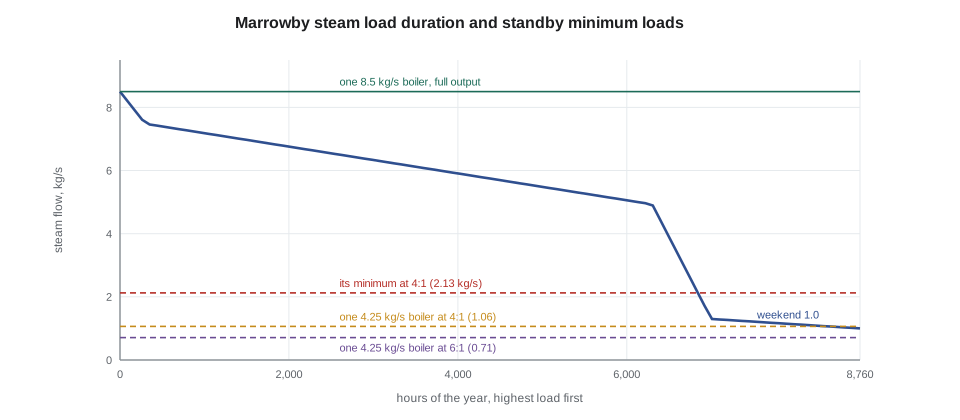
Marrowby's engineer supplied the numbers. Today Keswold sends up to 6.0 kg/s of steam at 1,200 kPa absolute through the extraction (PWR-320). The new line would add about 2.5 kg/s on average, bringing the design peak to about 8.5 kg/s. On weekends and holidays the whole site can fall to about 1.0 kg/s, mostly for cleaning and space heating. Marrowby can ride through a few minutes of low pressure but must start shutting down cookers after about twenty minutes without steam, and a full day's lost production costs more than a year of steam.
A load duration curve arranges the hours of a year in order of load, from the highest to the lowest. It shows at a glance how many hours the plant runs near peak, how many at average and how many at the minimum, and it is the starting point for deciding how many units to buy and how big each should be. A plant that runs near peak for a few hundred hours a year may be better served by a small peaking unit than by making the base unit larger.
Redundancy and the number of units
Reliability decides the number of units. N+1 means enough units to carry the load with one out of service; N+2 allows for one in maintenance and one failing. A single unit large enough for the whole load is cheaper to buy and run than two half-size units, but when it is down the customer has nothing. Two half-size units cost more but give half the supply on a single failure and allow maintenance one at a time. The choice depends on the consequence of losing supply, which for Marrowby is large.
For a standby supply the question becomes: standby for what? Keswold's normal steam comes from the steam turbine extraction. The standby must carry Marrowby when the gas turbine is out, whether tripped, in a planned outage or in an inspection. A standby that takes hours to start is not much use for a trip. Package boilers kept warm, with their drums pressurized from the main steam system or kept at low fire, can pick up load in minutes, but keeping them warm costs fuel.
Worked problem
How many hours does the standby run?
Keswold's gas turbine is unavailable for about 4 in 100 of the year through forced outages and planned maintenance (a sample planning figure). If the standby boilers must carry Marrowby's full design peak of 8.5 kg/s during those hours, how much steam heat do they supply in a year, with an enthalpy rise of 2,766.6 kJ/kg from the 60 °C condensate to the delivered steam?
Show solution
- \[0.04 \times 8{,}760 = 350 \text{ h}\]
- \[Q = 350 \times 3{,}600 \times 8.5 \times 2{,}766.6 \text{ kJ} \approx 29{,}700 \text{ GJ}\]
Answer: About 350 hours and 29,700 GJ a year at the design peak, an upper bound because Marrowby rarely runs at peak. The standby is a capital-heavy, low-utilization asset, so its purchase price and its readiness matter more than a point or two of efficiency. That changes if the standby is also used to carry the growth in demand, as lesson 12 explores.
Turndown and minimum load
Turndown is the ratio of a boiler's maximum continuous output to its minimum stable output. Below the minimum, the burner cannot hold a stable flame within its emission limits, or the boiler cycles on and off, wasting fuel in purges and stressing the pressure parts. Package watertube boilers with modern burners commonly offer turndowns of about 4:1 to 10:1 (typical), depending on the burner, the fuel and the emission limits; low-NOx burners often lose turndown. A unit sized for the peak may spend much of the year near or below its minimum.
Worked problem
Can the standby follow the weekend load?
Compare three standby arrangements for Marrowby's weekend minimum of 1.0 kg/s: one boiler of 8.5 kg/s with 4:1 turndown, and two boilers of 4.25 kg/s each with 4:1 or 6:1 turndown.
Show solution
- \[\frac{8.5}{4} = 2.13 \text{ kg/s} \qquad \frac{4.25}{4} = 1.06 \text{ kg/s} \qquad \frac{4.25}{6} = 0.71 \text{ kg/s}\]
Answer: The single large boiler cannot follow 1.0 kg/s at all; it would cycle. One small boiler at 4:1 is just above the minimum and would cycle at the lightest loads. One small boiler at 6:1 can follow the weekend load with margin. Two 4.25 kg/s boilers with 6:1 turndown also give N+1 on a failure at average load, so on duty, reliability and minimum load they are the better choice, at a higher price.
Choosing a boiler type
Boilers for a plant like Keswold or Cantwell fall into a few families, each with its own strengths (PWR-120, PWR-330).
- Firetube boilers are simple, cheap and tolerant of load swings because of their large water content, but they are limited to modest pressures and sizes, typically up to about 2,100 kPa (300 psig) and about 9 kg/s (70,000 lb/h) in the largest units (typical).
- Package watertube boilers, such as Cantwell's D-type units, are shop-assembled, shipped by road and suited to higher pressures and larger outputs; they start faster than field-erected units and are the usual choice for industrial standby and growth.
- Field-erected watertube boilers suit large outputs and solid fuels, but take years to build.
- Heat recovery steam generators use gas turbine or engine exhaust and may add duct firing; Keswold's HRSG is limited to about 22.0 kg/s (175,000 lb/h) at full winter duct firing (PWR-320), so it has no margin to carry Marrowby's growth in the coldest weather.
- Electric boilers, either resistance or electrode type, convert electricity to steam at nearly 100 in 100 efficiency, start quickly, have no stack and no on-site emissions, and are limited by the electrical supply and its price (lesson 10).
Selection also weighs the fuel and its supply, the emission limits in the plant's approval or permit, the steam pressure and temperature the customer needs, the space available, delivery time, maintenance needs, the skills of the operators, and whether the new unit changes the plant's registration or class. A new boiler at Keswold adds to the plant's rating and its inspection program, and it must fit Keswold's air approval or permit, which may need an amendment.
Choosing a turbine
When a plant raises steam at a higher pressure than its users need, the drop between the two is an opportunity. A pressure-reducing valve wastes it; a back-pressure turbine turns it into power, exhausting at the process pressure. The power available depends on the steam flow and the enthalpy drop, and the back-pressure turbine makes sense when the steam flow is steady and large enough to justify the turbine's cost and maintenance. A condensing turbine exhausts to a condenser under vacuum, extracting far more power from each kilogram but rejecting the latent heat to cooling water. An extraction-condensing turbine, like Keswold's, does both and can trade power for process steam as the host's demand varies (PWR-320).
Turbine selection asks the same questions as boiler selection: what are the steam conditions, flows and their range, what is the value of power and of steam, how many hours a year will the unit run, and what is the cost of its outages? A large condensing turbine designed for base load will be inefficient at low flow; a small back-pressure turbine sized for the minimum steam flow may run all year at its best efficiency. For Marrowby's growth, a back-pressure turbine between a new higher-pressure boiler and the extraction header would only make sense if the new boiler ran most of the year, which a standby does not.
Auxiliaries decide reliability
Many plant failures start in the auxiliaries rather than in the boiler or turbine. A new boiler needs feedwater, fuel, combustion air, controls, a stack, blowdown, chemical feed, water treatment capacity and electrical supply, and each must be sized for the duty and its redundancy.
- Feedwater pumps: sized for the boiler's maximum flow plus blowdown and a margin, at a head that overcomes drum pressure, line losses and control valve drop; usually two pumps, one running and one standby, with a minimum flow recirculation line.
- Deaeration: the new boiler's feedwater must come from a deaerator with enough capacity and storage; Keswold's existing deaerator and makeup plant were sized for the HRSG and must be checked.
- Water treatment: extra makeup raises the load on the reverse osmosis unit and polishers, which at Keswold were sized for about 10 m³/h (44 gpm) of feed (PWR-330).
- Fuel gas: the gas supply and regulator station must carry the new boilers' input alongside the gas turbine and duct burners, and the utility may need to confirm capacity.
- Electrical: motors for fans and pumps, controls and the burner management system need supply, preferably from a source that survives the loss of the gas turbine.
- Stack and emissions monitoring: height, location, sampling ports and any monitoring required by the approval or permit.
Worked problem
Sizing a feedwater pump
Each new 4.25 kg/s boiler needs its own feedwater pump. Water from the deaerator at about 105 °C has a density of about 955 kg/m³, and the pump must develop about 1,500 kPa. Estimate the flow, the hydraulic power and the shaft power at a pump efficiency of 0.60.
Show solution
- \[Q = \frac{4.25}{955} = 0.00445 \text{ m}^3/\text{s} = 4.45 \text{ L/s}\]
- \[P_h = Q\,\Delta p = 0.00445 \times 1{,}500 = 6.68 \text{ kW} \qquad P_s = \frac{6.68}{0.60} = 11.1 \text{ kW}\]
Answer: About 11 kW at the shaft, so a 15 kW motor would be chosen, leaving margin for wear and for the minimum flow recirculation. Two such pumps per boiler, or three shared between the two boilers, would give the redundancy a standby supply needs. The pump must also be checked for net positive suction head at the deaerator's level, as Pilar did for Cantwell (PWR-410).
Specifications and bid evaluation
Once the duty and arrangement are settled, the selection becomes a specification: the performance required, the design conditions, the codes and standards, the scope of supply, the guarantees, testing and documentation, and the commercial terms. A good specification states what the plant needs, not how the vendor should design it, and asks for the information needed to compare bids on an equal basis. A bid evaluation compares the price with the life cycle cost (lesson 6), the guaranteed efficiency and emissions, turndown, start time, delivery, the vendor's experience and support, and the exceptions each bidder has taken to the specification.
Morwenna's last advice in this session was about guarantees. "A guarantee is only worth what you can measure. If the vendor guarantees efficiency at full load and turndown at 6:1, write into the contract how and when you'll test it, with what instruments, and what happens if it falls short. Otherwise you have a brochure."
Thinking about the whole life
Equipment chosen today will be run by people who have not yet been hired, under rules not yet written, for twenty or thirty years. Morwenna asked Anselm to add three questions to every selection: can the plant's own operators and technicians run and maintain it, or will it depend on a single vendor; will parts and service be available for its whole life; and can it be adapted if the fuel, the duty or the emission limits change? A slightly more expensive unit that answers yes to all three is often the better buy.
Common mistakes
MistakeStarting a selection study from a vendor catalogue.
InsteadStart from the duty: flows, conditions, variation and the consequence of losing supply.
MistakeSizing a single unit for the peak load.
InsteadUse the load duration curve; consider the minimum load, turndown and redundancy.
MistakeIgnoring turndown and minimum stable load.
InsteadCheck that the units can follow the lowest load without cycling.
MistakeTreating a standby unit as if efficiency were the main criterion.
InsteadFor low-utilization standby duty, price and readiness matter more.
MistakeForgetting the auxiliaries.
InsteadCheck feedwater, deaeration, water treatment, fuel, electrical supply and the stack for the new duty.
MistakeAccepting guarantees without test terms.
InsteadWrite the test method, instruments and remedies into the contract.
Summary and key terms
- Selection starts with the duty and the consequence of losing supply; the load duration curve shows how many hours the plant spends at each load.
- Redundancy (N+1, N+2) decides the number of units; two smaller units cost more but keep supply on a single failure.
- Turndown sets the lowest load a unit can follow; low-load operation below it causes cycling and wear.
- Boiler type depends on pressure, size, load swings, fuel, space, delivery and emissions; HRSGs depend on gas turbine exhaust; electric boilers depend on the grid.
- Back-pressure turbines recover the drop to process pressure when flows are steady; condensing and extraction turbines trade steam for power.
- Auxiliaries and a clear specification with testable guarantees decide whether the selection succeeds.
- Duty
- The steam or power a plant must supply, at stated conditions, variation and reliability.
- Load duration curve
- The hours of a year arranged from highest to lowest load.
- N+1 redundancy
- Enough units to carry the load with one out of service.
- Turndown
- The ratio of maximum to minimum stable output.
- Minimum stable load
- The lowest output at which a unit can run without cycling or losing flame stability.
- Back-pressure turbine
- A turbine that exhausts at a process pressure above atmospheric.
- Specification
- A document stating the performance, conditions, standards and commercial terms required of equipment.
Practice problems
Work each problem on paper first, then reveal the answer to check.
A 6 kg/s boiler has 5:1 turndown. Minimum stable load?
Show answer
1.2 kg/s.
Hydraulic power for 5 L/s against 1,200 kPa?
Show answer
6.0 kW.
Hours in a year at 3 in 100 unavailability?
Show answer
About 263 h.
Why would two half-size units be chosen over one full-size unit?
Show answer
Supply continues on a single failure, maintenance can be done one at a time, and the smaller units can follow lower loads.
Lesson quiz · 5 questions
Score 60% or more to complete this lesson.
Create a free account to save your progress, take quizzes and earn a certificate.