
PWR-510 · Lesson 12 of 12 · 24 min
A plant expansion case study
▶ Video coming soon A video version of this lesson is on the way.
By the last session of the autumn, Anselm's study of Marrowby's expansion had grown from a page of questions into a draft report, and Morwenna asked him to present it to her as he would to the owner. The report would go to the owner's director of operations early in 2027 as a feasibility study, the select phase of the project (lesson 5). Everything in it after November 2026 was a plan. This lesson follows the study from the customer's need to a recommendation, drawing on every earlier lesson in the course.
The need
Marrowby's new production line, planned to start in 2028, would raise its average steam demand by about 2.5 kg/s and its design peak from 6.0 to about 8.5 kg/s at 1,200 kPa absolute. Marrowby also wanted a permanent standby supply, so that it would no longer depend on a rented package boiler during Keswold's outages or lose steam when the gas turbine tripped (lesson 3). Its sustainability manager wanted to know how each option would affect the emissions of the steam it buys (lesson 10).
Anselm's first page set out the constraints. Keswold's heat recovery steam generator has spare capacity for more duct firing in most of the year, but at full winter duct firing it already makes its maximum of 22.0 kg/s (175,000 lb/h), so it cannot carry the growth on the coldest days (PWR-320). The existing NPS 8 line to Marrowby is too small for the new peak (lesson 4). Each extra unit of extraction steam costs Keswold power, about 0.68 MW per kg/s (0.31 MW per 3,600 lb/h) (PWR-320). And whatever supplies the standby must be able to start and carry Marrowby within about twenty minutes of a gas turbine trip.
The options
The study considered four options, after screening out several others, such as a second gas turbine, which was far too large for the need, and a back-pressure turbine on a new high-pressure boiler, which would not pay at standby utilization (lesson 3).
- Option A, status quo with rentals: carry the growth on extraction and duct firing when the HRSG has capacity, rent package boilers for outages and accept the risk of trips and winter shortfalls.
- Option B, gas package boilers: two package watertube boilers of 4.25 kg/s (34,000 lb/h) each with 6:1 turndown, on the reserved site north of the HRSG, carrying standby duty and winter peaks, with the growth otherwise supplied by extraction and duct firing; a new line to Marrowby.
- Option C, electric boilers: two electrode boilers of about 7 MW each, with a new medium voltage service, carrying the growth and providing standby; a new line to Marrowby.
- Option D, gas package boilers made ready for later electrification: option B, with hydrogen-ready burners specified, space and a spare breaker position for a future electrode boiler, and connections for thermal storage.
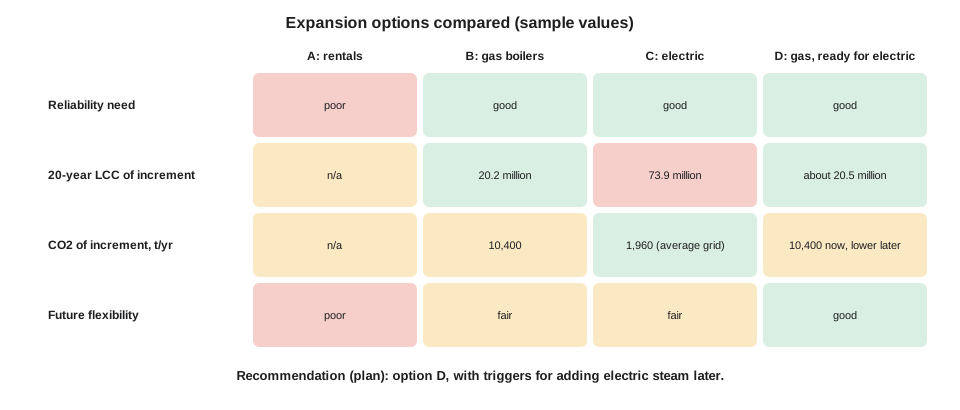
Option A was rejected early. It could not meet Marrowby's reliability requirement, and the cost of a single day's lost production at Marrowby exceeded the annual cost of owning standby boilers (lesson 6). The study's work was in comparing B, C and D.
Sizing and layout
The boiler sizes came from lesson 3: two units of 4.25 kg/s (34,000 lb/h) give N+1 at average load, can carry the design peak together, and at 6:1 turndown can follow the weekend minimum of 1.0 kg/s (8,000 lb/h). Each needs about 14.0 MW (48.2 MMBtu/h) of fuel input at full load and 0.84 efficiency, two feedwater pumps of about 15 kW (20 hp) each (lesson 3), extra capacity from the makeup water plant, and a stack with sampling ports. The site plan's reserved area takes the boilers, a small building and their auxiliaries without blocking the gas turbine's laydown area (lesson 4).
The new steam line would be NPS 12 rather than NPS 10, so that it could carry the full design peak at about 25 m/s and leave room for further growth, and the existing NPS 8 line would be kept as a second route, giving Marrowby supply when either line is out of service (lesson 4). The line needs three expansion loops on the pipe bridge, spring hangers at the rise and drop, drip legs at each low point, and a warm-up bypass at the extraction header.
The standby boilers would be kept warm, with their drums pressurized and burners at low fire or in a hot standby mode, so that they could pick up Marrowby's load within minutes of a trip. That costs fuel. Anselm estimated the hours the boilers would carry Marrowby in a year with a major outage: about 3 in 100 forced unavailability of the gas turbine plus a 31-day outage, about 1,000 hours. In other years, without a major outage, a few hundred.
The incremental steam
The heart of the comparison was the cost and emissions of supplying the extra 2.5 kg/s (20,000 lb/h) of steam for about 7,000 hours a year.
Worked problem
Annual cost and CO₂ of the extra steam
The extra steam carries 2.5 kg/s × 2,766.6 kJ/kg = 6.92 MW of heat, or 174,300 GJ over 7,000 hours. Compare a gas package boiler at 0.84 efficiency, with gas at 5.50 dollars per GJ (sample), with an electric boiler at 0.99 efficiency, with electricity at 0.13 dollars per kWh and a grid average of 0.04 t/MWh (samples).
Show solution
- \[\text{Gas: } \frac{174{,}300}{0.84} = 207{,}500 \text{ GJ} \times 5.50 = 1.14 \text{ million dollars/yr} \qquad CO_2 = 207{,}500 \times 50.3 \text{ kg} = 10{,}400 \text{ t}\]
- \[\text{Electric: } \frac{48{,}420 \text{ MWh}}{0.99} = 48{,}900 \text{ MWh} \times 130 = 6.36 \text{ million dollars/yr} \qquad CO_2 = 48{,}900 \times 0.04 = 1{,}960 \text{ t}\]
Answer: Electric steam would cut the CO₂ of the extra steam by about 8,500 t a year on the sample grid average, but cost about 5.2 million dollars a year more. Supplied instead by more duct firing and extraction, where the HRSG has capacity, the extra steam would need a little less fuel than a package boiler (about 189,500 GJ at a marginal 0.92) but would cost Keswold about 1.7 MW of output while it ran.
Anselm's point to Morwenna was that duct firing and extraction remain the cheapest way to make most of the extra steam when the HRSG has room, so in options B and D the package boilers would run mainly for standby and winter peaks, not all year. The comparison above shows the cost of each technology if it carried the whole increment, which is the fair basis for comparing B and C.
Life cycle cost
Worked problem
Twenty-year life cycle cost
Compare the 20-year life cycle cost, at the owner's 7 in 100, of supplying the increment with gas package boilers (capital 6.5 million dollars, annual fuel 1.14 million, operation and maintenance 0.15 million) and with electrode boilers (capital 5.7 million including the new electrical service, annual electricity 6.36 million, operation and maintenance 0.08 million). The new steam line is common to both and left out.
Show solution
- \[LCC_{gas} = 6.5 + (1.14 + 0.15) \times 10.594 = 20.2 \text{ million}\]
- \[LCC_{elec} = 5.7 + (6.36 + 0.08) \times 10.594 = 73.9 \text{ million}\]
Answer: At sample prices the electric option costs more than three and a half times as much over 20 years. Its cost per tonne of CO₂ avoided is about 600 dollars, against a sample carbon cost of 110 dollars per tonne, the 2026 level of the federal benchmark schedule. The gas option would pay that carbon cost on its emissions above Keswold's standard, about 1.15 million dollars a year if all 10,400 t were charged, and the electric option would still be far more expensive.
The break-even electricity price was the more useful figure for the owner. Anselm solved for the price at which the electric option's annual cost, including its lower capital cost spread over 20 years, equalled the gas option's.
Worked problem
When would electric steam compete?
Find the electricity price at which the electric option's annual cost equals the gas option's, without and with a carbon cost of 110 dollars per tonne on the gas option's emissions. The electric option's capital is 0.8 million dollars lower, worth about 75,500 dollars a year over 20 years at 7 in 100.
Show solution
- \[p = \frac{1{,}291{,}200 - 80{,}000 + 75{,}500}{48{,}900{,}000 \text{ kWh}} = 0.026 \text{ dollars/kWh}\]
- \[p_{carbon} = \frac{1{,}291{,}200 + 1{,}147{,}900 - 80{,}000 + 75{,}500}{48{,}900{,}000} = 0.050 \text{ dollars/kWh}\]
Answer: Electric steam would compete only if Keswold could buy electricity for about 2.6 cents per kWh, or about 5.0 cents with the sample carbon cost. Average industrial prices are far above that, but some hours of the year, at night and when renewable output is high, are much cheaper. An electrode boiler with thermal storage that ran only in those hours could make part of the steam at a competitive price, which is why option D keeps the door open.
Approvals, codes and the plant's obligations
Two new boilers change Keswold's registration and approvals. Each boiler's design must be registered with TSSA and the boilers inspected on installation; the plant's rating rises, though it remains a first-class plant with the same chief engineer requirement (lesson 1). The environmental compliance approval must be amended for the new sources before construction, and with about 50 GJ/h of input each, the boilers fall under the federal Multi-Sector Air Pollutants Regulations' NOx limits for new boilers (PWR-330). Their emissions add to Keswold's greenhouse gas reports under the Emissions Performance Standards program. The fuel gas supply and the installation must meet the gas codes adopted by TSSA, and the electrical work requires ESA notification.
The compliance register (lesson 9) gains new lines for each of these, and Ingeborg's risk-based inspection program gains two boilers and a steam line to assess. The steam contract with Marrowby would be amended to cover the new volumes, the standby obligation and how the cost of the boilers is shared.
Risks
Anselm's risk register for the project listed the main risks, each with an owner and a response.
| Risk | Response |
|---|---|
| Marrowby delays or cancels the new line | Contract terms that cover Keswold's costs; build the standby boilers first, the line second |
| Approval or permit takes longer than planned | Early pre-application meetings with the regulator; schedule float |
| Boiler delivery delays | Order early in the define phase; liquidated damages in the supply contract |
| Gas supply capacity insufficient | Early confirmation from the gas utility |
| Tie-ins to the extraction header | Plan tie-ins for the 2027 short outage or use a hot tap under strict control |
| Cost growth | Class 3 estimate before approval; contingency sized from the risk review |
| Policy change on emissions | Hydrogen-ready burners; space and electrical provision for electrification |
The recommendation
Anselm recommended option D: two gas package boilers of 4.25 kg/s (34,000 lb/h) with 6:1 turndown and hydrogen-ready burners, a new NPS 12 line to Marrowby with the existing line kept as a second route, and space, a spare medium voltage breaker position and piping connections reserved for a future electrode boiler and thermal storage. Its life cycle cost is close to option B's, a little higher for the provisions, and it meets the reliability need at the lowest cost while leaving the plant ready for the decarbonization options that may become worthwhile. The trigger for adding electric steam would be off-peak electricity available at a delivered price near the break-even, or a carbon cost or customer commitment that changes the balance, with the grid's emissions confirmed to be lower than gas steam.
The proposed schedule, all of it a plan: the feasibility study to the owner in February 2027; with approval, a define phase from spring to autumn 2027 with pre-application meetings with the regulators, a Class 3 estimate and the boiler specification; boilers ordered in late 2027; installation and tie-ins in 2028, timed before Marrowby's line starts; and commissioning with a pre-startup safety review and a performance test of the guarantees (lessons 3 and 5).
Morwenna asked one question at the end. "If the owner says the budget is tight and asks you to drop the second boiler, what do you say?" Anselm thought about it. "That a single boiler can't follow the weekend load and leaves Marrowby with nothing when it trips or is in maintenance. That one day of Marrowby's lost production costs more than the second boiler costs to own for a year. And that if they still want one boiler, I'll write down the risk and ask them to sign it." Morwenna nodded. "That's the job."
What the case study shows
The expansion study brought together every part of the course. It started with the duty and the customer's consequence of losing supply, selected equipment by redundancy and turndown, checked layout and piping, used engineering economics and life cycle cost, considered decarbonization honestly with sensitivity and break-even analysis, listed the regulatory obligations and the risks, and ended with a recommendation that a chief engineer could defend to the owner, the customer and the regulator. Anselm would carry it forward as the project's owner while he prepared for his examinations, with Morwenna watching from the next office until 2028.
Common mistakes
MistakeComparing options without stating what each must achieve.
InsteadSet out the need, constraints and reliability requirement first.
MistakeComparing technologies on different duties.
InsteadCompare each option carrying the same increment of steam.
MistakePresenting only the life cycle cost.
InsteadAdd the break-even price and the conditions that would change the decision.
MistakeIgnoring the approvals a new source needs.
InsteadList registration, approval or permit, emission standards and reporting changes early.
MistakeDesigning only for today's choice.
InsteadReserve space and connections for options that may become worthwhile.
MistakeAccepting a budget cut that removes redundancy without recording the risk.
InsteadExplain the consequence and ask the decision-maker to accept the risk in writing.
Summary and key terms
- The expansion study began with Marrowby's need: growth, a design peak and a permanent standby supply.
- The options were rentals, gas package boilers, electric boilers and gas boilers made ready for electrification.
- Two 6:1 package boilers give N+1, follow the weekend load and carry the peak; a new NPS 12 line plus the existing line gives two routes.
- At sample prices, gas boilers have a far lower life cycle cost; electric steam would compete only at very low electricity prices, and its emissions benefit depends on the grid.
- New boilers need registration, approvals or permits, emission standards compliance and additions to the compliance register and RBI program.
- The recommendation balanced reliability, cost and future flexibility, with a schedule, a risk register and triggers for later decarbonization.
- Feasibility study
- A study that compares options and recommends one for further definition.
- Standby supply
- A source kept ready to carry a load when the normal source is unavailable.
- Hot standby
- A boiler kept pressurized and warm so that it can pick up load quickly.
- Break-even price
- The price at which two options have equal annual cost.
- Hydrogen-ready burner
- A burner designed to accept hydrogen blends with limited modification.
- Thermal storage
- A means of storing heat, such as a steam accumulator or hot water tank, for later use.
- Trigger
- A condition that, when met, starts a planned later step.
Practice problems
Work each problem on paper first, then reveal the answer to check.
Annual heat in 3.0 kg/s of steam with a 2,766.6 kJ/kg rise over 7,000 hours?
Show answer
About 209,200 GJ.
Fuel for that heat at 0.84 efficiency and its cost at 5.50 dollars per GJ?
Show answer
About 249,000 GJ; about 1.37 million dollars.
LCC over 20 years at 7 in 100 of 4.0 million capital plus 0.9 million a year?
Show answer
About 13.5 million.
Why keep the existing NPS 8 line after building the new one?
Show answer
As a second route so Marrowby has supply when either line is out of service.
Lesson quiz · 5 questions
Score 60% or more to complete this lesson.
Create a free account to save your progress, take quizzes and earn a certificate.