
PWR-410 · Lesson 7 of 12 · 28 min
Plant heat rate and performance testing
▶ Video coming soon A video version of this lesson is on the way.
On the heat balance afternoon at Keswold on November 10, Ingeborg Haverlund had given Grazyna a copy of the plant's design heat balance at full winter load, with permission to use it for teaching. Grazyna handed it to Pilar at the seventh session with one instruction: "Find Keswold's heat rate. Then tell me which of the five heat rates you could find is the right one." Okonkwo, who had been there that afternoon, grinned. He had asked Ingeborg the same question and been given the same answer: it depends who is asking.
This lesson defines heat rate and its variants, gross and net, higher and lower heating value, and for cogeneration plants; shows how heat rate varies with load and how incremental heat rate is used; describes performance testing under the ASME performance test codes, with corrections to reference conditions and test uncertainty; and shows how component tests, such as a turbine section's enthalpy-drop efficiency, locate the losses behind a plant's heat rate.
Heat rate
Heat rate is the fuel energy needed to produce one unit of electricity. It is the reciprocal of electrical efficiency, expressed in units that keep the numbers convenient:
Lower heat rate is better. A heat rate of 3,600 kJ/kWh would mean an efficiency of one. A modern combined cycle runs at about 5,700 to 6,200 kJ/kWh on the lower heating value (typical), a simple-cycle gas turbine at about 9,000 to 11,000, and an older coal unit at about 9,500 to 11,000 on the higher heating value (typical).
Every heat rate must state its basis, in four respects:
- Gross or net. Gross output is measured at the generator terminals; net output is gross less the plant's auxiliary load (pumps, fans, compressors, cooling tower fans, lighting and controls) and sometimes less the step-up transformer losses. Net heat rate is what the owner pays for.
- Higher or lower heating value. North American utility practice reports steam plant heat rates on the HHV; gas turbine makers and most combined cycle data use the LHV. For Cantwell's gas, HHV ÷ LHV = 37.3 ÷ 33.6 (1,030 ÷ 931) = 1.110, so the same plant's HHV heat rate is 11 in 100 higher.
- Conditions. Ambient temperature, pressure, humidity, cooling water temperature and, for cogeneration, process steam flows all change heat rate; a quoted value applies only at stated conditions.
- Period. A test heat rate at steady full load is lower than the annual average heat rate, which includes starts, part-load hours and degradation.
Keswold's heat rates
Worked problem
Five heat rates from one heat balance
At full winter load, Keswold's design balance shows: gas turbine fuel 132,353 kW and duct burner fuel 9,801 kW, both on the LHV; gas turbine output 45,000 kW; steam turbine generator output 18,028 kW; auxiliary load 1,500 kW; process steam to Marrowby Foods 16,600 kW. Find the gross and net heat rates on the LHV, the net heat rate on the HHV, and the overall energy utilization.
Show solution
- \[\text{fuel} = 132{,}353 + 9{,}801 = 142{,}154 \text{ kW}; \quad P_{gross} = 63{,}028 \text{ kW}; \quad P_{net} = 61{,}528 \text{ kW}\]
- \[HR_{gross} = \frac{142{,}154 \times 3{,}600}{63{,}028} = 8{,}119 \text{ kJ/kWh}, \qquad HR_{net} = \frac{142{,}154 \times 3{,}600}{61{,}528} = 8{,}317 \text{ kJ/kWh}\]
- \[HR_{net,HHV} = 8{,}317 \times 1.110 = 9{,}233 \text{ kJ/kWh}\]
- \[\text{utilization} = \frac{61{,}528 + 16{,}600}{142{,}154} = 0.550\]
Answer: The gross LHV figure, 8,119 kJ/kWh, is the most flattering, and the net HHV figure, 9,233, the most honest about fuel bought. None of them is fair to a cogeneration plant, because none gives credit for the 16.6 MW of steam sold.
Heat rate in cogeneration
A cogeneration plant makes two products from one fuel, so its fuel must be divided between them, and every method of doing so involves a choice. The most common is the fuel chargeable to power (FCP), also called the net heat rate with thermal credit: the useful heat is assumed to have displaced fuel in a conventional boiler of stated efficiency, that fuel is subtracted, and the remainder is charged to the electricity.
Worked problem
Keswold's fuel chargeable to power
Using a reference boiler efficiency of 0.85 on the LHV, find Keswold's FCP and the equivalent efficiency of its electricity.
Show solution
- \[\text{credit} = \frac{16{,}600}{0.85} = 19{,}529 \text{ kW}\]
- \[FCP = \frac{(142{,}154 - 19{,}529) \times 3{,}600}{61{,}528} = 7{,}175 \text{ kJ/kWh}, \qquad \eta = \frac{3{,}600}{7{,}175} = 0.502\]
Answer: On this basis Keswold's electricity is made at an efficiency of about 0.50, better than its unfired combined cycle efficiency of 0.48, because the steam sold carries part of the fuel. A different reference boiler efficiency gives a different answer, which is why such figures must always state their assumptions.
Other allocation methods divide the fuel in proportion to the energy or the exergy of the two products, or compare the plant with separate production of both. In Ontario, Keswold sells its power under arrangements with the Independent Electricity System Operator, as PWR-320 described, and the terms of such contracts, not thermodynamics, settle which efficiency figures matter commercially. Federal and provincial greenhouse gas programs have their own rules for attributing emissions between electricity and heat.
Whatever method is used, the plant's operators should track the same figure in the same way every month, because the purpose of a heat rate is to show change.
Heat rate and load
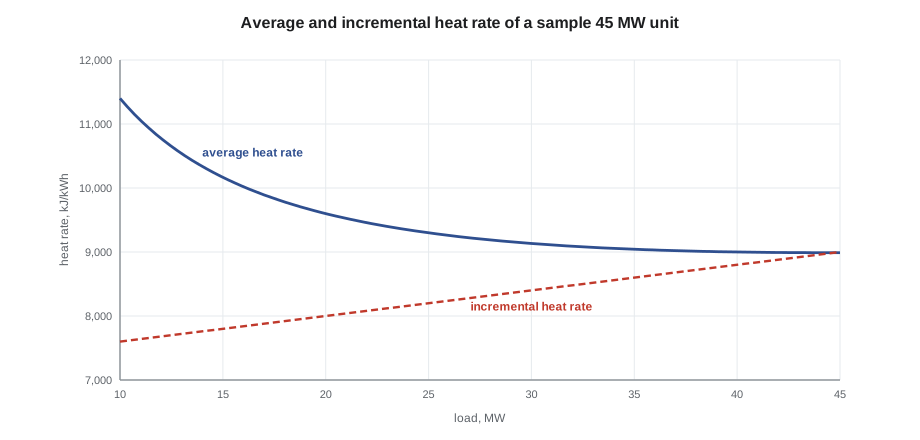
A unit's heat rate depends on its load. At low load, fixed losses such as radiation, auxiliary power and the steam needed to keep the turbine warm are spread over less output, gas turbines lower their firing temperature, and steam turbines with throttle governing lose efficiency across their valves. Heat rate therefore rises as load falls, gently near full load and steeply at low load. A plant's heat rate curve is obtained from tests at several loads and is often fitted with an input-output curve, the fuel input as a function of output, for example a quadratic:
The average heat rate at a given load is H ÷ P, and the incremental heat rate is the slope dH/dP, the extra fuel needed for one more unit of output. Incremental heat rate is what matters when deciding how to share load between units: total fuel is least when every unit runs at the same incremental heat rate, the equal incremental cost principle used in economic dispatch. A unit with a low average heat rate may still be the wrong one to load up if its incremental heat rate at that point is high.
| Load, MW | Fuel, GJ/h | Average heat rate, kJ/kWh | Incremental heat rate, kJ/kWh |
|---|---|---|---|
| 20 | 192.0 | 9,600 | 8,000 |
| 30 | 274.0 | 9,133 | 8,400 |
| 40 | 360.0 | 9,000 | 8,800 |
| 45 | 404.5 | 8,989 | 9,000 |
Performance testing
A performance test measures a plant's or a component's output, efficiency or heat rate under controlled conditions, to check a guarantee, to find degradation, or to establish a baseline before and after an outage or a modification. In North America, the methods are those of the ASME Performance Test Codes (PTCs). The ones a power engineer meets most often are:
| Code | Scope |
|---|---|
| PTC 46 | Overall plant performance: net output and heat rate of a complete plant, including combined cycles and cogeneration |
| PTC 22 | Gas turbines: output and heat rate |
| PTC 6 | Steam turbines: output, heat rate and section efficiencies |
| PTC 4 | Fired steam generators: efficiency by the input-output and energy balance methods (PWR-330) |
| PTC 4.4 | Gas turbine heat recovery steam generators |
| PTC 12.2 and PTC 12.1 | Steam surface condensers and closed feedwater heaters |
| PTC 19 series | Instruments and measurement, including test uncertainty (PTC 19.1) |
The codes describe how to plan a test, agree on it with all parties, select and calibrate instruments, stabilize the plant, run it for a set duration with limits on how much conditions may vary, calculate the results and correct them, and evaluate their uncertainty. The parties write a test procedure in advance, agreeing on the operating mode, the boundaries, the instruments and the correction curves. Codes are not law, but contracts often require a test "in accordance with" a named code.
Test results are corrected to reference conditions so they can be compared with a guarantee or a previous test. A gas turbine's output and heat rate depend strongly on the ambient temperature, pressure and humidity, so the maker supplies correction curves or factors; a steam turbine's results are corrected for steam conditions and backpressure; a combined cycle's for all of these, plus cooling water temperature and process flows.
Worked problem
Correcting a gas turbine test
After its offline wash in October, Keswold's gas turbine was tested at an inlet temperature of 25 °C. It made 41.8 MW and burned 125,000 kW of fuel (LHV). The maker's curves give an output correction factor of 1.060 and a heat rate correction factor of 0.985 from 25 °C to the ISO reference of 15 °C. Find the corrected output and heat rate, and compare them with the ISO rating of 45 MW and 10,588 kJ/kWh.
Show solution
- \[P_{corr} = 41.8 \times 1.060 = 44.3 \text{ MW} \quad (0.985 \text{ of rating})\]
- \[HR_{meas} = \frac{125{,}000 \times 3{,}600}{41{,}800} = 10{,}766 \text{ kJ/kWh}, \qquad HR_{corr} = 10{,}766 \times 0.985 = 10{,}604 \text{ kJ/kWh}\]
Answer: Corrected output is 1.5 in 100 below the new-and-clean rating and corrected heat rate about 0.15 in 100 above it. For a machine with several years of operation, that is normal **recoverable and non-recoverable degradation**: the wash recovers compressor fouling, while blade wear and seal clearances are recovered only at a major inspection. The figures here are a teaching example; Keswold's own test records belong to Keswold.
Every test result has an uncertainty, calculated under PTC 19.1 from the systematic uncertainty of each instrument and the random scatter of the readings, combined through the sensitivity of the result to each measurement. Fuel flow and heating value usually dominate heat rate uncertainty; for a well-instrumented gas turbine test, the uncertainty in heat rate may be under one part in 100, while for a plant with only its normal station instruments it may be several parts in 100 (typical). A difference between two tests smaller than their uncertainty may not be real, which is the same lesson Okonkwo learned in PWR-330 about the two methods of finding boiler efficiency.
Locating the losses: component tests
Heat rate tells an owner that something has changed; component tests tell the engineer what. For a steam turbine, the simplest is the enthalpy-drop test of a section in which the steam is superheated at both ends: measure the inlet and outlet pressures and temperatures, find the enthalpies from IAPWS-IF97, and compare the actual drop with the isentropic drop.
Worked problem
Keswold's high-pressure section
Before the autumn outage, Keswold's steam turbine received steam at 6,000 kPa abs and 480 °C (h = 3,375.2 kJ/kg, s = 6.8198 kJ/kg·K) and the steam reached the extraction point at 1,200 kPa abs and 287 °C (h = 3,018.0 kJ/kg). The isentropic enthalpy at 1,200 kPa is 2,929.6 kJ/kg. Find the section efficiency. After the outage, the extraction temperature at the same inlet conditions was about 283 °C. Find the new efficiency.
Show solution
- \[\eta = \frac{3{,}375.2 - 3{,}018.0}{3{,}375.2 - 2{,}929.6} = \frac{357.2}{445.6} = 0.80\]
- \[h_{283} = 3{,}009.3 \text{ kJ/kg} \;\Rightarrow\; \eta = \frac{365.9}{445.6} = 0.82\]
Answer: 0.80 before and about 0.82 after, the improvement PWR-320 recorded when the silica deposits were cleaned from the early stages and the packing replaced. A drop of only a few degrees in exhaust temperature for the same inlet conditions means two points of section efficiency.
Enthalpy-drop tests cannot be used where the steam is wet, because temperature and pressure no longer fix the state; low-pressure section efficiency is found from an overall energy balance instead. Other component tests include boiler efficiency tests (PWR-330), condenser cleanliness factor from the ratio of actual to design heat transfer coefficient, feedwater heater terminal temperature differences (lesson 2), cooling tower capability tests, and pump tests against the maker's curves. Together, they let an engineer build a heat rate deviation table: how much of the difference between actual and design heat rate is due to each cause, such as condenser backpressure, main steam temperature, excess air or a heater out of service. Many plants run such calculations continuously in their distributed control system or performance software.
Worked problem
What one point of heat rate is worth
If Keswold runs 7,000 hours a year at its full winter load, what is a heat rate improvement of 1 in 100 worth, at a sample gas price of 5.50 dollars per GJ (HHV)?
Show solution
- \[0.01 \times 142{,}154 \text{ kW} \times 7{,}000 \text{ h} \times 0.0036 = 35{,}820 \text{ GJ (LHV)} \times 1.110 = 39{,}770 \text{ GJ (HHV)}\]
- \[39{,}770 \times 5.50 = 218{,}700 \text{ dollars a year}\]
Answer: More than 200,000 dollars a year for one point. That is why heat rate monitoring, washing schedules and condenser cleaning are managed so closely in large plants.
Pilar gave her answer to Grazyna's question at the end of the session: the net heat rate on the HHV is what the owner pays for, the gross LHV figure is what a maker guarantees, the FCP is what the steam customer's contract is likely to argue about, and the corrected test heat rate is what tells the operators whether something has changed. "And the uncertainty," Grazyna said, "tells you whether to believe it."
Common mistakes
MistakeQuoting a heat rate without its basis.
InsteadState gross or net, HHV or LHV, the conditions and the period.
MistakeComparing a test result directly with a guarantee.
InsteadCorrect the result to the guarantee's reference conditions first.
MistakeLoading the unit with the lowest average heat rate.
InsteadShare load so that incremental heat rates are equal.
MistakeTreating a small difference between tests as real.
InsteadCompare it with the test uncertainty.
MistakeUsing enthalpy-drop tests on wet-steam sections.
InsteadTemperature and pressure do not fix a wet state; use an energy balance.
Summary and key terms
- Heat rate is fuel input per kWh of output; efficiency = 3,600 ÷ HR in kJ/kWh.
- Every heat rate must state gross or net, HHV or LHV, conditions and period.
- Cogeneration heat rates need a method of allocating fuel, such as fuel chargeable to power.
- Incremental heat rate, the slope of the input-output curve, governs economic loading of units.
- ASME PTCs set test methods; results are corrected to reference conditions and given an uncertainty.
- Component tests, such as turbine section enthalpy-drop efficiency, locate the causes of heat rate changes.
- Heat rate
- Fuel energy input per unit of electrical output.
- Net output
- Gross generator output less auxiliary load.
- Fuel chargeable to power
- Fuel charged to electricity after deducting the fuel the useful heat would have needed in a reference boiler.
- Incremental heat rate
- The additional fuel needed for one more unit of output at a given load.
- Input-output curve
- A unit's fuel input as a function of its output, from tests.
- Performance test code
- An ASME code that sets the methods for testing the performance of plant equipment.
- Correction to reference conditions
- Adjusting test results for differences between test and reference conditions.
- Test uncertainty
- The calculated range within which the true value of a test result is expected to lie.
Practice problems
Work each problem on paper first, then reveal the answer to check.
A plant burns 900 GJ/h of fuel and makes 95 MW net. Find its heat rate and efficiency.
Show answer
9,474 kJ/kWh; 3,600 ÷ 9,474 = 0.380.
A plant has a net LHV heat rate of 7,500 kJ/kWh and HHV ÷ LHV = 1.11. Find its HHV heat rate.
Show answer
8,325 kJ/kWh.
A cogeneration plant burns 100 MW of fuel, makes 30 MW net and supplies 40 MW of useful heat. With a reference boiler of 0.85, find the FCP.
Show answer
(100 − 47.06) × 3,600 ÷ 30 = 6,353 kJ/kWh.
With H = 40 + 7.2P + 0.02P², find the incremental heat rate at 25 MW.
Show answer
7.2 + 0.04 × 25 = 8.2 GJ/MWh = 8,200 kJ/kWh.
Lesson quiz · 5 questions
Score 60% or more to complete this lesson.
Create a free account to save your progress, take quizzes and earn a certificate.