
PWR-410 · Lesson 1 of 12 · 32 min
Advanced thermodynamic cycles
▶ Video coming soon A video version of this lesson is on the way.
Pilar Quenneville had held her Third Class certificate for six years when she enrolled, in the autumn of 2026, in a part-time Second Class course. She had the hours: more than 2,880 as a third class operating engineer at Cantwell, logged and signed. What she did not yet have was the Second Class way of thinking about a plant, in which a boiler, a turbine and a chiller are all examples of the same few cycles, and every efficiency can be compared with the best that physics allows. Grazyna Wolanski, the chief engineer, offered to work through the course with her on Tuesday evenings in the plant's training room, and Okonkwo Demarest, studying for his own Third Class papers, asked if he could sit in when his shifts allowed.
"At Third Class you learned the cycles one machine at a time," Grazyna said at the first session. "At Second Class you compare them. You ask what limits each one, how far the real machine is from its ideal, and where the losses are. That is what the next twelve weeks are for."
This lesson reviews the laws of thermodynamics as they apply to cycles, then works through the ideal gas cycles that underlie engines, the Carnot cycle as the upper limit, the Stirling and Ericsson cycles, and the second-law ideas of entropy generation and exergy that let an engineer measure how much of a fuel's value a plant really uses.
Cycles and the two laws
A thermodynamic cycle is a series of processes that returns a working fluid to its starting state. Because the fluid ends where it began, its internal energy is unchanged over the cycle, and the first law reduces to a simple statement: the net work out equals the net heat in.
The second law says that no cycle can convert all the heat it receives into work; some heat must always be rejected to a colder body. The Kelvin-Planck statement puts it this way: no device operating in a cycle can produce work while exchanging heat with a single reservoir. The Clausius statement says that heat cannot by itself flow from a colder body to a hotter one, which is why a refrigerator needs a work input. The two statements are equivalent: a machine that broke one would also break the other.
The second law is expressed quantitatively through entropy. For any process, the entropy change of a system equals the entropy carried in with heat, plus the entropy generated inside by irreversibilities such as friction, mixing, throttling and heat transfer across a finite temperature difference. Entropy generation is never negative, and it is zero only for an ideal, reversible process. Every real loss in a plant is, in the end, entropy generated somewhere.
The Carnot cycle
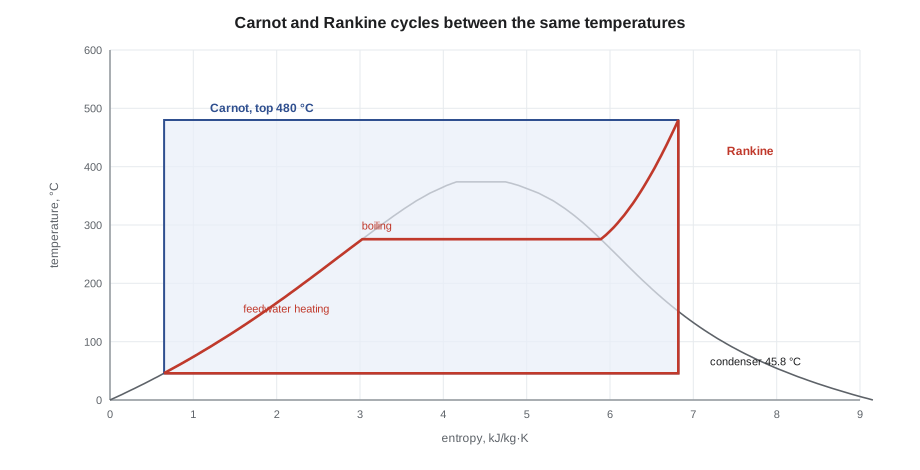
The Carnot cycle is the reversible cycle operating between a single hot reservoir at absolute temperature T_H and a single cold reservoir at T_C. It consists of four processes: reversible isothermal heat addition at T_H, reversible adiabatic (isentropic) expansion to T_C, reversible isothermal heat rejection at T_C, and isentropic compression back to T_H. On a temperature-entropy diagram it is a rectangle.
The temperatures must be absolute: kelvins in SI or degrees Rankine in US units. No engine working between the same two temperatures can be more efficient than a Carnot engine, and all reversible engines between them have the same efficiency. The Carnot efficiency therefore sets the ceiling against which any real cycle can be judged.
Worked problem
Keswold's Carnot limit
Keswold's steam turbine receives steam at 480 °C and exhausts to a condenser at 10 kPa absolute, where the saturation temperature is 45.8 °C. Find the Carnot efficiency between these temperatures.
Show solution
- \[T_H = 480 + 273.15 = 753.15 \text{ K}, \qquad T_C = 45.8 + 273.15 = 318.96 \text{ K}\]
- \[\eta_{Carnot} = 1 - \frac{318.96}{753.15} = 0.577\]
Answer: 0.577. An ideal simple Rankine cycle at Keswold's steam conditions reaches only about 0.38, because most of its heat is added at temperatures far below the top value.
The Carnot cycle cannot be built in practice. Isothermal heat addition to a gas is very slow, and with steam, isentropic compression of a wet mixture to saturated liquid would need a compressor handling two phases. Its value is as a benchmark and as a guide: any change that raises the average temperature at which heat is added, or lowers the average temperature at which it is rejected, moves a real cycle toward Carnot. Superheating, reheating and feedwater heating in a steam plant, and regeneration in a gas turbine, all work this way.
A useful refinement is the idea of a mean temperature of heat addition. For any internally reversible process, the heat added equals the area under the process line on the T-s diagram, so a mean temperature can be defined as the heat added divided by the entropy change. The efficiency of an ideal cycle is then one minus the ratio of the mean temperatures of rejection and addition. A steam cycle rejecting heat at a condensing temperature of 46 °C (115 °F) but receiving heat from feedwater at about 46 °C (115 °F) up to 480 °C (900 °F) has a mean addition temperature of only about 240 °C (465 °F), and that, far more than the top temperature, sets its efficiency.
Air-standard cycles
Internal combustion engines and gas turbines do not operate on closed cycles: air enters, fuel burns, and products leave. To analyse them, engineers use air-standard assumptions: the working fluid is air, behaving as an ideal gas; combustion is replaced by heat addition from an outside source; the exhaust is replaced by heat rejection that returns the air to its initial state; and all processes are internally reversible. With constant specific heats taken at room temperature, the analysis is called cold air-standard. The results overstate real efficiencies, but they show correctly how compression ratio, heat addition and gas properties affect performance.
For air at room temperature the constants are: specific heat at constant pressure c_p = 1.005 kJ/kg·K, at constant volume c_v = 0.718 kJ/kg·K, gas constant R = 0.287 kJ/kg·K and ratio of specific heats k = 1.4. Isentropic processes of an ideal gas follow:
The Otto cycle
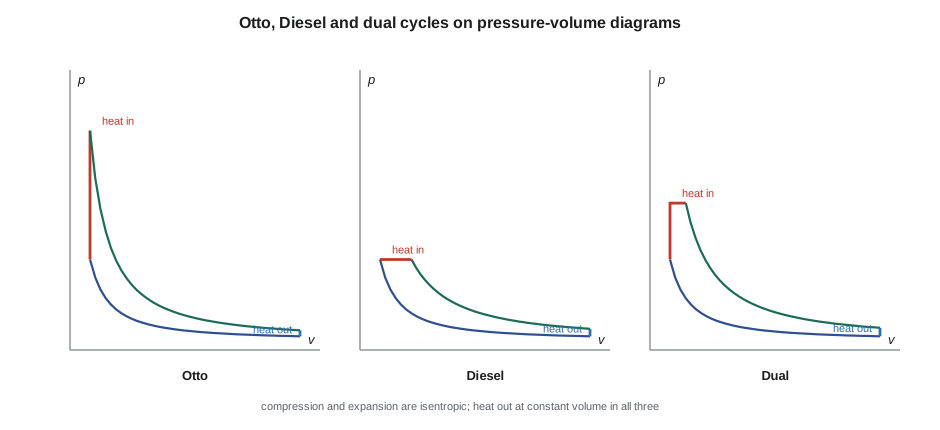
The Otto cycle is the ideal cycle for spark-ignition engines, including the natural gas engines used for generators and combined heat and power. It has four processes: isentropic compression, constant-volume heat addition (the spark-ignited combustion, idealized as instantaneous), isentropic expansion, and constant-volume heat rejection. Its efficiency depends only on the compression ratio r, the ratio of the largest to the smallest cylinder volume:
With k = 1.4, a compression ratio of 8 gives 0.565, 10 gives 0.602 and 12 gives 0.630. Raising the compression ratio raises efficiency, but in a spark-ignition engine the ratio is limited by knock, the spontaneous ignition of the unburned mixture ahead of the flame front. Natural gas resists knock better than gasoline, which is one reason large gas engines run at compression ratios around 11 to 13 (typical), often with turbocharging and lean-burn combustion.
Worked problem
An air-standard Otto cycle
An Otto cycle has a compression ratio of 10. Air enters at 300 K (27 °C), and 1,200 kJ/kg of heat is added at constant volume. Using cold air-standard properties, find the temperatures after compression, after heat addition and after expansion, the net work and the efficiency.
Show solution
- \[T_2 = 300 \times 10^{0.4} = 753.6 \text{ K}\]
- \[T_3 = 753.6 + \frac{1{,}200}{0.718} = 2{,}424.9 \text{ K}\]
- \[T_4 = \frac{2{,}424.9}{10^{0.4}} = 965.4 \text{ K}\]
- \[q_{out} = 0.718 \times (965.4 - 300) = 477.7 \text{ kJ/kg}\]
- \[w_{net} = 1{,}200 - 477.7 = 722.3 \text{ kJ/kg}, \qquad \eta = \frac{722.3}{1{,}200} = 0.602\]
Answer: The efficiency equals the formula value of 0.602; the temperature after expansion is the exhaust temperature of the ideal cycle.
Real engines fall well short of the air-standard result. Specific heats rise with temperature, so the actual temperature after combustion is lower; heat is lost to the cylinder walls and jacket water; combustion takes time; the valves and the gas exchange absorb pumping work; and friction absorbs more. The gas engine Grazyna had pencilled in for Cantwell's combined heat and power study, a unit of about 2,000 kW electrical, would convert about 0.42 of its fuel's lower heating value to electricity (typical maker data), against about 0.63 for an ideal Otto cycle at its compression ratio. The rest of the fuel energy leaves in the exhaust and the jacket and oil coolers, which is exactly what a CHP plant recovers.
The Diesel and dual cycles
The Diesel cycle is the ideal cycle for compression-ignition engines. Air alone is compressed, to a much higher ratio than in a spark-ignition engine, and fuel is injected near the end of compression and burns as the piston begins to descend. The ideal heat addition is therefore at constant pressure. The ratio of the cylinder volumes at the end and the start of heat addition is the cutoff ratio r_c:
The bracketed term is always greater than one, so at the same compression ratio a Diesel cycle is less efficient than an Otto cycle. Diesel engines are more efficient in practice because they run at much higher compression ratios, typically 14 to 22 (typical), with no knock limit, because the fuel is not present during compression. A larger cutoff ratio, meaning more fuel injected for more power, lowers the ideal efficiency.
Worked problem
An air-standard Diesel cycle
A Diesel cycle has a compression ratio of 18 and a cutoff ratio of 2. Air enters at 300 K. Find the temperatures at the end of compression, at cutoff and at the end of expansion, the heat added and rejected, and the efficiency.
Show solution
- \[T_2 = 300 \times 18^{0.4} = 953.3 \text{ K}, \qquad T_3 = 2 \times 953.3 = 1{,}906.6 \text{ K}\]
- \[T_4 = T_3 \left(\frac{r_c}{r}\right)^{0.4} = 1{,}906.6 \times \left(\frac{2}{18}\right)^{0.4} = 791.7 \text{ K}\]
- \[q_{in} = 1.005 \times (1{,}906.6 - 953.3) = 958.1 \text{ kJ/kg}, \qquad q_{out} = 0.718 \times (791.7 - 300) = 353.0 \text{ kJ/kg}\]
- \[\eta = 1 - \frac{353.0}{958.1} = 0.632\]
Answer: 0.632, the same as the formula gives. An Otto cycle at a compression ratio of 18 would reach 0.685.
Real engines add heat partly at constant volume and partly at constant pressure, and the dual cycle (also called the limited-pressure or Sabathé cycle) models this with both. It reduces to the Otto cycle when the cutoff ratio is one and to the Diesel cycle when the constant-volume pressure rise is zero. Cantwell's 400 kW standby diesel generator, tested monthly as described in PWR-230, works on a cycle of this kind.
| Cycle | Heat addition | Heat rejection | Efficiency depends on |
|---|---|---|---|
| Carnot | Isothermal | Isothermal | T_C and T_H only |
| Otto | Constant volume | Constant volume | Compression ratio |
| Diesel | Constant pressure | Constant volume | Compression ratio and cutoff ratio |
| Dual | Constant volume then constant pressure | Constant volume | Compression, pressure and cutoff ratios |
| Brayton | Constant pressure | Constant pressure | Pressure ratio |
| Stirling | Isothermal (with regeneration) | Isothermal (with regeneration) | T_C and T_H only |
| Ericsson | Isothermal (with regeneration) | Isothermal (with regeneration) | T_C and T_H only |
| Rankine | Constant pressure (with phase change) | Constant pressure (condensing) | Pressures and temperatures of the steam |
Stirling and Ericsson cycles
The Stirling cycle consists of two isothermal processes joined by two constant-volume processes, and the Ericsson cycle of two isothermal processes joined by two constant-pressure processes. In each, the heat rejected during one of the connecting processes is stored in a regenerator, a matrix of fine wire or metal, and returned during the other. With a perfect regenerator, all the external heat is added at the top temperature and rejected at the bottom temperature, and both cycles reach the Carnot efficiency.
Stirling engines are external-combustion engines: the heat can come from any source, including burning biomass, concentrated sunlight or radioactive decay, which is why they have been used in small solar dish generators, submarine propulsion and space power systems. They are quiet and efficient but expensive and bulky for their power, because heat must pass through walls into the working gas. The Ericsson cycle is approached by a gas turbine with many stages of intercooling and reheat and a regenerator, as lesson 3 shows: in the limit of infinite stages, the compression and expansion become isothermal.
Entropy generation and lost work
The Carnot benchmark compares cycles. A second, more practical tool locates the losses inside a plant. Every irreversible process generates entropy, and the work that could have been obtained but was not, the lost work or exergy destruction, equals the entropy generated multiplied by the absolute temperature of the surroundings, T₀:
Heat transfer across a large temperature difference is one of the biggest sources of entropy generation in a boiler. When heat Q passes from a flame at T₁ to water and steam at T₂, the entropy generated is:
Worked problem
Lost work in a boiler
1,000 kW of heat passes from combustion gases at an average 1,200 °C to boiling water at 185 °C. The surroundings are at 20 °C. Find the entropy generated and the lost work.
Show solution
- \[S_{gen} = \frac{1{,}000}{458.15} - \frac{1{,}000}{1{,}473.15} = 1.504 \text{ kW/K}\]
- \[W_{lost} = 293.15 \times 1.504 = 441 \text{ kW}\]
Answer: Of every 1,000 kW passed from the flame to the water at Cantwell's pressure, the capacity to do about 441 kW of work is destroyed in the heat transfer itself, even though no energy is lost. This is why high steam pressures and temperatures, which raise T₂, improve power plant efficiency.
Exergy
Exergy, also called availability, is the maximum useful work that could be obtained from a stream or a quantity of energy as it is brought into equilibrium with the surroundings, the dead state. For a flowing stream, ignoring kinetic and potential energy, the specific flow exergy is:
where h₀ and s₀ are the properties of the fluid at the temperature and pressure of the surroundings. Energy is conserved, but exergy is destroyed by every irreversibility, so an exergy balance of a plant shows where the real losses are. An energy balance of a power plant shows the condenser as the largest loss, because most of the heat leaves there; an exergy balance shows that the condenser heat, at about 46 °C, has little value, and that the largest destruction of exergy happens in the boiler, in combustion and in heat transfer across large temperature differences.
Worked problem
The exergy of Cantwell's steam
Cantwell's boilers make saturated steam at 1,136 kPa absolute (h_g = 2,781.8 kJ/kg, s_g = 6.5408 kJ/kg·K). Take the dead state as liquid water at 20 °C and 101.325 kPa (h₀ = 84.0 kJ/kg, s₀ = 0.2965 kJ/kg·K). Find the flow exergy of the steam and compare it with its enthalpy above the dead state.
Show solution
- \[h - h_0 = 2{,}781.8 - 84.0 = 2{,}697.8 \text{ kJ/kg}\]
- \[\psi = 2{,}697.8 - 293.15 \times (6.5408 - 0.2965) = 867.3 \text{ kJ/kg}\]
- \[\frac{867.3}{2{,}697.8} = 0.321\]
Answer: About 0.32 of the steam's energy is exergy. By the same calculation, Keswold's main steam at 6,000 kPa and 480 °C (880 psia and 900 °F) carries about 0.42, which is why it can make power that Cantwell's steam cannot.
Exergy analysis explains much of what Second Class engineers are asked to judge. Using high-pressure steam to heat a building, or throttling it through a pressure reducing valve, destroys exergy that a back-pressure turbine could have turned into power; cogeneration recovers it. A heat pump that lifts ambient heat to a moderate temperature can use far less exergy than a boiler burning fuel at a flame temperature of 1,900 °C (3,450 °F) to make 70 °C (158 °F) water. The second-law efficiency of a device, the ratio of the exergy it delivers to the exergy it consumes, measures how close the device comes to perfection in a way the first-law efficiency cannot. A boiler that is 0.82 efficient by the first law may have a second-law efficiency of about 0.35 to 0.45 (typical).
At the end of the session Pilar wrote three numbers at the top of her notebook: 0.577 for the Carnot limit of Keswold's steam cycle, 0.42 for the gas engine Grazyna was studying, and 0.32 for the fraction of Cantwell's steam that was exergy. "Everything we do here for the next twelve weeks," Grazyna said, "is about those three kinds of number: what is possible, what the machine does, and what the energy is really worth."
Common mistakes
MistakeUsing degrees Celsius or Fahrenheit in the Carnot formula.
InsteadUse absolute temperatures, kelvins or degrees Rankine; otherwise the result is meaningless.
MistakeThinking a Diesel cycle is less efficient than an Otto cycle in practice because the formula says so.
InsteadThe comparison holds only at the same compression ratio; Diesel engines run at much higher ratios.
MistakeTreating air-standard efficiencies as achievable.
InsteadReal engines lose heat to walls, have variable specific heats, take time to burn and absorb pumping and friction work; they reach roughly two thirds of the ideal.
MistakeJudging a plant's losses from an energy balance alone.
InsteadAn exergy balance shows that the boiler, not the condenser, destroys the most work potential.
MistakeBelieving a perfect regenerator makes any gas cycle reach Carnot.
InsteadOnly the Stirling and Ericsson cycles, with isothermal heat exchange, reach Carnot with perfect regeneration.
Summary and key terms
- Over a cycle, net work equals net heat; efficiency is one minus the ratio of heat rejected to heat added.
- The Carnot efficiency, 1 − T_C ÷ T_H with absolute temperatures, is the upper limit between two temperatures.
- Raising the mean temperature of heat addition or lowering that of rejection improves any cycle.
- The Otto efficiency depends on compression ratio; the Diesel efficiency also falls as the cutoff ratio rises.
- Stirling and Ericsson cycles with perfect regeneration reach the Carnot efficiency.
- Lost work equals T₀ times the entropy generated; exergy is the work potential of energy relative to the surroundings.
- Carnot cycle
- The reversible cycle of two isothermal and two isentropic processes; the most efficient possible between two temperatures.
- Air-standard assumptions
- Simplifications that model engine and gas turbine cycles as closed cycles of ideal-gas air with external heat transfer.
- Compression ratio
- The ratio of the largest to the smallest cylinder volume in a reciprocating engine.
- Cutoff ratio
- In a Diesel cycle, the ratio of cylinder volumes at the end and the start of heat addition.
- Regenerator
- A heat store that takes heat from the working fluid in one part of a cycle and returns it in another.
- Entropy generation
- Entropy created inside a system by irreversible processes; never negative.
- Exergy
- The maximum useful work obtainable from energy or a stream brought into equilibrium with the surroundings.
- Second-law efficiency
- The ratio of the exergy delivered by a device to the exergy it consumes.
Practice problems
Work each problem on paper first, then reveal the answer to check.
Find the Carnot efficiency between 540 °C and 30 °C.
Show answer
1 − 303.15 ÷ 813.15 = 0.627.
Find the Otto efficiency at a compression ratio of 12, with k = 1.4.
Show answer
1 − 12^−0.4 = 0.630.
Find the Diesel efficiency at r = 16 and r_c = 2, with k = 1.4.
Show answer
0.614.
2,000 kW passes from gas at 1,000 °C to steam at 250 °C with surroundings at 20 °C. Find the lost work.
Show answer
S_gen = 2,000 ÷ 523.15 − 2,000 ÷ 1,273.15 = 2.252 kW/K; lost work = 293.15 × 2.252 = 660 kW.
Lesson quiz · 5 questions
Score 60% or more to complete this lesson.
Create a free account to save your progress, take quizzes and earn a certificate.