
PWR-410 · Lesson 3 of 12 · 24 min
Gas turbine and combined cycle analysis
▶ Video coming soon A video version of this lesson is on the way.
Okonkwo came to the third session with a sheet from his Keswold visits: the gas turbine's pressure ratio of about 12, its firing temperature, the exhaust flow and temperature, and the steam turbine's output with the duct burners off. Grazyna had asked him to bring it. "PWR-320 showed you how the Brayton cycle works," she said. "Tonight we change it. We will add a regenerator, an intercooler and a reheat combustor one at a time and see which ones help, and then we will put Keswold's steam plant on top and see why combined cycles took over the power business."
This lesson extends the Brayton cycle analysis of PWR-320 with component efficiencies, the effect of pressure ratio on efficiency and specific work, regeneration, intercooling and reheat, and then analyses combined cycles and the efficiency of Keswold's plant as a combined cycle.
The Brayton cycle with real components
The ideal Brayton cycle has isentropic compression, constant-pressure heat addition, isentropic expansion and constant-pressure heat rejection. Its efficiency depends only on the pressure ratio r_p:
Real compressors and turbines have isentropic efficiencies η_c and η_t, defined so that the compressor needs more work and the turbine gives less than the ideal machines:
For the examples in this lesson the air enters at 15 °C (288.15 K), the turbine inlet temperature is 1,150 °C (1,423.15 K), η_c = 0.86 and η_t = 0.89, the values used for Keswold in PWR-320, with c_p = 1.005 kJ/kg·K and k = 1.4 for both air and gas. These cold-air assumptions understate the turbine work, because the hot gas has a higher specific heat, but they show the trends correctly.
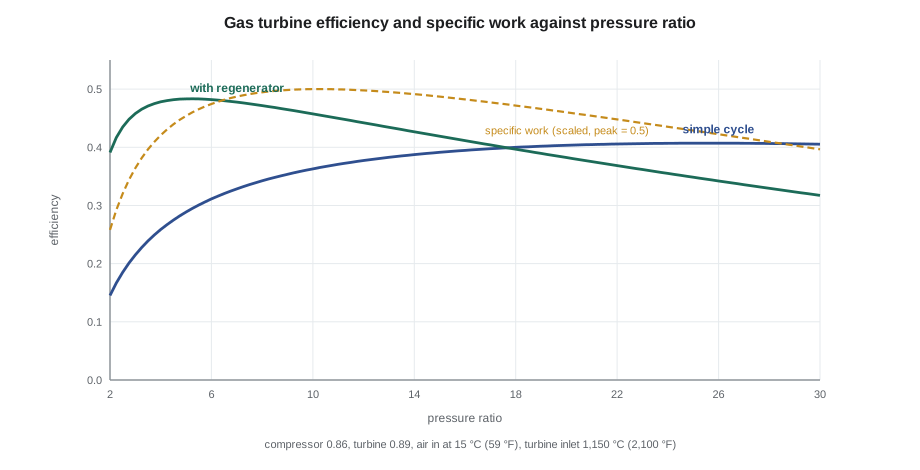
With real components, the efficiency no longer rises without limit as the pressure ratio rises. At a high pressure ratio, the compressor work becomes so large, and the heat that can be added between the compressor outlet temperature and the fixed turbine inlet temperature so small, that the net work falls toward zero. There are two optimum pressure ratios: one for the most specific work (net work per kilogram of air, which sets the size of the machine for a given output) and a higher one for the best efficiency.
| Pressure ratio | Simple cycle efficiency | Net work, kJ/kg | Exhaust temperature, °C | Efficiency with regenerator (effectiveness 0.80) |
|---|---|---|---|---|
| 4 | 0.259 | 252.7 | 735.8 | 0.478 |
| 6 | 0.311 | 284.9 | 642.5 | 0.482 |
| 8 | 0.342 | 297.0 | 582.6 | 0.472 |
| 12 | 0.377 | 298.9 | 506.1 | 0.442 |
| 16 | 0.395 | 289.6 | 457.0 | 0.411 |
| 20 | 0.403 | 276.3 | 421.6 | 0.382 |
| 30 | 0.405 | 238.1 | 362.7 | 0.317 |
The table shows why industrial and utility gas turbines run at pressure ratios between about 12 and 25 (typical): specific work is near its peak at a ratio of about 10 to 12, and efficiency keeps improving slowly beyond that. Aeroderivative turbines, developed from jet engines, run at higher ratios, 25 to 40 (typical), because they also have higher turbine inlet temperatures, which move both optimum ratios upward. Raising the turbine inlet temperature is the most powerful single improvement, and it is why gas turbine makers have invested so heavily in blade cooling, thermal barrier coatings and single-crystal blade alloys.
Regeneration
In a simple-cycle gas turbine, the exhaust leaves hot: about 506 °C (942 °F) at a pressure ratio of 12 in the table, and hotter at lower ratios. A regenerator (also called a recuperator) is a gas-to-air heat exchanger that uses this exhaust to preheat the compressed air before it enters the combustor, so less fuel is needed to reach the turbine inlet temperature. Its performance is described by its effectiveness ε, the fraction of the possible temperature rise of the air that is achieved:
The net work is unchanged, because the compressor and turbine are unchanged; only the heat input falls. A regenerator can help only when the turbine exhaust is hotter than the compressor outlet. At high pressure ratios the two temperatures approach each other, and beyond the crossover a regenerator would heat the exhaust instead of the air.
Worked problem
Adding a regenerator
For the cycle at a pressure ratio of 6, the compressor outlet is 239.0 °C and the turbine exhaust is 642.5 °C. A regenerator of effectiveness 0.80 is added. Find the air temperature entering the combustor, the heat input and the efficiency.
Show solution
- \[T_x = 239.0 + 0.80 \times (642.5 - 239.0) = 561.8\ ^\circ\text{C}\]
- \[q_{in} = 1.005 \times (1{,}150 - 561.8) = 591.1 \text{ kJ/kg} \quad (\text{was } 915.6)\]
- \[\eta = \frac{284.9}{591.1} = 0.482 \quad (\text{was } 0.311)\]
Answer: The efficiency rises from 0.311 to 0.482. At a pressure ratio of 12 the same regenerator raises it only from 0.377 to 0.442, because there is less temperature difference to work with.
Regenerators are used on small gas turbines and microturbines, which run at low pressure ratios, and on some mechanical-drive units on pipelines. Large industrial turbines usually do without them: the exchanger is large and costly, adds pressure losses on both the air and gas sides, takes time to warm up, and suffers from thermal cycling. In plants that need heat or extra power, the exhaust heat is better used in a heat recovery steam generator (HRSG), which is what Keswold does.
Intercooling and reheat
The compressor work is proportional to the absolute temperature of the air being compressed, so cooling the air partway through compression reduces the work. With intercooling between two stages of equal pressure ratio, each stage compresses from near the inlet temperature, and the total work falls. Similarly, the turbine work rises with the absolute temperature of the gas, so reheating the gas in a second combustor partway through the expansion increases the turbine work. In the limit of many stages of intercooling and reheat, compression and expansion become isothermal, and with a perfect regenerator the cycle becomes the Ericsson cycle of lesson 1, reaching the Carnot efficiency.
Each addition, taken alone, has a surprising effect on efficiency.
| Arrangement (pressure ratio 6) | Net work, kJ/kg | Heat input, kJ/kg | Efficiency |
|---|---|---|---|
| Simple | 284.9 | 915.6 | 0.311 |
| Regenerator only | 284.9 | 591.1 | 0.482 |
| Two-stage intercooled | 313.6 | 1,042.4 | 0.301 |
| Intercooled with reheat | 378.5 | 1,329.9 | 0.285 |
| Intercooled, reheat and regenerator | 378.5 | 725.9 | 0.521 |
Intercooling raises the net work by about 10 in 100 but lowers the efficiency, because the air now leaves the compressor colder, at 112.7 °C (234.9 °F) instead of 239.0 °C (462.2 °F), and the combustor must add more heat. Reheat raises the net work further, by about a third over the simple cycle, but the extra heat is added at a lower pressure and so at a lower effective temperature, and the exhaust leaves even hotter. Both make sense only when the exhaust heat is recovered, by a regenerator or by an HRSG. Some modern aeroderivative units use intercooling to raise output, and one family of large heavy-duty turbines uses sequential combustion, a second combustor after the first turbine stage, to raise output and keep the exhaust hot for a combined cycle. Gas turbines built for combined cycles are optimized for the combination, not for simple-cycle efficiency.
Worked problem
Reheat and regenerator at a pressure ratio of 12
At a pressure ratio of 12, with two-stage intercooling, reheat to 1,150 °C between two equal turbine stages and a regenerator of effectiveness 0.80, the calculation gives compressor outlet 157.8 °C, exhaust 771.5 °C, net work 473.7 kJ/kg and heat input 884.1 kJ/kg. Find the efficiency and compare it with the simple cycle.
Show solution
- \[\eta = \frac{473.7}{884.1} = 0.536 \quad (\text{simple: } 0.377)\]
- \[\frac{473.7}{298.9} = 1.58\]
Answer: 0.536, with nearly 60 in 100 more output per unit of air. The machine would be large, complicated and costly; a combined cycle reaches higher efficiency more simply.
The combined cycle
A combined cycle uses the exhaust of a gas turbine, the topping cycle, to raise steam for a steam turbine, the bottoming cycle. The gas turbine exhaust, at 500 to 650 °C (930 to 1,200 °F) (typical), is too hot to throw away and well suited to raising steam at moderate pressure and temperature. If η_g is the gas turbine efficiency and the steam plant turns a fraction η_b of the gas turbine's exhaust heat (its fuel input less its output, ignoring small losses) into power, the combined efficiency is:
The bottoming efficiency η_b is itself the product of the fraction of exhaust heat the HRSG recovers and the efficiency of the steam cycle on that heat. A modern heavy-duty gas turbine of about 0.40 efficiency, with a bottoming cycle converting about 0.35 to 0.38 of its exhaust heat into power, gives a combined efficiency of 0.61 to 0.63 (typical), and the best large plants reach a little over 0.62 to 0.64 on the lower heating value (typical). The bottoming cycle improves when the HRSG has two or three pressure levels and reheat, because the steam is raised at temperatures that follow the cooling gas more closely, which reduces the entropy generated in heat transfer across large temperature differences, as lesson 1 showed.
Worked problem
Keswold as a combined cycle
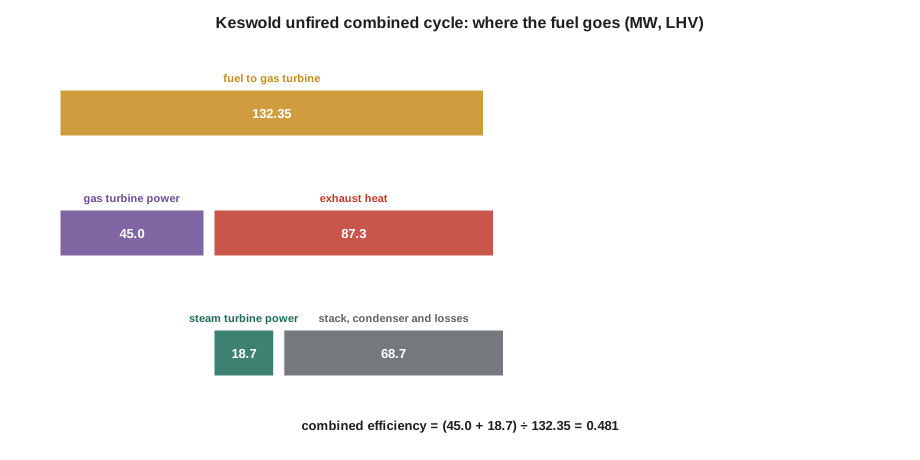
With the duct burners off and no extraction to Marrowby Foods, Keswold's gas turbine makes 45 MW at an efficiency of 0.34 on the LHV, and its steam turbine generator makes 18.68 MW from the unfired HRSG. Find the fuel input, the gas turbine's exhaust heat, the bottoming efficiency and the combined efficiency. Then find the heat rates.
Show solution
- \[\text{fuel} = \frac{45}{0.34} = 132.35 \text{ MW}, \qquad \text{exhaust heat} = 132.35 - 45 = 87.35 \text{ MW}\]
- \[\eta_b = \frac{18.68}{87.35} = 0.214, \qquad \eta_{cc} = 0.34 + 0.66 \times 0.214 = 0.481\]
- \[HR_{GT} = \frac{3{,}600}{0.34} = 10{,}590 \text{ kJ/kWh}, \qquad HR_{cc} = \frac{3{,}600}{0.481} = 7{,}480 \text{ kJ/kWh}\]
Answer: 0.481 on the LHV, against 0.34 for the gas turbine alone. Keswold's bottoming efficiency is modest because its single-pressure HRSG recovers about 0.65 of the exhaust heat and its steam cycle, at moderate steam conditions, turns about 0.34 of that into power.
The two factors in Keswold's bottoming efficiency can be checked. The HRSG cools 145 kg/s of exhaust gas from 545 °C to about 201 °C (1,013 °F to about 395 °F); if the gas could be cooled to ambient, the recovered fraction would be about (545 − 201) ÷ (545 − 15) = 0.65 ((1,013 − 395) ÷ (1,013 − 59) = 0.65), and the steam plant's 18.68 MW out of the 54.9 MW absorbed in the HRSG is about 0.34. A three-pressure reheat HRSG would cool the gas to about 85 to 100 °C (185 to 210 °F) (typical) and run a steam cycle near 0.38, raising the bottoming efficiency to well over 0.30.
Duct firing, cogeneration and part load
Keswold's duct burners, in the HRSG inlet, burn extra gas in the turbine exhaust, which still contains about 13 to 15 parts in 100 oxygen (typical). Duct firing raises steam output quickly and cheaply, and the extra heat is converted at nearly boiler efficiency, but the extra steam makes power only at the steam cycle's efficiency, so the plant's electrical efficiency falls when the burners are on. In a cogeneration plant that is acceptable, because the extra steam usually goes to the process. At Keswold's full winter load, with the burners on and 6.0 kg/s extracted for Marrowby Foods, PWR-320 found an electrical efficiency of about 0.44 and a total fuel utilization of about 0.56. Lesson 7 shows how such a plant's heat rate is defined and tested.
Gas turbines lose efficiency at part load. A single-shaft turbine running at constant speed reduces output by lowering the firing temperature, and both its efficiency and its exhaust temperature fall. Most units close their inlet guide vanes at first, reducing airflow so that the exhaust temperature stays high for the HRSG, and only then reduce firing temperature. Below roughly half load, emissions of carbon monoxide rise as the low-NOx combustors approach their stability limits, and many units have a minimum emissions-compliant load. On hot days the air is less dense, so the mass flow, the output and the efficiency all fall; PWR-320 found that a 15 K rise in inlet temperature cost about 6 in 100 of Keswold's net output, which is why the plant has evaporative inlet cooling.
Pilar ended the evening by writing the formula for the combined cycle on a card for her study binder, and next to it the two numbers that had surprised her: intercooling alone lowers efficiency, and the efficiency of the combination is higher than either machine could reach alone. "That is the whole idea of cogeneration too," Grazyna said. "Use the heat one machine cannot."
Common mistakes
MistakeAssuming a higher pressure ratio always means higher efficiency.
InsteadWith real components, efficiency peaks and specific work peaks at a lower ratio.
MistakeAdding a regenerator to a high-pressure-ratio gas turbine.
InsteadA regenerator helps only when the exhaust is much hotter than the compressor outlet.
MistakeExpecting intercooling alone to raise efficiency.
InsteadIt raises net work but lowers the compressor outlet temperature, so more fuel is needed; it pays only with heat recovery.
MistakeAdding the gas and steam turbine efficiencies to find the combined efficiency.
InsteadUse η_cc = η_g + (1 − η_g) η_b, where η_b applies to the gas turbine's exhaust heat.
MistakeIgnoring the effect of duct firing on electrical efficiency.
InsteadExtra steam from duct firing makes power at steam-cycle efficiency, so electrical efficiency falls.
Summary and key terms
- With real compressors and turbines, gas turbine efficiency and specific work each have an optimum pressure ratio.
- A regenerator lowers heat input without changing net work, and helps most at low pressure ratios.
- Intercooling and reheat raise net work but lower efficiency unless the exhaust heat is recovered.
- Combined efficiency is η_g + (1 − η_g) η_b; modern combined cycles reach about 0.6 or more on the LHV.
- Keswold, unfired, reaches about 0.48: its single-pressure HRSG and moderate steam conditions limit the bottoming cycle.
- Hot weather, part load and duct firing all lower a gas turbine plant's electrical efficiency.
- Isentropic efficiency
- The ratio of ideal to actual work for a compressor, or actual to ideal work for a turbine.
- Specific work
- Net work per unit mass of air; it sets the size of a gas turbine for a given output.
- Regenerator
- In a gas turbine, a heat exchanger that preheats compressed air with turbine exhaust; also called a recuperator.
- Effectiveness
- The ratio of the actual heat transfer in an exchanger to the maximum possible.
- Intercooling
- Cooling air between stages of compression to reduce compressor work.
- Topping and bottoming cycles
- In a combined cycle, the gas turbine cycle and the steam cycle that uses its exhaust heat.
- Duct burner
- A burner in the HRSG inlet that fires extra fuel into the turbine exhaust.
- Inlet guide vanes
- Adjustable vanes at the compressor inlet that control airflow at part load.
Practice problems
Work each problem on paper first, then reveal the answer to check.
Find the ideal Brayton efficiency at a pressure ratio of 16 with k = 1.4.
Show answer
1 − 16^−0.2857 = 0.547.
A gas turbine has a compressor outlet of 300 °C and exhaust of 600 °C. A regenerator of effectiveness 0.75 is added. Find the air temperature into the combustor.
Show answer
300 + 0.75 × 300 = 525 °C.
A gas turbine of 0.38 efficiency feeds a bottoming cycle with η_b = 0.32. Find the combined efficiency.
Show answer
0.38 + 0.62 × 0.32 = 0.578.
A combined cycle has an efficiency of 0.58 on the LHV. Find its heat rate.
Show answer
3,600 ÷ 0.58 = 6,207 kJ/kWh.
Lesson quiz · 5 questions
Score 60% or more to complete this lesson.
Create a free account to save your progress, take quizzes and earn a certificate.