
PWR-230 · Lesson 9 of 12 · 25 min
Cooling water systems
▶ Video coming soon A video version of this lesson is on the way.
On Saturday, October 24, 2026, Pilar Quenneville did the weekly cooling tower check and took Tamar Ellingsen with her up the roof ladder. Cantwell's small induced-draft cooling tower sits on the roof of the pump gallery and rejects the heat from the water-cooled chiller that serves the control room, the electrical rooms and the offices all year round. Pilar opened the access door just far enough to look at the fill and the basin, then closed it and stood upwind while she drew a water sample. "This is the most dangerous water in the plant," she said, "and not because it's hot. Warm, sunlit, splashing water full of nutrients is exactly where Legionella grows. If we let this tower go, it could make people sick a block away."
This lesson covers how open recirculating cooling systems work, the water balance of a cooling tower with its evaporation, blowdown and cycles of concentration, how cooling water is treated against scale, corrosion and biological growth, how Legionella is controlled and what Ontario, Quebec and Hamilton require, and how closed cooling and heating loops are cared for.
Kinds of cooling water system
- Once-through systems take water from a river, lake or the city main, pass it through the equipment once and discharge it. They use enormous amounts of water; once-through cooling with city water is wasteful and prohibited by many municipalities' bylaws or codes.
- Open recirculating systems pass the water through the equipment and then through a cooling tower, where part of it evaporates to cool the rest. The cooled water returns to the equipment. Most plant and building cooling uses this kind of system.
- Closed systems circulate the same water, or a water-glycol mixture, in a sealed loop, cooled by a heat exchanger, a dry cooler or a closed-circuit cooling tower. Little water is lost, so the water can be treated heavily and stays clean. Chilled water loops and hot water heating loops are closed systems.
How a cooling tower works
In a cooling tower, warm water is sprayed or distributed over fill, a pack of corrugated plastic sheets or splash bars that spreads the water into thin films and droplets, while air is drawn through it. A small part of the water evaporates, and the latent heat of that evaporation comes from the rest of the water, which is cooled. The cooled water collects in the basin and is pumped back to the equipment.
Towers are described by how the air moves:
- Induced-draft towers have a fan at the top that pulls air through; forced-draft towers have a fan at the base that pushes it. Natural-draft towers, the huge hyperbolic shells at power stations, rely on the chimney effect.
- In counterflow towers the air rises straight up against the falling water; in crossflow towers it moves sideways across it.
Other parts include the drift eliminators, baffles at the air outlet that catch droplets before they leave the tower, the make-up valve that replaces lost water, the bleed or blowdown line, the basin heater that keeps the water from freezing in winter, and the fan, motor and gearbox or belt drive.
A cooling tower cannot cool water below the air's wet-bulb temperature, the temperature a wetted thermometer reaches as water evaporates from it. Two terms describe tower performance:
- The range: hot water temperature in minus cold water temperature out. It is set by the heat load and the water flow.
- The approach: cold water temperature out minus the wet-bulb temperature. It is set by the tower's size and condition. A typical design approach is about 4 to 6 K (7 to 10 °F).
At a typical summer design condition, Cantwell's tower cools water from 35 °C (95 °F) to about 29.4 °C (85 °F), a range of 5.6 K (10 °F), with a wet bulb of about 23.3 °C (74 °F), an approach of about 6.1 K (11 °F).
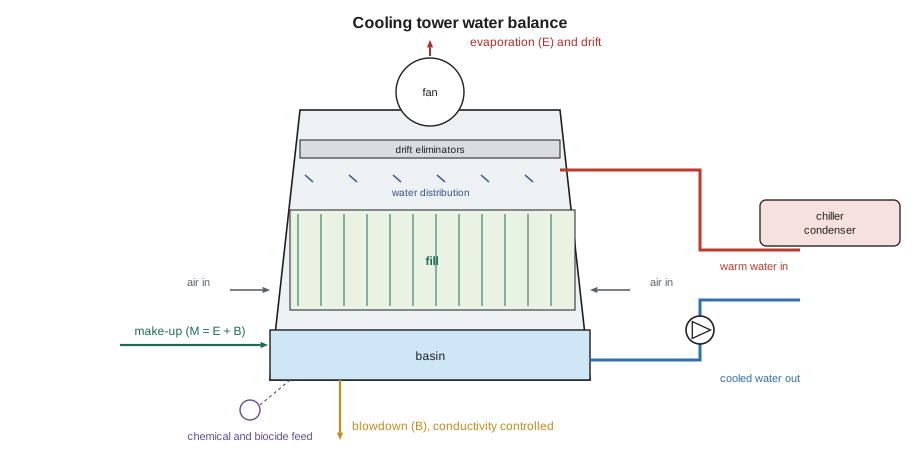
The water balance
Water leaves an open recirculating system in three ways:
- Evaporation (E): the water that cooled the rest. It leaves as pure vapour and takes no dissolved solids with it. A useful rule of thumb is that about 1 in 100 of the circulating flow evaporates for every 5.6 K (10 °F) of range.
- Drift: droplets carried out with the air. Modern drift eliminators keep it to a very small fraction of the circulating flow, typically well under 1 in 10,000.
- Blowdown (B): water drained on purpose to keep the dissolved solids from building up too far, together with any other losses such as leaks.
Make-up (M) replaces all of it. As the water evaporates, the dissolved solids that were in the make-up stay behind and concentrate. The ratio of the concentration in the tower water to the concentration in the make-up is the cycles of concentration (C). The same idea appeared for boiler blowdown in PWR-220 lesson 9:
where B includes drift. Cycles are measured by comparing the conductivity, or better the chloride or magnesium, of the tower water with that of the make-up.
Worked problem
Water balance for Cantwell's tower
The tower circulates 15 L/s with a range of 5.6 K, and runs at 4 cycles of concentration. Estimate the evaporation, blowdown and make-up, per hour and per day.
Show solution
- Evaporation, by the rule of thumb:
- \[E = 0.01 \times 15 = 0.15 \text{ L/s} = 540 \text{ L/h}\]
- Blowdown:
- \[B = \frac{540}{4 - 1} = 180 \text{ L/h}\]
- Make-up:
- \[M = 540 + 180 = 720 \text{ L/h} \to 720 \times 24 = 17{,}280 \text{ L/day}\]
Answer: About 720 L/h of make-up, about 17 m³ a day at full load. Raising the cycles from 4 to 6 would cut the blowdown to 108 L/h and the make-up to 648 L/h, saving about 1.7 m³ a day, but the water would then carry 6 times the make-up's hardness, so the scale control program would need to be checked first.
Worked problem
Checking the heat load
Check that the flow and range in the last example match the chiller's heat rejection of about 352 kW. Take the specific heat of water as 4.19 kJ/kg·K and 1 L as 1 kg.
Show solution
- \[Q = 15 \times 4.19 \times 5.6 \approx 352 \text{ kW}\]
Answer: About 352 kW, which matches. The chiller's cooling capacity of 290 kW plus its compressor's 62 kW of input all leave through the tower (lesson 10).
Blowdown is usually controlled automatically: a conductivity controller opens a solenoid valve when the tower water's conductivity reaches its set point. Cantwell's city water has a conductivity of about 400 µS/cm, so at 4 cycles the controller is set at about 1,600 µS/cm. Water meters on the make-up and blowdown lines let the operator check the cycles and spot leaks, and in many cities they also support a credit on the sewer charge for the water that evaporated.
Cooling water problems
Open recirculating water causes four kinds of trouble, often together:
- Scale: as the water concentrates and is heated in the condenser tubes, calcium carbonate and other minerals exceed their solubility and deposit on the hottest surfaces. Hamilton's city water, with a hardness of about 120 mg/L as calcium carbonate and an alkalinity of about 95 mg/L, would reach about 480 mg/L hardness at 4 cycles, enough to scale without treatment.
- Corrosion: the water is saturated with oxygen from the air, and the steel piping, copper condenser tubes and galvanized tower parts all corrode. Galvanized towers suffer white rust, a soft white zinc deposit, if the water's pH and alkalinity are not controlled, especially when new.
- Fouling: dust, pollen, leaves and silt washed out of the air, corrosion products and microbial slime build up in the basin, the fill and the condenser.
- Biological growth: bacteria, algae and fungi thrive in warm, aerated, sunlit water. They form biofilm, a slimy layer that insulates heat transfer surfaces, causes corrosion underneath it (microbiologically influenced corrosion), and shelters harmful organisms such as Legionella.
Treating cooling water
A cooling water treatment program, usually designed and serviced by a water treatment supplier such as Keziah Ostby's company, combines several parts:
- Scale inhibitors and dispersants, such as phosphonates and polymers, which hold minerals in solution or keep them suspended so they do not stick to surfaces, along with blowdown to keep the cycles within the program's limits. Some systems also feed acid to lower the alkalinity, which needs careful control.
- Corrosion inhibitors, such as orthophosphate, zinc, molybdate and azoles for copper (tolyltriazole), which form protective films on the metal.
- An oxidizing biocide, usually sodium hypochlorite (bleach) or a bromine compound, fed continuously or in frequent doses to hold a free halogen residual, typically about 0.5 to 1.0 mg/L, in the tower water.
- A non-oxidizing biocide, fed as a periodic slug dose and alternated between types, to reach organisms that the oxidizer misses and to penetrate biofilm.
- Filtration, often a side-stream filter that cleans part of the circulating flow continuously, and regular cleaning of the basin and strainers.
Operators check the program by testing: conductivity, pH, the inhibitor level and the free halogen residual, usually daily or at each visit, with bacteria counts by dip slide weekly and Legionella cultures by an accredited lab on a schedule. Pilar's sample that morning gave a conductivity of 1,580 µS/cm, pH 8.4, a free chlorine residual of 0.7 mg/L and an inhibitor reading in range. She set out a dip slide in the incubator and logged everything on the tower sheet.
She also checked the things that a test kit cannot: the drift eliminators were in place with no gaps, the fill showed no slime or broken sections, the basin had no sludge build-up, the make-up float valve was not stuck, the conductivity probe was clean, and the chemical feed pumps were running with product in their tanks.
Legionella and Legionnaires' disease
Legionella bacteria live naturally in fresh water in small numbers. In warm water between about 25 and 45 °C (77 and 113 °F), with nutrients and biofilm to shelter in, they multiply. When contaminated water is turned into a fine aerosol, as in the drift from a cooling tower, people can breathe it in. In some people, especially older people, smokers and those with weakened immunity, the result is Legionnaires' disease, a severe pneumonia that can kill. Several large outbreaks, including ones in Canada and the United States, have been traced to cooling towers, with cases among people who were never near the building.
Legionella is controlled by keeping the water clean and treated, avoiding stagnant water, and preventing aerosols from leaving the tower:
- Maintain the biocide residual continuously, and keep the tower and basin clean.
- Avoid dead legs, pipes where water stands still, and drain towers that are taken out of service, or keep them circulating and treated.
- Keep drift eliminators intact and in place.
- Test for Legionella regularly and act on the results by a written plan.
- Clean and disinfect the tower at start-up after a shutdown, and at least as often as the plan requires.
In Canada, there is no single national rule. Ontario has no provincial cooling tower registry, although owners' general duties under occupational health and safety law still apply. The City of Hamilton is the only municipality in Ontario that requires registration: under its Cooling Tower Registry By-law, owners register each tower with Public Health Services' Safe Water Program, keep the registration information current, and notify the city of changes within 10 days, and the city provides a risk management plan template to help owners maintain their towers. Quebec regulates cooling towers under the Régie du bâtiment du Québec's Safety Code: towers are registered, each has a written maintenance program, and Legionella pneumophila must be tested at every restart and every 30 days, with action thresholds. A result of 10,000 CFU/L or more requires the owner to find the cause and correct it, and at 1,000,000 CFU/L or more the owner must decontaminate the tower promptly and the lab notifies the RBQ and public health.
Cantwell's tower is registered with Hamilton Public Health Services, and its risk management plan, built on the city's template, sets out the treatment program, the monitoring and testing schedule, the action levels for Legionella results, the cleaning and disinfection procedure and who is responsible for each task. Grazyna reviews it every spring with Keziah.
Working safely around towers
- Work on the tower fan, the fill or the basin is done under lockout of the fan motor and the pumps. A fan that windmills in the wind can still turn, so it is secured before anyone reaches into its path.
- Anyone cleaning a tower or working inside it, or close to its discharge while it runs, wears the respiratory protection the plan specifies, typically at least a half-face respirator with P100 filters, along with eye protection and gloves.
- Cooling tower chemicals include strong oxidizers, acids and biocides. Read the safety data sheets, wear the specified protection, and never mix products: bleach and acid together release chlorine gas.
- Rooftop work needs fall protection where guards or railings are not in place, and ladders and platforms must be in good condition.
Closed loops
Closed hot water and chilled water loops lose little water, so they can hold high concentrations of inhibitor and stay clean for years if they are properly treated and kept closed:
- Corrosion inhibitors such as nitrite, molybdate or silicate blends, with an azole for copper, are held within the supplier's range and tested regularly.
- Loops exposed to freezing use glycol, propylene or ethylene, with its own inhibitor package. Glycol strength is checked with a refractometer before winter, as the Ardoch Tower glycol top-up in PWR-120 lesson 10 showed.
- Side-stream filters remove corrosion products and debris.
- Make-up water is metered. A loop that keeps taking make-up has a leak, and every litre of make-up brings in oxygen and hardness and dilutes the inhibitor. That is exactly what had happened to the district loop that scaled plate exchanger 2 in lesson 8.
- Bacteria can grow in closed loops too, especially when the inhibitor is low or nitrite-based programs are contaminated, so loops are tested for bacteria periodically.
Common mistakes
MistakeLetting a cooling tower run without biocide for a few days because the feed pump is down.
InsteadRestore treatment at once or dose by hand; Legionella control must be continuous.
MistakeRaising cycles of concentration to save water without checking the scale program.
InsteadHigher cycles concentrate hardness; the inhibitor program must allow for it.
MistakeLeaving a tower basin full and stagnant during a shutdown.
InsteadDrain it or keep it circulating and treated, and disinfect it before restart.
MistakeMixing bleach and acid in the chemical area.
InsteadNever mix them; together they release chlorine gas.
MistakeIgnoring steady make-up to a closed loop.
InsteadFind the leak; make-up brings in oxygen and hardness and dilutes the inhibitor.
Summary and key terms
- Cooling systems are once-through, open recirculating with a tower, or closed loops.
- A tower cools water by evaporation; range is hot minus cold water, approach is cold water minus wet bulb.
- Evaporation is about 1 in 100 of flow per 5.6 K (10 °F) of range; blowdown B = E ÷ (C − 1) and make-up M = E + B.
- Cooling water treatment controls scale, corrosion, fouling and biological growth with inhibitors, biocides, blowdown and filtration.
- Legionella grows in warm water and spreads in aerosols; continuous biocide, cleanliness, drift eliminators and testing control it.
- Hamilton requires cooling tower registration and a risk management plan; Quebec requires registration, a maintenance program and monthly Legionella testing; Ontario has no provincial registry.
- Cooling tower
- A device that cools water by evaporating part of it into a stream of air.
- Range
- Hot water temperature entering a tower minus cold water temperature leaving it.
- Approach
- Cold water temperature leaving a tower minus the air's wet-bulb temperature.
- Wet-bulb temperature
- The temperature reached by a wetted thermometer as water evaporates from it; the lowest a tower can cool to.
- Cycles of concentration
- The ratio of dissolved solids in the tower water to those in the make-up.
- Drift eliminator
- Baffles that catch water droplets before air leaves a cooling tower.
- Biofilm
- A slimy layer of microbes on wetted surfaces that shelters bacteria and insulates heat transfer.
- Legionella
- Bacteria that grow in warm water and can cause Legionnaires' disease when inhaled in aerosols.
- Water management program
- A written program for controlling Legionella in building water systems.
Practice problems
Work each problem on paper first, then reveal the answer to check.
A tower circulates 30 L/s with a range of 5.6 K. Estimate the evaporation.
Show answer
About 0.3 L/s, or 1,080 L/h.
At 5 cycles, what blowdown goes with that evaporation?
Show answer
About 270 L/h.
Tower water conductivity is 2,000 µS/cm and make-up is 400 µS/cm. What are the cycles?
Show answer
5.
Water leaves a tower at 28 °C with a wet bulb of 22 °C. What is the approach?
Show answer
6 K.
Name three ways Legionella is controlled in a cooling tower.
Show answer
Continuous biocide residual, keeping the tower clean and free of stagnant water, intact drift eliminators, and regular testing with action levels.
Lesson quiz · 5 questions
Score 60% or more to complete this lesson.
Create a free account to save your progress, take quizzes and earn a certificate.