
PWR-230 · Lesson 6 of 12 · 26 min
Lubrication and bearings
▶ Video coming soon A video version of this lesson is on the way.
On Wednesday, September 23, 2026, Fenella Thorncroft made her quarterly oil sampling round, and Tamar Ellingsen carried the tray of clean sample bottles. They drew oil from both instrument air compressors while they ran, from the bearing housings of the two motor-driven feed pumps and from the condensate transfer pumps. Two more bottles were already labelled and waiting in the tray: a sample Lorne had drawn from the backup turbine's sump at the end of its September 10 run, while the oil was still warm, and one Pilar had taken from the generator's crankcase after the September 14 load test. "Oil is the cheapest part of any machine and the one that kills it fastest when it goes wrong," Fenella said. "The lab tells us what's going on inside the machine without opening it."
This lesson explains how lubricants separate moving surfaces, how oils and greases are specified, how plain and rolling bearings work and how long they last, how bearings are lubricated in service, and how oil analysis reveals wear, contamination and degradation before a failure.
What a lubricant does
A lubricant puts a film between two surfaces that move against each other, so that they slide on the film instead of on each other. It also carries heat away, keeps out dirt and water, protects against rust, and in engines carries away combustion soot and acids.
How thick that film is decides how a bearing behaves:
- Boundary lubrication: the film is thinner than the roughness of the surfaces, and the peaks touch. Friction and wear are high. It happens at start-up, at very low speed and under shock loads. Antiwear and extreme-pressure additives form chemical films on the metal to help.
- Mixed lubrication: part of the load is carried by the film and part by touching peaks.
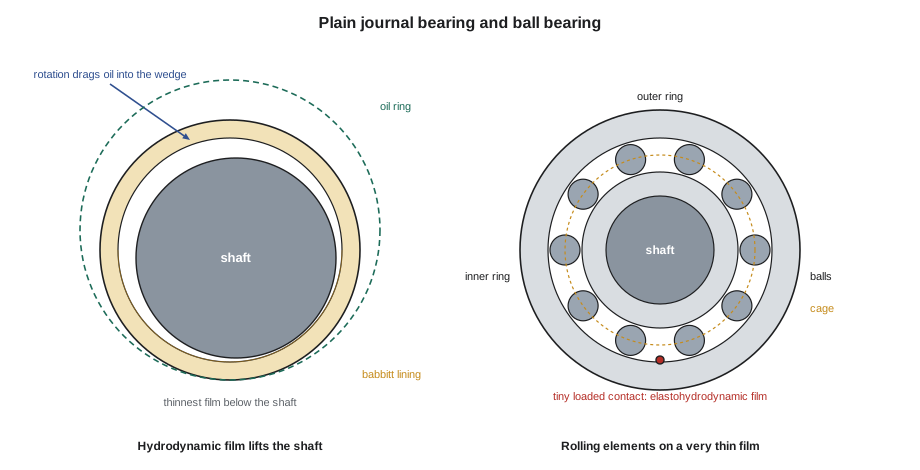
- Hydrodynamic or full-film lubrication: the motion of the shaft drags oil into a wedge-shaped gap and builds enough pressure to lift the shaft completely off the bearing. No metal touches and wear is almost nil. Plain journal bearings run this way once they are up to speed.
- Elastohydrodynamic lubrication: in a rolling bearing, the contact between ball and race is so small and so highly loaded that the metal deforms elastically and the oil's viscosity rises enormously under pressure, forming a film less than a micrometre thick that still separates the surfaces.
The film depends on speed, load and above all on the oil's viscosity. Too thin an oil and the film collapses; too thick and the oil churns, heats up and wastes power.
Viscosity and how oils are specified
Viscosity is a fluid's resistance to flow. Industrial oils are specified by kinematic viscosity in centistokes (cSt, the same as mm²/s), and viscosity falls steeply as temperature rises. The viscosity index (VI) describes how much: a high-VI oil changes less with temperature.
Industrial oils are graded by the ISO viscosity grade (ISO VG) system. The number is the mid-point kinematic viscosity at 40 °C (104 °F), and each grade allows 10 in 100 either side of it.
Worked problem
What does ISO VG 68 allow?
An oil is sold as ISO VG 68. What range of kinematic viscosity at 40 °C (104 °F) does that allow?
Show solution
- \[68 \times 0.9 = 61.2 \text{ cSt} \qquad 68 \times 1.1 = 74.8 \text{ cSt}\]
Answer: Between 61.2 and 74.8 cSt. Grades in common plant use run in a series: 22, 32, 46, 68, 100, 150, 220, 320 and so on, each about 1.5 times the one before. Turbine oils are usually ISO VG 32 or 46; screw compressor oils 32 to 68; gear oils 150 to 320. The machine's manual sets the grade.
Engine and gear oils are often graded by the SAE system instead. An engine oil marked 15W-40 behaves like a thin SAE 15 oil when cold (the W stands for winter) and like an SAE 40 oil at running temperature.
Lubricants have two main parts:
- The base oil: refined mineral oil for most applications, or synthetic oils (polyalphaolefins, esters, polyalkylene glycols) for very high or low temperatures, long drain intervals and compressor service. Some synthetics do not mix with mineral oils or attack certain seals and paints.
- Additives: oxidation inhibitors, rust and corrosion inhibitors, antiwear and extreme-pressure agents, antifoam agents, demulsifiers that help water separate, and in engine oils detergents and dispersants that keep soot in suspension.
A turbine oil is chosen for oxidation stability and quick separation from water; a compressor oil for resistance to oxidation at high temperature and low carbon-forming tendency; an engine oil for detergency and acid neutralizing. Using the wrong one, even of the right viscosity, shortens machine life.
Greases
A grease is an oil held in a thickener, like a sponge holding water. The thickener is a soap such as lithium or lithium complex, or a non-soap such as polyurea, calcium sulphonate or clay. Grease stays where it is put and seals out dirt, so it is used where oil would leak away: most rolling bearings on motors, fans and small pumps.
Greases are graded for stiffness by the NLGI number, from 000 (almost fluid) to 6 (block). NLGI 2 is the common grade for motor and pump bearings. The base oil viscosity inside the grease matters just as much as with an oil.
Greases with different thickeners may be incompatible: mixed together, they can soften and run out of the bearing, or harden. When changing a bearing's grease, purge the old grease out completely, and keep one grease gun for each grease, clearly labelled.
Plain bearings
A plain bearing or journal bearing is a sleeve, usually lined with a soft white metal called babbitt (a tin- or lead-based alloy), in which the shaft turns on an oil film. Once up to speed, the shaft rides on a hydrodynamic film and the bearing can last indefinitely. At start-up and shutdown, before the film forms, the shaft rubs the babbitt, which is soft enough to embed small dirt particles and not score the shaft.
- Small turbines and pumps feed their plain bearings with oil rings that hang loosely on the shaft, dip into the sump, and carry oil up to the top of the shaft as they turn. A ring that stops turning, because the oil level is too low or too high or the ring is damaged, starves the bearing.
- Larger machines use a pressurized oil system: a pump, cooler, filter and a header to each bearing, with a low oil pressure trip.
- Thrust bearings hold the shaft's axial position. Tilting-pad thrust bearings use pivoting pads that each form their own oil wedge.
A babbitt bearing is damaged quickly by loss of oil, by dirt larger than the film thickness, by water in the oil, and by electric current passing through the shaft from a motor or drive, which pits the surface.
Rolling element bearings
A rolling element bearing has an inner ring, an outer ring, a set of balls or rollers, and a cage that spaces them. Rolling friction is low even at start-up, so these bearings need little lubricant and suit frequent starts.
- Deep-groove ball bearings carry radial load and some thrust. They are the usual bearing in electric motors.
- Angular contact ball bearings carry higher thrust in one direction and are often used in pairs on pumps.
- Cylindrical roller bearings carry heavy radial load.
- Tapered roller and spherical roller bearings carry heavy combined loads; spherical rollers also tolerate some misalignment.
Rolling bearings eventually fail by fatigue: after many millions of load cycles, small cracks form below the surface of the races and the metal flakes away, called spalling. The basic rating life, L10, is the life that 90 in 100 of a large group of identical bearings will reach or exceed under the same conditions. For a bearing with dynamic load rating C and an equivalent load P:
where the exponent p is 3 for ball bearings and 10/3 for roller bearings.
Worked problem
Rated life of a pump bearing
A deep-groove ball bearing on a pump has a dynamic load rating of 30 kN and carries an equivalent load of 3 kN at 1,780 r/min. What is its L10 life in hours?
Show solution
- Load ratio:
- \[C \div P = 30 \div 3 = 10\]
- Life in revolutions:
- \[L_{10} = 10^3 \times 10^6 = 10^9 \text{ revolutions}\]
- Life in hours:
- \[10^9 \div (1{,}780 \times 60) \approx 9{,}360 \text{ h}\]
Answer: About 9,360 hours, a little over a year of continuous running. Because life varies with the cube of the load ratio, halving the load raises life eightfold, and a small overload from misalignment or imbalance shortens it sharply. Most bearings in practice fail long before their rated life from poor lubrication, contamination or misalignment, not from fatigue.
Lubricating rolling bearings
Most motor and small pump bearings are grease-lubricated. The art is in giving the right amount at the right interval:
- Too little grease and the bearing runs on boundary lubrication and wears.
- Too much grease and the rolling elements churn it, the bearing runs hot, the grease breaks down, and excess grease can be forced past the seals into a motor's windings. Overgreasing is one of the most common causes of motor bearing failure.
Manufacturers state the interval and quantity. Where they do not, a widely used estimate of the grease quantity for relubrication is:
with G in grams, D the bearing's outside diameter in millimetres and B its width in millimetres.
Worked problem
Grease for a motor bearing
A motor's drive-end bearing is 130 mm outside diameter and 31 mm wide. How much grease should it get at each relubrication, by the estimate?
Show solution
- \[G = 0.005 \times 130 \times 31 \approx 20 \text{ g}\]
Answer: About 20 g. Fenella calibrates each grease gun by weighing the grease from ten strokes, so the plant's lubrication sheets can say how many strokes each bearing gets, not just "grease it".
Where a motor has a grease relief plug, it is removed while greasing and the motor run for a while before it is refitted, so excess grease can escape. Grease fittings are wiped clean before the gun is attached, so dirt is not pumped into the bearing.
Oil-lubricated rolling bearings, on larger pumps, use an oil bath kept at the middle of the lowest ball by a constant-level oiler, or oil mist. The oil level is a round item: too low and the bearing starves, too high and it churns and overheats.
Bearing temperatures
A bearing that is running normally settles at a steady temperature above the surroundings. Typical running temperatures are 50 to 80 °C (120 to 175 °F) for rolling bearings and somewhat lower for oil-ring plain bearings; the manufacturer's alarm and trip settings govern. More useful than any absolute value is the trend: a bearing that has run for months at one temperature and is now 10 K (18 °F) warmer at the same load and room temperature needs attention, even if it is below the alarm. Rising temperature, new noise and rising vibration (lesson 7) together usually mean a bearing is on its way out.
Oil analysis
An oil sample is a picture of what is happening inside the machine. A lab tests it for three kinds of information:
- The condition of the oil: viscosity, acid number (a rise means the oil is oxidizing), remaining additives, and for engine oils, base number, soot and fuel dilution.
- Contamination: water (by the Karl Fischer method, in parts per million), dirt and other particles (a particle count, reported as an ISO 4406 cleanliness code such as 18/16/13), and coolant or process fluid.
- Wear: wear metals measured by spectrometry in parts per million, such as iron from shafts and gears, tin and lead from babbitt, copper from bronze cages and coolers, chromium from rings.
One result means little; a trend from samples taken the same way at the same point means a lot. Good sampling practice is:
- Sample with the machine running or within minutes of stopping, with the oil warm and well mixed.
- Use the same sample point every time, ideally a dedicated valve upstream of the filter, flushed before the sample is taken.
- Use clean, dry bottles, fill to the mark, cap them at once and label each one with the machine, date, oil type and hours on the oil.
- Never sample from the bottom drain of a reservoir; it collects water and sludge and gives a misleading picture.
The lab report on Cantwell's batch came back in early October. The compressor, feed pump and generator oils were normal and in line with their previous results. The backup turbine's sump showed water at about 600 ppm, above the lab's caution limit of 500 ppm for that oil, with normal wear metals. Grazyna's note on the report asked for the sump to be drained and refilled after the next monthly run, a resample one month later, and a check of the gland leak-off and the steam near the bearing housings, because a little gland steam condensing near the bearing is a common way for water to reach a turbine's oil.
Storing and handling lubricants
- Keep lubricants in a clean, dry, labelled store, in closed containers, with the oldest stock used first.
- Use clean, dedicated, labelled transfer containers for each oil; never use a container that held something else.
- Filter new oil into reservoirs where the machine needs very clean oil; new oil is often dirtier than the machine needs.
- Never mix oils or greases of different types in a machine without checking compatibility.
- Clean up spills at once. Oil on a floor is a slip hazard, and oil-soaked rags and insulation can ignite.
- Wear gloves; prolonged skin contact with oils causes dermatitis. A jet of grease or hydraulic oil from a high-pressure leak can inject oil under the skin, a medical emergency even when the wound looks small.
Common mistakes
MistakePumping grease into a bearing until it comes out of the seals.
InsteadGive the stated quantity; overgreasing makes bearings run hot and fail.
MistakeMixing greases because the gun was handy.
InsteadThickeners may be incompatible; use one labelled gun per grease.
MistakeTaking an oil sample from the reservoir drain.
InsteadSample from the same running sample point every time.
MistakeChoosing a replacement oil on viscosity alone.
InsteadMatch the type and additive package as well as the grade.
MistakeIgnoring a bearing that is running warmer than usual but below the alarm.
InsteadTrends matter; investigate rising temperature with noise and vibration.
Summary and key terms
- Lubricant films range from boundary through mixed to full hydrodynamic; rolling bearings run on elastohydrodynamic films.
- ISO VG grades give the mid-point viscosity at 40 °C (104 °F), with 10 in 100 either side.
- Greases are oils held in thickeners, graded by NLGI number; different thickeners may be incompatible.
- Plain bearings float the shaft on an oil wedge; rolling bearings fail by fatigue, with L10 life = (C/P)^p × 10⁶ revolutions.
- Overgreasing is as harmful as undergreasing; quantities and intervals should be specified.
- Oil analysis tracks oil condition, contamination and wear metals; trends from consistent samples reveal problems early.
- Hydrodynamic lubrication
- A full oil film that lifts a shaft off its bearing, built by the shaft's own rotation.
- Viscosity index
- A number describing how little an oil's viscosity changes with temperature.
- ISO viscosity grade
- An industrial oil grade equal to the mid-point kinematic viscosity in cSt at 40 °C.
- Babbitt
- A soft white-metal alloy used to line plain bearings.
- L10 life
- The life that 90 in 100 of identical rolling bearings reach or exceed.
- NLGI grade
- A number describing the stiffness of a grease.
- Oil ring
- A loose ring that carries oil from a sump onto a turning shaft.
- Oil analysis
- Laboratory testing of a lubricant sample for condition, contamination and wear metals.
Practice problems
Work each problem on paper first, then reveal the answer to check.
What viscosity range does ISO VG 46 allow at 40 °C?
Show answer
41.4 to 50.6 cSt.
A ball bearing has C = 20 kN and P = 4 kN. What is its L10 life in revolutions?
Show answer
125 million revolutions.
That bearing turns at 3,560 r/min. What is its L10 life in hours?
Show answer
About 585 h, far too short; the bearing is too small for the load.
A bearing is 72 mm in outside diameter and 19 mm wide. How much grease, by the estimate?
Show answer
About 6.8 g.
Why is the oil sample taken with the machine running or just stopped?
Show answer
So the oil is warm and well mixed and the sample represents what is circulating.
Lesson quiz · 5 questions
Score 60% or more to complete this lesson.
Create a free account to save your progress, take quizzes and earn a certificate.