
PRIN-141 · Lesson 2 of 12 · 25 min
Controlling a stage I: authorizing work packages
Controlling a stage is the process the project manager uses to run a delivery stage. It starts when the board authorizes the stage, and it ends when the stage has been completed and the boundary decision has been made, or when the board stops the project. Its purpose is to assign the work, monitor it, deal with issues and risks, report progress to the board and take corrective action so that the stage stays within its tolerances. This lesson looks at the first and most important of its activities: authorizing work packages. Lessons 3 and 4 cover the rest of the process.
The activities of controlling a stage
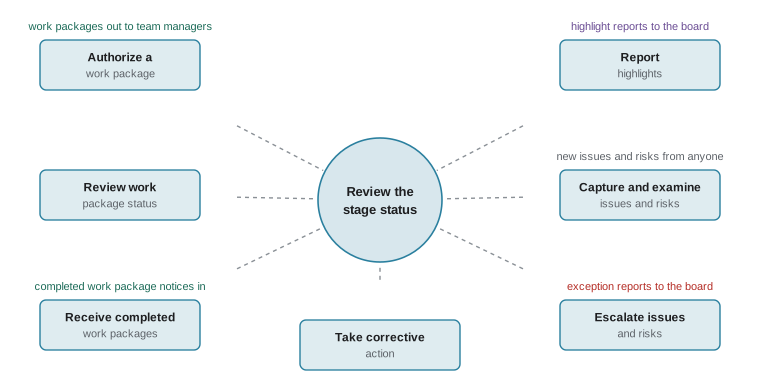
Study guides describe eight activities in controlling a stage. They fall into three groups. The work package activities assign and receive the work. The monitoring and reporting activities keep track of the stage and keep the board informed. The issue and exception activities deal with problems and decide whether they can be handled within the stage or must be escalated.
| Group | Activity (in our words) | Lesson |
|---|---|---|
| Work packages | Authorize a work package | 2 |
| Work packages | Review work package status | 3 |
| Work packages | Receive completed work packages | 3 |
| Monitoring and reporting | Review the stage status | 3 |
| Monitoring and reporting | Report highlights | 3 |
| Issues and exceptions | Capture and examine issues and risks | 4 |
| Issues and exceptions | Take corrective action | 4 |
| Issues and exceptions | Escalate issues and risks | 4 |
The activities do not run in a fixed order. Authorizing work packages tends to happen early in the stage, but new work packages can be authorized at any point, for example when a change is approved or when one team finishes and the next can start. Reviewing stage status happens regularly, perhaps weekly. Capturing issues happens whenever something new arrives. The process is better thought of as a control loop than as a sequence.
What a work package is
A work package is the set of information about one or more required products, collated by the project manager to pass responsibility for their delivery formally to a team manager or team member. It is an agreement, not an instruction thrown over a wall. The team manager must be able to say whether the work can be done within the constraints, and the project manager must be able to hold the team manager to what was agreed. The work package is the main control between the managing and delivering levels.
| Work package content | What it covers | Ridgeline Water WP1: pilot meter installation |
|---|---|---|
| Date and parties | Date of agreement, project manager, team manager | Week 9; project manager and Northline Metering's installation lead |
| Description of the work | What is to be produced | Install and commission 2,800 smart meters in the pilot district |
| Product descriptions | Each product with its quality criteria | Installed meter: sealed, reading verified, photo record, register entry |
| Techniques, processes and procedures | How the work must be done | Utility installation standard; confined-space and traffic-control procedures |
| Development interfaces | Interfaces the team must keep | Meter data system for commissioning; customer operations for appointments |
| Operations and maintenance interfaces | What the people who will run the products need | Field service crews trained on meter replacement |
| Change control requirements | How changes are handled | No change to meter model or firmware without a request for change |
| Joint agreements | Effort, cost, start and end dates, key milestones | 21 weeks; 980 thousand; 50 % installed by week 22 |
| Tolerances | Work package tolerances | Cost +3 %; time +1 week; scope 2,750 to 2,800 meters |
| Constraints | What the team must not do | No installations on weekends; water off no more than 30 minutes |
| Reporting arrangements | Checkpoint frequency and content | Weekly checkpoint report each Monday |
| Problem handling and escalation | How issues are raised | Raise issues to the project manager within one working day |
| Extracts or references | Relevant parts of plans and logs | Pilot stage plan extract; risks R07 and R12 |
| Approval method | Who approves completed products and how | Quality inspector samples 5 % of installations; customer operations accepts appointment records |
Authorizing a work package
Authorizing a work package means agreeing its contents with the team manager and then formally handing over responsibility. The project manager prepares the work package from the stage plan, product descriptions and the relevant management approaches. The team manager reviews it, in managing product delivery, and may negotiate: the effort may be underestimated, a constraint may be unworkable, or a dependency on another team may be missing. Once both agree, the project manager authorizes it and updates the stage plan and the registers. Work starts only when the work package is authorized.
The project manager should also make sure that the team manager understands the tolerances and what happens when they are threatened. Work package tolerances are set by the project manager within the stage tolerances, and they are normally tighter than the stage tolerances so that the project manager keeps some room to move money or time between work packages. If a team manager forecasts that a work package will exceed its tolerances, the team manager raises an issue to the project manager. The team manager does not escalate to the board.
| Work package | Team manager | Cost ($000) | Cost tolerance | Time tolerance |
|---|---|---|---|---|
| WP1 Pilot meter installation | Northline Metering installation lead | 980 | +3 % | +1 week |
| WP2 Collector network | Ridgeline network team lead | 190 | +5 % | +1 week |
| WP3 Billing interface | Ridgeline IT lead | 160 | +5 % | +1 week |
| WP4 Customer communication and appointments | Customer operations supervisor | 50 | +5 % | 0 weeks |
| Project management, assurance and contingency | Project manager | 70 |
Checking that work package tolerances nest
Because work package tolerances sit inside stage tolerances, the project manager should check that the worst case of all work packages together does not already use up the whole stage tolerance. If it does, the project manager has no room to absorb problems and will escalate to the board far more often than necessary. The code below performs that check for the pilot stage.
stage_budget, stage_tol = 1450, 0.05   # stage cost +5 %
wps = {  # name: (cost, tolerance fraction)
    "WP1 installation": (980, 0.03),
    "WP2 network": (190, 0.05),
    "WP3 billing interface": (160, 0.05),
    "WP4 customer communication": (50, 0.05),
}
pm_and_contingency = 70
worst = sum(c * (1 + t) for c, t in wps.values()) + pm_and_contingency
stage_limit = stage_budget * (1 + stage_tol)
used = sum(c * t for c, t in wps.values())
print(f"stage upper limit {stage_limit:,.1f}k; work packages at worst case {worst:,.1f}k")
print(f"work package tolerances use {used:,.1f}k of the stage's {stage_budget * stage_tol:,.1f}k tolerance ({used / (stage_budget * stage_tol):.0%})")
print("nests" if worst <= stage_limit else "does not nest")stage upper limit 1,522.5k; work packages at worst case 1,499.4k work package tolerances use 49.4k of the stage's 72.5k tolerance (68%) nests
The work package tolerances use about 68 % of the stage's cost tolerance, leaving the project manager about 23 thousand of room to absorb problems before the stage limit is reached. Using most but not all of the stage tolerance in this way is a sensible pattern: the team managers have enough freedom to manage their own work, and the project manager keeps a reserve.
Work packages and contracts
Two of Ridgeline Water's work packages go to internal teams and one goes to an external supplier. For an internal team, the work package is the whole agreement. For a supplier, the work package sits alongside a contract. The contract sets the commercial terms: price, payment, warranties, liability and termination. The work package sets the management terms for this piece of work: products, quality criteria, tolerances, reporting and escalation. The two must be consistent. If the contract says a fixed price for 3,000 meters and the work package says 2,800 after the exception plan, a contract variation is needed, handled through the commercial management approach.
Ridgeline Water's installation contract with Northline Metering includes holdback under the provincial construction and prompt payment legislation that applies to the installation work, so each progress payment holds back a percentage until the work is substantially complete and the lien period has passed. The work package's approval method gives the quality inspector's sample results to the payment certifier, so that the evidence for payment and the evidence for product approval are the same.
Work packages in agile delivery
PRINCE2 works with agile delivery, and work packages adapt naturally. For the billing interface, Ridgeline's IT team works in two-week sprints. The project manager authorizes one work package for the interface with a fixed time and cost, and lets the scope flex within agreed limits: the must-have features for billing accuracy are fixed, while some reporting features are could-haves. The team's sprint reviews act as the quality method, and the checkpoint report frequency matches the sprint cycle. What the project manager must not do is authorize a work package with no defined products, no acceptance criteria and no tolerances, and call it agile.
| Element | Traditional work package | Agile work package (WP3) |
|---|---|---|
| Scope | Fixed products with full descriptions | Prioritized features; must-haves fixed, could-haves flexible |
| Time and cost | Estimated; tolerances on both | Fixed timebox and team cost; tolerance mostly on scope |
| Quality method | Inspection or testing at the end | Definition of done; sprint review and automated tests |
| Reporting | Weekly checkpoint report | Checkpoint report at the end of each sprint, with burn-up |
| Escalation trigger | Forecast breach of cost or time tolerance | Forecast that must-haves cannot be delivered in the timebox |
Who does what
Authorizing a work package involves several roles. The project manager prepares and authorizes it. The team manager reviews it and agrees it. Project assurance may check that the work package reflects the quality, risk and commercial approaches and that the approval method gives the user side a proper say. Project support updates the registers and the configuration records. The board is not normally involved, unless the work package needs a decision outside the project manager's authority, such as a supplier change.
| Role | Part in authorizing a work package |
|---|---|
| Project manager | Prepares, negotiates and authorizes the work package; updates the stage plan |
| Team manager | Reviews, negotiates and accepts the work package; produces a team plan |
| Project assurance | Checks consistency with management approaches and approval methods |
| Project support | Records the work package; updates registers and product records |
| Project board | Normally not involved; decides only matters outside delegated authority |
Worked problem
Spotting a weak work package
The project manager drafts WP2 for the collector network: 'Build the collector network for the pilot district. Report problems.' What is missing, and what should be added?
Show solution
- Products and quality criteria are missing: the network design, installed collectors, and a coverage test report with a read-rate target.
- Tolerances are missing: add cost +5 % and time +1 week, and a scope tolerance on coverage.
- Interfaces are missing: the installation team needs collectors live before meters are commissioned.
- Reporting is missing: set a weekly checkpoint report.
- Escalation and approval are missing: issues within one working day; the coverage report approved by the network assurance lead and accepted by customer operations.
Answer: A work package must define the products and their quality criteria, tolerances, interfaces, reporting, escalation and approval. Without them the team manager cannot be held to anything and the project manager cannot control the stage.
Common mistakes
MistakeIssuing a work package without agreeing it with the team manager.
InsteadNegotiate and agree it; it is a two-way agreement.
MistakeSetting work package tolerances equal to the stage tolerances.
InsteadSet them within the stage tolerances so the project manager keeps some room to absorb problems.
MistakeLetting work start before the work package is authorized.
InsteadStart work only after authorization so that responsibility is clear.
MistakeLetting the contract and the work package say different things.
InsteadKeep them consistent and vary the contract through commercial management when the work package changes.
MistakeWriting an agile work package with no products, criteria or tolerances.
InsteadFix the timebox and must-haves, define done, and let lower-priority scope flex.
Summary and key terms
- Controlling a stage has eight activities in three groups: work packages, monitoring and reporting, and issues and exceptions.
- A work package is a formal agreement between the project manager and a team manager.
- It defines products, quality criteria, interfaces, tolerances, constraints, reporting, escalation and approval.
- Work package tolerances nest within stage tolerances and should leave the project manager some room.
- For suppliers, the work package sits alongside a consistent contract.
- Agile work packages fix time, cost and must-haves and let lower-priority scope flex.
- Work package
- The information about required products that formally passes responsibility for delivering them to a team manager.
- Work package tolerance
- The permissible deviation for a work package, set by the project manager within the stage tolerances.
- Team manager
- The person responsible for delivering the products in a work package.
- Approval method
- How and by whom the completed products in a work package will be approved.
- Checkpoint report
- A time-driven progress report from a team manager to the project manager.
- Timebox
- A fixed period in which a team delivers as much prioritized scope as it can.
Practice problems
Work each problem on paper first, then reveal the answer to check.
Name the three groups of activities in controlling a stage.
Show answer
Work package activities, monitoring and reporting activities, and issue and exception activities.
Who prepares and authorizes a work package?
Show answer
The project manager.
Who sets work package tolerances?
Show answer
The project manager, within the stage tolerances.
What does a team manager do if a work package will exceed its tolerance?
Show answer
Raises an issue to the project manager.
Give three contents of a work package.
Show answer
Product descriptions, tolerances and reporting arrangements (also interfaces, constraints, approval method and others).
What percentage of the pilot stage's cost tolerance do the work package tolerances use?
Show answer
About 68 %.
How do a contract and a work package differ?
Show answer
The contract sets commercial terms; the work package sets the management terms for the work.
What is usually fixed in an agile work package?
Show answer
The timebox, the team cost and the must-have scope.
When can work on a work package start?
Show answer
Only after the work package is authorized.
What role checks that a work package reflects the management approaches?
Show answer
Project assurance.
Lesson quiz · 5 questions
Score 60% or more to complete this lesson.
Create a free account to save your progress, take quizzes and earn a certificate.