
PRIN-141 · Lesson 10 of 12 · 25 min
Closing a project I: planned closure, handover and acceptance
Every project should end on purpose. A project that simply fades away, with the team drifting to other work and the products half handed over, leaves the organization paying for loose ends: products nobody supports, costs still charged to the project, benefits nobody measures. Closing a project is the PRINCE2 process that brings a project to a controlled end. It confirms that the products have been accepted, hands them over to the people who will use and support them, evaluates the project, and recommends closure to the board. This lesson covers planned closure and handover. Lesson 11 covers evaluation, lessons and the special case of premature closure.
When closing a project starts
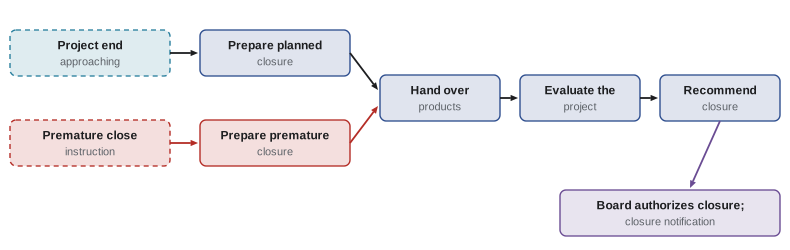
Closing a project is part of the final stage. It is triggered when the project manager, reviewing the stage status in controlling a stage, sees that the project end is approaching. It replaces managing a stage boundary at the end of the final stage, because there is no next stage to plan. It can also be triggered at any time by the board's instruction to close the project prematurely. In both cases, the project manager prepares closure, but only the board can authorize it.
| Activity (in our words) | Purpose | Main outputs |
|---|---|---|
| Prepare planned closure | Confirm that the project has delivered what was agreed and that the products are accepted | Updated project plan with actuals; confirmation of acceptance |
| Prepare premature closure | Bring a stopped project to a controlled end and salvage what is useful | Updated plans; records of partial products; follow-on actions |
| Hand over products | Pass products to the people who will operate, maintain and support them | Handover and acceptance records; follow-on action recommendations |
| Evaluate the project | Assess the project against its baselines and capture lessons | End project report; lessons report; updated benefits management approach |
| Recommend project closure | Ask the board to authorize closure | Draft closure notification; request to close |
Ridgeline Water's final stage
Ridgeline Water's final stage, rollout stage 2, ran from week 71 to week 101. After the exception plan in rollout stage 1, the project manager built a materials survey into the stage plan, and the crews installed meters in the newer subdivisions at a realistic rate from the start. The stage also included the work that only makes sense at the end: retiring the manual meter-reading routes, completing the hourly data reports for customers, finishing the operating procedures, and preparing the support arrangements that operations would need after the project. The project manager started closing the project at week 96, when the last installations were in sight.
Preparing planned closure
Preparing planned closure answers a simple question: has the project done what it was set up to do? The project manager updates the project plan with the actual results of the final stage, checks the product register to confirm that every product has been approved, and confirms that the users and those who will support the products have accepted them. The acceptance criteria in the project product description, agreed in initiation, are the test. Where a criterion has not been fully met, the shortfall must be visible: either it was accepted with a concession, or it becomes a follow-on action.
| Acceptance criterion (project product description) | Result at week 100 | Status |
|---|---|---|
| At least 99 % of the 40,000 accounts on smart meters | 39,688 of 40,008 accounts (99.2 %) | Met |
| Daily read rate of at least 98 % across the network | 98.6 % over the last four weeks | Met |
| Bills issued from smart readings with error rate below 0.1 % | 0.04 % in the last two billing cycles | Met |
| Hourly consumption visible to customers online | Live since week 88 | Met |
| Manual reading routes retired | All routes retired by week 98; readers redeployed | Met |
| Operations able to support the system without the project | Support procedures approved; on-call rota in place | Met |
| 320 accounts where owners refused access | Still on manual estimates | Accepted with concession; follow-on action |
The code below performs the acceptance check from the product register's summary data. It is the same logic the project manager used in receiving completed work packages, applied to the project's final product.
accounts = 40008
on_smart = 39688
refused = 320
criteria = [  # name, actual, target, comparison
    ("share of accounts on smart meters", on_smart / accounts * 100, 99.0, ">="),
    ("daily read rate %", 98.6, 98.0, ">="),
    ("billing error rate %", 0.04, 0.10, "<="),
]
for name, actual, target, op in criteria:
    ok = actual >= target if op == ">=" else actual <= target
    print(f"{name:34} {actual:6.2f} vs {op} {target:5.2f}  {'met' if ok else 'NOT MET'}")
print(f"accounts not converted: {accounts - on_smart} ({refused} refused access)")share of accounts on smart meters 99.20 vs >= 99.00 met daily read rate % 98.60 vs >= 98.00 met billing error rate % 0.04 vs <= 0.10 met accounts not converted: 320 (320 refused access)
All the measurable criteria are met. The 320 properties where owners refused access are a known shortfall. The board accepted them as a concession at the rollout stage 2 boundary planning, because the utility, not the project, has the tools to deal with them over time. They become a follow-on action, described below.
Handing over products
Handing over is not simply delivering a final batch of products. Ridgeline handed most products over in phases: the pilot district at week 38, each rollout area as it went live. Closing a project checks that every handover is complete and properly accepted, and that the organization is ready to run the products without the project. That means the operations and maintenance arrangements are in place: support teams trained, procedures approved, spare parts stocked, warranties and contracts transferred, records and documentation filed where operations can find them.
| Product | Received by | Handover evidence | Ongoing arrangements |
|---|---|---|---|
| Smart meters (39,688 installed) | Customer operations and field services | Acceptance records by area; product register | Meter warranty to year 10; replacement procedure; 46 spare meters |
| Collector network | Network operations | Coverage test reports; as-built network map | Vendor support contract transferred to operations budget |
| Billing interface and hourly data | IT operations | Integration test reports; release notes | Change process moves from the project to IT service management |
| Customer portal features | Customer operations | User acceptance sign-off | Support through the customer service centre |
| Operating procedures and training | Customer operations, network operations | Approved procedures; training records | Owned and updated by operations |
| Project documentation | Records management | Archived project file | Retained under the records schedule |
The senior user and the senior supplier play key parts. The senior user confirms that the users have accepted the products and that the benefits can now be realized. The senior supplier confirms that the supplier side has delivered, that warranties and support obligations are clear, and that the supplier's resources can be released. Project assurance checks that the acceptance evidence is complete, rather than taking it on trust.
Ridgeline Water's finance team records the smart meters and collector network as tangible capital assets under Canadian public sector accounting standards, using the project's cost records and the as-built data from the product register. The asset management team adds them to the asset register with their installation dates and expected lives, which feeds the municipality's asset management plan.
Follow-on action recommendations
Not everything ends neatly when a project closes. Some work is left over, some issues are still open, some risks will continue to affect the products in operation, and some ideas emerged too late to include. Rather than lose them, the project manager records them as follow-on action recommendations, usually in the end project report, and passes each one to the person or group that should own it after closure. Each recommendation should say what needs doing, why and who should take it on.
| Follow-on action | Why | Recommended owner |
|---|---|---|
| Convert the 320 refused-access properties | Estimates are less accurate and some may hide leaks | Customer operations, with a revised access bylaw or policy |
| Replace 210 meters with early battery drain | Off-specification accepted under warranty | Field services, with Northline under warranty |
| Use hourly data for district leak detection analytics | Further leak savings beyond the business case | Network operations; possible future project |
| Review tariffs using hourly consumption data | Opportunity identified during the project | Finance and council |
| Measure benefits for two years after closure | Benefits continue after the project | Executive, under the benefits management approach |
Releasing resources and closing the books
Closing a project also means releasing what the project used. Team members return to their line roles, contractors' engagements end, offices and equipment are returned, and the project's cost codes are closed so that no further costs can be charged to it. These are practical steps, but they matter: a project left open in the finance system attracts costs that belong elsewhere, and a project team never formally released is still, in a sense, waiting for instructions. At Ridgeline, the project manager agreed a date with finance to close the cost codes one month after the board's closure decision, to allow final invoices and holdback or retainage releases to be processed.
Worked problem
Ready to close?
At week 100 a project manager reports that all products are installed and the team wants to move on. The product register shows 12 products still at 'in review', operations has not signed the support procedures, and two warranties have not been transferred. Should the project manager recommend closure?
Show solution
- Planned closure requires every product to be approved and accepted. Twelve products in review means that test is not met.
- Operations has not accepted the support procedures, so the organization is not ready to run the products without the project.
- Warranties not transferred means support obligations are unclear after closure.
- The project manager should finish the approvals and handovers first, or, if some cannot be finished, record them as concessions or follow-on actions with owners, and only then recommend closure.
Answer: Not yet. Closure is recommended when products are accepted and handed over, or when any shortfall is explicitly accepted or passed on as a follow-on action.
Closure in agile and phased projects
Projects that deliver in releases, like Ridgeline's rollout areas or an agile product team's releases, have usually handed most products over long before the final stage. That does not make closing a project less important; it changes its emphasis. Instead of a single large handover, preparing planned closure checks that every earlier handover was properly accepted and that nothing was left in limbo between the project and operations. For an agile team, it also means agreeing what happens to the remaining backlog. Items that were never delivered are not simply abandoned: those still wanted are passed to operations or to a future project as follow-on actions, and the rest are explicitly dropped, so that nobody later assumes they were delivered.
| Closure question | Big-bang handover | Phased or agile handover |
|---|---|---|
| What is handed over at closure? | Most products | The last release and any remaining items |
| Main closure risk | Operations not ready for everything at once | Earlier handovers never formally accepted |
| Remaining scope | Usually none | Backlog items passed on as follow-on actions or explicitly dropped |
| Key evidence | Final acceptance records | Acceptance records for every release, checked together |
Common mistakes
MistakeTreating closure as the moment the team stops working.
InsteadClose when acceptance and handover are confirmed and the board authorizes it.
MistakeHanding products over without support arrangements.
InsteadConfirm operations, maintenance, warranties and records are ready.
MistakeLeaving unfinished work unrecorded.
InsteadRecord it as follow-on action recommendations with proposed owners.
MistakeLetting the project manager close the project.
InsteadThe project manager recommends closure; the board authorizes it.
MistakeLeaving cost codes open indefinitely.
InsteadClose them on an agreed date after final invoices.
Summary and key terms
- Closing a project is part of the final stage and replaces managing a stage boundary at the end.
- It is triggered by the project end approaching, or by a board instruction to close prematurely.
- Preparing planned closure confirms acceptance against the project product description's criteria.
- Handover makes sure products are accepted and that operations and support are ready.
- Follow-on action recommendations pass unfinished work, open issues and ideas to owners.
- Resources are released and cost codes closed after the board's decision.
- Planned closure
- Closing a project at the end of its final stage, as planned.
- Handover
- Transferring products and their support arrangements to the people who will use and maintain them.
- Follow-on action recommendations
- Recommended actions for unfinished work, open issues and risks, passed to owners at closure.
- Concession
- A decision to accept a product that does not fully meet its specification.
- Acceptance criteria
- Measurable criteria the project's product must meet to be accepted.
- Operational acceptance
- Confirmation by operations that it can run and support the products.
Practice problems
Work each problem on paper first, then reveal the answer to check.
What normally triggers closing a project?
Show answer
The project end approaching, seen in controlling a stage.
What else can trigger it?
Show answer
A board instruction to close the project prematurely.
Which product's acceptance criteria are used to check planned closure?
Show answer
The project product description.
What share of Ridgeline's accounts are on smart meters at closure?
Show answer
About 99.2 % (39,688 of 40,008).
How were the 320 refused-access properties handled?
Show answer
Accepted as a concession and passed on as a follow-on action.
Name three things operations needs before it can run the products.
Show answer
Trained staff, approved procedures and transferred warranties or support contracts (also spares and records).
Who confirms that the users have accepted the products?
Show answer
The senior user.
What are follow-on action recommendations?
Show answer
Recommended actions for unfinished work, open issues, risks and ideas, passed to owners after closure.
Why close cost codes after closure?
Show answer
So no further costs are charged to the project.
Who authorizes project closure?
Show answer
The project board.
Lesson quiz · 5 questions
Score 60% or more to complete this lesson.
Create a free account to save your progress, take quizzes and earn a certificate.