
PRIN-141 · Lesson 12 of 12 · 25 min
Capstone: from stage authorization to closure, with exam strategy
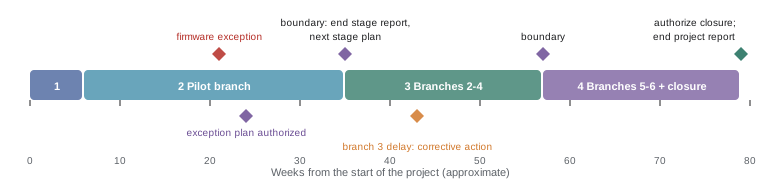
This capstone runs the four delivery processes end to end on the second case used throughout this track: Harbour City Libraries, the invented public library system installing self-service kiosks, RFID tags and online room booking across its six branches. PRIN-140 took it from the library board's mandate to an authorized project: four stages of 30, 360, 370 and 340 thousand, a total of 1,100 thousand against a ceiling of 1.2 million. PRIN-131 controlled its pilot branch stage up to the moment, in week 15 of the stage, when a kiosk firmware fault pushed the forecast stage end to week 29.1 against a 28-week limit. Here we pick up the story at that exception and follow it through the stage boundary, the third stage and closure. The lesson ends with exam strategy for questions on the delivery processes.
Step 1: the exception and the exception plan
The project manager's exception report recommended a stage exception plan with a revised time tolerance, because measuring patron uptake over a representative period was the whole point of the pilot, and the kiosk vendor was bearing the cost of the firmware fix. The board met within the week. It confirmed that project tolerances could absorb a delay of just over a week, asked the vendor's account manager to confirm the recertification date in writing, and requested an exception plan.
The project manager produced the exception plan in managing a stage boundary. It covered weeks 15 to the end of the stage: kiosk recertification in weeks 15 to 16.5, installation and training shifted accordingly, and the 10-week measured pilot running to about week 29.1. The cost rose by 12 thousand, mainly for extra staff cover during the shifted training, giving a stage cost of 372 thousand, within the existing cost tolerance of +5 % (378 thousand). The time limit was revised to week 30. The board authorized the exception plan, and the project manager resumed controlling the stage against it.
| Process step | Who | Product |
|---|---|---|
| Detect forecast breach (review the stage status) | Project manager | Updated stage forecast |
| Escalate | Project manager | Exception report |
| Decide (directing a project) | Project board | Request for an exception plan |
| Produce the exception plan (managing a stage boundary) | Project manager | Exception plan; updated project plan and business case |
| Authorize the exception plan (directing a project) | Project board | Authorization; revised time limit week 30 |
| Resume control (controlling a stage) | Project manager | Revised work packages for the kiosk vendor and training team |
Step 2: the pilot stage boundary
The measured pilot ended at week 29. Self-checkout reached 58 % of loans in the last four weeks against a forecast of 60 %, and room booking errors fell to almost zero. The project manager had started managing the stage boundary at week 25. The end stage report showed the stage at 372 thousand and week 29.1, within the exception plan's tolerances, and the kiosk accessibility off-specification from PRIN-131 resolved by a software update. The updated business case used the measured uptake: staff time freed was slightly below forecast, but the project remained clearly justified. The next stage plan covered three more branches in 20 weeks for 370 thousand, using the pilot's actual tagging rate, which had settled at about 10,300 items a week with helpers.
| Boundary product | Harbour City Libraries after the pilot |
|---|---|
| End stage report | Stage within revised tolerances; uptake 58 % against 60 % forecast; accessibility off-specification resolved |
| Next stage plan | Branches 2, 3 and 4 in 20 weeks; 370 thousand; cost +5 %, time +2 weeks |
| Updated project plan | Forecast total 1,112 thousand against 1,100 baseline; close about 1.5 weeks later than planned |
| Updated business case | Benefits about 95 % of forecast at measured uptake; still clearly positive |
| Lessons | Check vendor firmware status before installation; extend measurement into the school term |
The board authorized stage 3 with one condition: because uptake was the key benefit driver, the project manager was to report self-checkout share by branch in every highlight report. The chief librarian, as executive, also asked the senior user to brief branch staff associations before the rollout, because staff concerns about job changes had surfaced in the pilot.
Harbour City Libraries' accessibility criteria for kiosks and the booking system follow provincial accessibility standards, such as Ontario's AODA standards where they apply, and the library's own policy. The end stage report confirmed that the software update had resolved the off-specification for screen reader support and kiosk height for wheelchair users, and the accessibility review was repeated in each new branch.
Step 3: controlling stage 3
Stage 3 had three work packages: kiosk installation by the vendor, RFID tagging by a temporary team under the library's circulation manager, and training and change support under the branch services manager. The project manager authorized them in the first week, using pilot data for estimates and tolerances. Checkpoint reports were weekly. In week 8 of the stage, branch 3's planned renovation of its entrance was delayed by the city's facilities department, so the kiosks could not be installed in their planned location on time. The project manager examined the issue: swapping the order of branches 3 and 4 kept the stage on schedule at no extra cost, which was within the project manager's authority. The work packages were adjusted, the change recorded and the board told in the next highlight report. No escalation was needed.
Step 4: the final stage and closure
Stage 4 covered the last two branches and closure. The project manager started closing the project when the final kiosks were commissioned. Preparing planned closure checked the acceptance criteria in the project product description: kiosks in all six branches, at least 95 % of the circulating collection tagged, room booking online for every branch, accessibility criteria met, and staff trained. All were met except tagging, which reached 96 % of the circulating collection but left a special collection of rare and fragile items untagged, by design, as agreed by the senior user. The remaining 4 % of the general collection, mostly items out on loan during tagging, became a follow-on action for circulation staff.
stages = {"Initiation": (30, 29), "Pilot branch": (360, 372), "Branches 2-4": (370, 366), "Branches 5-6 and closure": (340, 343)}
ceiling, base = 1200, sum(b for b, a in stages.values())
actual = sum(a for b, a in stages.values())
for k, (b, a) in stages.items():
    print(f"{k:26} baseline {b:4}  actual {a:4}  variance {a - b:+4}")
print(f"total {actual} against baseline {base} ({(actual - base) / base:+.1%}); headroom to the {ceiling} ceiling: {ceiling - actual}")
tagged, collection = 0.96, 1.00
print(f"circulating collection tagged: {tagged:.0%} (criterion 95 %) -> {'met' if tagged >= 0.95 else 'not met'}")Initiation baseline 30 actual 29 variance -1 Pilot branch baseline 360 actual 372 variance +12 Branches 2-4 baseline 370 actual 366 variance -4 Branches 5-6 and closure baseline 340 actual 343 variance +3 total 1110 against baseline 1100 (+0.9%); headroom to the 1200 ceiling: 90 circulating collection tagged: 96% (criterion 95 %) -> met
The project cost 1,110 thousand, 0.9 % above its baseline and well inside the ceiling the library board set. Handover went to three groups: library IT took the kiosks, RFID system and booking platform, with the vendor support contract transferred to its budget; circulation took the procedures and the follow-on tagging; branch services took the training materials. The end project report recorded the uptake at 61 % across all branches in the final month, the staff time freed, the two exceptions and the lessons, and it updated the benefits management approach: staff time freed and patron satisfaction would be reviewed at six and twelve months by the chief librarian. The board authorized closure and the library board received the closure notification.
Exam strategy for the delivery processes
PRINCE2 exams test the processes heavily, and especially the questions of who does what, when and with which products. The Foundation exam has 60 multiple-choice questions in 60 minutes, closed book, with a pass mark of 36 (60 %). The Practitioner exam, as described in 2026 study guides, gives 150 minutes for scenario-based questions worth 70 marks, with a pass mark of 60 % (42 marks). It mixes one-mark multiple-choice questions with three-mark matching questions, and only the official PRINCE2 7 manual may be used, as a printed copy or the official digital edition, with handwritten notes and permanent tabs allowed in the printed book. Check the current rules with PeopleCert when you book.
| Question clue | What it is usually testing | Where to look in your tabbed manual |
|---|---|---|
| 'Who should…' or 'who is responsible for…' | Roles: project manager versus team manager versus board | Process activity tables; the roles appendix |
| 'What should the project manager do first?' | The correct sequence: examine, then act within authority or escalate | Controlling a stage activities |
| Forecast beyond tolerance | Exception route: exception report, board decision, exception plan | Progress practice; managing a stage boundary |
| Team manager facing a problem | Raise an issue to the project manager, never to the board | Managing product delivery |
| End of stage | End stage report, next stage plan, updated project plan and business case | Managing a stage boundary |
| End of project or 'stop the project' | Planned versus premature closure; board authorizes | Closing a project; directing a project |
| Benefits after the project | Benefits management approach; executive owns reviews | Business case practice; closing a project |
In the Practitioner exam, time is the scarce resource. Matching questions are worth three marks each and usually take longer, so it pays to plan time by marks rather than by question count. The code below shows a simple time plan.
total_minutes, marks = 150, 70
reserve = 15                     # minutes kept for review at the end
per_mark = (total_minutes - reserve) / marks
for kind, m in [("one-mark question", 1), ("three-mark matching question", 3)]:
    print(f"{kind:29} about {per_mark * m:.1f} minutes")
print(f"pass mark {0.6 * marks:.0f} of {marks}")one-mark question about 1.9 minutes three-mark matching question about 5.8 minutes pass mark 42 of 70
With 15 minutes kept for review, each mark is worth just under two minutes: about two minutes for a one-mark question and nearly six for a three-mark matching question. If a question is taking much longer, mark your best answer, flag it and move on. Read the scenario for the facts that decide the answer: who raised the problem, which tolerance is threatened, which stage the project is in and what has already been authorized.
A last word on the processes
The processes can look like a lot of procedure. In practice, they are a small number of ideas applied consistently. Work is delegated through agreements with tolerances. Each level reports regularly and escalates only forecast breaches of tolerances it does not control. Every stage ends with a decision based on evidence. Every project ends on purpose, with its products handed over, its lessons passed on and its remaining benefits owned. Ridgeline Water and Harbour City Libraries applied those ideas with different scales of paperwork, and both reached a controlled end.
Worked problem
A Practitioner-style scenario
Harbour City Libraries' stage 3 is under way. The RFID tagging team manager forecasts that tagging at branch 4 will take two weeks longer than the work package allows because a large donation arrived. The stage still has 1.5 weeks of its time tolerance unused. What should happen first, and who decides?
Show solution
- The team manager raises an issue to the project manager; the team manager does not contact the board.
- The project manager examines it: can extra helpers, reordering or tagging the donation later keep the stage within its tolerance?
- If a corrective action keeps the stage within tolerance (for example tagging the donation in stage 4), the project manager takes it and reports it in the highlight report.
- If every workable option would push the stage beyond its tolerance, the project manager sends an exception report to the board.
Answer: First, the team manager raises an issue to the project manager, who decides on corrective action if the stage can stay within tolerance. Only a forecast breach of stage tolerance goes to the board, by exception report.
Common mistakes
MistakeAnswering 'project board' to every decision question.
InsteadIdentify which level owns the threatened tolerance or authority.
MistakeConfusing the end stage report and the end project report.
InsteadEnd stage report at each boundary; end project report at closure.
MistakeForgetting that the board, not the project manager, authorizes closure.
InsteadThe project manager recommends; the board authorizes.
MistakeSpending equal time on every Practitioner question.
InsteadPlan time by marks and flag slow questions.
MistakeSearching the manual for every answer.
InsteadUse tabs for process tables and roles; answer recall questions from memory.
Summary and key terms
- Harbour City Libraries' pilot exception went from exception report to board decision, exception plan and resumed control.
- The pilot boundary used measured uptake to update the business case and plan stage 3.
- A stage 3 issue was resolved by corrective action within the project manager's authority.
- Closure confirmed acceptance, handed over to three groups, recorded follow-on actions and planned benefits reviews.
- Process questions test who does what, when and with which products.
- Plan Practitioner exam time by marks and use the manual's process tables efficiently.
- Exception plan
- A plan that replaces the current stage or project plan after an exception, when requested.
- End stage report
- The report on a stage's performance used for the boundary decision.
- End project report
- The report evaluating the whole project at closure.
- Follow-on action recommendations
- Actions passed to owners for unfinished work, open issues and ideas at closure.
- Benefits management approach
- How and when benefits will be measured, including after closure.
- Matching question
- A Practitioner question format in which several items are matched to options, worth more than one mark.
Practice problems
Work each problem on paper first, then reveal the answer to check.
What revised time limit did the board approve for Harbour City's pilot stage?
Show answer
Week 30.
What was the pilot stage cost after the exception plan?
Show answer
372 thousand, within the +5 % tolerance of 378 thousand.
What self-checkout share did the measured pilot reach?
Show answer
58 % against a forecast of 60 %.
How was the branch 3 renovation delay handled?
Show answer
The project manager swapped branches 3 and 4 as corrective action and reported it.
What did the whole project cost against its baseline?
Show answer
1,110 thousand against 1,100 thousand (+0.9 %).
What became a follow-on action at closure?
Show answer
Tagging the remaining 4 % of the general collection.
Who reviews benefits after closure at Harbour City?
Show answer
The chief librarian, as executive, at six and twelve months.
What are the Foundation exam's format and pass mark?
Show answer
60 questions in 60 minutes, closed book, pass at 36.
About how long should a three-mark matching question take in the Practitioner exam?
Show answer
Nearly six minutes.
A team manager forecasts a work package overrun. What happens first?
Show answer
The team manager raises an issue to the project manager.
Lesson quiz · 5 questions
Score 60% or more to complete this lesson.
Create a free account to save your progress, take quizzes and earn a certificate.