
PRIN-141 · Lesson 1 of 12 · 26 min
Delivering the project: the stage processes
PRIN-140 followed a project from its mandate to the moment the project board authorized it. This course follows what happens next: the stages in which the products are actually built, the boundaries between those stages, and the controlled end of the project. Four processes do this work. Controlling a stage is how the project manager runs each delivery stage day to day. Managing product delivery is how team managers accept, build and hand back the work. Managing a stage boundary prepares the information the board needs to decide whether to continue, and plans the next stage. Closing a project confirms that the products are accepted, hands them over and evaluates the project. Directing a project, which PRIN-140 studied, sits above all four, and its decisions start and end each of them.
Process and activity names in this course follow common PRINCE2 7 usage as described in published study guides. When you sit a PRINCE2 exam, the official PRINCE2 7 manual is the authority for exact wording, so check the names there as you build your tabs and notes.
Where these processes sit
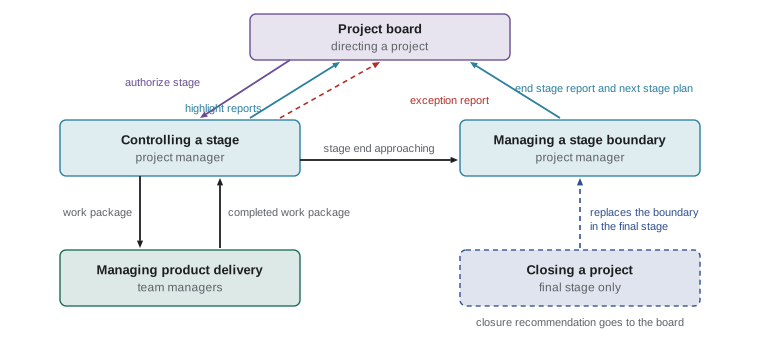
The PRINCE2 process model has three levels of management inside the project. The project board directs, the project manager manages and team managers deliver. Above the board, the business layer (corporate, program or customer management) sets project tolerances and receives the closure notification. Starting up and initiating happen once at the start. Then each delivery stage follows the same rhythm: the board authorizes the stage, the project manager controls it, team managers deliver work packages within it, and near its end the project manager manages the stage boundary to prepare the next authorization. The final stage ends with closing a project instead of a stage boundary.
| Process | Owner | Triggered by | Main outputs |
|---|---|---|---|
| Controlling a stage | Project manager | Stage authorized (or exception plan approved) by the board | Work packages, highlight reports, issue and risk records, exception reports, updated stage plan |
| Managing product delivery | Team manager | Work package authorized by the project manager | Team plan, checkpoint reports, specialist products, completed work package |
| Managing a stage boundary | Project manager | Stage end approaching, or the board asks for an exception plan | End stage report, next stage plan or exception plan, updated project plan and business case |
| Closing a project | Project manager | Project end approaching, or the board instructs premature closure | End project report, handover records, follow-on action recommendations, closure recommendation |
| Directing a project | Project board | Requests and reports from the project manager | Authorizations, ad hoc direction, closure notification |
The running case: Ridgeline Water's delivery stages
Like PRIN-130, PRIN-131 and PRIN-140, this course uses Ridgeline Water, the invented municipal water utility replacing about 40,000 manually read water meters with smart meters that report over a radio network. PRIN-140 ended with the board authorizing the project and the pilot stage at week 8. PRIN-131 controlled that pilot stage and dealt with an exception at week 24, when cleaning legacy billing data added about 70 thousand to the stage cost. The board approved an exception plan with a revised cost tolerance, a 30-week pilot and 2,800 connections instead of 3,000. This course picks the story up inside the pilot stage and follows it through the stage boundary, the two rollout stages and closure at the end of the project.
| Stage | Weeks (baseline) | Weeks (after the pilot exception plan) | Budget ($000) | Ends with |
|---|---|---|---|---|
| 1 Initiation | 0 to 8 | 0 to 8 | 160 | Board authorizes the project and the pilot stage |
| 2 Pilot | 8 to 37 | 8 to 38 | 1,450 (revised to 1,568) | Stage boundary: decision on rollout stage 1 |
| 3 Rollout stage 1 | 37 to 67 | 38 to 68 | 3,700 | Stage boundary: decision on rollout stage 2 |
| 4 Rollout stage 2 and closure | 67 to 100 | 68 to 100 | 4,290 | Closing a project: closure recommendation |
The pilot stage has four work packages, each led by a team manager. Northline Metering, the meter supplier and installer, installs meters in the pilot district. Ridgeline's own network team, working with the radio network vendor, builds and tunes the collector network. Ridgeline's IT team builds and tests the interface between the meter data system and the upgraded billing system. Customer operations runs the customer communication and appointment booking for installations. These four teams return in almost every lesson.
How the processes hand over to one another
The processes are easiest to understand as a chain of triggers. A trigger is an event or a product that starts a process or an activity. The board's authorization of a stage triggers controlling a stage. Inside it, the project manager authorizes work packages, which trigger managing product delivery for each team manager. Team managers send checkpoint reports back, and a completed work package notice when they finish. The project manager reviews stage status regularly. When the end of the stage approaches, that review triggers managing a stage boundary. If a forecast shows a stage tolerance will be breached, the project manager sends an exception report, the board decides, and if it asks for an exception plan, managing a stage boundary produces it. In the final stage, the approach of the project end triggers closing a project.
| Trigger | Sent by | Received by | Starts |
|---|---|---|---|
| Stage authorization | Project board | Project manager | Controlling a stage |
| Authorized work package | Project manager | Team manager | Managing product delivery |
| Checkpoint report | Team manager | Project manager | Reviewing work package status |
| Completed work package notice | Team manager | Project manager | Receiving completed work packages |
| Stage end approaching | Project manager (from stage status review) | Project manager | Managing a stage boundary |
| Exception report | Project manager | Project board | The board's exception decision |
| Request for an exception plan | Project board | Project manager | Managing a stage boundary (exception plan) |
| Project end approaching | Project manager | Project manager | Closing a project |
| Instruction to close prematurely | Project board | Project manager | Closing a project (premature closure) |
Management by exception in delivery
These processes are where management by exception really earns its keep. The board does not want to be involved in the daily work of installing meters, and it should not need to be. It has delegated the stage to the project manager within stage tolerances. The project manager in turn delegates work packages to team managers within work package tolerances. Each level reports regularly, but decisions move upward only when a forecast shows a tolerance will be breached. The result is that the board's time is spent on the decisions that genuinely belong to it: whether to continue at each stage boundary, how to respond to exceptions and whether to close the project.
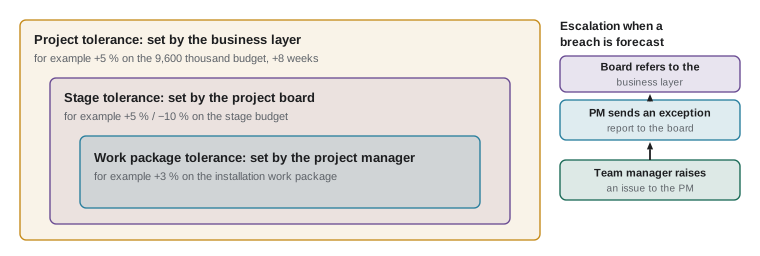
A useful way to read the stage processes is to ask, for any event, which level of management owns the decision. A single meter that fails its acceptance test is the team manager's problem: rework it. A batch of faulty meters that will delay the installation work package beyond its tolerance is the project manager's: adjust the work packages, take corrective action or approve a change within delegated authority. A delay that will push the whole stage past its time tolerance is the board's. A delay that would breach the project's time tolerance belongs to the business layer.
A first look at the products
Several management products appear repeatedly in this course. A work package is the agreement between the project manager and a team manager about what will be delivered, how and under what constraints. A checkpoint report is the team manager's regular progress report to the project manager. A highlight report is the project manager's regular progress report to the board. An exception report warns the board of a forecast breach of stage or project tolerance. An end stage report summarizes the stage at its boundary, and an end project report evaluates the whole project at closure. The project log (the daily log and lessons log) and the registers for issues, risks, quality and products are updated throughout.
| Product | From | To | Event- or time-driven |
|---|---|---|---|
| Work package | Project manager | Team manager | Event-driven |
| Checkpoint report | Team manager | Project manager | Time-driven |
| Highlight report | Project manager | Project board | Time-driven |
| Issue report | Project manager | Project board (when needed) | Event-driven |
| Exception report | Project manager | Project board | Event-driven |
| End stage report | Project manager | Project board | Event-driven |
| Exception plan | Project manager | Project board | Event-driven |
| End project report | Project manager | Project board | Event-driven |
Mapping the stage lifecycle in code
The code below models Ridgeline Water's stage sequence after the pilot exception plan and lists which process is active, and which board decision falls due, at each boundary. It also checks the time position against the project's time tolerance of 8 weeks over the 100-week baseline.
stages = [  # (name, start_week, end_week, ends_with)
    ("Initiation", 0, 8, "authorize the project and the pilot stage"),
    ("Pilot", 8, 38, "stage boundary: authorize rollout stage 1"),
    ("Rollout stage 1", 38, 68, "stage boundary: authorize rollout stage 2"),
    ("Rollout stage 2 and closure", 68, 100, "closing a project: authorize closure"),
]
baseline_end, time_tol = 100, 8
for name, a, b, ends in stages:
    proc = "initiating a project" if name == "Initiation" else "controlling a stage + managing product delivery"
    print(f"weeks {a:3}-{b:3}  {name:28} {proc:48} then {ends}")
forecast_end = stages[-1][2]
used = max(0, forecast_end - baseline_end)
print(f"forecast close week {forecast_end}; time tolerance used {used} of {time_tol} weeks")weeks 0- 8 Initiation initiating a project then authorize the project and the pilot stage weeks 8- 38 Pilot controlling a stage + managing product delivery then stage boundary: authorize rollout stage 1 weeks 38- 68 Rollout stage 1 controlling a stage + managing product delivery then stage boundary: authorize rollout stage 2 weeks 68-100 Rollout stage 2 and closure controlling a stage + managing product delivery then closing a project: authorize closure forecast close week 100; time tolerance used 0 of 8 weeks
The forecast close is still week 100 because the project plan absorbs the one-week slip from the pilot inside rollout stage 2. None of the project's 8 weeks of time tolerance has been used yet. That position will change during the course, and the board will see each change in highlight reports, end stage reports and, if necessary, exception reports.
Ridgeline Water reports to its municipal council through the general manager. Council receives a summary at each major stage boundary because the rollout stages commit capital approved in the municipal budget. In most Canadian municipalities, capital budgets are approved annually by council, so the project plan aligns the boundary at week 38 with the council meeting where the rollout contract award goes forward.
Common misunderstandings
Students often treat the stage processes as a strict sequence: control the stage, then manage the boundary, then repeat. In practice they overlap. Controlling a stage runs for the whole stage, including the weeks when the project manager is also preparing the boundary products. Managing product delivery runs in parallel for every active work package. And managing a stage boundary can be triggered in the middle of a stage when the board asks for an exception plan. A second misunderstanding is that team managers report to the board. They do not: their reports go to the project manager, who consolidates them in highlight reports. A third is that the project manager can close the project. Only the board can authorize closure, and only after the project manager recommends it.
Worked problem
Which process is active?
It is week 30 of Ridgeline Water's pilot stage. Northline Metering is installing meters, the IT team is testing the billing interface, and the project manager has started drafting the plan for rollout stage 1. Which processes are active?
Show solution
- The stage is under way, so controlling a stage is active for the project manager.
- Each team manager is working on an authorized work package, so managing product delivery is active for each of them.
- Drafting the next stage plan is part of managing a stage boundary, which the project manager starts as the stage end approaches.
- The board is directing throughout, receiving highlight reports and available for ad hoc direction.
Answer: Directing a project, controlling a stage, managing product delivery (for each team) and managing a stage boundary are all active at once. Closing a project is not; it belongs to the final stage.
Common mistakes
MistakeThinking team managers send highlight reports to the board.
InsteadTeam managers send checkpoint reports to the project manager, who sends highlight reports to the board.
MistakeRunning managing a stage boundary only after the stage has finished.
InsteadStart it as the stage end approaches so the board can decide without delay.
MistakeEnding the final stage with a stage boundary.
InsteadThe final stage ends with closing a project.
MistakeBelieving the project manager can close the project.
InsteadThe project manager recommends closure; the board authorizes it.
MistakeEscalating every problem to the board.
InsteadEscalate only forecast breaches of the tolerance the board controls.
Summary and key terms
- Four processes deliver a project: controlling a stage, managing product delivery, managing a stage boundary and closing a project.
- The project manager owns three of them; team managers own managing product delivery.
- Directing a project starts and ends each stage through the board's authorizations.
- Triggers such as authorized work packages, checkpoint reports and stage end approaching connect the processes.
- Nested tolerances let each level manage by exception.
- Ridgeline Water's pilot, two rollout stages and closure form the running case.
- Controlling a stage
- The process in which the project manager assigns work, monitors progress, handles issues and takes corrective action within a stage.
- Managing product delivery
- The process in which a team manager accepts, executes and delivers a work package.
- Managing a stage boundary
- The process that reports on the current stage and plans the next one, or produces an exception plan.
- Closing a project
- The process that confirms acceptance, hands over products, evaluates the project and recommends closure.
- Trigger
- An event or product that starts a process or activity.
- Delivery stage
- A stage in which specialist products are created, controlled by the project manager under board authorization.
Practice problems
Work each problem on paper first, then reveal the answer to check.
Which four processes does this course cover?
Show answer
Controlling a stage, managing product delivery, managing a stage boundary and closing a project.
Who owns managing product delivery?
Show answer
The team manager.
What triggers controlling a stage?
Show answer
The board's authorization of a stage or an exception plan.
What does the final stage end with instead of a stage boundary?
Show answer
Closing a project.
Who receives checkpoint reports?
Show answer
The project manager.
Who receives highlight reports?
Show answer
The project board.
What can trigger managing a stage boundary in the middle of a stage?
Show answer
A board request for an exception plan.
What were the main changes from Ridgeline Water's pilot exception plan?
Show answer
A revised cost tolerance, a 30-week pilot and 2,800 connections instead of 3,000.
Who sets project tolerances?
Show answer
The business layer.
Who authorizes project closure?
Show answer
The project board.
Lesson quiz · 5 questions
Score 60% or more to complete this lesson.
Create a free account to save your progress, take quizzes and earn a certificate.