
PRIN-140 · Lesson 9 of 12 · 25 min
Initiating a project II: controls, the project plan and the refined business case
With tailoring agreed and the management approaches drafted, the project manager turns to the three products that give the board its main evidence when it decides whether to authorize the project: the project controls, the project plan and the detailed business case. They are developed together, because each depends on the others. The controls define the stages and tolerances that the plan must respect; the plan supplies the costs and timescales the business case needs; and the business case determines whether the plan is worth executing at all.
Set up the project controls
Project controls are the arrangements that let each level of management monitor and control the level below. In plain terms, they answer five questions. How is the project divided into management stages, and where are the decision points? What tolerances apply at each level? What reports will be produced, by whom, how often and for whom? How will exceptions and issues be escalated? And how will the project's records be kept and its lessons captured? The answers come partly from the business layer, partly from the board's preferences and partly from the management approaches.
| Control | What is decided | Ridgeline Water |
|---|---|---|
| Management stages | Number, length and decision points | Initiation; pilot; rollout 2–8; rollout 9–20 and closure |
| Project tolerances | Set by the business layer | +5 % cost; +8 weeks; −10 % annual benefit; scope changes beyond two districts escalated |
| Stage tolerances | Set by the board for each stage | Pilot: +5 %/−10 % cost, ±2 weeks; rollout stages agreed at each boundary |
| Work package tolerances | Set by the project manager | Typically ±1 week and ±5 % per package |
| Time-driven reports | Highlight and checkpoint reports | Fortnightly highlights in the pilot, monthly in rollout; weekly checkpoints |
| Event-driven reports | End stage, exception, issue and end project reports | As defined in the issue and risk approaches |
| Escalation | Routes and response times | Exceptions considered by the board within five working days |
| Records | Where the project log is kept | Utility's project tool, maintained by project support |
Stage boundaries deserve care. They should fall where a real decision can be made with new information: after the pilot, when the leak benefit can be measured; after the first rollout group, when installation rates are known. They should also fit external constraints, such as council approval cycles. PRIN-130 covered the factors in choosing stages; in initiation those choices become firm controls in the PID.
Allocating tolerances between levels
Tolerances must nest. Stage tolerances should leave room within project tolerances, so that one bad stage does not automatically breach the whole project. The project manager proposes, and the board agrees, how much of the project's tolerance each stage may use. The code below checks Ridgeline Water's proposed allocation: each stage's upper cost tolerance in thousands, added up, should not exceed the project's cost tolerance, and the board should keep some project tolerance in reserve.
project_budget = 9600
project_tol_pct = 0.05
stages = {  # name: (budget, upper cost tolerance as a fraction)
    "1 Initiation": (160, 0.10),
    "2 Pilot": (1450, 0.05),
    "3 Rollout 2-8": (3700, 0.04),
    "4 Rollout 9-20": (4290, 0.03),
}
project_tol = project_budget * project_tol_pct
used = 0.0
print(f"{'Stage':16} {'Budget':>7} {'Tol %':>6} {'Tol $000':>9}")
for name, (budget, tol) in stages.items():
    amount = budget * tol
    used += amount
    print(f"{name:16} {budget:7,} {tol*100:5.1f}% {amount:9.1f}")
print(f"Sum of stage tolerances: {used:.1f} of project tolerance {project_tol:.1f} thousand")
print(f"Unallocated reserve at project level: {project_tol - used:.1f} thousand ({(project_tol - used) / project_tol:.0%})")
print("Allocation acceptable:", used <= project_tol)Stage Budget Tol % Tol $000 1 Initiation 160 10.0% 16.0 2 Pilot 1,450 5.0% 72.5 3 Rollout 2-8 3,700 4.0% 148.0 4 Rollout 9-20 4,290 3.0% 128.7 Sum of stage tolerances: 365.2 of project tolerance 480.0 thousand Unallocated reserve at project level: 114.8 thousand (24%) Allocation acceptable: True
The four stage tolerances add up to about 365 thousand out of a project tolerance of 480 thousand, leaving about 115 thousand, or 24 %, unallocated. That reserve gives the board room to absorb a stage exception without immediately referring the project to the business layer. Note that the percentages differ: initiation has a large percentage but a small amount, and the later rollout stages, which are larger and better understood after the pilot, have smaller percentages. Rollout tolerances are provisional and will be confirmed at each stage boundary.
Create the project plan
The project plan is a high-level plan for the whole project. It shows the major products, the management stages and their boundaries, the main activities and resources, the costs and timescales, and the key dependencies, both internal and external. PRIN-130 described how plans are built with product-based planning; in initiation, the project manager applies those techniques to the whole project at a level of detail suitable for the board. The first delivery stage will be planned in more detail during managing a stage boundary at the end of initiation.
The project plan also refines the project product description from starting up, with the senior user confirming the acceptance criteria now that more is known. For Ridgeline Water, initiation's coverage survey and supplier engagement allow the plan to show realistic installation rates, network build times and costs, and the billing interface workshop allows the plan to show the dependency on IT's upgrade explicitly, with a date by which the upgraded interface must be available.
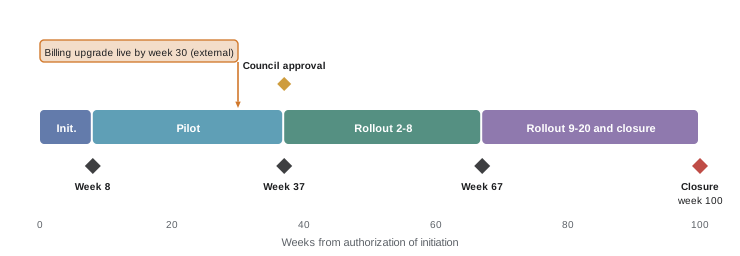
| Project plan element | Ridgeline Water |
|---|---|
| Plan description and prerequisites | Smart metering for 20 districts; council approval of the main contract before rollout |
| External dependencies | Billing system upgrade by week 30; radio licence if required; supplier lead times |
| Planning assumptions | Installation rate of 450 meters a week after the pilot; customer access in 85 % of first visits |
| Stages and decision points | Weeks 8, 37 and 67, closure at week 100 |
| Budgets | Stage budgets totalling 9,600 thousand; risk budget and change budget held separately |
| Tolerances | Project and stage tolerances as above |
| Product descriptions | Project product description refined; key product descriptions attached |
| Schedule | Outline schedule by stage, with critical external dependencies |
Refine the business case
The outline business case from starting up becomes the detailed business case. The executive remains accountable, with the project manager typically drafting. It now uses the project plan's costs and timescales, the refined benefits from the senior users, the major risks from the risk register and an updated investment appraisal. It must answer the question the board will ask at the end of initiation: is the whole project worth doing, and is it still the best option? The benefits management approach is finalized at the same time, so that the business case's benefits can be measured.
| Business case element | Outline (starting up) | Detailed (initiation) |
|---|---|---|
| Costs | Order of magnitude, about 9.6 million | Stage budgets from the project plan; supplier quotes; risk and change budgets |
| Benefits | Main benefits roughly sized | Each benefit with an owner, measure, baseline, target and timing |
| Options | Do nothing, do minimum, do something | Confirmed after market engagement; preferred option justified |
| Investment appraisal | First NPV and payback | Updated NPV, payback, sensitivity and scenario analysis |
| Risks | Major risks to justification | Aggregated risk profile from the risk register |
| Dis-benefits | Identified | Measured or described, with mitigations (for example meter readers' redeployment) |
For Ridgeline Water, the most important refinement concerns the leak benefit. Initiation's leak data analysis estimates current non-revenue water more precisely, and the pilot stage is designed to measure how customers respond to alerts. The detailed business case therefore states clearly that the decision to roll out will be revisited at the end of the pilot, with a threshold: if measured leak savings fall below about 70 % of forecast, rollout should be reconsidered. This links the business case, the stage structure and the board's decision at week 37.
For a Canadian municipal utility, the detailed business case may also need to follow provincial asset management planning rules where they apply, such as Ontario's regulation on asset management planning for municipal infrastructure, and the municipality's own capital budgeting policies. Federal infrastructure funding programs, where used, bring their own reporting requirements.
How the three products fit together
Controls, plan and business case are developed iteratively. A first draft of the plan may show costs that weaken the business case, prompting a change of approach; a tolerance allocation may show that the plan has too little contingency; a benefits profile may suggest moving a stage boundary so that a benefit can be measured before the next commitment. Initiation's job is to bring them into agreement and to make the remaining uncertainties visible to the board.
| If initiation finds… | It may change… |
|---|---|
| Costs higher than the outline business case assumed | The approach (for example fewer districts per stage) or the business case conclusion |
| A key benefit cannot be measured until late | Stage boundaries, so a decision follows measurement |
| Tolerances leave no reserve | Stage tolerances or the request to the business layer for project tolerances |
| A critical external dependency | The plan's sequence and a risk response |
| Major risks to justification | The risk budget, the approach or the decision to proceed |
Worked problem
Nesting tolerances
A project has a budget of 2,000 thousand and a project cost tolerance of +4 % set by the business layer. The project manager proposes three delivery stages of 600, 800 and 600 thousand, each with +5 % cost tolerance. Is this allocation sensible?
Show solution
- Project tolerance: 4 % of 2,000 = 80 thousand.
- Stage tolerances: 5 % of 600 + 5 % of 800 + 5 % of 600 = 30 + 40 + 30 = 100 thousand.
- The stage tolerances add up to more than the project tolerance, so exceptions in two stages could breach project tolerance without the board ever having seen a stage exception.
- Reduce stage tolerances, for example to 3 %, 2.5 % and 3 % (18 + 20 + 18 = 56 thousand), leaving 24 thousand as a reserve.
- Record the allocation in the project controls and confirm later stages' tolerances at each boundary.
Answer: No: the stages' tolerances (100 thousand) exceed the project tolerance (80 thousand). Reduce them so they nest with a reserve.
Reporting arrangements in the controls
The reporting part of the project controls deserves as much care as the tolerances, because reports are how the board knows whether to intervene. The controls should say, for each report, who produces it, who receives it, how often or on what event, what it must contain and how quickly it must be acted on. They should also say how reports are delivered: a highlight report sent as a short email with a link to the project tool may be read; a 20-page document attached to a meeting invitation often is not.
| Report | From | To | Frequency or trigger | Ridgeline Water arrangement |
|---|---|---|---|---|
| Checkpoint report | Team manager | Project manager | Time-driven | Weekly, in the project tool |
| Highlight report | Project manager | Project board | Time-driven | Fortnightly in the pilot, monthly in rollout; one page with RAG by tolerance used |
| Issue report | Project manager | Board or change authority | Event-driven | When an issue needs a decision beyond delegated authority |
| Exception report | Project manager | Project board | Event-driven | When a stage tolerance is forecast to be exceeded; considered within five working days |
| End stage report | Project manager | Project board | Event-driven | At each stage boundary, with the next stage plan |
| Staff report to council | Executive | Council (business layer) | Event-driven | At stage boundaries where council approval is needed |
Look at the last row. PRINCE2's reports serve the project's levels of management, but public organizations often have their own reporting obligations, such as staff reports to council or a board of directors. Recording them in the controls avoids duplicated effort: the end stage report can be written so that it becomes the basis of the staff report, instead of the project manager producing two different accounts of the same stage.
Common mistakes
MistakeSetting stage tolerances that add up to more than the project tolerance.
InsteadNest stage tolerances within project tolerance and keep a reserve.
MistakePlacing stage boundaries at arbitrary dates.
InsteadPlace them where a decision can be made with new information.
MistakeWriting the detailed business case before the project plan exists.
InsteadDevelop plan and business case together; costs and timings come from the plan.
MistakeHiding the key uncertainty to make the business case look stronger.
InsteadState it and design stages to resolve it.
MistakePlanning the whole project in full detail during initiation.
InsteadKeep the project plan high level; detail the first delivery stage at the stage boundary.
Summary and key terms
- Project controls define stages, tolerances, reporting, escalation and records.
- Tolerances nest: work package within stage, stage within project, with a reserve.
- The project plan covers the whole project at board level, with stages and dependencies.
- The project product description is refined alongside the plan.
- The detailed business case uses the plan's costs and timescales and confirms the project is worth doing.
- Controls, plan and business case are developed together and must agree.
- Project controls
- Arrangements for monitoring and controlling the project at each level of management.
- Project plan
- A high-level plan for the whole project, showing stages, products, costs and timescales.
- Detailed business case
- The business case refined in initiation, used to authorize the project.
- Planning assumption
- An assumption on which a plan depends, recorded so it can be monitored.
- External dependency
- A product or event outside the project that the project relies on.
- Risk budget
- Money set aside to fund responses to identified risks.
- Change budget
- Money set aside to fund approved changes.
Practice problems
Work each problem on paper first, then reveal the answer to check.
Name three things project controls define.
Show answer
Stages and decision points; tolerances; reporting; escalation; records.
Who sets stage tolerances?
Show answer
The project board.
Why should stage tolerances leave a reserve within project tolerance?
Show answer
So one stage exception does not automatically breach project tolerance.
What share of Ridgeline Water's project cost tolerance is left unallocated?
Show answer
About a quarter (about 115 of 480 thousand).
Which product is refined alongside the project plan?
Show answer
The project product description.
Who is accountable for the detailed business case?
Show answer
The executive.
What threshold does Ridgeline Water set for reconsidering rollout?
Show answer
Measured leak savings below about 70 % of forecast.
Name Ridgeline Water's key external dependency.
Show answer
The billing system upgrade by week 30.
Why plan the first delivery stage separately?
Show answer
The project plan is high level; the stage plan is prepared in managing a stage boundary at the end of initiation.
In the nesting example, what was wrong?
Show answer
Stage tolerances of 100 thousand exceeded the project tolerance of 80 thousand.
Lesson quiz · 5 questions
Score 60% or more to complete this lesson.
Create a free account to save your progress, take quizzes and earn a certificate.