
PRIN-140 · Lesson 8 of 12 · 25 min
Initiating a project I: tailoring and management approaches
Once the board has authorized initiation, the project manager runs initiating a project. Its purpose, in plain terms, is to establish solid foundations for the project, so that the organization understands the work that needs to be done to deliver the products before it commits to a significant spend. Initiating a project produces the project initiation documentation (PID). This lesson covers the first part of the process: agreeing the tailoring requirements and preparing the management approaches. Lesson 9 covers project controls, the project plan and the refined business case, and lesson 10 covers assembling the PID.
| Activity group (common PRINCE2 7 usage) | Main outputs | Lesson |
|---|---|---|
| Agree the tailoring requirements | Tailoring decisions recorded for the PID | 8 |
| Prepare the management approaches | Risk, quality, issue, communication, commercial, digital and data, sustainability and benefits management approaches, with their registers | 8 |
| Set up the project controls | Stages, tolerances, reporting and escalation arrangements | 9 |
| Create the project plan | Project plan, refined project product description | 9 |
| Refine the business case | Detailed business case | 9 |
| Assemble the project initiation documentation | PID | 10 |
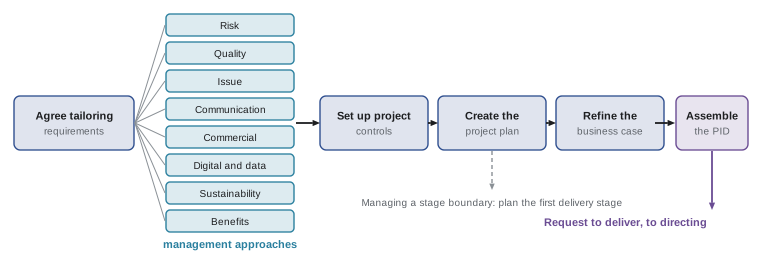
Agree the tailoring requirements
Tailoring is one of PRINCE2's seven principles, and PRINCE2 7 makes it explicit as the first piece of work in initiation. The project manager, with project assurance and the executive, decides how PRINCE2 will be adapted for this project: which management products will be combined or held in tools, which roles are combined, how often reports are produced, how agile delivery fits, and which corporate standards apply. The decisions are recorded, with reasons, so that assurance and auditors can see that departures from the method were deliberate rather than accidental.
Tailoring at this point builds on decisions already made in starting up. The project approach, the team structure and the scale of the initiation stage all embodied tailoring choices. Initiation formalizes them and extends them to the controls and approaches that will govern delivery. Good tailoring answers the question: what is the least management this project can safely use, given its size, complexity, risk and environment?
| Tailoring decision | Options | Ridgeline Water's choice and reason |
|---|---|---|
| Management products | Separate documents; combined documents; records in a project tool | PID as one document with approaches as sections; registers in the utility's project tool |
| Reporting frequency | Weekly, fortnightly, monthly highlight reports | Fortnightly during the pilot; monthly in rollout once the process is stable |
| Role combinations | Executive and senior user combined; separate | Separate: two senior users with distinct interests |
| Agile elements | None; iterative product work; full agile delivery | Iterative delivery for the portal and alerts; linear for installation |
| Corporate standards | Utility templates; supplier's processes | Utility's capital project standard; supplier's quality system for installation |
| Terminology | PRINCE2 terms; organization's own terms | Organization's terms where they exist (for example 'gate review' for stage boundary), mapped in the PID |
What a management approach is
A management approach describes how a particular aspect of the project will be managed. PRINCE2 7 uses the term management approach for products that earlier editions often called strategies. Each approach typically covers the procedures to follow, the tools and techniques to use, the records and reports to keep, the timing of the main activities, and the roles and responsibilities involved. The approaches are prepared in initiation, approved as part of the PID, and then used throughout the project. They are baselines: once approved, changes to them go through change control.
PRIN-130 and PRIN-131 described what the approaches must contain from the perspective of each practice: the benefits management approach in PRIN-130, the quality, risk and issue management approaches in PRIN-131. This lesson looks at them from the process side: when they are prepared, in what order, by whom, and how the project manager makes sure they fit together. A common failure is a set of approaches written by different people from different templates that contradict each other, for example a risk approach that escalates every risk above a score of 12 to the board while the issue approach routes all escalations through monthly meetings.
| Management approach (common PRINCE2 7 names) | Main question | Related practice | Records it usually sets up |
|---|---|---|---|
| Risk management approach | How will we identify, assess and respond to risks? | Risk | Risk register |
| Quality management approach | How will we plan and check quality? | Quality | Quality register |
| Issue management approach | How will we handle issues and control changes to baselines? | Issues | Issue register; product register |
| Communication management approach | Who needs what information, when and how? | Organizing | Stakeholder information in the project log |
| Commercial management approach | How will we manage suppliers and contracts? | Organizing; plans | Contract records |
| Digital and data management approach | How will we use and protect data and digital tools? | All practices | Data inventory; tool list |
| Sustainability management approach | How will we manage sustainability targets and impacts? | Progress; quality; business case | Sustainability measures |
| Benefits management approach | How and when will benefits be measured and reviewed? | Business case | Benefits review schedule |
Preparing the approaches in a sensible order
There is no mandatory order, but some sequences work better than others. Tailoring decisions come first, because they affect every approach. The communication management approach benefits from an early stakeholder analysis, since it also informs risk identification. The risk management approach and the quality management approach can be drafted in parallel; the issue management approach should follow the risk approach so that the boundary between a risk and an issue is defined consistently. The commercial management approach depends on the project approach chosen in starting up and on procurement rules. The digital and data approach and the sustainability approach often draw on corporate policies. The benefits management approach is finalized alongside the detailed business case.
Ridgeline Water's project manager adapts existing utility templates where they exist and asks specialists to contribute: the procurement lead drafts most of the commercial approach, the privacy officer contributes to the digital and data approach, and the environmental coordinator drafts the sustainability approach. Project assurance reviews them together for consistency before they are assembled into the PID.
Ridgeline Water's digital and data management approach must address how meter readings, which reveal patterns of household activity, are collected, stored and used. For a Canadian municipal utility, provincial public-sector privacy law applies, such as Ontario's Municipal Freedom of Information and Protection of Privacy Act or the equivalent in other provinces; a privacy impact assessment early in initiation is the usual tool.
Checking the approaches fit together
The code below builds a simple coverage matrix for Ridgeline Water's draft approaches. For each approach it checks that the five common elements are present (procedures, tools, records, timing, roles), and it checks one consistency rule: that every approach that escalates matters to the board uses the same response time the board agreed in starting up.
elements = ["procedures", "tools", "records", "timing", "roles"]
approaches = {
    "Risk":            {"procedures": 1, "tools": 1, "records": 1, "timing": 1, "roles": 1, "escalation_days": 5},
    "Quality":         {"procedures": 1, "tools": 1, "records": 1, "timing": 1, "roles": 1, "escalation_days": 5},
    "Issue":           {"procedures": 1, "tools": 1, "records": 1, "timing": 0, "roles": 1, "escalation_days": 20},
    "Communication":   {"procedures": 1, "tools": 1, "records": 0, "timing": 1, "roles": 1, "escalation_days": None},
    "Commercial":      {"procedures": 1, "tools": 0, "records": 1, "timing": 1, "roles": 1, "escalation_days": 5},
    "Digital and data":{"procedures": 1, "tools": 1, "records": 1, "timing": 1, "roles": 0, "escalation_days": None},
    "Sustainability":  {"procedures": 1, "tools": 1, "records": 1, "timing": 1, "roles": 1, "escalation_days": None},
    "Benefits":        {"procedures": 1, "tools": 1, "records": 1, "timing": 1, "roles": 1, "escalation_days": 5},
}
agreed_days = 5
print(f"{'Approach':17}" + "".join(f"{e[:5]:>7}" for e in elements) + "  escal.")
for name, a in approaches.items():
    row = "".join(f"{'yes' if a[e] else '--':>7}" for e in elements)
    d = a["escalation_days"]
    esc = "n/a" if d is None else ("ok" if d == agreed_days else f"{d} days!")
    print(f"{name:17}{row}  {esc}")
gaps = [(n, e) for n, a in approaches.items() for e in elements if not a[e]]
print("Gaps:", "; ".join(f"{n}: {e}" for n, e in gaps))Approach proce tools recor timin roles escal. Risk yes yes yes yes yes ok Quality yes yes yes yes yes ok Issue yes yes yes -- yes 20 days! Communication yes yes -- yes yes n/a Commercial yes -- yes yes yes ok Digital and data yes yes yes yes -- n/a Sustainability yes yes yes yes yes n/a Benefits yes yes yes yes yes ok Gaps: Issue: timing; Communication: records; Commercial: tools; Digital and data: roles
Four gaps appear: the issue approach has no timing, the communication approach does not say what records it keeps, the commercial approach does not say which tools are used for contract management, and the digital and data approach does not assign roles. The issue approach also escalates in 20 days rather than the five days the board agreed. These are small fixes, but each could cause real trouble in delivery: an issue sitting for four weeks because the issue approach and the board's expectations disagree is exactly the kind of failure the decision log analysis in lesson 6 found.
Who prepares and approves the approaches
| Role | Responsibility for management approaches (our summary) |
|---|---|
| Project manager | Prepares or coordinates all approaches; ensures they are consistent |
| Executive | Approves them as part of the PID; owns the benefits management approach with the senior user |
| Senior user | Contributes to quality and benefits approaches; confirms user involvement |
| Senior supplier | Contributes to quality, commercial and technical aspects; confirms supplier processes fit |
| Project assurance | Reviews approaches for consistency with corporate standards and with each other |
| Specialists | Contribute to commercial, digital and data, and sustainability approaches |
| Project support | Sets up the registers and tools the approaches require |
Worked problem
Tailoring for a small project
A municipal parks department starts a 10-week project to install new signage in six parks, with a budget of 80 thousand, one supplier and a familiar process. The project manager is about to write eight separate management approaches. What tailoring would you recommend?
Show solution
- Record the tailoring decision: one short PID with each approach as a paragraph or two.
- Combine risk and issue management into one short section with a single log, since the volume will be low.
- Use the organization's standard purchasing process as the commercial approach and reference it rather than rewriting it.
- Keep a brief quality section: the acceptance criteria for signs and how installation will be checked.
- Keep communication simple: who is told before work starts in each park; and note that benefits (visitor wayfinding) will be reviewed by the parks manager after the project.
Answer: One concise PID with short combined sections, references to existing corporate processes and a recorded tailoring decision, rather than eight standalone documents.
Common mistakes
MistakeSkipping the tailoring decisions and copying every template.
InsteadAgree and record tailoring first, with reasons.
MistakeWriting management approaches that contradict each other.
InsteadHave assurance review them together for consistency.
MistakeTreating approaches as documents to file and forget.
InsteadThey are baselines used throughout delivery and changed only through change control.
MistakeIgnoring the digital and data and sustainability approaches because earlier editions did not have them.
InsteadAddress them proportionately, even if briefly.
MistakeLetting a supplier's process replace the project's approach without checking it.
InsteadReference supplier processes where they fit, and record how they link to the project's controls.
Summary and key terms
- Initiating a project establishes solid foundations and produces the PID.
- Tailoring is agreed and recorded first, with reasons.
- Management approaches describe how each aspect of the project will be managed.
- Common PRINCE2 7 approaches: risk, quality, issue, communication, commercial, digital and data, sustainability and benefits.
- Each approach covers procedures, tools, records, timing and roles.
- Approaches must be consistent with each other and with the board's agreed arrangements.
- Once approved in the PID, approaches are baselines under change control.
- Initiating a project
- The process that establishes solid foundations and produces the PID.
- Tailoring
- Adapting PRINCE2 to suit the project's context, recorded with reasons.
- Management approach
- A description of how a particular aspect of the project will be managed.
- Commercial management approach
- How the project will manage suppliers, contracts and commercial relationships.
- Digital and data management approach
- How the project will use, protect and govern data and digital tools.
- Sustainability management approach
- How the project will manage sustainability targets and impacts.
- Baseline
- An approved version of a product that can be changed only through change control.
Practice problems
Work each problem on paper first, then reveal the answer to check.
What is the purpose of initiating a project?
Show answer
To establish solid foundations so the organization understands the work before committing to a significant spend.
Which activity comes first in initiation?
Show answer
Agreeing the tailoring requirements.
What did earlier editions often call management approaches?
Show answer
Strategies.
Name four management approaches.
Show answer
Any four of risk, quality, issue, communication, commercial, digital and data, sustainability, benefits.
Which five elements does a management approach usually cover?
Show answer
Procedures, tools, records, timing and roles.
Why should the issue approach follow the risk approach?
Show answer
So the boundary between risks and issues is defined consistently.
Who reviews the approaches for consistency?
Show answer
Project assurance.
What inconsistency did the coverage check find in Ridgeline Water's issue approach?
Show answer
It escalated in 20 days rather than the agreed five.
Why is a privacy impact assessment relevant to Ridgeline Water?
Show answer
Meter readings reveal household activity, so data protection must be addressed in the digital and data approach.
What happens to the approaches once the PID is approved?
Show answer
They become baselines under change control.
Lesson quiz · 5 questions
Score 60% or more to complete this lesson.
Create a free account to save your progress, take quizzes and earn a certificate.