
PRIN-140 · Lesson 11 of 12 · 25 min
Roles and tailoring across the early processes
Lessons 2 to 10 followed the early processes activity by activity. This lesson looks across them from two angles. First, roles: who is responsible for producing, reviewing and approving each key product of starting up, directing and initiating, and where responsibilities are most often confused. Second, tailoring: how the early processes change for very small projects, agile delivery and projects within programs. PRIN-150 treats tailoring and Practitioner scenarios in depth; here the focus is on the first three processes.
Who does what in the early processes
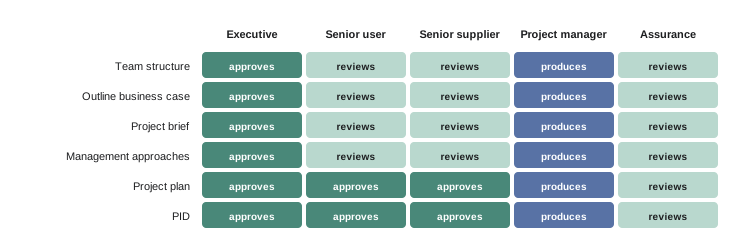
PRINCE2 assigns responsibilities to roles, not to named people, and it distinguishes several kinds of involvement: producing a product, reviewing it, approving it, and being consulted or informed. Study guides often present these in tables using letters such as P for produces, R for reviews and A for approves. The table below summarizes common practice for the key products of the early processes in our own words. Exact allocations in the official manual may differ in detail, and every project tailors them.
| Product or decision | Business layer | Executive | Senior user | Senior supplier | Project manager | Project assurance |
|---|---|---|---|---|---|---|
| Project mandate | Provides | — | — | — | — | — |
| Appoint executive | Approves | — | — | — | — | — |
| Appoint project manager | — | Approves | — | — | — | — |
| Project management team structure | — | Approves | Reviews | Reviews | Produces | Reviews |
| Outline business case | Consulted | Approves (owns) | Reviews | Reviews | Produces | Reviews |
| Project product description | — | Approves | Approves (leads on content) | Reviews | Produces | Reviews |
| Project brief | — | Approves | Reviews | Reviews | Produces | Reviews |
| Initiation stage plan | — | Approves | Reviews | Reviews | Produces | Reviews |
| Authorize initiation | Informed | Decides (board) | Board member | Board member | Requests | Advises |
| Management approaches | — | Approves | Reviews | Reviews | Produces | Reviews |
| Project plan | — | Approves | Approves | Approves | Produces | Reviews |
| Detailed business case | Consulted | Approves (owns) | Reviews | Reviews | Produces | Reviews |
| PID | — | Approves | Approves | Approves | Produces | Reviews |
| Authorize the project | Informed | Decides (board) | Board member | Board member | Requests | Advises |
A few patterns stand out. The project manager produces almost everything but approves almost nothing in these processes: approval sits with the executive, often with senior users and senior suppliers for products that commit their resources. Project assurance reviews nearly everything, because its job is to give the board confidence. The business layer appears only at the edges: it provides the mandate, appoints the executive, sets project tolerances and is consulted on the business case and informed of decisions.
Common confusions about roles
| Confusion | Clarification (our summary) |
|---|---|
| The project manager owns the business case because they write it | The executive owns it; the project manager often drafts it |
| The board approves the mandate | The mandate comes from the business layer; the board does not yet exist |
| Senior users decide the project approach | The approach is proposed by the project manager and approved by the executive, with user and supplier input |
| Project assurance approves products | Assurance reviews and advises; the relevant board role approves |
| The business layer authorizes initiation | The project board authorizes initiation, within any limits the business layer has set |
| Team managers write the PID | Team managers may contribute specialist input; the project manager produces the PID |
In exam questions, these confusions often appear as plausible distractors. A question might ask who is responsible for preparing the outline business case and offer both the executive and the project manager. The usual reasoning is that the executive is responsible, because the executive owns the business case, even though the project manager may help draft it. Read such questions carefully for the distinction between ownership or accountability and the work of producing a document.
Building and checking a RACI matrix
Some organizations express role responsibilities as a RACI matrix: responsible (does the work), accountable (one person who approves and answers for it), consulted and informed. The code below builds a RACI matrix for Ridgeline Water's early products and checks two rules: every product has exactly one accountable role, and no role is both responsible and accountable for the same assurance-sensitive product without a recorded reason.
roles = ["BL", "EX", "SU", "SS", "PM", "PA"]
raci = {
    "Project mandate":          {"BL": "A", "EX": "I"},
    "Team structure":           {"EX": "A", "SU": "C", "SS": "C", "PM": "R", "PA": "C"},
    "Outline business case":    {"BL": "C", "EX": "A", "SU": "C", "SS": "C", "PM": "R", "PA": "C"},
    "Project brief":            {"EX": "A", "SU": "C", "SS": "C", "PM": "R", "PA": "C"},
    "Initiation stage plan":    {"EX": "A", "SU": "C", "SS": "C", "PM": "R", "PA": "C"},
    "Management approaches":    {"EX": "A", "SU": "C", "SS": "C", "PM": "R", "PA": "C"},
    "Project plan":             {"EX": "A", "SU": "A", "SS": "C", "PM": "R", "PA": "C"},
    "PID":                      {"EX": "A", "SU": "C", "SS": "C", "PM": "R", "PA": "C"},
}
print(f"{'Product':24}" + "".join(f"{r:>4}" for r in roles))
for product, m in raci.items():
    print(f"{product:24}" + "".join(f"{m.get(r, '.'):>4}" for r in roles))
problems = []
for product, m in raci.items():
    acc = [r for r, v in m.items() if v == "A"]
    if len(acc) != 1:
        problems.append(f"{product}: {len(acc)} accountable roles ({', '.join(acc)})")
    if m.get("PA") in ("R", "A"):
        problems.append(f"{product}: assurance is producing or approving")
print("Problems:", problems if problems else "none")Product BL EX SU SS PM PA Project mandate A I . . . . Team structure . A C C R C Outline business case C A C C R C Project brief . A C C R C Initiation stage plan . A C C R C Management approaches . A C C R C Project plan . A A C R C PID . A C C R C Problems: ['Project plan: 2 accountable roles (EX, SU)']
The check finds one problem: the project plan has two accountable roles, the executive and the senior user. In the produce, review and approve table above, several board members approve the project plan, because it commits their resources. A RACI matrix forces a single A, so the project should decide whether the executive is accountable with the senior user consulted, or record that board approval is collective with the executive deciding in case of disagreement. Either is acceptable if it is explicit; the danger is two people each thinking the other is accountable.
Tailoring for small projects
On a small, low-risk project, the early processes can be very light. Starting up and initiating might take a few days in total. The project brief and PID might be one document that evolves: a short brief for the decision to initiate, extended with a plan, a few paragraphs on controls and approaches and a refined business case for the decision to authorize. The board might be the executive alone, combining the senior user role, with a supplier representative attending only for key decisions. The decisions still happen: someone with authority decides to invest in initiation and then decides to authorize the project.
| Element | Large project (Ridgeline Water) | Small project (park signage, 80 thousand) |
|---|---|---|
| Starting up | 4 weeks | 1–2 days |
| Project brief | About 12 pages | One or two pages, later extended into the PID |
| Initiation stage | 8 weeks, about 160 thousand | 2–3 days |
| Management approaches | Eight sections in the PID | A few combined paragraphs; corporate processes referenced |
| Board | Executive, two senior users, two senior suppliers | Executive also acting as senior user; supplier attends key decisions |
| Decisions | Formal meetings with minutes | Short meetings or recorded emails |
Tailoring for agile delivery
In agile environments, the early processes still provide governance, but their products look different. The project product description may be expressed as a product vision and goals, with acceptance criteria focused on outcomes rather than detailed features. The project plan may be a release roadmap. Management stages may align with groups of releases or a fixed number of sprints. Scope is often the flexed performance target, while time and cost are fixed by tolerances. The initiation stage typically produces an initial backlog, a definition of done, team working agreements and a release plan, alongside the business case and controls the board needs.
The danger in agile settings is to skip starting up and initiation in the name of speed. Without a deliberate decision to invest, without a business case and without agreed tolerances, an agile team can deliver features efficiently for months without anyone checking whether the project is still worth doing. The early processes, scaled down, are what give agile delivery its governance.
Tailoring within a program
When a project is part of a program, the program provides much of what starting up would otherwise create. The program's project brief or project definition may serve as the mandate and much of the project brief. The program may appoint the executive, define the business case's contribution to program benefits, provide management approaches through program standards and set project tolerances. The project's starting up becomes a short confirmation exercise, and initiation focuses on what is specific to the project. Benefits are usually managed and reviewed by the program rather than the project.
In the Canadian federal context, projects within programs follow Treasury Board's policy framework and departmental project management standards, which define approval gates that a PRINCE2 project would map to its stage boundaries, and provincial governments have comparable frameworks.
Worked problem
Spotting role errors in a scenario
In a scenario, a project manager writes the outline business case, approves it, and sends the project brief to the business layer for authorization to initiate. Project assurance then signs the initiation stage plan as approved. Identify the role errors.
Show solution
- The project manager may draft the outline business case, but the executive owns and approves it.
- The project brief goes to the project board, not the business layer, for authorization to initiate.
- Project assurance reviews and advises; it does not approve the initiation stage plan. The executive (the board) approves it when authorizing initiation.
- The business layer's role is to provide the mandate, appoint the executive and set project tolerances, and to be informed of the decision.
Answer: The executive approves the outline business case; the board, not the business layer, authorizes initiation; assurance reviews rather than approves.
Role descriptions in practice
Role descriptions are the practical tool that turns the responsibility tables into agreed commitments. A useful role description for an early-process role is short and specific to the project: it names the role holder, states what they will produce, review or approve, gives an estimate of the time required in each stage, states any limits on their authority, and records their agreement. Copying the generic PRINCE2 role description into every appointment letter tells the role holder very little.
| Element | Example: Ridgeline Water's senior user (billing manager) |
|---|---|
| Purpose of the role | Represent billing staff and customers' billing needs on the board |
| Products to approve | Project product description; billing-related product descriptions; PID; stage plans affecting billing staff |
| Products to review | Business case benefits for billing accuracy; quality approach for billing tests |
| Commitments | Release two billing clerks for testing during the pilot; attend board meetings |
| Time required | About four days in initiation; about two days a month in delivery |
| Authority limits | May accept billing products within quality tolerance; escalates others to the executive |
| Agreement | Signed or confirmed by email at the end of starting up |
Tailored role descriptions also make later disagreements easier to settle. If, during the pilot, the billing manager is asked to release staff she had not expected to provide, the role description shows what was agreed. If the commitment needs to grow, that is a change to the plan and to her commitments, handled openly rather than through informal pressure.
Common mistakes
MistakeSaying the project manager owns the business case.
InsteadThe executive owns it; the project manager often drafts it.
MistakeHaving project assurance approve products.
InsteadAssurance reviews and advises; board roles approve.
MistakeLeaving two roles each thinking the other is accountable.
InsteadMake accountability explicit, with one accountable role or a recorded collective decision rule.
MistakeSkipping starting up and initiation in agile projects.
InsteadScale them down but keep the decisions, business case and tolerances.
MistakeRepeating program-level work in a project's starting up.
InsteadUse what the program provides and focus on what is project-specific.
Summary and key terms
- In the early processes the project manager produces most products; the executive and other board members approve them.
- Project assurance reviews nearly everything but does not approve.
- The business layer provides the mandate, appoints the executive, sets project tolerances and is informed.
- RACI matrices require a single accountable role, which exposes ambiguity.
- Small projects compress the early processes but keep the decisions.
- Agile projects adapt the products (vision, roadmap, backlog) while keeping governance.
- Projects in programs reuse program products and focus starting up and initiation on what is specific.
- RACI
- A responsibility matrix: responsible, accountable, consulted, informed.
- Produce, review, approve
- A common way of showing role responsibilities for PRINCE2 products.
- Release roadmap
- An agile plan showing intended releases over time, used as a project plan.
- Definition of done
- The agreed criteria a product increment must meet to be considered complete.
- Program
- A temporary structure that coordinates related projects to achieve outcomes and benefits.
Practice problems
Work each problem on paper first, then reveal the answer to check.
Who produces most of the products in starting up and initiation?
Show answer
The project manager.
Who approves the project brief?
Show answer
The executive, on behalf of the board.
Does project assurance approve the PID?
Show answer
No; it reviews and advises. Board roles approve.
Who provides the project mandate?
Show answer
The business layer.
What problem did the RACI check find?
Show answer
The project plan had two accountable roles.
How might the brief and PID be handled on a small project?
Show answer
As one evolving document.
What might replace the project plan in agile delivery?
Show answer
A release roadmap.
Which performance target is often flexed in agile projects?
Show answer
Scope.
What can a program provide to a project's starting up?
Show answer
The mandate, the executive, standards, management approaches and project tolerances.
In the role-errors example, who should authorize initiation?
Show answer
The project board.
Lesson quiz · 5 questions
Score 60% or more to complete this lesson.
Create a free account to save your progress, take quizzes and earn a certificate.