
PRIN-140 · Lesson 1 of 12 · 26 min
The PRINCE2 process model
This course is an independent study of the first three PRINCE2 processes: starting up a project, directing a project and initiating a project. PRINCE2® is a registered trademark of PeopleCert. Every explanation, example and question here is original; none of it reproduces the official manual or real exam questions. Process and activity names follow common PRINCE2 7 usage as described in published study guides; when you sit a PRINCE2 exam, the official PRINCE2 7 manual is the authority, so confirm exact wording there. In the Practitioner exam it is the only book you may consult.
The earlier courses in this track built the toolkit. PRIN-110 and PRIN-120 covered the principles and the people side of projects. PRIN-130 and PRIN-131 covered the seven practices: business case, organizing, plans, quality, risk, issues and progress. The practices describe what must be managed throughout a project. The processes, which this course and PRIN-141 study, describe when and by whom. They turn the practices into a sequence of activities with owners, inputs, outputs and decision points. If the practices are the ingredients, the processes are the recipe.
Seven processes, one lifecycle
PRINCE2 has seven processes. Each one is a structured set of activities designed to achieve a specific objective, and each is owned by a particular level of management. Two of them, starting up and initiating, happen once at the beginning of a project. One, directing, runs from the end of starting up until the project closes. Three, controlling a stage, managing product delivery and managing a stage boundary, repeat for every delivery stage. The last, closing a project, happens once at the end, as part of the final stage.
| Process | Objective in plain terms | Who mainly owns it | When it runs | Course |
|---|---|---|---|---|
| Starting up a project | Check the project is worthwhile and viable before committing to initiation | Executive and project manager | Pre-project, once | PRIN-140 |
| Directing a project | Let the project board make the key decisions and stay accountable while delegating day-to-day management | Project board | From the end of starting up to closure | PRIN-140 |
| Initiating a project | Lay solid foundations: agree the plan, controls, management approaches and refined business case | Project manager | Initiation stage, once | PRIN-140 |
| Controlling a stage | Assign work, monitor progress, handle issues and take corrective action within stage tolerances | Project manager | Each delivery stage | PRIN-141 |
| Managing product delivery | Control the link between the project manager and team managers through agreed work packages | Team manager | Each delivery stage | PRIN-141 |
| Managing a stage boundary | Give the board what it needs to decide whether to continue, and plan the next stage | Project manager | End of each stage except the last | PRIN-141 |
| Closing a project | Confirm acceptance, hand over products, evaluate the project and recommend closure | Project manager | End of the final stage | PRIN-141 |
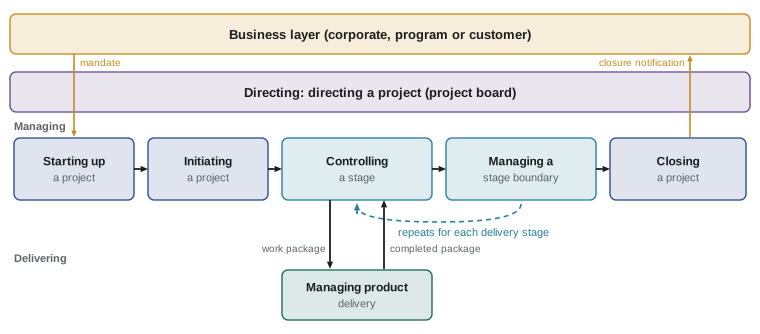
Management levels and the processes
The process model sits on top of the four levels of management that PRIN-120 introduced. The business layer, which might be corporate management, a program or a customer organization, commissions the project and sets project-level tolerances. Directing is the project board's level. Managing is the project manager's level. Delivering is the level of team managers and their teams. Each process belongs mainly to one level, and the boundaries between levels are where authority is handed down and where exceptions are escalated back up.
| Level | Processes it owns | What crosses the boundary downward | What crosses the boundary upward |
|---|---|---|---|
| Business layer | None (outside the project) | Project mandate; project tolerances; corporate standards | Requests for advice; project-level exceptions; closure notification |
| Directing | Directing a project | Authorizations; stage tolerances; ad hoc direction | Exception reports that breach project tolerance; escalations |
| Managing | Starting up, initiating, controlling a stage, managing a stage boundary, closing | Work packages with tolerances | Highlight reports; end stage reports; exception reports; issue reports |
| Delivering | Managing product delivery | (Teams work within the work package) | Checkpoint reports; completed work packages; issues raised |
Note that the executive and project manager work together in starting up before the project board formally exists. Starting up is technically a pre-project process: no project has yet been authorized, and it is the board's decision to authorize initiation, made in directing a project, that formally creates the project. This is one of the most frequently tested ideas in Foundation exams, because it explains why starting up should be short, cheap and focused on a single decision.
Stages and where the processes fall
PRIN-130 showed that a PRINCE2 project is divided into management stages, each ending with a board decision. Every project has at least two management stages: an initiation stage and one or more delivery stages. The final delivery stage also contains closing a project. Starting up is not a stage at all; it comes before the first stage. The processes line up with this structure as follows.
| Part of the lifecycle | Processes active | Decision at the end |
|---|---|---|
| Pre-project | Starting up a project (managing); the board begins directing at the end | Authorize initiation |
| Initiation stage | Initiating a project; managing a stage boundary (to plan the first delivery stage); directing | Authorize the project (and usually the next stage) |
| Each subsequent delivery stage | Controlling a stage; managing product delivery; managing a stage boundary; directing | Authorize the next stage, or an exception plan, or premature closure |
| Final delivery stage | Controlling a stage; managing product delivery; closing a project; directing | Authorize project closure |
The initiation stage contains two managing processes. Initiating a project produces the project initiation documentation (PID). Managing a stage boundary, run towards the end of initiation, produces the stage plan for the first delivery stage and updates the business case and project plan. The board can then make one combined decision: authorize the project, and authorize the first delivery stage. This course covers the first part of that sequence in detail and points to PRIN-141 for the stage boundary work itself.
Ridgeline Water: the early timeline
This course follows Ridgeline Water, the invented municipal water utility from PRIN-130 and PRIN-131, from the day its smart-metering idea first appears to the moment the project board authorizes the project. PRIN-130 built its business case, team and plans; PRIN-131 controlled its pilot stage. Here we go back to the beginning to see how those artefacts were produced by the processes. The investment appraisal from PRIN-130 still applies: the smart-meter option costs 5,000 thousand in year 0 and 4,600 thousand in year 1 and returns a net 1,240 thousand a year from years 2 to 15, giving an NPV of about 2,309 thousand at 5 %. All figures are illustrative.
| Step | Process | Duration (illustrative) | Key output or decision |
|---|---|---|---|
| General manager issues mandate | Business layer | — | Project mandate |
| Starting up | Starting up a project | 4 weeks | Project brief; initiation stage plan |
| Board decides | Directing a project | 1 meeting | Authorize initiation |
| Initiation stage | Initiating a project, then managing a stage boundary | 8 weeks | PID; pilot stage plan |
| Board decides | Directing a project | 1 meeting | Authorize the project and the pilot stage |
| Pilot stage | Controlling a stage and others (PRIN-131, PRIN-141) | 29 weeks | End stage report; rollout stage plan |
Planning the stage boundaries
The code below lays out Ridgeline Water's stages, as they will appear in the project plan produced during initiation, and calculates where each board decision falls. Starting up is shown before week 0 of the project because it is pre-project. The durations match PRIN-130's plan; the rollout stages are split so that each ends at a natural decision point, after a group of districts.
stages = [
    ("Starting up (pre-project)", 4, 0),
    ("1 Initiation", 8, 160),
    ("2 Pilot district", 29, 1450),
    ("3 Rollout: districts 2-8", 30, 3700),
    ("4 Rollout: districts 9-20 and closure", 33, 4290),
]
week = -stages[0][1]
total_cost = 0
print(f"{'Stage':38} {'Start':>5} {'End':>5} {'Cost $000':>9}")
for name, weeks, cost in stages:
    start, end = week, week + weeks
    total_cost += cost
    print(f"{name:38} {start:5d} {end:5d} {cost:9,}")
    week = end
print(f"Project duration from authorization of initiation: {week} weeks")
print(f"Project cost (stages 1-4): {total_cost:,} thousand")Stage Start End Cost $000 Starting up (pre-project) -4 0 0 1 Initiation 0 8 160 2 Pilot district 8 37 1,450 3 Rollout: districts 2-8 37 67 3,700 4 Rollout: districts 9-20 and closure 67 100 4,290 Project duration from authorization of initiation: 100 weeks Project cost (stages 1-4): 9,600 thousand
The project runs for 100 weeks from the authorization of initiation, plus four weeks of starting up beforehand, and its stages add up to 9,600 thousand: the 5,000 and 4,600 thousand of capital cost in the business case. Each row ends at a board decision. The initiation stage is short and cheap compared with the delivery stages, which is exactly what PRINCE2 intends: the organization commits a small amount to find out whether the large amount is worth committing.
Processes are not phases
A common misunderstanding is to treat the seven processes as seven consecutive phases. They are not. Directing a project runs in parallel with everything from the end of starting up onwards. Controlling a stage and managing product delivery run in parallel within each delivery stage. Managing a stage boundary overlaps with the end of controlling a stage. And the processes describe management activity, not the specialist work of building meters or writing software, which follows its own technical lifecycle and may overlap stage boundaries.
A second misunderstanding is to think every activity in every process must be done in full. PRINCE2's principle of tailoring applies to processes as much as to practices. On a small project, starting up and initiating might be combined into a few days, the project brief and PID might be the same evolving document, and the board might make its decisions in a short meeting or by email. What cannot be dropped is the purpose of each process: a deliberate decision to invest in initiation, a deliberate decision to authorize the project, and a deliberate decision to close it.
| Myth | What PRINCE2 actually expects (our summary) |
|---|---|
| The seven processes happen one after another | Directing runs throughout; stage processes repeat and overlap |
| Starting up is the first stage | Starting up is pre-project; the initiation stage is the first stage |
| Every activity produces a separate document | Products can be combined, verbal or held in tools, if the purpose is met |
| The board manages the project | The board directs; the project manager manages; teams deliver |
| Processes describe the technical work | Processes describe management; specialist work follows its own lifecycle |
Worked problem
Placing activities in the right process
Ridgeline Water's general manager emails the director of finance and operations: 'The council wants options for replacing our manual meter reading. Please look into it.' Over the next weeks: (a) the director agrees to be executive and appoints a project manager; (b) the board meets and agrees to spend money on detailed planning; (c) the project manager prepares the risk management approach; (d) the board agrees to fund the pilot. Name the process for each.
Show solution
- The email is the project mandate, issued by the business layer.
- (a) Appointing the executive and project manager is the first activity of starting up a project.
- (b) Agreeing to spend money on detailed planning is the board authorizing initiation, in directing a project.
- (c) Preparing the risk management approach happens during initiating a project.
- (d) Funding the pilot is the board authorizing the project and the first delivery stage, in directing a project, after the PID and the pilot stage plan are presented.
Answer: (a) starting up; (b) directing (authorize initiation); (c) initiating; (d) directing (authorize the project and the stage).
Common mistakes
MistakeCalling starting up a project the first stage.
InsteadStarting up is pre-project; the initiation stage is the first management stage.
MistakeThinking the project board owns controlling a stage.
InsteadThe project manager owns controlling a stage; the board directs through decisions and tolerances.
MistakeRunning the seven processes as consecutive phases.
InsteadDirecting runs throughout; delivery-stage processes repeat and overlap.
MistakeProducing every management product as a separate formal document regardless of project size.
InsteadTailor the form; keep the purpose and the decisions.
MistakeExpecting closing a project to be a separate stage.
InsteadClosing is part of the final delivery stage.
Summary and key terms
- PRINCE2 has seven processes, each owned mainly by one level of management.
- Starting up a project is pre-project; the board's decision to authorize initiation creates the project.
- Directing a project runs from the end of starting up to closure.
- Every project has at least two management stages: initiation and at least one delivery stage.
- The initiation stage contains initiating a project and managing a stage boundary.
- Controlling a stage, managing product delivery and managing a stage boundary repeat for each delivery stage; closing happens in the final stage.
- Processes describe management activity and can be tailored, but their decisions cannot be skipped.
- Process
- A structured set of activities designed to accomplish a specific objective.
- Starting up a project
- The pre-project process that checks whether initiating the project is worthwhile and viable.
- Directing a project
- The process that lets the project board be accountable for the project's success through key decisions.
- Initiating a project
- The process that establishes solid foundations and produces the project initiation documentation.
- Initiation stage
- The first management stage, in which the project is planned and the PID is approved.
- Business layer
- The corporate, program or customer management that commissions the project and sets project tolerances.
- Pre-project
- The period before the project is authorized, covered by starting up a project.
- Management level
- One of the business layer, directing, managing and delivering.
Practice problems
Work each problem on paper first, then reveal the answer to check.
How many PRINCE2 processes are there?
Show answer
Seven.
Which process is pre-project?
Show answer
Starting up a project.
Which decision formally creates the project?
Show answer
The project board's decision to authorize initiation.
Which process runs from the end of starting up to the end of the project?
Show answer
Directing a project.
What is the minimum number of management stages?
Show answer
Two: the initiation stage and at least one delivery stage.
Which level owns managing product delivery?
Show answer
Delivering (team managers).
Which two managing processes run in the initiation stage?
Show answer
Initiating a project and managing a stage boundary.
In which stage does closing a project happen?
Show answer
The final delivery stage.
Name one thing the business layer sends down to the project.
Show answer
The project mandate, or the project tolerances.
Why should starting up be short?
Show answer
It only needs to support one decision: whether initiation is worth investing in.
Lesson quiz · 5 questions
Score 60% or more to complete this lesson.
Create a free account to save your progress, take quizzes and earn a certificate.