
PLB-410 · Lesson 8 of 12 · 24 min
Fixtures, water heaters and service review
Fixtures, appliances and water treatment make up about 13 per cent of the Red Seal plumber exam, and water services are part of the 19 per cent for water service and distribution. These are the topics that apprentices work with every week, which makes them dangerous: familiarity makes candidates read quickly and answer from habit. Luis set Maya a rule for this review. "For every question, say the rule before you look at the options. If you can't say the rule, you're answering from habit."
This lesson reviews fixtures, traps and their requirements; water temperature limits and mixing; water heater sizing, recovery and safety devices; water services; and water treatment. Each section ends with the kind of calculation or rule the exam asks about.
Fixtures and their requirements
The code sets general requirements for every fixture: smooth, non-absorbent surfaces, an overflow where one is required, a trap on every fixture except those with an integral trap, and accessible connections. It also sets how many fixtures a building needs, by occupancy and number of people, which is a building code question as much as a plumbing one. Exam questions on fixture counts give the occupancy table or extract and test whether the candidate reads the occupant load and the ratio correctly.
| Fixture topic | What the exam usually tests |
|---|---|
| Fixture counts | Reading an occupancy table: people per fixture, separate counts for each sex, and the rounding up rule |
| Overflows | Which fixtures need one, and that the overflow connects on the inlet side of the trap |
| Water closets | Elongated bowls and open-front seats for public use; flush volumes; flushometer pressure needs |
| Showers | Minimum floor area and dimensions, pan liners and the temperature limit at the valve |
| Floor drains | Trap seal protection by a trap primer or other means when the drain rarely receives water |
| Accessible fixtures | Heights, clearances and lever handles, set by the accessibility rules the code references |
The rounding rule catches many candidates. When an occupancy table gives one water closet per 25 people and a floor has 60 people, the answer is three, not two. Fixture counts round up, because a fraction of a fixture cannot be installed and the requirement is a minimum.
Traps
Every trap must have a water seal deep enough to resist the pressure swings in a vented drainage system, but not so deep that solids collect. Codes commonly require a seal of at least about 38 mm. The trap must be the right size for the fixture, and it must not be smaller than the fixture outlet. Traps that depend on moving parts, interior partitions or concealed internal parts are generally prohibited, as are S-traps and crown-vented traps, because they lose their seal or clog.
Trap seal loss has a small number of causes, and a question that describes a symptom is asking for one of them: siphonage, from a fixture drain that is too long, too steep or unvented; back pressure, from a stack without enough venting; evaporation, in a fixture that is rarely used; capillary action, from a strand of hair or a rag hanging over the weir; and momentum, from a sudden large discharge, such as a bucket of water poured into a floor drain.
Temperature limits and mixing
Hot water must be stored hot enough to control the growth of Legionella bacteria, commonly at least 60 °C, but delivered cool enough not to scald. The Ontario Building Code limits the temperature of water delivered to showers and bathtubs in dwellings to 49 °C, using a pressure-balancing, thermostatic or combination valve or a mixing valve at the heater. A scald at 60 °C can happen in a few seconds; at 49 °C it takes several minutes.
Mixing calculations come up often. When hot and cold water mix, the mixed temperature is the weighted average of the two, weighted by flow. Rearranged, the equation gives the fraction of hot water in the mix.
Worked problem
Hot water fraction at a shower
The heater stores water at 60 °C. Cold water enters at 10 °C. A shower runs at 7.5 L/min at 41 °C. What fraction of the flow comes from the heater, and how much hot water does a ten-minute shower use?
Show solution
- \[f = \frac{41 - 10}{60 - 10} = \frac{31}{50} = 0.62\]
- \[V_{\text{hot}} = 0.62 \times 7.5 \times 10 = 46.5\ \text{L}\]
Answer: About 62 per cent of the flow is hot, and the shower draws about 46 litres from the heater. Raising the storage temperature lowers the fraction and makes the tank last longer, which is why a mixing valve at the heater lets a smaller tank serve the same demand safely.
Water heater sizing and recovery
A storage water heater's useful output in a busy hour is roughly the hot water stored, about 70 per cent of the tank is usable before the outlet temperature drops, plus the water it can heat during the hour, its recovery. Recovery depends on the input, the efficiency and the temperature rise. The heat needed to raise water is the mass times the specific heat times the rise, so a litre raised by one degree Celsius needs about 4.19 kJ.
Worked problem
Recovery and first-hour delivery
A gas water heater has an input of 11 kW and a thermal efficiency of 0.80. The tank holds 189 L. Cold water enters at 10 °C and the heater stores at 60 °C. What is the recovery rate, and about how much hot water can it deliver in the first hour?
Show solution
- \[\text{output} = 0.80 \times 11 = 8.8\ \text{kW} = 8.8 \times 3600 = 31\,680\ \text{kJ/h}\]
- \[\text{recovery} = \frac{31\,680}{4.19 \times (60 - 10)} \approx 151\ \text{L/h}\]
- \[\text{first hour} \approx 0.70 \times 189 + 151 \approx 283\ \text{L}\]
Answer: The heater recovers about 151 L per hour at a 50-degree rise and can supply roughly 280 L in a busy first hour. Six ten-minute showers like the previous example would use about 280 L of hot water, right at the limit.
Electric heaters recover more slowly, because their elements are usually smaller in input, but they are nearly 100 per cent efficient at the tank. Tankless heaters have no storage and are sized by the flow and the temperature rise at the coldest inlet temperature, which is why a tankless unit that works in summer can fall short in January.
Water heater safety devices
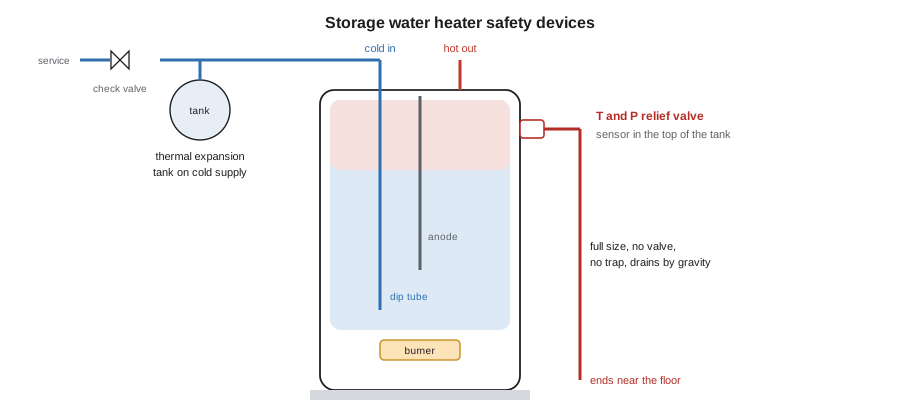
Every storage water heater needs a temperature and pressure relief valve, with the temperature sensor in the top portion of the tank where the water is hottest. The valve is sized to relieve at least the heater's input, and set at or below the tank's rated working pressure. Its discharge pipe must be the full size of the valve outlet, must not be reduced, trapped or valved, must drain by gravity, and must terminate where discharge is visible and will not scald anyone, close to the floor or to an approved receptor. Every one of those words has appeared in an exam question.
Thermal expansion is the second safety topic. When a heater warms water in a closed system, one with a check valve, backflow preventer or pressure-reducing valve on the service, the expanding water has nowhere to go. Pressure rises until the relief valve drips. The fix is a thermal expansion tank on the cold supply, sized for the heater volume and the system pressure, not a new relief valve. A dripping relief valve on a heater in a building with a new meter and check valve is a classic exam scenario.
- Seismic straps or other restraint where the code requires them.
- A drain pan with a drain where a leak would damage the building, such as a heater above a finished ceiling.
- Protection of ignition sources from flammable vapours, commonly by raising the burner in a garage or using a flammable-vapour-ignition-resistant heater.
- Combustion air and venting for gas heaters, as in lesson 7.
Water services
The water service runs from the main or the meter to the building. Its size comes from the demand and the pressure budget in lesson 5, with a minimum size set by the code, commonly 19 mm. It must be buried below the depth of frost penetration, protected where it passes through foundations, separated from building sewers by the distance or arrangement the code requires, and made of materials rated for the pressure and for potable water. Where the service enters the building, a shutoff valve and, where required, a pressure-reducing valve and backflow preventer are installed.
Exam questions about services often test the separation rule. When a water service and a building sewer share a trench, the code requires either a minimum horizontal distance between them or that the water pipe sits on a shelf at a minimum height above the sewer, or that the sewer is made of pressure-rated pipe. Reading the full rule, not just the first distance, is the point.
Water treatment
Treatment equipment appears in exam questions about softeners, filters, disinfection and reverse osmosis. Hardness is measured in milligrams per litre as calcium carbonate or in grains per gallon, and one grain per gallon equals about 17.1 mg/L. A softener exchanges calcium and magnesium for sodium or potassium, and is sized by the hardness, the daily water use and the capacity of its resin between regenerations. Its regeneration discharge goes to the drain through an air gap.
Worked problem
Softener capacity
A house uses 680 L of water a day. The hardness is 257 mg/L. How many grains of hardness does the softener remove each day, and how many days does a 32,000-grain resin bed last between regenerations?
Show solution
- \[\text{hardness} = \frac{257}{17.1} \approx 15\ \text{gpg}, \quad 680\ \text{L} \approx 180\ \text{US gal}\]
- \[\text{daily load} = 15 \times 180 = 2700\ \text{grains}\]
- \[\text{days} = \frac{32\,000}{2700} \approx 11.9\]
Answer: The bed lasts about 11 to 12 days. Most softeners regenerate earlier than the full capacity to keep a reserve, so in practice the controller might be set to regenerate every 10 days.
Grains are a United States unit of mass, and many softeners sold in Canada are still rated in them, which is why the conversion is worth knowing.
A review calculator
# Fixtures, heaters and services: mixing, recovery, softener
t_hot, t_cold, t_mix, flow, minutes = 60, 10, 41, 7.5, 10    # C, C, C, L/min, min
f = (t_mix - t_cold) / (t_hot - t_cold)
print(f"Shower: hot fraction {f:.2f}, hot water used {f * flow * minutes:.1f} L")

input_kw, eff, tank = 11, 0.80, 189
recovery = eff * input_kw * 3600 / (4.19 * (t_hot - t_cold))
print(f"Heater: recovery {recovery:.0f} L/h, first hour about {0.7 * tank + recovery:.0f} L")
showers = (0.7 * tank + recovery) / (f * flow * minutes)
print(f"        enough for about {showers:.1f} ten-minute showers in the first hour")

use_l, hard_mg = 680, 257
grains = hard_mg / 17.1 * use_l / 3.785
print(f"Softener: {grains:.0f} grains a day; 32,000-grain bed lasts {32000 / grains:.1f} days")Shower: hot fraction 0.62, hot water used 46.5 L
Heater: recovery 151 L/h, first hour about 284 L
enough for about 6.1 ten-minute showers in the first hour
Softener: 2700 grains a day; 32,000-grain bed lasts 11.9 daysCommon mistakes
MistakeRounding a fixture count down.
InsteadFixture counts are minimums and round up.
MistakeReducing or valving a relief valve discharge pipe.
InsteadRun it full size, by gravity, unvalved, to a safe, visible point.
MistakeReplacing a dripping relief valve in a closed system.
InsteadInstall a thermal expansion tank; the valve is doing its job.
MistakeSetting the heater to the delivery limit to prevent scalds.
InsteadStore hot enough to control bacteria and limit delivery with a mixing or limiting valve.
MistakeSizing a tankless heater for the summer inlet temperature.
InsteadSize it for the flow and the rise at the coldest inlet temperature.
Summary and key terms
- Fixture counts come from occupancy tables and round up; every fixture needs a trap unless it has one built in.
- Trap seals must be deep enough to resist pressure swings, commonly at least 38 mm; seal loss comes from siphonage, back pressure, evaporation, capillary action or momentum.
- Store hot water hot, commonly 60 °C, and limit delivery at showers and bathtubs in dwellings to 49 °C.
- The hot fraction of a mix is the rise needed divided by the rise available.
- First-hour delivery is about 70 per cent of storage plus the recovery; recovery is output divided by the heat needed per unit volume.
- Relief valve discharge runs full size, by gravity, unvalved, to a safe and visible point; closed systems need thermal expansion tanks.
- Recovery rate
- The volume of water a heater can raise through a given temperature rise in an hour.
- First-hour delivery
- The approximate hot water a heater can supply in a busy hour, from storage plus recovery.
- Thermal expansion tank
- A small tank on the cold supply that absorbs expansion in a closed system.
- Trap seal
- The depth of water in a trap that blocks sewer gas.
- Grain per gallon
- A hardness unit equal to about 17.1 mg/L as calcium carbonate.
Practice problems
Work each problem on paper first, then reveal the answer to check.
An occupancy table requires one lavatory per 40 people. How many for 90 people?
Show answer
Three, because 90 / 40 = 2.25 rounds up.
Hot water at 55 °C and cold at 5 °C mix to 40 °C. What is the hot fraction?
Show answer
35 / 50 = 0.70.
A 9 kW electric heater raises water by 45 °C. What is its recovery?
Show answer
9 × 3600 / (4.19 × 45), about 172 L/h.
Why does a relief valve drip after a check valve is added at the meter?
Show answer
Thermal expansion has nowhere to go; a thermal expansion tank is needed.
Convert 171 mg/L of hardness to grains per gallon.
Show answer
About 10 gpg.
Lesson quiz · 5 questions
Score 60% or more to complete this lesson.
Create a free account to save your progress, take quizzes and earn a certificate.