
PLB-410 · Lesson 12 of 12 · 20 min
Full mock exams and the final two weeks
Fourteen days before her exam date, Maya cleared her calendar of everything except work, sleep and the plan Luis had helped her write. She had studied for eleven weeks. Her error log had more than two hundred rows. Her last three practice scores were 81, 84 and 83 per cent. "The last two weeks are not for learning the trade," Luis told her. "You already know it. They're for making sure that what you know shows up on the day."
This lesson covers full-length mock exams, how to judge readiness from practice scores, a day-by-day plan for the final two weeks, the last forty-eight hours, the exam day itself, and what comes after. It ends with Maya's exam.
Full-length mock exams
A full mock is the closest rehearsal there is: 125 questions, four hours, the same rules as the real exam, in one sitting, ideally at the same time of day as the booking. It tests stamina, pacing and reading under fatigue as much as knowledge. Maya took two full mocks in the final two weeks, one on day 13 and one on day 6, with enough time after each to analyse it and act on the results.
A mock exam needs good questions. Maya built hers from three sources: question banks from her in-school or related instruction materials, questions her study group had written, and questions she had written herself from the blueprint and then set aside for a month so that she had forgotten the answers. She mixed topics in the proportions of the blueprint, so that a mock was a fair sample of the real thing.
- Take it at a table, not on a couch, with a timer visible and the phone in another room.
- Follow the two-pass plan and the checkpoints exactly as you will on the day.
- Mark only after the end, and record the time each section took.
- Log every wrong answer and every lucky guess by cause within twenty-four hours.
- Look at the score last. The error causes matter more than the number.
Reading a practice score
A single practice score is noisy. On any exam, a candidate's score varies from sitting to sitting because the questions vary and because the candidate does. Thinking about the score as a sample helps decide how much margin is enough.
Worked problem
How much margin is enough?
Suppose Maya's true accuracy, the chance she gets any one exam question right, is 80 per cent. The exam has 125 questions and needs 88 correct. What score does she expect, how much does it typically vary, and how far below her expected score is the pass mark?
Show solution
- \[\mu = n p = 125 \times 0.80 = 100\]
- \[\sigma = \sqrt{n p (1 - p)} = \sqrt{125 \times 0.80 \times 0.20} = \sqrt{20} \approx 4.5\]
- \[\frac{\mu - 88}{\sigma} = \frac{100 - 88}{4.5} \approx 2.7\ \text{standard deviations}\]
Answer: She expects about 100 correct, give or take about 4 or 5. The pass mark sits nearly three standard deviations below, so at a true 80 per cent she passes on almost any day. At a true 72 per cent, the expected score would be 90, only about 0.4 standard deviations above the pass mark, and a bad day could easily fail.
This model is simple, because real questions are not all equally hard, but it gives the right intuition: a margin of ten percentage points above the pass mark is comfortable, and a margin of two or three is a coin toss on a bad day. The program below estimates the chance of passing for a range of true accuracies, using the exact binomial distribution rather than the approximation.
# Chance of passing for a given true accuracy (binomial model)
from math import comb, ceil

n, pass_mark = 125, 0.70
need = ceil(pass_mark * n)

def p_pass(p):
    return sum(comb(n, k) * p ** k * (1 - p) ** (n - k) for k in range(need, n + 1))

def pct(x):
    return f"{x:6.1%}" if x < 0.9995 else " >99.9%"

print(f"{n} questions, {need} needed to pass")
for acc in (0.68, 0.70, 0.72, 0.75, 0.78, 0.80, 0.85):
    print(f"  true accuracy {acc:.0%}: expected {acc * n:5.1f} correct, chance of passing {pct(p_pass(acc))}")

scores = [0.64, 0.71, 0.74, 0.78, 0.79, 0.81, 0.84, 0.83]       # Maya's practice scores
recent = sum(scores[-3:]) / 3
print(f"Average of the last three practice scores: {recent:.1%} -> chance of passing about {pct(p_pass(recent)).strip()}")125 questions, 88 needed to pass true accuracy 68%: expected 85.0 correct, chance of passing 31.9% true accuracy 70%: expected 87.5 correct, chance of passing 50.5% true accuracy 72%: expected 90.0 correct, chance of passing 69.5% true accuracy 75%: expected 93.8 correct, chance of passing 90.0% true accuracy 78%: expected 97.5 correct, chance of passing 98.2% true accuracy 80%: expected 100.0 correct, chance of passing 99.6% true accuracy 85%: expected 106.2 correct, chance of passing >99.9% Average of the last three practice scores: 82.7% -> chance of passing about >99.9%
Two things stand out in the output. A candidate whose true accuracy is exactly the pass mark passes only about half the time. And the chance of passing rises steeply over a few percentage points, which is why the last few points of improvement in the final weeks are worth so much.
The final two weeks
Maya's plan for the last fourteen days balanced three kinds of work: full mocks to rehearse, targeted review driven by the error log, and light mixed practice to keep everything warm. New topics were off the list. The plan also tapered: the hardest work was in the first week, and the last two days were light.
| Days before the exam | Main task | Notes |
|---|---|---|
| 14 | Review the error log; list the top ten weak topics | Plan the week from the causes, not from the syllabus |
| 13 | Full mock exam 1 | Exam conditions, same time of day as the booking |
| 12 | Analyse mock 1: log every error by cause | Update the weak-topic list |
| 11 to 9 | Targeted review of the top weak topics; 20 mixed questions a day | Spaced reviews continue |
| 8 | Formula sheet and summary pages: read and rewrite from memory | Anything you cannot rewrite goes back on the list |
| 7 | Light day: 20 mixed questions, rest | Sleep is part of the plan |
| 6 | Full mock exam 2 | Compare pacing and causes with mock 1 |
| 5 | Analyse mock 2; fix the remaining top causes | Focus on reading and lookup errors if they persist |
| 4 to 3 | Mixed practice and final reviews of weak topics | Short sessions; stop while fresh |
| 2 | Logistics check; light review of summary pages | Route, documents, food, alarm |
| 1 | Rest; a short walk through the formula sheet only | No new questions after midday |
| 0 | Exam | Follow the plan |
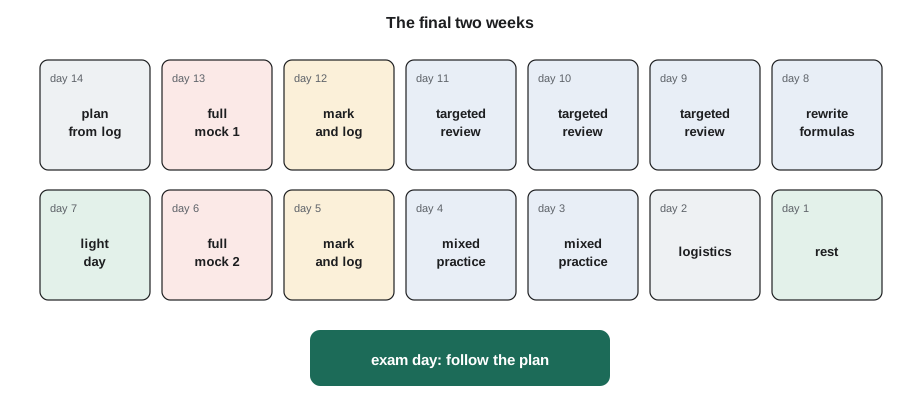
The rule against new topics in the last week surprises some candidates. The reason is that a new topic studied in the final days is poorly learned and crowds out review of topics that are almost secure. The marks are in turning 70 per cent topics into 90 per cent topics, not in turning 0 per cent topics into 40 per cent ones.
The last forty-eight hours
Two days before the exam, Maya did a logistics check. She confirmed the location and the start time, looked up the route and parking, and planned to arrive thirty minutes early. She put her identification, the confirmation letter and a bottle of water by the door. The exam provides the calculator and the reference information, so she brought nothing else, and she knew where she would leave her phone.
The evening before, she read her formula sheet once, ate a normal dinner, and went to bed at her usual time. Luis had told her that one more evening of cramming would cost more in sleep than it gained in knowledge, and her mock exams had shown it: her worst score had come after a late night.
On the day
Maya's exam day routine was the one she had rehearsed twice. A normal breakfast. Arrive early, find the washroom, settle in. Read the instructions fully, including how to flag and how to move between questions. Then start the clock on her pacing plan.
- First pass, about 1 minute 45 seconds per question, best answer and flag on anything uncertain.
- Checkpoint at each quarter: on pace or ahead, ten seconds of rest, a sip of water.
- Review pass on flagged questions, closest first; change answers only for a reason.
- Final check: every question has an answer.
Two things happen to almost everyone during a long exam. A run of hard questions comes along and shakes confidence. And a question appears on a topic that seems never to have been studied. Maya had a response ready for both. For the run of hard questions, she reminded herself that the exam is a mix, and that hard questions are hard for everyone. For the unknown topic, she used elimination, chose the best remaining answer, flagged it and moved on. One question is a small share of the marks, and the next one is a fresh start.
Maya's exam
The exam was on a Tuesday morning at a testing centre on the east side of Hamilton. Maya finished the first pass with forty minutes to spare and twenty-two questions flagged. She changed three answers on review, each for a reason she could name: a NOT she had missed, a gauge pressure that should have been absolute, and a vent table column she had read one step too early. She handed in with ten minutes left. Five weeks later, a letter from Skilled Trades Ontario arrived. She had passed, with a score comfortably above the mark, and her Certificate of Qualification carried the Red Seal.
Luis took the crew for lunch. Grace sent a photo of the old galvanised pipe they had cut out together in Mrs. Patel's basement, with the caption "you've come a long way". Raj, now in his third year, asked whether he could borrow her error log. She said yes, but told him the log was not the useful part. The useful part was writing it.
After the exam
A Certificate of Qualification is not the end of learning. In Ontario, the certificate is renewed each year to stay in good standing. Codes change on a regular cycle, and a journeyperson is expected to keep up with each new edition. New materials, methods and equipment arrive every year, from press fittings to smart leak detection, and manufacturers' training is how most plumbers learn them. Many journeypersons go on to add certificates, such as a gas technician certificate, backflow prevention testing or medical gas installation, or to move into supervision, estimating, inspection, teaching or their own business.
Maya also took on a new role. Northbridge Mechanical assigned her an apprentice of her own, and the first thing she did was hand over a copy of the pacing plan and the six error causes. The habits that got her through the exam were the same ones that make a good plumber: read the whole question, check the definition, find the exception, carry the units, and test before you trust.
Managing nerves
Some anxiety before an exam is normal and even useful: it sharpens attention. Too much narrows attention and makes reading careless, which is exactly the error the log is designed to prevent. Maya used three techniques that are simple enough to work under pressure. Before the exam, she wrote down for two minutes what she was worried about, which research on test anxiety suggests can free up attention for the task. During the exam, she used slow breathing at each checkpoint, breathing out for longer than she breathed in. And when a hard question rattled her, she named the feeling to herself, "this is just a hard one", and returned to the five-step method, because a routine gives the mind something to do other than worry.
Preparation is the strongest defence against nerves. A candidate who has rehearsed the full exam twice, knows her pacing plan, and has a reason behind every answer she changes has very little left to be surprised by. Maya walked in nervous, but she was not afraid, because nothing about the morning was new.
Common mistakes
MistakeStudying new topics in the final week.
InsteadUse the final week to turn nearly secure topics into secure ones.
MistakeTaking a mock exam in short sessions with breaks to look things up.
InsteadTake full mocks in one sitting under exam conditions.
MistakeJudging readiness from one high score.
InsteadUse the average of the last few full-length scores and keep a margin.
MistakeCramming late the night before.
InsteadSleep at the usual time; fatigue costs more than a last review gains.
MistakeLetting one unknown question shake confidence.
InsteadEliminate, choose, flag and move on; one question is a small share of the marks.
Summary and key terms
- Full mock exams rehearse stamina, pacing and reading as well as knowledge; take them under exam conditions and analyse every error.
- Treat a practice score as a sample: a margin of about ten points above the pass mark is comfortable.
- A candidate whose true accuracy equals the pass mark passes only about half the time.
- Plan the final two weeks with two mocks, marking and logging after each, targeted review and a taper.
- Check logistics two days before, sleep normally, and follow the rehearsed routine on the day.
- After passing, keep the certificate in good standing, keep up with code changes and keep adding skills.
- Full mock exam
- A practice exam of full length taken in one sitting under exam conditions.
- True accuracy
- The underlying chance of answering a question correctly, estimated from practice scores.
- Standard deviation
- A measure of how much a score typically varies from its expected value.
- Taper
- Reducing study load in the final days so that the candidate arrives rested.
- Logistics check
- Confirming location, time, route and documents before the exam.
Practice problems
Work each problem on paper first, then reveal the answer to check.
At a true accuracy of 75 per cent on 125 questions, what is the expected score?
Show answer
93.75, about 94 correct.
What is the standard deviation at 75 per cent on 125 questions?
Show answer
The square root of 125 × 0.75 × 0.25, about 4.8.
Why are new topics avoided in the final week?
Show answer
They are poorly learned and crowd out review of nearly secure topics.
How many full mocks does Maya's plan include, and when?
Show answer
Two, on days 13 and 6 before the exam.
What should a candidate do with a question on an unfamiliar topic?
Show answer
Eliminate what she can, choose the best answer, flag it and move on.
Lesson quiz · 5 questions
Score 60% or more to complete this lesson.
Create a free account to save your progress, take quizzes and earn a certificate.