
PLB-410 · Lesson 3 of 12 · 24 min
Code navigation drills
Luis timed Maya with his phone. "Minimum size of a building drain serving a single water closet. Go." She knew the answer from the job, but he made her find it in the code anyway, and it took her almost three minutes: she started in the wrong section, found the right table, then went back to check the footnotes. "On the job, three minutes is nothing," he said. "On the exam, a question with a code extract gives you the information, but you still have to read the table the right way, and you have less than two minutes. And when you're certified, nobody will hand you the extract. You'll be the one finding it."
This lesson is a set of drills. It gives a method for finding any requirement in the plumbing code, a set of practice lookups grouped by type, and a way to time and track your speed so that you can see it improve. The goal is that every common lookup becomes a habit: the first place you look is the right place.
How a plumbing code is built
Every plumbing code has a structure, and learning the structure is the first drill. Part 7 of the Ontario Building Code and the National Plumbing Code of Canada are organized in the same way. Definitions come first, in the general part of the code. Then come sections on materials and equipment, on piping, on drainage systems, on venting systems, on potable water systems and on non-potable water systems. Within each section, articles are numbered in a hierarchy: the part, the section, the subsection, the article and the sentence. A reference such as 7.4.9.3.(1) means Part 7, Section 4, Subsection 9, Article 3, Sentence 1. Tables are numbered after the article that uses them, so a table always sits close to the rule that tells you how to apply it.
Maya made a one-page map of the code's structure and kept it in the front of her notebook. It listed each section or chapter, its main subjects and its most-used tables. For the first two weeks, she looked at the map before every lookup. By the third week, she no longer needed it.
The five-step lookup
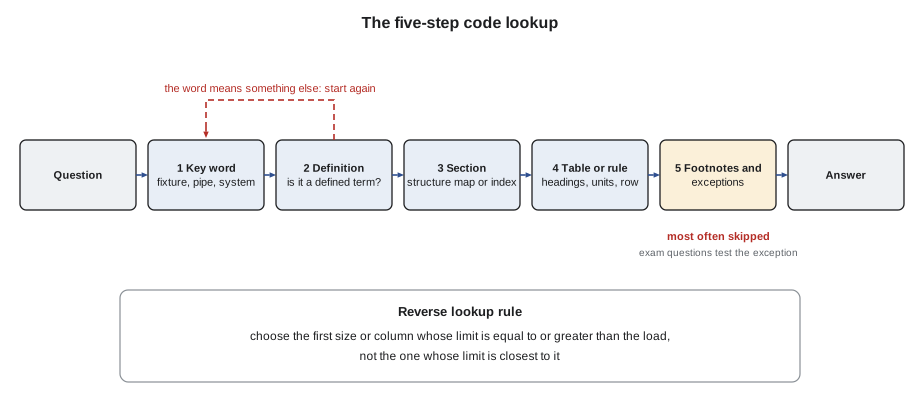
Luis taught her a method that turned searching into a routine. It has five steps, and skipping any of them is where most lookup errors come from.
- Pick the key word. Every question has one or two words that decide where the answer lives: a fixture, a pipe type, a system, a test. In "What is the minimum trap size for a floor drain?", the key words are trap and floor drain.
- Check the definition. If the key word is a defined term, read the definition. The exam uses defined terms exactly. A branch is not a stack, a fixture drain is not a trap arm in every code, and a building drain stops where the building sewer begins.
- Find the section. Use the structure map or the index to go to the right section. The index is alphabetical and lists many terms under the system they belong to, so try both the specific word and the system.
- Read the table or the rule. Read the column headings and the units first, then find the row. Check whether the table gives a maximum or a minimum, and whether values are per fixture, per branch or per stack.
- Check footnotes and exceptions. Many rules have exceptions in the next sentence, and many tables have footnotes that change the value for one case. Read them every time, even when you are sure.
The fifth step is the one most candidates skip, and the exam writers know it. A common question pattern gives a situation that falls into an exception, with the general rule as one of the wrong options. A candidate who stops at the general rule picks the distractor.
Drill set 1: definitions
Definitions are the fastest marks on the exam and the most common source of avoidable errors. Maya drilled them with flash cards: the term on the front, the definition and an example on the back. She worked through the defined terms that come up most in plumbing questions until she could explain each in one sentence.
| Term | What to remember |
|---|---|
| Branch | A drain that connects fixtures to a stack or building drain; it is mostly horizontal. |
| Stack | A vertical drain that extends one or more storeys; a soil stack carries toilet waste. |
| Building drain | The lowest horizontal drain inside the building that receives the stacks and carries waste to the building sewer. |
| Building sewer | The pipe from the building drain to the public sewer or private treatment system. |
| Developed length | The length measured along the centre line of the pipe and fittings, not in a straight line. |
| Fixture unit | A number that represents a fixture's load on the drainage system, used for sizing. |
| Flood level rim | The edge of a fixture from which water overflows. |
| Trap seal | The depth of water between the crown weir and the top of the dip of a trap. |
| Wet vent | A vent that also carries waste from fixtures other than water closets, within limits. |
| Cross-connection | Any connection through which non-potable water or other substances could enter the potable system. |
A good definition drill has three questions for each term: what it is, what it is not, and one example on a real job. Maya added a fourth after a practice test: where does it stop? Many errors came from not knowing the boundary between a fixture drain and a branch, or between a building drain and a building sewer.
Drill set 2: tables
Tables hold most of the numbers on the exam. Even when the exam supplies a table extract, the candidate has to know how the table is used. Maya drilled each of the main tables with three types of question: a direct lookup, a reverse lookup and a combined lookup.
- Direct lookup: given the input, find the value. What is the fixture unit value of a bathtub?
- Reverse lookup: given a value, find the input. What is the smallest stack that can carry a given number of fixture units?
- Combined lookup: two tables or a table and a rule. How many fixture units does a group of fixtures produce, and what size branch carries them?
The reverse lookup is where most mistakes happen. When a table lists the maximum load for each size, the answer to "what size is needed" is the first size whose maximum is equal to or greater than the load, not the size whose maximum is closest to the load. A load of 21 fixture units on a branch table that allows 20 for one size and 160 for the next needs the larger size, even though 21 is much closer to 20.
Worked problem
Reading a sizing table in reverse
A simplified practice table used in this course allows these maximum loads on horizontal branches: 38 mm, 3 fixture units; 50 mm, 6; 75 mm, 20; 100 mm, 160. A branch serves a load of 21 fixture units. What is the minimum size, and how much spare capacity does it have?
Show solution
- \[21 > 20 \to 75\ \text{mm is too small}\]
- \[21 \le 160 \to 100\ \text{mm is the first size that carries the load}\]
- \[\text{spare} = 160 - 21 = 139\ \text{fixture units}\]
Answer: The branch must be 100 mm. It has a large spare capacity, which is normal: drainage tables step up in large jumps.
Drill set 3: rules and exceptions
The third drill is for rules that are written as sentences rather than tables: where a cleanout is required, how far a trap may be from its vent, when an air admittance valve may be used, which fittings may change direction. For each rule, Maya wrote a card with the rule on one side and the exception on the other. Then she wrote one exam-style question that tested the exception rather than the rule.
| Rule type | Typical exception to look for |
|---|---|
| Minimum pipe size | A smaller size permitted for a specific fixture or a short length |
| Fitting use | A fitting allowed in one direction of flow but not the other, or allowed only in vent piping |
| Cleanout spacing | Different spacing for larger pipes, or a fixture trap counted as a cleanout |
| Vent requirements | Fixtures or arrangements allowed without an individual vent, within limits |
| Test requirements | Alternative tests permitted for certain materials or when water would freeze |
Luis's favourite exam pattern was what he called the almost-rule question. The question describes a situation that is almost the common case but differs in one detail, such as a pipe size, a vertical rather than horizontal direction, or a fixture that is not a water closet. The wrong options include the answer for the common case. The only defence is to read the question for the detail and to read the rule to the end.
Navigating with extracts and with the full code
On the Red Seal exam, code information arrives in the question: a table extract, a short quotation or a value. The navigation skill is then reading the extract correctly and quickly. Maya practised by covering the answer options, reading the extract, writing her own answer, and only then uncovering the options. That stopped the options from steering her toward a familiar but wrong number. At work, the same skill runs the other way: she needed to find the extract herself in the full code. She drilled both, because the exam is one day and the job is a career.
A useful drill is the reverse question: open the code at a random table, and write a question that the table answers. It builds familiarity with tables you might otherwise skip, and it shows how the exam writers think, because that is exactly how they work.
Timing and tracking
Drills only improve speed if speed is measured. Maya logged every lookup: the date, the type of lookup, the time in seconds and whether she got it right. Each week, she worked out her average time and her accuracy for each type. Luis set targets: definitions under 30 seconds, direct table lookups under 45 seconds, combined lookups under 2 minutes, all with at least 90 per cent accuracy.
Worked problem
Measuring improvement
In week 1, Maya's ten combined lookups took a total of 31 minutes. In week 4, ten combined lookups took 17 minutes. What were her average times, and by what percentage did her time fall?
Show solution
- \[\bar{t}_1 = \frac{31 \times 60}{10} = 186\ \text{s}, \qquad \bar{t}_4 = \frac{17 \times 60}{10} = 102\ \text{s}\]
- \[\text{reduction} = \frac{186 - 102}{186} \times 100 \approx 45\ \%\]
Answer: Her average fell from 186 seconds to 102 seconds, about 45 per cent faster, and now inside the 2-minute target.
The program below takes a drill log, computes the average time and accuracy by drill type each week, and flags any type that misses its target. Maya ran it every Sunday evening and used the flags to choose the next week's drills.
# Code navigation drill log: weekly average time and accuracy by type
log = [  # (week, type, seconds, correct)
    (1, "definition", 48, True), (1, "definition", 35, True), (1, "definition", 62, False),
    (1, "direct", 70, True), (1, "direct", 95, True), (1, "direct", 58, False),
    (1, "combined", 190, True), (1, "combined", 240, False), (1, "combined", 165, True),
    (4, "definition", 22, True), (4, "definition", 18, True), (4, "definition", 31, True),
    (4, "direct", 41, True), (4, "direct", 38, True), (4, "direct", 52, True),
    (4, "combined", 110, True), (4, "combined", 98, True), (4, "combined", 131, False),
]
targets = {"definition": 30, "direct": 45, "combined": 120}   # seconds
for week in sorted({w for w, *_ in log}):
    print(f"Week {week}")
    for kind, target in targets.items():
        rows = [(s, c) for w, k, s, c in log if w == week and k == kind]
        avg = sum(s for s, _ in rows) / len(rows)
        acc = 100 * sum(c for _, c in rows) / len(rows)
        ok = "on target" if avg <= target and acc >= 90 else "DRILL MORE"
print(f" {kind:10s} avg {avg:6.1f} s (target {target:3d}) accuracy {acc:5.1f} % {ok}")Week 1 definition avg 48.3 s (target 30) accuracy 66.7 % DRILL MORE direct avg 74.3 s (target 45) accuracy 66.7 % DRILL MORE combined avg 198.3 s (target 120) accuracy 66.7 % DRILL MORE Week 4 definition avg 23.7 s (target 30) accuracy 100.0 % on target direct avg 43.7 s (target 45) accuracy 100.0 % on target combined avg 113.0 s (target 120) accuracy 66.7 % DRILL MORE
In the sample log, week 4 meets the time targets for all three types, but combined lookups are still below 90 per cent accuracy, so the program flags them. Speed without accuracy is no improvement. Maya's response was to slow down on combined lookups and add the footnote check back in, which brought accuracy up within two weeks without losing much time.
A twenty-minute daily drill
Luis's daily drill took twenty minutes and had four parts. Maya did it at lunch on work days, with a timer running.
| Minutes | Drill | Example |
|---|---|---|
| 0 to 5 | Five definitions from flash cards | Developed length, flood level rim, trap seal, wet vent, cross-connection |
| 5 to 10 | Three direct table lookups | Fixture unit value of a shower; trap size for a laundry tub; minimum vent size |
| 10 to 17 | Two combined lookups | Size a branch for a bathroom group and a kitchen sink; size a stack for three floors |
| 17 to 20 | Log the results and pick tomorrow's weakest type | Write times and accuracy in the drill log |
After six weeks, Maya's lookups were fast enough that she started to see the structure of questions before she read the options: "this is a combined lookup with a footnote" or "this is a definition question disguised as a sizing question". That recognition is the real goal of drilling. It lets you spend the time saved on the questions that need thought.
Common mistakes
MistakeGoing straight to the table without checking the definition of the key word.
InsteadCheck the definition first; the exam uses defined terms exactly.
MistakeChoosing the size whose maximum is closest to the load.
InsteadChoose the first size whose maximum is equal to or greater than the load.
MistakeStopping at the general rule.
InsteadRead to the end of the article or section and check footnotes and exceptions.
MistakeLooking at the answer options before finding the answer.
InsteadFind and write your answer first, then compare it with the options.
MistakeDrilling without timing or logging.
InsteadLog time and accuracy by drill type and set targets.
Summary and key terms
- Learn the structure of the code first: definitions, then materials, piping, drainage, venting and water systems, with tables next to the rules that use them.
- Use a five-step lookup: key word, definition, section, table or rule, footnotes and exceptions.
- Drill definitions, direct lookups, reverse lookups and combined lookups separately.
- In a reverse lookup, pick the first size whose maximum carries the load.
- Exams often test the exception; read every rule to the end.
- Time and log every drill, and set targets for both speed and accuracy.
- Developed length
- Length measured along the centre line of the pipe and fittings.
- Reverse lookup
- Using a table to find the input, such as a size, that carries a given value.
- Combined lookup
- A question that needs two tables, or a table and a rule, together.
- Exception
- A part of a rule that changes the requirement for a specific case.
- Drill log
- A record of lookup times and accuracy used to target practice.
Practice problems
Work each problem on paper first, then reveal the answer to check.
What do the parts of a reference such as 7.4.9.3.(1) mean?
Show answer
Part 7, Section 4, Subsection 9, Article 3, Sentence 1.
What are the five steps of a code lookup?
Show answer
Key word, definition, section, table or rule, then footnotes and exceptions.
A practice branch table allows 6 fixture units for 50 mm and 20 for 75 mm. What size carries 7 fixture units?
Show answer
75 mm, the first size whose maximum is at least 7.
Ten lookups took 25 minutes. What is the average time per lookup?
Show answer
150 seconds.
Why cover the answer options when practising with extracts?
Show answer
So that familiar but wrong options do not steer your reading.
Lesson quiz · 5 questions
Score 60% or more to complete this lesson.
Create a free account to save your progress, take quizzes and earn a certificate.