
PLB-410 · Lesson 2 of 12 · 20 min
Using the RSOS and exam weightings
On the second Saturday of her study plan, Luis asked Maya a question she could not answer. "If you had sixty hours to study, how many would you give to venting?" She guessed ten. He opened the Red Seal exam weightings for plumbers on his laptop and showed her that sanitary drainage, sewers and venting together carry about a quarter of the exam, while specialized systems such as medical gas and fire protection carry under a tenth. "The people who wrote this exam told you where the marks are," he said. "Most apprentices never look."
This lesson shows how to read the Red Seal Occupational Standard, how the exam weightings follow from it, and how to turn the weightings and an honest self-assessment into a study plan with hours attached. The same method works for any exam that publishes a blueprint.
What the Red Seal Occupational Standard is
The Red Seal Occupational Standard, usually shortened to RSOS, is a national description of the plumber trade, developed by the provinces and territories with industry and reviewed on a regular cycle. It breaks the trade into major work activities, each major work activity into tasks, and each task into sub-tasks. For each sub-task it lists performance criteria, which describe what a competent plumber does, and knowledge criteria, which describe what they need to know. The exam questions are written against these sub-tasks, so the RSOS is the closest thing a candidate has to a list of every topic the exam can ask about.
The RSOS is long, and Maya did not try to read it cover to cover. She used it as a checklist. For each task, she read the sub-task titles and asked herself whether she could explain the work to an apprentice and answer a question about it. Where the answer was no, she marked it for study. The knowledge criteria were especially useful, because they named things she had done on the job without learning the theory, such as the principles of steam traps and the chemistry behind water treatment.
The weightings by major work activity
The Red Seal exam weightings show how many questions come from each major work activity. For the plumber exam, the seven major work activities and their approximate shares are listed below, with the number of questions each share represents on a 125-question exam.
| Major work activity | Share | About how many questions |
|---|---|---|
| A. Performs common occupational skills (safety, tools, communication, rigging, planning) | 11 % | 14 |
| B. Prepares and assembles tube, tubing and pipe | 10 % | 12 |
| C. Installs, services and maintains sewers, sewage treatment and drainage, waste and vent systems | 26 % | 33 |
| D. Installs, services and maintains water service and distribution systems | 19 % | 24 |
| E. Installs, services and maintains fixtures, appliances and water treatment systems | 13 % | 16 |
| F. Installs, services and maintains low-pressure steam and hydronic heating systems | 13 % | 16 |
| G. Installs, services and maintains specialized systems | 8 % | 10 |
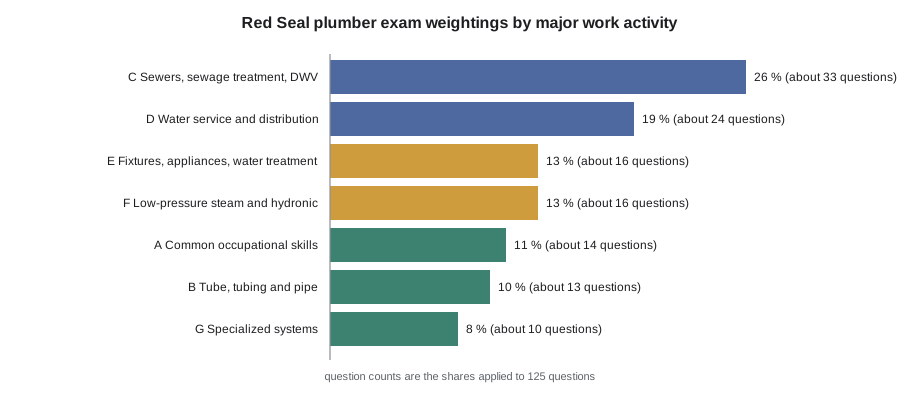
Two things stand out. First, the two largest major work activities, C and D, are the drainage and water supply systems that plumbers spend most of their time on, and together they are 45 per cent of the exam. Second, the hydronic heating share, 13 per cent, is as large as the fixtures share and larger than the share for pipe preparation. Many apprentices in Ontario spend little time on hydronic systems at work, so this is where unprepared candidates lose marks. Luis called it the quiet sixteen questions.
Turning weightings into study hours
A study plan that follows only the blueprint gives the most time to the biggest areas, even if the candidate already knows them well. A plan that follows only weaknesses spends hours on small areas. The useful plan combines both. Maya rated herself from 1 to 5 in each area, where 1 meant she would struggle with most questions and 5 meant she would get almost all of them right. Each area's priority was its share of the exam multiplied by a weakness factor, and her available hours were divided in proportion to the priorities.
Worked problem
A weighted study plan
Maya has 60 study hours. She rates herself 4 on drainage and venting (share 26 per cent) and 2 on hydronic heating (share 13 per cent). Using a weakness factor equal to 6 minus the rating, compare the two priorities. If the total of all seven priorities is 2.40, how many hours go to each of these two areas?
Show solution
- \[p_{C} = 0.26 \times (6 - 4) = 0.52\]
- \[p_{F} = 0.13 \times (6 - 2) = 0.52\]
- \[h_{C} = 60 \times \frac{0.52}{2.40} = 13\ \text{h}, \qquad h_{F} = 60 \times \frac{0.52}{2.40} = 13\ \text{h}\]
Answer: Both areas get 13 hours. Hydronic heating has half the share of drainage and venting, but Maya's weakness there doubles its priority. Without the weakness factor she would have spent half as much time on it.
The factor of 6 minus the rating is a simple choice, and it works because it never reaches zero: even an area rated 5 gets some review time. Some candidates square the factor to push more time toward weak areas. The exact formula matters less than doing the calculation at all, because it turns a vague feeling about what to study into a schedule.
# Weighted study plan: exam share x weakness factor
hours = 60
areas = {   # area: (share of exam, self-rating 1 to 5)
    "A Common occupational skills": (0.11, 3),
    "B Tube, tubing and pipe":      (0.10, 4),
    "C Sewers and DWV":             (0.26, 4),
    "D Water service/distribution": (0.19, 3),
    "E Fixtures, appliances, treatment": (0.13, 4),
    "F Low-pressure steam/hydronic": (0.13, 2),
    "G Specialized systems":        (0.08, 2),
}
prio = {a: share * (6 - rating) for a, (share, rating) in areas.items()}
total = sum(prio.values())
print(f"Total priority {total:.2f}")
print(f"{'Area':36s} share rating  hours")
for a, p in sorted(prio.items(), key=lambda kv: -kv[1]):
    share, rating = areas[a]
    print(f"{a:36s} {share * 100:4.0f} %   {rating}    {hours * p / total:5.1f}")
print(f"{'Total':36s} {hours:5.1f}")Total priority 2.72 Area share rating hours D Water service/distribution 19 % 3 12.6 C Sewers and DWV 26 % 4 11.5 F Low-pressure steam/hydronic 13 % 2 11.5 A Common occupational skills 11 % 3 7.3 G Specialized systems 8 % 2 7.1 E Fixtures, appliances, treatment 13 % 4 5.7 B Tube, tubing and pipe 10 % 4 4.4 Total 60.0
Run the program with your own ratings. Rate yourself after a diagnostic test rather than from memory, because people tend to overrate areas they enjoy and underrate areas they have not looked at in a while. Maya re-rated herself after each mock exam and reran the plan, which moved hours from areas she had fixed to areas that were still weak.
Reading a task in the RSOS
To see how the RSOS turns into questions, Luis walked Maya through one task in major work activity C: installing venting systems. The sub-tasks include determining the type and size of vents required, installing vent piping, and testing the venting system. The knowledge criteria list the purpose of venting, the types of vents, the effect of trap seal loss, and the code requirements for vent sizing, grade and connections. Every one of those lines can become a question.
| RSOS line | A question it could become |
|---|---|
| Purpose of venting | Which of the following is the main reason for venting a trap? |
| Types of vents | Which type of vent serves two fixtures connected at the same level? |
| Effect of trap seal loss | A trap loses its seal when an upstream fixture drains. What is the most likely cause? |
| Vent sizing | What is the minimum size of a vent stack serving a given load and length? |
| Testing venting systems | What test pressure applies to a new drainage and vent system under an air test? |
Writing questions from the blueprint like this is the method Maya's study group used. It forces a close reading, and it produces practice questions aimed exactly at the exam's topics. The questions in this course were written the same way.
The code you will be tested on
The Red Seal exam is national, so its code questions follow the National Plumbing Code of Canada. Ontario's plumbing rules, in Part 7 of the Ontario Building Code, are closely based on the national code and organized the same way: general requirements, materials and equipment, piping, drainage systems, venting systems, potable water systems and non-potable water systems. Where Ontario differs from the national code, the exam follows the national rules, but the exam rarely turns on a provincial difference. Luis's advice was to study the principles and the national values, and to be aware of where Ontario's rules differ so that a familiar number from work does not mislead you.
Because the exam provides the code information a question needs, candidates do not have to memorize table values. They do need to know how a table is used: which column to read, how to add loads, what a footnote changes and when an exception applies. A candidate who knows how the drainage tables work can answer a question that quotes an extract of one in under two minutes. A candidate who has never used them cannot.
- Ontario-specific items to watch: the rules for hot water temperature at showers and bathtubs, backflow and cross-connection programs run by municipalities, and the treatment of sumps and backwater valves in local by-laws. The exam tests the principle; your job will test the local rule.
- Definitions are worth studying for both. Many questions turn on a definition: what counts as a branch, a stack, a fixture drain, a developed length or a building drain. Definitions in the code are precise, and the exam uses them precisely.
A diagnostic test before the plan
Before writing her study plan, Maya took a diagnostic test: fifty mixed practice questions in about an hour and a half, without preparation, timed. The point was not the score but the pattern. She sorted her wrong answers by major work activity and compared her accuracy in each with her self-ratings. Two surprises came out. She had rated herself 4 on water service and distribution, but got only 60 per cent of those questions right, mostly because of sizing problems with several steps. And she had rated herself 2 on specialized systems, but got 80 per cent, because her medical gas work on the hospital wing had taught her more than she realized.
She reran the plan with ratings based on the diagnostic. Hours moved from areas she had overrated to areas she had not. That is the value of a diagnostic: it replaces opinion with evidence, early enough to change the plan.
| Step | What Maya did | Time |
|---|---|---|
| 1 | Read the blueprint and listed the areas with their shares | 1 h |
| 2 | Took a timed diagnostic test of mixed questions | 1.5 h |
| 3 | Sorted wrong answers by area and rated each area 1 to 5 | 1 h |
| 4 | Ran the weighted plan and wrote hours into her calendar | 0.5 h |
| 5 | Re-rated and reran the plan after each mock exam | 0.5 h each |
Keeping the plan honest
A plan on paper does not study itself. Maya put her hours into a calendar as fixed blocks: three evenings a week for ninety minutes, and four hours on Saturday mornings. Each block had a topic from the plan and a product at the end: ten questions answered, a summary page written, a set of sizing problems worked. When a block was missed, it was moved, not dropped. Luis checked her notebook every Monday at the start of the shift, which she found irritating for about two weeks and then relied on.
She also kept a running total of hours against the plan. By week six she was behind on water supply and ahead on fixtures, so she moved two Saturday blocks. That kind of adjustment is what makes a plan work. A plan that is never changed is usually a plan that is not being followed.
Common mistakes
MistakeGiving every major work activity the same time.
InsteadWeight study by the blueprint share and by your own weakness.
MistakeRating yourself from memory instead of from a test.
InsteadTake a timed diagnostic and rate each area from the results.
MistakeIgnoring hydronic heating because you rarely work on it.
InsteadIt carries about 16 questions; treat it as a main area.
MistakeMemorizing table values the exam will provide.
InsteadLearn how to use the tables: columns, loads, footnotes and exceptions.
MistakeWriting a plan and never revising it.
InsteadRe-rate and rerun the plan after each mock exam.
Summary and key terms
- The RSOS breaks the trade into major work activities, tasks and sub-tasks, with performance and knowledge criteria; exam questions are written against the sub-tasks.
- The weightings put 26 per cent on sewers and DWV, 19 per cent on water supply, 13 per cent each on fixtures and hydronic heating, 11 per cent on common skills, 10 per cent on pipe preparation and 8 per cent on specialized systems.
- A study plan that multiplies each area's share by a weakness factor gives a practical split of hours.
- A timed diagnostic test gives ratings based on evidence rather than opinion.
- The exam supplies code information; learn how to use tables, definitions and exceptions rather than memorizing values.
- RSOS
- Red Seal Occupational Standard, the national description of a trade used to write the exam.
- Major work activity
- One of the main divisions of the trade in the RSOS, such as water service and distribution.
- Sub-task
- The smallest unit of work in the RSOS, with performance and knowledge criteria.
- Exam weighting
- The share of exam questions drawn from each major work activity.
- Diagnostic test
- A timed practice test taken before study to find strong and weak areas.
Practice problems
Work each problem on paper first, then reveal the answer to check.
Which major work activity carries the most questions on the Red Seal plumber exam?
Show answer
C, sewers, sewage treatment and DWV systems, at about 26 per cent or 33 questions.
About how many questions come from low-pressure steam and hydronic heating?
Show answer
About 16, or 13 per cent of 125.
Maya rates herself 3 on water service (19 per cent). What is the priority with a factor of 6 minus the rating?
Show answer
0.19 times 3, which is 0.57.
Why take a diagnostic test before writing the plan?
Show answer
It shows actual strengths and weaknesses, which are often different from self-ratings.
Does the Red Seal exam expect you to memorize code table values?
Show answer
No. It provides the code information; you need to know how to use it.
Lesson quiz · 5 questions
Score 60% or more to complete this lesson.
Create a free account to save your progress, take quizzes and earn a certificate.