
PLB-410 · Lesson 11 of 12 · 21 min
Practice exam strategy and error logs
By week eight, Maya had answered more than four hundred practice questions, and her scores had climbed from 64 per cent on the diagnostic to the high seventies. Then they stopped climbing. For two weeks she sat at 78 or 79 no matter how much she studied. Luis asked for her error log, read it for ten minutes, and handed it back. "You're not missing knowledge any more," he said. "Half of these you knew. You're missing them in the reading."
This lesson is about the part of exam performance that is not knowledge: reading questions accurately, eliminating options, managing time over a long exam, deciding when to guess and when to change an answer, and keeping an error log that turns every wrong answer into a specific fix. These skills are worth several marks to almost every candidate, and they are learned the same way as the trade, by practice with feedback.
How a multiple-choice question is built
Every question has a stem, the question itself, and four options: one key, the correct answer, and three distractors. Good distractors are not random. Each one is the answer a candidate would reach by a specific mistake: the general rule instead of the exception, the closest table value instead of the next one up, a gauge pressure instead of an absolute, a units slip, or a correct statement that does not answer the question asked. Knowing this changes how you read the options. When your answer matches one, ask what mistake would produce each of the others. If you can name the mistakes, you can be confident.
Stems also carry signal words that change the question completely. Maya circled them in every practice question until it became automatic.
| Signal word | What it means | Common trap |
|---|---|---|
| NOT, EXCEPT | Three options are true; find the false one | Picking the first true statement you recognize |
| MOST, BEST, PRIMARY | Several options may be partly right; pick the strongest | Picking an option that is true but less important |
| FIRST, NEXT | A sequence question; order matters | Picking a correct step that comes later |
| MINIMUM, MAXIMUM | Whether the answer is a floor or a ceiling | Reading a maximum table as a minimum |
| Always, never, only | Absolute words; often found in distractors | Accepting an absolute that has exceptions |
A method for every question
Luis taught Maya a sequence of five steps for each question. It sounds slow, but with practice it takes only seconds on easy questions, and it saves the most time on hard ones because it stops her rereading.
- Read the stem to the end, and circle the signal words and the numbers.
- Say or write your own answer before looking at the options, if you can.
- Read all four options, even if the first one matches your answer.
- Eliminate the options you can rule out, and say why.
- Choose, flag if unsure, and move on within your time budget.
Reading all four options matters because exam writers sometimes put a partly correct answer before a fully correct one. Saying why an option is wrong matters because it exposes guesses that feel like knowledge.
Elimination and guessing
Since there is no penalty for a wrong answer, every question should be answered. The only question is how good the guess is. A blind guess among four options is right a quarter of the time. Eliminating one option raises that to a third; eliminating two raises it to a half. Across many unsure questions, that is a lot of marks.
Worked problem
The value of elimination
On a mock exam, Maya is unsure of 20 questions. If she guesses blindly on all 20, how many does she expect to get right? If she can eliminate two options on each of them first, how many?
Show solution
- \[E_{\text{blind}} = 20 \times \frac{1}{4} = 5\]
- \[E_{\text{elim}} = 20 \times \frac{1}{2} = 10\]
- \[\text{gain} = 10 - 5 = 5\ \text{marks} = \frac{5}{125} = 4\ \%\ \text{of the exam}\]
Answer: Elimination is worth about five extra marks, four per cent of the exam. For a candidate near the pass mark, that is the difference.
Some patterns help when elimination runs out. Options with absolute words such as always and never are wrong more often than options with qualified words. When two options say opposite things, one of them is often the key. When one option is much more specific and complete than the others, it is often the key, because writers are careful to make the key fully correct. None of these is reliable enough to override knowledge, but they beat a blind guess.
Changing answers
Many candidates believe that the first answer is usually right and that changing it is a mistake. Research on multiple-choice tests has generally found the opposite: when people change an answer, the change is more often from wrong to right than from right to wrong. The useful rule is not to avoid changes but to change only for a reason: a misread word found on review, a calculation error found, or a later question that reminds you of a rule. Changing because of a vague feeling is where the losses come from.
Maya tested this on herself. In her error log, she marked every answer she changed in the review pass. Over four mock exams, she changed 23 answers: 15 from wrong to right, 5 from right to wrong and 3 from wrong to wrong. All five losses had the same note: "changed on a feeling". She kept reviewing, and stopped changing without a reason.
Pacing a long exam
Four hours is a long time to concentrate. Maya's plan used two passes. On the first pass she answered every question she could within her time budget, about 1 minute 45 seconds, and flagged any she was unsure of or that needed long calculations. She did not skip questions completely; she always marked a best answer before flagging, so that nothing was blank if time ran out. On the second pass, in the time she had banked, she returned to the flagged questions in order of how close she thought she was.
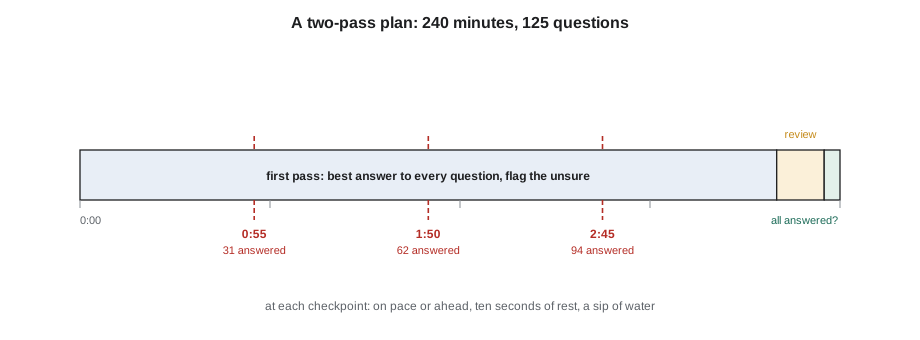
Concentration drops in the second half of any long exam, and mistakes from misreading rise. Maya practised the full length at least three times, so that her pace and her reading held up at the end. She also planned short resets: at each checkpoint, ten seconds with her eyes closed, a slow breath, a sip of water. They cost less than a minute in total and helped more than she expected.
The error log
The error log is the single most useful tool in this course. Maya's log had one row for every wrong answer and every lucky guess, with six columns: the date, the source, the topic, the cause, the fix and a review date. The cause column was the important one. Luis insisted that every error be put into one of six causes, because each cause has a different fix.
| Cause | What it looks like | Fix |
|---|---|---|
| Knowledge gap | Did not know the rule or fact | Study the topic; write a summary card; add it to spaced review |
| Misread | Missed NOT, a number, a unit or a key word | Circle signal words; read to the end of the stem every time |
| Lookup error | Read the wrong table, row, column or exception | Five-step lookup; check headings and footnotes |
| Calculation slip | Right method, wrong number | Units on every line; sanity checks |
| Time pressure | Rushed or guessed because the clock was short | Pacing plan; flag earlier; drill speed on that question type |
| Second-guessing | Changed a right answer without a reason | Change only for a specific reason found on review |
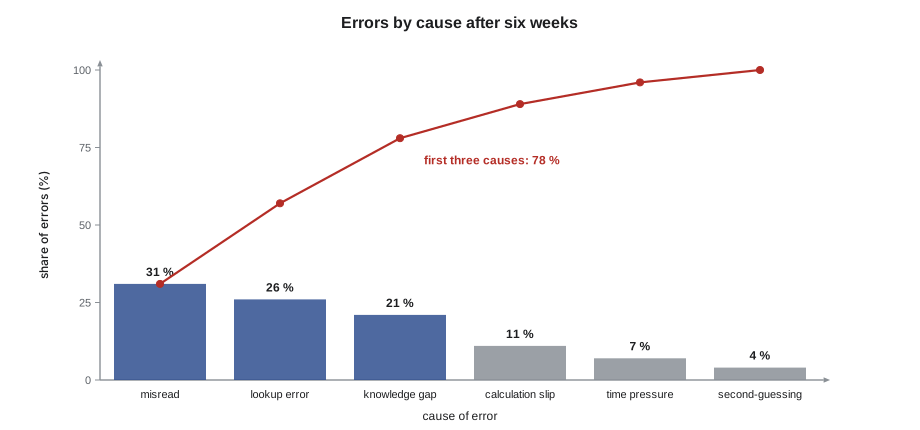
When Maya sorted her log, the result explained her plateau. Knowledge gaps, which she had been studying hard, were only about a fifth of her errors. Misreads and lookup errors together were more than half. She had been fixing the wrong problem. For the next two weeks, she spent less time on new content and more on reading discipline and lookups, and her scores rose into the mid-eighties.
The program below does the sorting. It counts errors by cause and by topic, ranks the causes by their share, and prints the review dates for each knowledge-gap error using a spaced schedule of 1, 3, 7 and 14 days.
# Error log review: causes, topics and spaced review dates
from collections import Counter
from datetime import date, timedelta

log = [  # (date, topic, cause)
    ("2026-09-07", "venting", "misread"), ("2026-09-07", "hydronic", "knowledge gap"),
    ("2026-09-08", "water supply", "lookup error"), ("2026-09-09", "drainage", "lookup error"),
    ("2026-09-10", "backflow", "misread"), ("2026-09-12", "water heaters", "calculation slip"),
    ("2026-09-13", "hydronic", "knowledge gap"), ("2026-09-13", "venting", "misread"),
    ("2026-09-14", "rigging", "knowledge gap"), ("2026-09-15", "water supply", "lookup error"),
    ("2026-09-16", "drainage", "misread"), ("2026-09-17", "storm", "time pressure"),
    ("2026-09-19", "fixtures", "second-guessing"), ("2026-09-20", "water supply", "lookup error"),
    ("2026-09-21", "venting", "misread"), ("2026-09-22", "steam", "knowledge gap"),
]
causes = Counter(c for _, _, c in log)
total, running = len(log), 0
print(f"{total} errors by cause")
for cause, n in causes.most_common():
    running += n
    print(f"  {cause:16s} {n:2d}  {100 * n / total:5.1f} %   cumulative {100 * running / total:5.1f} %")
print("Topics:", ", ".join(f"{t} {n}" for t, n in Counter(t for _, t, _ in log).most_common(4)))
print("Spaced review for knowledge gaps:")
for d, topic, cause in log:
    if cause == "knowledge gap":
        start = date.fromisoformat(d)
        days = ", ".join((start + timedelta(k)).strftime("%b %d") for k in (1, 3, 7, 14))
print(f" {topic:9s} from {d}: {days}")16 errors by cause misread 5 31.2 % cumulative 31.2 % knowledge gap 4 25.0 % cumulative 56.2 % lookup error 4 25.0 % cumulative 81.2 % calculation slip 1 6.2 % cumulative 87.5 % time pressure 1 6.2 % cumulative 93.8 % second-guessing 1 6.2 % cumulative 100.0 % Topics: venting 3, water supply 3, hydronic 2, drainage 2 Spaced review for knowledge gaps: hydronic from 2026-09-07: Sep 08, Sep 10, Sep 14, Sep 21 hydronic from 2026-09-13: Sep 14, Sep 16, Sep 20, Sep 27 rigging from 2026-09-14: Sep 15, Sep 17, Sep 21, Sep 28 steam from 2026-09-22: Sep 23, Sep 25, Sep 29, Oct 06
The cumulative column is the key. When the top two or three causes add up to most of the errors, they are where the next week's effort goes. The topic count matters too: venting shows up three times, all as misreads, which suggests that Maya reads venting questions too quickly because she thinks she knows them.
Spaced review
Knowledge-gap errors need more than one fix. Material studied once is mostly forgotten within days; material reviewed at growing intervals sticks. Maya's schedule reviewed each gap 1, 3, 7 and 14 days after she first studied it, using a summary card and two or three new practice questions on the topic. If she got the review questions right, the topic moved to the next interval. If she got them wrong, it went back to the start. The schedule is simple to keep in a notebook or a calendar, and it ensures that early topics are not forgotten by exam day.
Mixing topics in practice sessions also helps. Practising one topic at a time feels easier, but mixed practice, where each question could be from any area, is closer to the exam and trains the skill of recognizing what kind of question it is. Maya did focused practice when learning a topic and mixed practice for everything else.
Practice exams under exam conditions
A practice exam only tells you something if it is taken like the real one. Maya's rules for mock exams were strict: the full length, a timer, no phone, no notes beyond what the exam allows, no stopping to look things up, and marking only after the end. Within a day, she logged every error with its cause, and within a week, she had reviewed every topic that produced a knowledge gap.
She also tracked her scores on a chart, with a line at the pass mark and a second line at her target of 80 per cent. The target gave her a margin for a bad day, a hard set of questions or nerves. A candidate who scores 72 per cent on practice exams may pass, but the margin is thin; a candidate who scores 82 per cent consistently will almost certainly pass.
Common mistakes
MistakeReading the first option that matches and moving on.
InsteadRead all four options before choosing.
MistakeLeaving a hard question blank to come back later.
InsteadMark a best answer, flag it and move on.
MistakeChanging answers on a feeling during review.
InsteadChange only for a specific reason, such as a misread word or a calculation error.
MistakeLogging errors without a cause.
InsteadPut every error into one of six causes; each cause has its own fix.
MistakeStudying new content when the log shows reading errors.
InsteadFix the causes that cost the most marks first.
Summary and key terms
- Distractors are built from specific mistakes; naming the mistake behind each option builds confidence in the key.
- Circle signal words such as NOT, MOST, FIRST and MINIMUM, and read the stem to the end.
- Answer every question; eliminating two options doubles the chance of a correct guess.
- Change an answer only for a specific reason; changes made for a reason are more often right than wrong.
- Use two passes with checkpoints, and never leave a flagged question blank.
- Log every error by cause, fix the biggest causes first, and review knowledge gaps at growing intervals.
- Key
- The correct option in a multiple-choice question.
- Distractor
- A wrong option, usually built from a common mistake.
- Stem
- The question part of a multiple-choice item.
- Error log
- A record of each wrong answer with its topic, cause, fix and review date.
- Spaced review
- Reviewing material at growing intervals so that it is retained.
Practice problems
Work each problem on paper first, then reveal the answer to check.
Maya is unsure of 16 questions and can eliminate one option on each. How many does she expect to get right?
Show answer
16 × 1/3, about 5.3.
A question asks which statement is NOT correct. What should you look for?
Show answer
The one false statement among three true ones.
What are the six causes in the error log?
Show answer
Knowledge gap, misread, lookup error, calculation slip, time pressure and second-guessing.
A topic is first studied on October 1. When are its spaced reviews?
Show answer
October 2, 4, 8 and 15.
Why aim for 80 per cent on practice exams when the pass mark is 70?
Show answer
To leave a margin for a bad day, harder questions or nerves.
Lesson quiz · 5 questions
Score 60% or more to complete this lesson.
Create a free account to save your progress, take quizzes and earn a certificate.