
PLB-410 · Lesson 1 of 12 · 20 min
The Red Seal plumber exam today
Maya Chen had one level of school and a few hundred hours left on her apprenticeship. She had roughed in Kingsway Tower, commissioned the hospital wing's medical gas lines with Daniela, and spent six months on the service trucks with Grace Lin. The last step between her and a Certificate of Qualification was the exam. Luis Ferreira, who had supervised her since her first week at Northbridge Mechanical, put a thick binder on the lunchroom table. "Twenty-two years ago I wrote this exam," he said. "I passed by four marks. I knew the work. What I didn't know was the exam. We are going to fix that for you."
This course is the final plumbing course in the program. It combines a second pass through the plumbing code, harder sizing problems that join several code tables into one answer, and a structured review of everything from PLB-110 to PLB-420. It also teaches the exam as a task in its own right: how the questions are built, how the weightings tell you where to spend study time, how to pace four hours, and how to turn every practice mistake into a lesson. By the end, Maya writes the exam. You will follow her plan and build your own.
What the Red Seal exam is
In Ontario, the plumber trade is a compulsory trade, and Skilled Trades Ontario issues the Certificate of Qualification that lets a journeyperson work in it. The certifying exam for plumbers is the Red Seal interprovincial exam. Passing it earns the provincial Certificate of Qualification and the Red Seal endorsement together, and the Red Seal tells employers in every province and territory that the holder met a national standard. The exam is written once the apprentice has completed the required hours and the in-school levels, and the training is signed off by the sponsor.
Luis made the point early: the Red Seal exam is a standards exam, not a code exam. Its questions are written from the Red Seal Occupational Standard, which describes what a competent plumber does across the whole trade. Code knowledge matters, especially for sizing and installation questions, but the exam also asks about tools, rigging, pipe joining, hydronic heating, fixtures, water treatment and safety. A candidate who studies only the code book misses a large part of the exam.
The format in numbers
The Red Seal plumber exam has 125 multiple-choice questions. Each question has four options with one correct answer, and each correct answer is worth one mark. There is no penalty for a wrong answer. The time allowed is four hours, and the pass mark is 70 per cent. A calculator is provided, along with the formulas, acronyms and code information needed for the questions. Candidates cannot bring their own books, notes, phones or devices. The exam is available in English and in French.
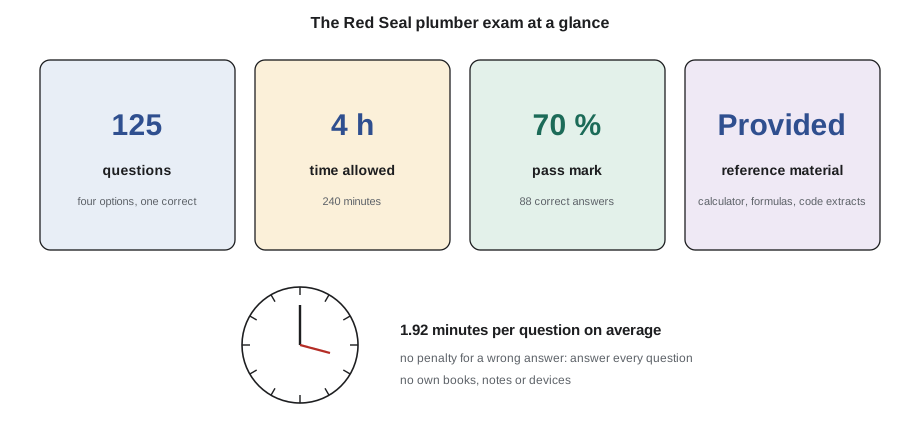
The questions are of three kinds. Knowledge and recall questions test facts and definitions, such as which fitting may not be used to change direction from horizontal to vertical. Procedural and application questions ask what to do next or how to apply a rule, such as which test pressure to use for a new system. Critical thinking questions give a situation and ask for the best decision, such as which repair to recommend when a customer's lateral shows roots and a sag. The last kind takes the most time, because two options often look reasonable.
Turning the numbers into a pacing plan
Before Maya opened a single practice question, Luis had her work out what the format meant for her time. The plan she wrote on the first page of her study notebook has two parts: the average time she can give each question, and the number of correct answers she needs to pass.
Worked problem
Pacing the Red Seal exam
The exam has 125 questions, a four-hour limit and a pass mark of 70 per cent. Maya wants to keep 20 minutes at the end for review. How long can she spend on each question on the first pass, and how many must she get right?
Show solution
- \[t_{\text{avg}} = \frac{240\ \text{min}}{125} = 1.92\ \text{min per question}\]
- \[t_{\text{first pass}} = \frac{240 - 20}{125} = 1.76\ \text{min} \approx 1\ \text{min}\ 46\ \text{s}\]
- \[N_{\text{pass}} = \lceil 0.70 \times 125 \rceil = \lceil 87.5 \rceil = 88\ \text{correct}\]
- \[N_{\text{wrong allowed}} = 125 - 88 = 37\]
Answer: About 1 minute 46 seconds per question on the first pass, with 88 correct answers needed. She can miss 37 questions and still pass, which means she does not need to be perfect, but she cannot afford to leave easy questions unanswered.
The figure of 37 wrong answers changed how Maya thought about the exam. She had been afraid of the hard sizing questions. Luis pointed out that if she got every recall and procedure question right, she could miss most of the hard questions and still pass. The reverse was not true. Losing easy marks to rushing or misreading is what fails candidates who know the trade.
A pacing plan only works if it is checked during the exam. Maya set checkpoints: after each quarter of the time, she should be at least a quarter of the way through the questions. Luis wrote a short program to print the checkpoints for any exam length, which she later used for every practice test.
# Exam pacing checkpoints
import math

questions = 125      # Red Seal plumber exam
minutes = 240
pass_mark = 0.70
review_min = 20      # time kept for a final review pass

first_pass = (minutes - review_min) / questions
need = math.ceil(pass_mark * questions)
print(f"Average per question: {minutes / questions:.2f} min")
print(f"First-pass budget:    {first_pass:.2f} min ({first_pass * 60:.0f} s)")
print(f"Correct answers needed: {need} of {questions} ({questions - need} may be wrong)")
print()
print("Checkpoint   Elapsed   Should have answered")
for frac in (0.25, 0.5, 0.75, 1.0):
    elapsed = (minutes - review_min) * frac
    done = round(questions * frac)
    h, m = divmod(round(elapsed), 60)
    print(f"{int(frac * 100):>5d} %     {h}:{m:02d}      {done:>4d}")
print(f"Review pass {(minutes - review_min) // 60}:{(minutes - review_min) % 60:02d}-{minutes // 60}:00 flagged questions only")Average per question: 1.92 min First-pass budget: 1.76 min (106 s) Correct answers needed: 88 of 125 (37 may be wrong) Checkpoint Elapsed Should have answered 25 % 0:55 31 50 % 1:50 62 75 % 2:45 94 100 % 3:40 125 Review pass 3:40-4:00 flagged questions only
Change the numbers at the top to match any practice test. A twenty-question quiz with a 40-minute limit gets the same treatment, and practising with checkpoints on short tests makes them automatic on the real one.
Eligibility, scheduling and the day itself
Maya's training consultant at Skilled Trades Ontario confirmed what she needed before she could book: the full apprenticeship hours logged and signed, all in-school levels passed, and her sponsor's confirmation that she had completed the training standard. Once approved, she received the exam booking information and paid the fee. Exams are held at approved locations under supervision, and the Red Seal program's modernization is moving more trades to computer-based delivery, so candidates should expect to answer on a screen. The confirmation letter lists the identification to bring, and arriving without it can mean losing the sitting.
Luis gave her a list for the day itself, and she taped it inside her notebook:
- Sleep properly the two nights before. Fatigue costs more marks than one more evening of study gains.
- Bring the identification the confirmation letter asks for, and nothing that is not allowed in the room.
- Arrive early enough to find the room, the washroom and a seat without rushing.
- Read the instructions on the screen or the paper calmly. Check how flagging, moving between questions and submitting work before starting.
- Start the clock on your pacing plan, and check it at each checkpoint.
What happens after
Results come from the province, not from the exam room. A pass leads to the Certificate of Qualification with the Red Seal endorsement, and in Ontario the certificate must be renewed each year to stay in good standing. A candidate who does not pass receives a report showing performance by major work activity, which is the most useful study document they will ever get, and can rewrite after the waiting period the province sets. Luis had seen good apprentices fail once and pass comfortably the second time, after using that report to aim their study.
Luis also gave her a reason to take the exam seriously that had nothing to do with marks. A certified plumber signs off work that protects drinking water, keeps sewer gas out of homes and carries hot water and gas safely. The exam is how the public knows that the person signing has the knowledge behind the signature. Passing it is the end of an apprenticeship and the start of being responsible for other people's safety without a supervisor checking the work.
How this course is organised
The course follows the order of Maya's study plan. Lessons 2 and 3 set up the tools: how the exam blueprint maps onto study time, and how to navigate the code quickly. Lessons 4 to 6 are the hard sizing problems: drainage and venting, water supply, and storm drainage with special systems. Lessons 7 to 10 review the rest of the trade in the order of the exam's weightings: gas, hydronic heating and backflow; fixtures, water heaters and services; plumbing math and science; and safety, tools and trade practices. Lessons 11 and 12 are about the exam itself: practice strategy, error logs, full mock exams and the final two weeks.
| Lessons | Focus | What Maya produced |
|---|---|---|
| 1 to 3 | The exam, the blueprint, code navigation | A pacing plan, a weighted study plan and a set of drill times |
| 4 to 6 | Complex sizing problems | A sheet of worked problems for drainage, venting, water supply and storm |
| 7 to 10 | Theory review across the trade | One summary page per topic and a list of formulas |
| 11 to 12 | Practice exams and strategy | An error log, two full mock exams and a two-week final plan |
Every lesson ends with practice questions and a five-question quiz written in the style of the exam: four options, one correct answer, distractors that a partly prepared candidate might choose. The course exam is a twenty-question mock that mixes every topic. Keep your scores. By lesson 11 you will analyse them the way Maya did.
Building the habit of the exam
Luis had Maya do one thing every working day from the first week: answer ten practice questions at lunch, with a timer, and write down each one she got wrong and why. It took fifteen minutes. Over twelve weeks, it added up to more than five hundred questions and a notebook that showed exactly where her knowledge was thin. She found, to her surprise, that her weak areas were not the hard sizing problems but hydronic heating, which she had barely touched since PLB-310, and rigging, which she had always left to the foreman.
Small, regular practice beats long cramming sessions for three reasons. Spacing the same topic over weeks makes it stick far better than repeating it in one evening. Answering questions, rather than rereading notes, forces the brain to retrieve the knowledge, which is the skill the exam tests. And timing every set builds a feel for pace that no amount of reading can give.
Maya also joined a study group with two other fourth-year apprentices from her in-school class. They met every second Thursday, each brought five questions they had written themselves on their weakest topic, and they argued about the answers. Writing a good question with three believable wrong answers turned out to be one of the best ways to learn a topic, because it forced her to know exactly why the wrong answers were wrong.
Common mistakes
MistakeStudying only the code book for the Red Seal exam.
InsteadStudy by the weightings: drainage and venting, water supply, fixtures, hydronic heating, tools and safety all carry marks.
MistakeTreating the pass mark as a target score.
InsteadAim well above 70 per cent in practice so that a bad day still passes.
MistakeLeaving questions blank when time runs short.
InsteadThere is no penalty for a wrong answer; answer every question, even with a best guess.
MistakeSpending ten minutes on one hard question early in the exam.
InsteadFlag it, move on and come back in the review pass.
MistakeBooking the exam before checking eligibility and identification rules.
InsteadConfirm hours, levels and sponsor sign-off, then read the confirmation letter carefully.
Summary and key terms
- The Red Seal plumber exam is a standards exam written from the Red Seal Occupational Standard; passing it earns the Ontario Certificate of Qualification with the Red Seal endorsement.
- It has 125 four-option questions, four hours and a 70 per cent pass mark; reference information and a calculator are provided.
- 88 correct answers pass; up to 37 may be wrong, so easy marks matter more than hard ones.
- A pacing plan with checkpoints keeps the first pass on schedule and leaves time to review flagged questions.
- Short daily timed practice with an error log beats long cramming sessions.
- Certificate of Qualification
- The provincial certificate that allows a journeyperson to work in a compulsory trade in Ontario.
- Red Seal endorsement
- The national seal on a certificate, showing the holder passed the interprovincial exam.
- Red Seal Occupational Standard
- The national description of a trade's tasks and knowledge, used to write the exam.
- Pass mark
- The minimum score needed to pass; 70 per cent for the Red Seal exam.
- Pacing plan
- A time budget per question with checkpoints during the exam.
Practice problems
Work each problem on paper first, then reveal the answer to check.
How many questions does the Red Seal plumber exam have, and how long is it?
Show answer
125 four-option multiple-choice questions in four hours.
How many correct answers are needed to pass at 70 per cent?
Show answer
88, because 70 per cent of 125 is 87.5 and a score must round up.
With 20 minutes kept for review, what is the first-pass time per question?
Show answer
About 1.76 minutes, or 1 minute 46 seconds.
Why should you never leave a question blank?
Show answer
Wrong answers are not penalized, so a guess can only help.
What is the most useful document a candidate who fails receives?
Show answer
The results report by major work activity, which shows where to aim study.
Lesson quiz · 5 questions
Score 60% or more to complete this lesson.
Create a free account to save your progress, take quizzes and earn a certificate.