
PLB-220 · Lesson 9 of 12 · 23 min
Relief valves, thermal expansion and water heater safety
Luis kept an old photograph in his phone that he showed every apprentice once. It was a basement after a water heater explosion: the tank had gone up through the floor above, leaving a ragged hole in the joists. "Somebody plugged the relief valve," he said. "The thermostat stuck, the tank kept heating, the pressure went up, and there was nothing to let it out." Maya had heard about relief valves in PLB-130. After seeing the picture, she never again treated a relief valve or its discharge pipe as a detail.
This lesson covers the devices that keep water heaters from becoming bombs: the temperature and pressure relief valve and its discharge piping, the control of thermal expansion in closed systems, and the other safety features and checks that protect people and buildings. It also covers vacuum relief and the dangers of a water heater that is fired without water.
Why a water heater can explode
Water heated in a closed tank can store a frightening amount of energy. At normal atmospheric pressure, water boils at 100 °C. Under pressure, it can be heated far above that without boiling, because the pressure keeps it liquid. If a tank of water that has been overheated under pressure suddenly ruptures, the pressure drops instantly and much of the superheated water flashes into steam, expanding to more than a thousand times its volume in a fraction of a second. That is what drives a tank through a floor.
Two things can push a water heater toward that point. One is overheating, when a thermostat or gas control fails and the burner or element keeps heating. The other is overpressure, when the pressure in the tank rises above its rated working pressure, either from the supply or from thermal expansion of the water as it heats. A water heater therefore needs protection against both temperature and pressure, and that is the job of the temperature and pressure relief valve.
The temperature and pressure relief valve
A temperature and pressure relief valve, usually called a T and P valve, opens when either the pressure or the temperature in the tank reaches its setting. A typical residential setting is 1035 kPa and 99 °C. The pressure setting must not exceed the tank's rated working pressure, which is marked on the heater's rating plate. The temperature part works through a sensing element, a probe filled with a material that expands with heat, which extends into the tank. The element must be in the hottest water, within the top 150 mm of the tank, which is why manufacturers provide a dedicated opening for the valve and why the valve must not be installed on a fitting that moves the probe away from the tank.
The valve must be rated for the heater's input. The relief capacity, in kilowatts or Btu per hour, is marked on the valve, and it must be at least equal to the heater's input so that the valve can discharge water and steam as fast as the heater can make heat. A small residential valve on a large commercial heater could open but not relieve fast enough. The valve must also be certified to the referenced standard, which in both countries is ANSI Z21.22/CSA 4.4 for relief valves on hot water supply systems.
No valve of any kind may be installed between the T and P valve and the tank, or in the discharge pipe, because closing it would disable the relief. A heater with a relief valve installed in the wrong opening, or with a valve that has been plugged or capped, has no protection. On service calls, Luis taught Maya to check every relief valve she saw: is it the right type, in the right opening, rated for the heater, and is the discharge pipe correct and clear?
Relief valve discharge piping
When a relief valve opens, it releases scalding water and steam. The discharge pipe carries that water to a safe place where it will not injure anyone or damage the building, and where someone will notice it. The code's rules for the discharge pipe come from those purposes.
- The pipe must be the full size of the valve outlet for its whole length, with no reductions.
- It must be made of a material rated for the temperature, such as copper or CPVC, not ordinary PVC or PEX that is not rated for it.
- It must drain by gravity, without traps or sags where water could collect, and without valves or plugs of any kind.
It must end at an approved location: within about 150 mm above the floor, over a floor drain, or into an indirect waste receptor or another location the code allows, with an air gap, so that the discharge is visible and cannot back up.
- Its end must not be threaded, so that nobody can screw a cap or plug onto it.
- It must not discharge where it could cause injury, damage the building, or freeze shut.
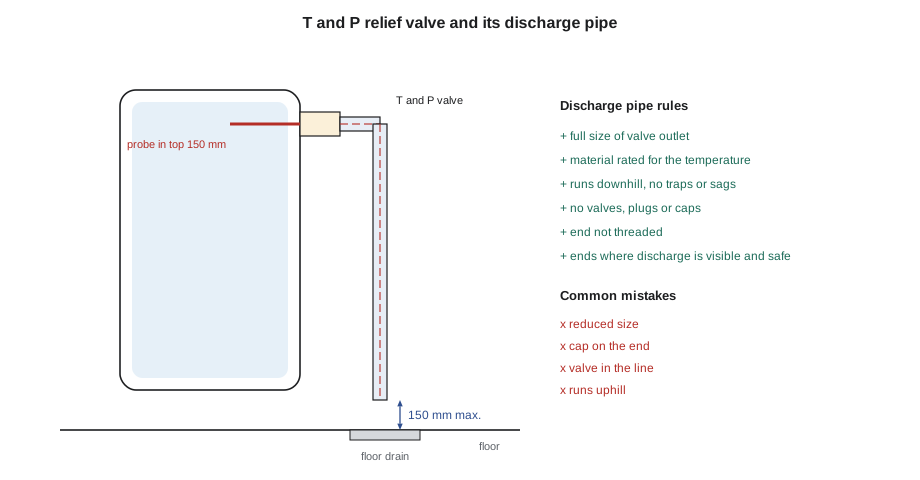
The most common discharge mistakes Maya found on service calls were PVC discharge pipes that had sagged from heat, discharge pipes reduced to a smaller size with a bushing, pipes run up and over a door frame so that they trapped water, and pipes that ended in a crawl space or behind a wall where no one would see a leak. A dripping relief valve is a warning that something is wrong, often high pressure or thermal expansion, and it should be visible so someone fixes the cause.
Worked problem
Checking a relief valve installation
On a service call to an older building near Kingsway, Maya finds a 190 L gas water heater with a T and P valve in the side opening near the top. The discharge pipe is 20 mm copper from the valve, then reduces to 15 mm PEX, runs across the ceiling and ends with a threaded adapter in a laundry tub. What problems does she report?
Show solution
- The discharge is reduced from the valve outlet size; it must be full size throughout.
- The PEX section may not be rated for relief valve discharge temperature, and the run across the ceiling must drain by gravity without sags or rises.
- The threaded end allows a cap or plug to be fitted; the end must be unthreaded.
- The laundry tub may be acceptable as an indirect receptor if the code allows it, with an air gap, but the discharge must be visible and safe for users of the tub.
- Recommend replacing the discharge pipe with full-size rated material, sloped downhill, ending at an approved location.
Answer: Check size, material, slope, valves, end and termination every time. Report and correct anything that could block or hide the relief.
Thermal expansion
Water expands when it is heated. Heating water from a cold supply temperature to a typical storage temperature increases its volume by close to two percent. In a 190 L tank, that is more than three litres of extra water each time the tank heats from cold. Where does that water go?
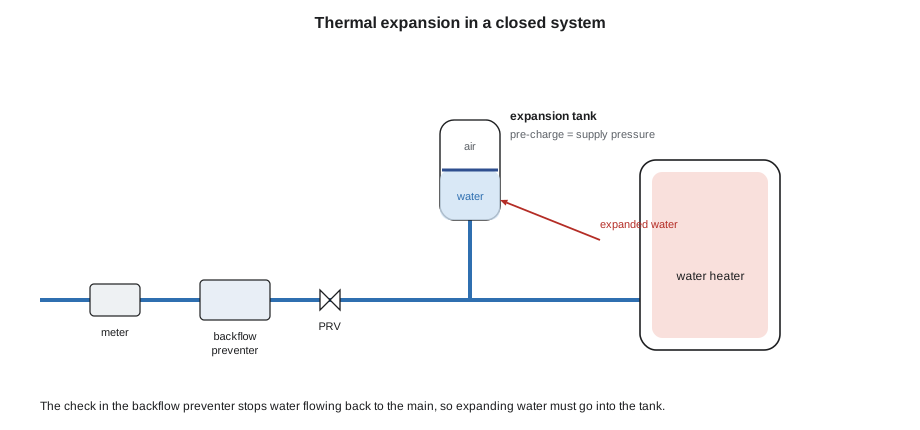
In an open system, it goes back into the water main. With no check valve or backflow preventer between the heater and the street, the expanding water simply pushes back through the meter and the service, and nobody notices. But most modern systems are closed. A pressure-reducing valve, a backflow preventer at the service, a check valve in the meter or a dual check at the heater stops the water from flowing back. In a closed system, the expanding water has nowhere to go, and because water hardly compresses, the pressure rises quickly every time the heater runs.
The results are predictable. The relief valve drips or discharges every time the heater fires, wasting water and wearing the valve. Toilet fill valves weep. Faucets and fixture connectors are stressed. Over months and years, repeated pressure spikes fatigue the tank and its fittings. A homeowner who replaces a dripping relief valve without fixing the expansion problem will be back with another dripping valve.
For this reason, the code requires a means of controlling thermal expansion where a water heater is in a closed system, such as one with a check valve, backflow preventer or pressure-reducing valve on the supply. Part 7 of the Ontario Building Code and many municipal water by-laws require it, and the City of Hamilton's backflow program means most buildings now have a closed system.
Expansion tanks
The most common way to control thermal expansion is a diaphragm expansion tank, sometimes called a thermal expansion tank. It is a small steel tank divided by a flexible diaphragm or bladder. One side holds air at a set pre-charge pressure; the other side is connected to the water system, usually on the cold supply to the heater between the check valve and the heater. When the water heats and expands, the extra water pushes into the tank, compressing the air slightly, and the pressure in the system rises only a little.
The tank must be sized for the volume of water heated and for the pressures in the system, and its air pre-charge must be set to match the system's supply pressure before it is installed. A tank pre-charged at the factory setting on a system with a higher supply pressure is already partly full of water before the heater fires, and it cannot absorb the expansion. Setting the pre-charge with a tire gauge and a pump, with the tank isolated and drained, is a step Maya learned to do on every installation.
In the sizing formula, the change in volume is the expansion of the water heated, the first pressure is the supply pressure (equal to the tank pre-charge) and the second is the highest pressure allowed in the system, set safely below the relief valve setting. Both pressures are absolute pressures, which means atmospheric pressure is added to the gauge readings. Manufacturers publish sizing tables based on this formula, and the program below works an example.
# Size a thermal expansion tank for a storage water heater
heater_L = 190.0
expansion = 999.7 / 983.2 - 1     # density ratio, 10 C to 60 C
dV = heater_L * expansion
atm = 101.3                        # kPa
p1 = 345 + atm                     # supply pressure = pre-charge, absolute
p2 = 690 + atm                     # max allowed, below the 1035 kPa relief setting
v_tank = dV / (1 - p1 / p2)
print(f"water expands {expansion*100:.1f}% -> {dV:.1f} L")
print(f"minimum expansion tank volume about {v_tank:.1f} L")water expands 1.7% -> 3.2 L minimum expansion tank volume about 7.3 L
The answer is a tank volume, not the volume of water it accepts; a tank of that size or the next larger standard size would be selected. The result depends heavily on the pressures. A higher supply pressure, or a lower maximum, makes the required tank much larger, because the air has less room to compress. That is why a building with high street pressure often has a pressure-reducing valve set lower, which also helps fixtures last longer.
Expansion tanks must be supported so that their weight, full of water, does not hang on the pipe connection, and they must be installed where they can be checked and replaced. A failed diaphragm lets water fill the air side; the tank then feels heavy and sounds solid when tapped, and the relief valve starts dripping again. Checking the pre-charge with the tank isolated and drained is part of servicing a water heater.
Other safety devices and checks
Water heaters have several other protections. Every storage heater has a high-limit control, an energy cut-off that shuts off the burner or elements if the water reaches a dangerous temperature even when the thermostat fails. Gas heaters have flame safety controls and, in modern residential models, flammable vapour ignition resistant combustion chambers. Electric heaters have a manual-reset high limit, which trips and must be reset by hand; a high limit that trips repeatedly is a symptom to diagnose, not a button to keep pressing.
A water heater supplied from the bottom, or one installed where the supply could be drained while the heater is full, may need a vacuum relief valve. If the supply is shut off and a lower faucet is opened, the tank could be siphoned, and a thin-walled tank can collapse under vacuum. A vacuum relief valve lets air in to prevent it. The code and the manufacturer say when one is needed.
Finally, maintenance keeps these devices working. Manufacturers recommend testing the relief valve periodically by lifting its lever briefly to make sure it opens and reseats, and replacing it at intervals or if it leaks after testing. Flushing sediment from the tank, checking the anode and checking the expansion tank pre-charge round out an annual service. On the Kingsway central plant, these checks were written into the building's maintenance schedule that Northbridge handed to the owner at turnover.
Common mistakes
MistakeInstalling a T and P valve away from the top of the tank on an extension fitting.
InsteadInstall it in the manufacturer's opening with the probe in the top of the tank.
MistakeReducing the discharge pipe or using unrated plastic.
InsteadRun it full size in a rated material, sloped downhill, with no valves.
MistakeCapping or threading the end of the discharge pipe.
InsteadLeave the end unthreaded and visible at an approved termination.
MistakeReplacing a dripping relief valve without checking for thermal expansion.
InsteadCheck the system pressure and install or service an expansion tank in a closed system.
MistakeInstalling an expansion tank without setting the pre-charge.
InsteadSet the air pre-charge to the supply pressure before connecting it.
Summary and key terms
- Overheated water under pressure can flash to steam if a tank ruptures; relief valves prevent this.
- A T and P valve opens at a set pressure and temperature, typically 1035 kPa and 99 °C, and must be rated for the heater's input.
- The sensing probe must be in the top of the tank, and no valve may be installed between the relief valve and the tank or in the discharge.
- Discharge piping is full size, rated for the temperature, sloped downhill, unthreaded at the end and ends at an approved visible location.
- Heating water from cold to storage temperature expands it by close to two percent.
- Closed systems need thermal expansion control, usually a diaphragm expansion tank pre-charged to the supply pressure.
- High limits, vacuum relief where needed and periodic testing complete the safety picture.
- T and P valve
- A relief valve that opens when tank pressure or temperature reaches its setting.
- Relief capacity
- The heat input a relief valve can discharge, which must equal or exceed the heater input.
- Closed system
- A water system where a check valve, backflow preventer or pressure-reducing valve stops water flowing back to the main.
- Thermal expansion
- The increase in water volume as it is heated.
- Expansion tank
- A tank with an air charge behind a diaphragm that absorbs expanded water.
- Pre-charge
- The air pressure set in an expansion tank before it is connected, equal to the supply pressure.
Practice problems
Work each problem on paper first, then reveal the answer to check.
What are typical residential T and P valve settings?
Show answer
1035 kPa and 99 °C.
Where must the sensing probe of a T and P valve be?
Show answer
In the top 150 mm of the tank.
Why must the discharge pipe end be unthreaded?
Show answer
So that nobody can cap or plug it.
By about how much does water expand when heated from cold to storage temperature?
Show answer
Close to two percent.
What makes a water system closed?
Show answer
A check valve, backflow preventer or pressure-reducing valve that stops flow back to the main.
What must be done to an expansion tank before it is connected?
Show answer
Set its air pre-charge to the system supply pressure.
Lesson quiz · 5 questions
Score 60% or more to complete this lesson.
Create a free account to save your progress, take quizzes and earn a certificate.