
PLB-220 · Lesson 12 of 12 · 23 min
Service, maintenance and troubleshooting
By the time the last floors of Kingsway Tower were finished, the first tenants had already moved into the lower floors, and the service calls had started: a toilet that ran all night, a shower that went cold when someone flushed next door, a kitchen faucet that dripped, and one suite where the hot water smelled like rotten eggs. Luis sent Maya out on these calls with a service truck and a rule. "Don't start by replacing parts," he said. "Start by asking questions and looking. Most problems tell you what they are if you let them."
This final lesson brings the course together. It covers routine maintenance of fixtures and water heaters, a method for troubleshooting, the most common problems and their causes, and the turnover and service records that close out a project. It ends with a capstone in which Maya works through a set of Kingsway service calls.
A method for troubleshooting
Good troubleshooting follows the same steps whatever the problem. First, gather information: ask the occupant what happens, when it started, whether it is constant or intermittent, and whether anything changed, such as a renovation, a new appliance or a water shutdown. Second, observe: see the problem yourself, look, listen and measure. Third, think about the system: which parts could cause this symptom, and in what order are they most likely? Fourth, test: check the most likely and easiest causes first, one at a time. Fifth, repair the cause, not just the symptom. Sixth, verify: confirm that the problem is gone and nothing else was disturbed. Finally, record what was found and done.
Two habits make the method work. One is changing one thing at a time, so that you know which change fixed the problem. The other is thinking about the whole system, not just the fixture in front of you. A relief valve that drips might be a bad valve, but it is more often a sign of high pressure or thermal expansion elsewhere in the system. A shower that runs cold when a toilet flushes is a pressure-balancing problem at the valve, but it might also point to an undersized branch.
Common fixture problems
Most fixture service calls fall into a handful of familiar problems. The table below lists them with their usual causes. Experienced plumbers carry the common repair parts for the fixtures in the buildings they service, so that most calls end with one visit.
| Symptom | Likely causes | Usual repair |
|---|---|---|
| Toilet runs or refills by itself | Worn flapper or flush valve seal; fill valve set too high or leaking; chain too short | Replace flapper or seal; adjust or replace fill valve; adjust chain |
| Weak or incomplete flush | Water level too low; partly clogged rim jets or trapway; restricted supply | Set water level; clear jets and trapway; check stop and supply |
| Water at toilet base | Failed seal; loose bowl; condensation on the tank | Reset bowl with new seal; tighten correctly; address humidity |
| Dripping faucet | Worn washer and seat, cartridge or ceramic disc seals | Replace washer and dress seat, or replace cartridge or seals |
| Low flow at one faucet | Clogged aerator or cartridge screen; partly closed stop | Clean aerator or screen; open stop fully |
| Slow lavatory or sink drain | Hair and soap in pop-up or trap; partial blockage in trap arm | Clean pop-up and trap; clear the line with a hand auger |
| Shower temperature swings | Worn pressure-balancing spool or cartridge; mineral build-up; supply pressure problems | Clean or replace cartridge; check pressures |
| Warm water at a cold tap | Crossflow through a single-handle valve or mixing valve without working checks | Find the fixture with the failed check and repair it |
The last row is worth remembering because it confuses people. Crossflow happens when hot and cold water can connect through a fixture or valve, for example a single-handle faucet or a mixing valve whose internal check valves have failed. When the pressure on one side is higher, water flows from that side into the other piping. The symptom may show up far away, as warm water at a cold tap in another room, or a mixing valve that cannot hold its temperature. Finding it means checking each likely fixture, often by shutting off the hot supply to one fixture at a time and seeing whether the symptom stops.
Shower valves are a particular case. A pressure-balancing cartridge that sticks with mineral deposits may let the temperature swing when another fixture is used, or may lock in a position that gives only cold water. Replacing the cartridge with the manufacturer's part is usually the fix, and after any cartridge replacement, the high-limit stop must be checked and reset with a thermometer, exactly as at installation. A cartridge replacement that resets the stop to the factory position can leave a valve able to scald.
Water heater maintenance
A storage water heater lasts longer and works better with simple periodic maintenance. Manufacturers' recommendations vary, but a typical annual service includes these tasks.
- Test the relief valve by lifting the lever briefly, standing clear of the discharge, and check that it reseats without dripping; replace it if it leaks.
- Flush sediment from the tank through the drain valve until the water runs clear, which keeps the burner or lower element from overheating under a layer of scale.
- Check the anode rod every few years, and replace it when it is worn down to its core wire.
- Check the expansion tank's air pre-charge with the tank isolated, and replace the tank if water comes out of the air valve.
- Check the temperature at a nearby fixture and at the heater, and confirm mixing valves are holding their settings.
- Check for leaks at connections, the drain pan and its drain, and look for corrosion.
- For gas heaters, have the gas fitter check the burner, flame, venting and combustion air; for tankless heaters, descale on schedule; for heat pump water heaters, clean the air filter and check the condensate drain.
On the Kingsway central plant, these tasks were part of the operations and maintenance manual that Northbridge handed over, with a schedule, the manufacturer's instructions and the settings recorded at start-up. A good maintenance schedule turns surprises into routine work.
Common water heater problems
No hot water from a gas heater usually means the burner is not firing: a pilot or igniter problem, a failed flame sensor or thermocouple, a gas supply problem, or a tripped high limit. Those repairs belong to a licensed gas fitter, as Lesson 10 explained, but the plumber can check simple things first, such as whether the gas valve is on and whether the heater has power if it needs it.
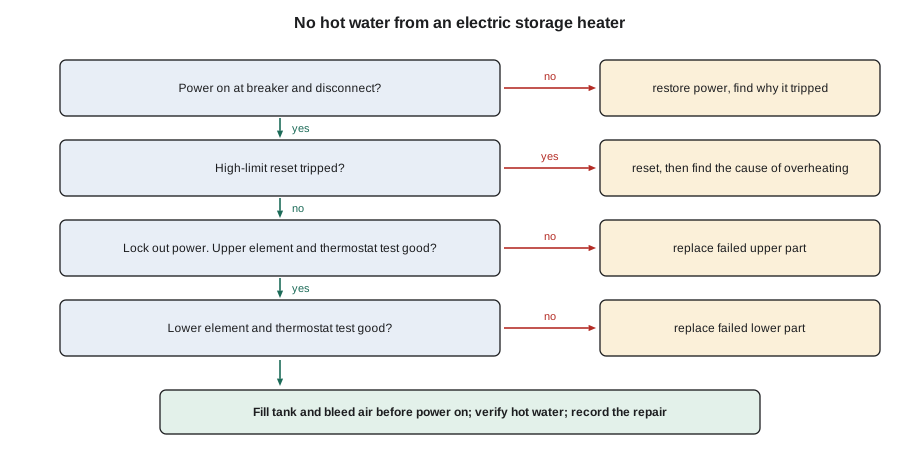
No hot water from an electric heater usually means a tripped breaker, a tripped manual-reset high limit, a failed element or a failed thermostat. Testing elements and thermostats means working on live electrical parts only after the power is locked out, and in many places this work is limited to people with the right training or licence. An element can be checked with a meter after the power is off: its resistance should match the value calculated from its rating, roughly 13 ohms for a 4500 W element at 240 V. An open circuit means a burned-out element.
Not enough hot water can mean a heater that is too small for the demand, a failed lower element on an electric heater, a broken dip tube letting cold water mix at the top of the tank, a thermostat set too low, a heavy layer of sediment, or a crossflow somewhere in the system diluting the hot water. A heater that gives hot water for a short time and then runs cold, with an electric heater, often has a failed lower element: the upper element heats the top of the tank, then hands over to a lower element that does not work.
Hot water that smells like rotten eggs is caused by bacteria in the tank that reduce sulphates in the water to hydrogen sulphide gas, often helped by the magnesium anode. The usual cures are to disinfect the tank and replace the magnesium anode with an aluminum-zinc or powered anode, as the manufacturer allows. Noisy heaters that rumble or pop usually have sediment on the bottom, where water trapped under the scale boils; flushing helps, and a heavily scaled tank may need replacing.
A dripping relief valve is a signal, not just a nuisance. It may be a worn valve, but it is often caused by high pressure from the supply or thermal expansion in a closed system. Measuring the static pressure with a gauge on a hose bibb or the drain valve, and watching it while the heater fires, shows which: a pressure that climbs as the heater runs points to thermal expansion and a missing or failed expansion tank.
# Check an electric water heater element with a meter reading (power locked out!)
def expected_ohms(watts, volts):
    return volts ** 2 / watts

rating_w, volts = 4500, 240
exp = expected_ohms(rating_w, volts)
for name, reading in (("upper element", 12.9), ("lower element", None)):
    if reading is None:
        print(f"{name}: open circuit -> element burned out, replace")
    elif abs(reading - exp) / exp < 0.10:
        print(f"{name}: {reading} ohms, expected about {exp:.1f} -> good")
    else:
print(f"{name}: {reading} ohms, expected about {exp:.1f} -> suspect")upper element: 12.9 ohms, expected about 12.8 -> good lower element: open circuit -> element burned out, replace
This matches the classic pattern of a heater that gives a short burst of hot water and then runs cold: the upper element is good and heats the top of the tank, and the lower element is open. Replacing the lower element, after draining the tank below it and with the power locked out, restores full capacity. Before turning the power back on, the tank must be full and the air bled out, as Lesson 7 stressed.
Turnover and records
When a project like Kingsway Tower is finished, the plumbing contractor hands it over to the owner with a package of records. PLB-130 described the water system records; for fixtures and water heaters, the package includes the fixture schedule as built, the manufacturers' installation and maintenance instructions, warranty registrations, the recorded settings of every shower valve stop and mixing valve, the start-up sheets for each water heater signed by the plumber and the gas fitter, the expansion tank pre-charges, and a maintenance schedule. Training the building's maintenance staff on the equipment is often part of the contract.
These records are not paperwork for its own sake. When a tenant reports scalding water two years later, the record shows what the stop was set to and who set it. When a water heater fails under warranty, the start-up sheet and the maintenance log decide whether the warranty is honoured. And when a new plumber comes to service the building, the records tell them how it was built.
Capstone: a week of Kingsway service calls
In her last week on the Kingsway job, Maya handled the first round of tenant service calls on her own, with Luis reviewing her reports. Each call used the method from the start of this lesson.
- Suite 304, toilet runs at night: she watched the tank refill every few minutes, found the flapper warped and the fill valve set too high, replaced the flapper, lowered the water level to the mark and confirmed the tank held overnight.
- Suite 512, shower goes cold when the toilet next door flushes: she found the pressure-balancing cartridge stiff with scale, replaced it, then reset and recorded the high-limit stop at the code maximum.
- Suite 208, warm water at the kitchen cold tap: she shut off the hot stop at the bathroom lavatory and the warm water stopped; the lavatory's single-handle faucet had a failed internal check, which she replaced.
- Suite 701, rotten egg smell from the hot water: the suite was fed by the central plant, so the smell pointed to a dead leg in the suite piping with stagnant water; flushing the line cleared it, and she reported the dead leg to the engineer.
- Café, relief valve dripping on the electric heater: a gauge showed the pressure climbing as the heater fired, the expansion tank was full of water, and she replaced the tank and set the new one's pre-charge to the supply pressure.
Worked problem
Writing up a service call
After the café call, Luis asks Maya for a short report the building manager can understand. What should it include?
Show solution
- The complaint in the occupant's words: the relief valve on the water heater drips onto the floor drain.
- What she observed and measured: static pressure at the supply, pressure rising while the heater fired, and an expansion tank that was waterlogged.
- The cause: the expansion tank's diaphragm had failed, so thermal expansion was raising the pressure to the relief valve setting.
- The repair: a new expansion tank of the same size, pre-charged to the supply pressure, and a test of the relief valve.
- The result and any recommendation: dripping stopped through three heating cycles; add the expansion tank check to the annual maintenance list.
Answer: A good service report states the complaint, observations, cause, repair, result and recommendation in plain language.
Luis read the reports and handed them back with one comment: they were the kind he would want to find in a building file if he were the next plumber in. That, he said, was the real end of the job.
Common mistakes
MistakeReplacing parts before finding the cause.
InsteadGather information, observe, think about the system and test the likely causes first.
MistakeReplacing a dripping relief valve without checking pressure.
InsteadMeasure static pressure and watch it while the heater fires to rule out expansion.
MistakeLeaving a shower valve's stop at the factory setting after a cartridge change.
InsteadReset and record the high-limit stop with a thermometer.
MistakeTesting electric elements with the power on.
InsteadLock out the power and verify it is off before testing.
MistakeClosing a call without recording what was done.
InsteadWrite the complaint, findings, cause, repair and result.
Summary and key terms
- Troubleshoot by gathering information, observing, thinking about the system, testing one thing at a time, repairing the cause, verifying and recording.
- Running toilets, dripping faucets, low flow, slow drains, temperature swings and crossflow have common, predictable causes.
- After any shower cartridge repair, reset and record the high-limit stop.
- Annual water heater service includes relief valve testing, sediment flushing, anode checks, expansion tank checks and temperature checks.
- No hot water on gas heaters is often a burner or flame problem for the gas fitter; on electric heaters it is often a high limit, element or thermostat.
- A dripping relief valve often points to high pressure or thermal expansion, not a bad valve.
- Turnover records and clear service reports protect the owner, the occupants and the contractor.
- Troubleshooting
- A systematic method of finding the cause of a problem before repairing it.
- Crossflow
- Hot and cold water connecting through a fixture or valve so one flows into the other piping.
- Dead leg
- A section of piping where water sits without flowing, which can let bacteria grow.
- Lockout
- Isolating and locking an energy source so equipment cannot be energized during work.
- Operations and maintenance manual
- The turnover document with equipment instructions, settings and maintenance schedules.
- Start-up sheet
- A record of the checks and settings made when equipment is first put into service.
Practice problems
Work each problem on paper first, then reveal the answer to check.
What is the first step in troubleshooting?
Show answer
Gather information from the occupant about the problem.
What usually causes a toilet to refill by itself?
Show answer
A worn flapper or flush valve seal, or a fill valve set too high.
What must be done after replacing a shower valve cartridge?
Show answer
Reset and record the high-limit stop with a thermometer.
What does an electric heater that runs cold after a short burst suggest?
Show answer
A failed lower element.
What causes a rotten egg smell in hot water from a tank?
Show answer
Bacteria reducing sulphates to hydrogen sulphide, often helped by the magnesium anode.
What does pressure that climbs while the heater fires indicate?
Show answer
Thermal expansion in a closed system without working expansion control.
Lesson quiz · 5 questions
Score 60% or more to complete this lesson.
Create a free account to save your progress, take quizzes and earn a certificate.