
PLB-220 · Lesson 7 of 12 · 23 min
Tank-type water heaters: gas and electric
Most of the hot water at Kingsway Tower comes from a bank of gas-fired condensing water heaters in the basement mechanical room, feeding a recirculating system that PLB-130 described. But the building has smaller water heaters too: an electric tank in the café, two tanks in the management office and amenity area, and a pilot heat pump water heater in the gym's laundry room. Before Maya worked on the big plant, Luis started her on the small tanks. "Every water heater does the same three things," he said. "It stores water, it heats it, and it keeps from killing anybody while it does. Learn those on a small tank and the big ones make sense."
This lesson covers storage-type water heaters, the most common kind: how gas and electric tanks are built and how they work, how they are sized and rated, and how they are installed. Lesson 8 covers tankless and heat pump water heaters, Lesson 9 the relief valves and expansion controls that keep water heaters safe, and Lesson 10 the venting and combustion air of gas appliances.
How a storage water heater is built
A storage water heater is an insulated steel tank that holds hot water ready for use. The tank is lined with a vitreous enamel, often called glass lining, fused to the inside of the steel to keep the water from corroding it. No lining is perfect, so every steel tank also has a sacrificial anode rod, usually magnesium or aluminum, which corrodes in place of the tank. When the anode is used up, the tank begins to corrode, which is why replacing the anode can extend a tank's life. Some heaters use a powered anode instead, which protects the tank with a small electric current and does not wear away.
Cold water enters through a dip tube, a plastic tube that carries it to the bottom of the tank so that it does not mix with the hot water at the top. Hot water leaves from the top through the hot outlet. Many tanks have heat traps in the inlet and outlet fittings, small loops or check balls that stop hot water from rising out of the tank into the piping when no water is being used. A drain valve near the bottom lets the tank be drained and flushed of sediment. A temperature and pressure relief valve is fitted in the opening provided by the manufacturer at the top or side of the tank, as Lesson 9 explains. The whole tank is wrapped in foam insulation inside an outer jacket.
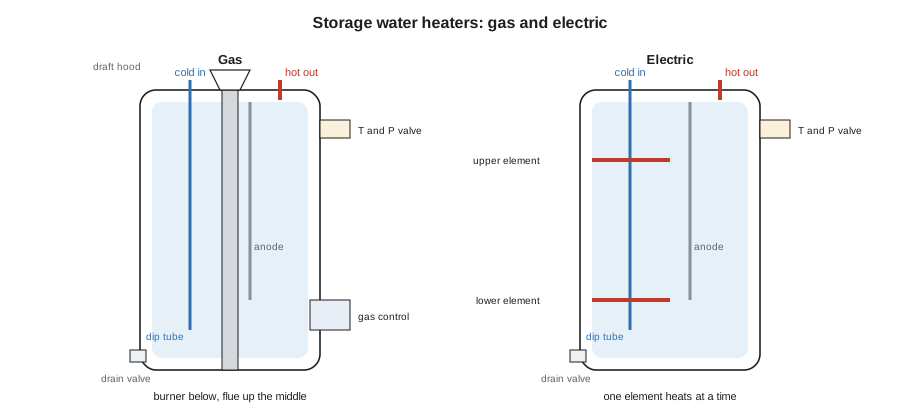
Gas-fired storage water heaters
In a conventional gas water heater, a burner under the tank heats the water through the tank bottom, and the hot combustion gases rise through a flue tube that runs up the centre of the tank. A twisted metal baffle in the flue slows the gases so that more heat passes into the water before they leave. The gases then pass through a draft hood on top of the heater, which lets room air mix with them and steadies the draft, and up a vent to the outdoors. Lesson 10 explains the different venting types.
The gas control valve, mounted on the front of the tank, combines a thermostat and a safety shut-off. The thermostat senses the water temperature through a probe in the tank and opens the main burner valve when the water cools. The safety shut-off uses a flame sensor, a thermocouple or thermopile on older models, or an electronic flame sensor on newer ones, to prove that the pilot or igniter flame is present; if it is not, the gas is shut off. Modern residential gas heaters also have a flammable vapour ignition resistant design, which stops a flame from reaching vapours from spilled gasoline or solvents near the floor, and a sensor that shuts the heater down if the combustion chamber overheats.
Larger gas water heaters, including the ones in Kingsway's mechanical room, are often condensing heaters. They extract so much heat from the combustion gases that water vapour in the gas condenses, giving thermal efficiencies above 90 percent. The condensate is acidic, so it must be drained to a suitable drain, often through a neutralizer, and the vent must be made of a material listed for condensing appliances, usually plastic or stainless steel. Condensing heaters use a fan to push the gases through the heat exchanger and out of the vent.
Electric storage water heaters
An electric water heater uses resistance elements immersed in the water. A typical residential tank has two elements, an upper and a lower, each with its own thermostat, wired so that only one heats at a time. When a lot of hot water is drawn, cold water fills the bottom of the tank and the upper element heats the top first so that some hot water is available quickly; then the lower element takes over to heat the rest. Common residential elements are 3000 to 4500 W at 240 V. Commercial electric heaters, like the one in the café, may have three-phase elements and much larger total input.
Electric heaters have no combustion and no vent, so they can be installed in places where a gas heater cannot. Their efficiency at the tank is close to 100 percent, because almost all the electricity becomes heat in the water, but electricity generated from fuel loses much of its energy at the power plant, and electricity costs more per unit of heat than gas in many places. That is why heat pump water heaters, covered in Lesson 8, have become important: they deliver two to four times more heat than the electricity they use.
Safety on an electric heater starts with the power. The heater must be on its own circuit with a disconnect within sight or lockable in the off position, and the power must be locked out before any element or thermostat is touched. An element that is energized without water around it burns out in seconds, so a new or drained tank must be completely full, with air bled out through an open hot faucet, before the power is turned on. Luis made Maya say it out loud every time: full tank, faucet runs steady, then power.
Sizing a storage water heater
A water heater is sized to meet the peak demand, not the average. For a home, the peak might be a morning when two showers run back to back while the dishwasher fills. For the café, it might be the lunch rush with the three-compartment sink and the dishwasher both running. The heater must deliver enough hot water during that peak, either from storage or from heating fast enough to keep up.
Two ratings describe this. The recovery rate is how much water the heater can heat per hour through a given temperature rise, set by its input and efficiency. The first-hour rating is how much hot water the heater can deliver in an hour starting with a full tank of hot water; it combines the usable storage with the recovery. For a residential heater, the first-hour rating on the label is the number to compare with the peak-hour demand of the household. For commercial heaters, designers use demand tables or methods from engineering guides, and the plumber installs what the engineer specified.
In metric units, with the input in kilowatts, the efficiency as a decimal and a temperature rise in degrees Celsius, the recovery in litres per hour is the input times the efficiency times 3600, divided by 4.19 times the temperature rise. The 4.19 is the heat needed to warm one litre of water by one degree, in kilojoules.
# Recovery rate and an estimated first-hour delivery for storage heaters
def recovery_L_per_h(kw, eff, rise_c):
    return kw * eff * 3600 / (4.19 * rise_c)

rise = 50                      # 10 C in, 60 C out
gas = recovery_L_per_h(11.7, 0.80, rise)       # about 40 000 Btu/h input
elec = recovery_L_per_h(4.5, 0.98, rise)
print(f"gas tank recovery: {gas:.0f} L/h   electric tank recovery: {elec:.0f} L/h")
tank = 189                     # litres
usable = 0.7 * tank            # rough share of a tank delivered before it cools
for name, r in (("gas", gas), ("electric", elec)):
print(f"{name}: about {usable + r:.0f} L in the first hour")gas tank recovery: 161 L/h electric tank recovery: 76 L/h gas: about 293 L in the first hour electric: about 208 L in the first hour
The difference is striking. A gas tank recovers more than twice as fast as an electric tank of the same size, because a gas burner puts in much more heat per hour than a single electric element. The estimate of first-hour delivery uses a rough rule that about 70 percent of the stored water comes out hot before the incoming cold dilutes it; the rating on the label comes from a standard test and is the number to use when comparing real heaters.
Efficiency ratings and regulations
Water heater efficiency is rated by a standard test that gives a uniform energy factor, or UEF, a number that combines how much of the fuel or electricity ends up as hot water in a typical day of use with standby losses. A higher UEF means a more efficient heater. In Canada, the minimum efficiency of water heaters sold is regulated by Natural Resources Canada under the Energy Efficiency Regulations, 2016, and by some provinces, and these rules are being tightened over time to push the market toward high-efficiency and heat pump products. Commercial heaters are rated by thermal efficiency and standby loss.
For the plumber, efficiency rules matter at replacement time. A heater that met the rules ten years ago may no longer be available, and its replacement may be larger, need a different vent, need a condensate drain, or be a heat pump unit that needs space and air. A quick replacement quote that ignores these changes can turn into a much bigger job once the new heater arrives.
Installing a storage water heater
Installation follows the code, the manufacturer's instructions and, for gas heaters, the gas code. The main steps and checks are the same for most tanks.
- Location: on a level, solid base with the service clearances the manufacturer requires, accessible for service and replacement, and protected from freezing and physical damage.
- Leak protection: where a leak would damage the building, a drain pan under the heater with a drain to a safe place, as the code requires.
Ignition protection: in a garage or another space where flammable vapours may be present, gas heaters are raised so the burner is at least about 450 mm above the floor, unless the heater is a listed flammable vapour ignition resistant type and the code allows it at floor level.
- Water connections: isolation valves on the cold inlet, and often on the hot outlet, unions or listed connectors so the heater can be removed, and dielectric fittings or listed connectors between dissimilar metals.
- Safety devices: a temperature and pressure relief valve with a full-size discharge pipe, and thermal expansion control where the system is closed (Lesson 9).
- Gas and venting: gas piping, shut-off and sediment trap by a licensed gas fitter, and venting as Lesson 10 explains.
- Electrical: a dedicated circuit and disconnect for electric heaters, and power for fans and controls on gas heaters, by an electrician.
- Start-up: fill the tank completely, bleed air at a hot faucet, check for leaks, then light or energize; set the thermostat and check the delivered temperature.
Earthquake strapping is required by codes in areas of high seismic risk, such as parts of British Columbia and the western United States, and some specifications require it everywhere. The straps tie the tank to the wall at the top and bottom thirds so that it cannot tip over and break its gas and water connections.
Worked problem
Replacing the café water heater
The café's electric storage heater is 190 L with a 6 kW three-phase element, and the owner wants a replacement that can keep up with the dishwasher and the three-compartment sink at lunch. The engineer specifies a 285 L heater with 12 kW. What should Maya check before the new heater is delivered?
Show solution
- The new heater is larger and heavier: check the floor, the door widths and the clearances in the space.
- The electrical supply must be upgraded for 12 kW; the electrician confirms the circuit and disconnect.
- Check that the drain pan and its drain suit the new footprint.
- Plan the relief valve discharge, expansion control and isolation valves for the new connections.
- Arrange the shutdown with the café so the old heater can be drained and removed outside business hours.
Answer: A replacement is a new installation. Check space, structure, power, pan, relief and expansion before the heater arrives.
Common mistakes
MistakeTurning on power to an electric heater before the tank is full.
InsteadFill completely and bleed air at a hot faucet first.
MistakeIgnoring the anode rod during service.
InsteadInspect and replace the anode to extend tank life.
MistakeSizing a heater from the average daily use.
InsteadSize for the peak demand using first-hour rating or the engineer's method.
MistakeReplacing a heater like for like without checking current efficiency rules.
InsteadCheck what models are now allowed and what venting, drainage and space they need.
MistakeInstalling a gas heater on a garage floor without checking ignition rules.
InsteadRaise it or use a listed vapour ignition resistant model as the code allows.
Summary and key terms
- Storage heaters are glass-lined steel tanks protected by an anode, with a dip tube, heat traps, drain valve and relief valve.
- Gas tanks heat from a burner below, with a central flue, baffle and draft hood; condensing heaters exceed 90 percent efficiency and need condensate drains.
- Electric tanks use upper and lower elements that heat one at a time; never energize an element in an empty tank.
- Recovery depends on input, efficiency and temperature rise; first-hour rating combines usable storage and recovery.
- Efficiency is rated by UEF, and NRCan and some provinces set rising minimum standards.
- Installation covers location, drain pan, ignition protection, valves, unions, dielectric connections, relief, expansion, gas, venting and power.
- Anode rod
- A magnesium or aluminum rod in a tank that corrodes in place of the steel.
- Dip tube
- A tube that carries incoming cold water to the bottom of a storage tank.
- Recovery rate
- The amount of water a heater can heat per hour through a stated temperature rise.
- First-hour rating
- The hot water a storage heater can deliver in one hour starting full and hot.
- Uniform energy factor
- A standard efficiency rating for water heaters that includes standby losses.
- Condensing heater
- A gas heater that recovers heat by condensing water vapour from the flue gases.
Practice problems
Work each problem on paper first, then reveal the answer to check.
What protects a glass-lined tank from corrosion where the lining is imperfect?
Show answer
The sacrificial anode rod.
What does the dip tube do?
Show answer
Carries cold water to the bottom of the tank so it does not mix with hot water at the top.
Why must an electric tank be full before power is turned on?
Show answer
An element energized in air burns out.
What two things set a heater's recovery?
Show answer
Its input and efficiency, for a given temperature rise.
Why do condensing heaters need a special drain?
Show answer
Their condensate is acidic.
Who regulates minimum water heater efficiency in Canada?
Show answer
Natural Resources Canada, with some provinces.
Lesson quiz · 5 questions
Score 60% or more to complete this lesson.
Create a free account to save your progress, take quizzes and earn a certificate.