
PLB-220 · Lesson 1 of 12 · 27 min
Fixtures: types, materials and certification marks
By the spring of her second level, Maya Chen had spent months underground and inside walls at Kingsway Tower, the 12-storey residential building over two parking levels in Hamilton where Northbridge Mechanical holds the plumbing contract. She had cut and joined pipe, hung drainage stacks, run water risers and helped test every one of them. Now the drywall was up and painted on the first six floors, and the finishing crews were moving in. Luis Ferreira, her journeyperson, walked her into a suite on the third floor where pallets of boxed toilets, vanities and tubs were stacked in the living room. "This is where people finally see our work," he said. "Nobody looks at a stack or a riser. They look at the toilet, the tap and the shower, and they notice right away if anything is wrong."
This course follows Maya through the finishing stage of a plumbing job: setting fixtures, installing faucets and valves, connecting appliances, and installing and servicing the water heaters that supply the building. PLB-210 taught how to find and read the plumbing code. PLB-220 applies that skill to the parts of the system that people touch every day. The first lesson is about the fixtures themselves: what they are, what they are made of, and how to tell whether a fixture is acceptable before it goes in.
What a fixture is
In the plumbing code, a fixture is a receptacle or device that is connected to the water supply, the drainage system, or both, and that receives water or waste and discharges it into the drainage system. Water closets, urinals, lavatories, sinks, bathtubs, showers, drinking fountains, floor drains and laundry tubs are all fixtures. A water heater is not a fixture; it is an appliance or piece of equipment. A dishwasher or clothes washer is an appliance that discharges to the drainage system through a fixture or an indirect connection.
The definition matters because many code rules are written in terms of fixtures. Drainage loads are counted in fixture units, every fixture needs a trap (some fixtures have one built in), most fixtures need an air gap or another way of protecting the water supply, and the number of fixtures in a building is set by the code based on who uses it. When Maya sets a fixture, she is completing a long chain of decisions that started when an engineer counted the occupants of the building.
Fixtures can be grouped in several useful ways. One is by what they receive. Soil fixtures, such as water closets and urinals, receive human waste. Waste fixtures, such as lavatories, sinks, tubs and showers, receive water that has been used for washing. A second grouping is by who uses them: private fixtures in a dwelling unit or a private washroom, and public fixtures in places where anyone may use them. Public fixtures face heavier use and often have different rules, such as limits on flow and requirements for tempered water. A third grouping is by how they are supplied and flushed: tank-type fixtures that store a measured amount of water, and flushometer fixtures that use the pressure of the supply directly.
| Fixture | Typical materials | Built-in trap? | Common uses |
|---|---|---|---|
| Water closet | Vitreous china | Yes | Every washroom |
| Urinal | Vitreous china, stainless steel | Yes (most) | Public and staff washrooms |
| Lavatory | Vitreous china, enamelled steel, solid surface | No | Hand washing |
| Kitchen sink | Stainless steel, enamelled cast iron, composite | No | Food preparation, dish washing |
| Bathtub | Enamelled steel, enamelled cast iron, acrylic, fibreglass | No | Bathing |
| Shower | Acrylic or fibreglass base, tiled base with liner | No | Bathing |
| Service (mop) sink | Terrazzo, moulded stone, enamelled cast iron | No | Cleaning crews |
| Floor drain | Cast iron, plastic | No (separate trap) | Mechanical rooms, washrooms |
Fixture materials
Fixture materials are chosen for strength, cleanability, resistance to staining and chemicals, appearance and cost. Each material has its own handling and installation habits, and an apprentice who knows them will break fewer fixtures and get fewer callbacks.
Vitreous china is the classic material for water closets, urinals and lavatories. It is a clay body fired at a high temperature until it becomes glass-like and non-porous, then glazed. It is hard, easy to clean and resistant to most chemicals, but it is brittle. A tool dropped into a toilet bowl, a closet bolt overtightened, or a fixture set on an uneven floor and then sat on can crack it. Cracks in vitreous china sometimes appear days after installation, which is why Luis insisted that Maya never set a water closet on a floor that rocked and never tightened a nut until the wrench met real resistance.
Enamelled cast iron is used for bathtubs, kitchen sinks and some service sinks. It is very heavy, quiet and durable, and the porcelain enamel surface holds up well, but the enamel can chip if something heavy is dropped on it. Enamelled steel is lighter and cheaper but louder and more prone to chipping. Stainless steel is used for kitchen sinks, commercial sinks, urinals and fixtures in correctional and high-abuse settings. Its gauge, which is a measure of thickness, matters: a lower gauge number means thicker steel.
Acrylic and fibreglass-reinforced plastic are used for bathtubs, shower bases and one-piece tub and shower units. They are light, warm to the touch and easy to shape, but they scratch more easily and must be supported properly underneath, often with a mortar bed or the support specified by the manufacturer, or they will flex and crack. Solid surface and engineered stone are used for vanity tops with integral bowls. Terrazzo and moulded stone are used for floor-mounted mop sinks and shower bases in commercial buildings.
Standards and certification marks
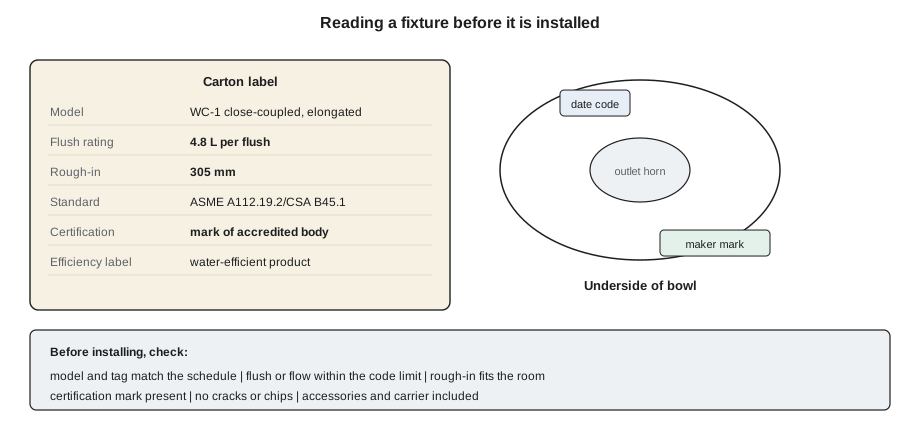
As PLB-210 explained, the plumbing code does not describe how a fixture must be made. Instead it requires fixtures to conform to referenced standards, and certification shows that a product meets them. For fixtures, the main family is the CSA B45 series, which covers plumbing fixtures such as vitreous china, enamelled, stainless steel and plastic fixtures. Many of these standards are now harmonized with the matching American standards, so a single document carries both a CSA number and an ASME number, for example ASME A112.19.2/CSA B45.1 for ceramic plumbing fixtures. Faucets and fittings are covered by ASME A112.18.1/CSA B125.1, and valves that limit temperature, such as shower valves and mixing valves, by CSA B125.3.
A certification mark from an accredited certification body, such as CSA Group, IAPMO, Intertek or another body accredited by the Standards Council of Canada, shows that the product has been tested to the standard and that the factory is audited. The mark is usually printed on the carton and molded or printed on the fixture itself. In Ontario, the Building Code requires plumbing products to conform to the referenced standards, and inspectors look for the mark as evidence. A fixture with no mark may be perfectly well made, but there is no proof of it, and the inspector can reject it.
Faucets and other fittings that deliver drinking water have an extra requirement: they must meet the limits on lead and other contaminants that can leach into the water. In both countries, products in contact with drinking water must meet NSF/ANSI/CAN 61, and the lead content of wetted surfaces is limited to a weighted average of 0.25 percent. The faucet carton usually shows a lead-free or low-lead statement along with the certification mark. Maya had learned about lead-free requirements for pipe and solder in PLB-110; the same idea applies to anything the water touches on the way to the user.
Water efficiency is another label to check. In both countries, the code sets maximum flush volumes and flow rates for many fixtures, and voluntary programs set lower targets. A toilet labelled for a higher flush volume than the code allows, or a showerhead with a flow higher than the limit, cannot be installed even if it carries a valid certification mark, because the mark only shows that the product meets its own standard, not that it meets every code rule where it is being installed.
| Fixture | Ontario Building Code maximum | Note |
|---|---|---|
| Water closet | 4.8 L per flush | Dual-flush: average of full and reduced flush |
| Urinal | 1.9 L per flush | Waterless urinals are also used where permitted |
| Showerhead | 7.6 L/min | Measured at the rated pressure |
| Lavatory faucet (public) | Low-flow aerator or metering faucet required | Check the code table and the specification |
Matching the fixture to the drawings and specification
Before a single fixture leaves its box, the foreman checks the delivery against the fixture schedule. The fixture schedule is a table on the mechanical drawings or in the specification that lists every fixture type by a tag, such as WC-1 or LAV-2, with its manufacturer and model or an approved equal, its material and colour, its trim, the supply and waste sizes, the rough-in dimensions, and any accessories such as seats, carriers or stops. Every fixture symbol on the plan carries one of these tags.
Checking the schedule catches problems that are expensive to fix after the fact. A water closet with a 254 mm rough-in in a room framed for 305 mm leaves a gap behind the tank. A wall-hung lavatory delivered without the carrier specified in the schedule cannot be hung. A barrier-free suite needs the taller toilet and the lavatory with knee space, not the standard ones. A substitution that looks the same may have a different flush volume or a different outlet location.
Maya spent her first morning on the finishing crew opening cartons on the third floor and checking them against the schedule with a printed copy and a pencil. She found two problems. The pallet of lavatory faucets for the barrier-free suites had been delivered with standard knob handles instead of the lever handles in the schedule, and one water closet carton was a different model from the rest. Luis told her to tag both, photograph the labels and send the photos to the office before anyone opened more boxes.
Worked problem
Checking a delivery against the fixture schedule
The fixture schedule for the Kingsway suites lists WC-1: floor-mounted, close-coupled, vitreous china, 4.8 L elongated bowl, 305 mm rough-in, certified to the referenced standard. A pallet of 24 water closets arrives. Maya checks one carton label: model matches, flush 4.8 L, rough-in 305 mm, certification mark present. Another carton shows the same model but a rough-in of 254 mm. What should she do?
Show solution
- Stop: a different rough-in means the fixture will not fit the framing and the waste location.
- Check every carton on the pallet, not just the first one, and count how many are affected.
- Tag the wrong cartons, set them aside and photograph the labels.
- Report to the foreman, who contacts the supplier for an exchange before installation starts.
Answer: Never install a fixture that does not match the schedule. Check every carton, isolate the wrong ones and report before work starts.
Receiving, storing and handling fixtures
Fixtures are heavy, fragile and expensive, and they spend days or weeks on site before they are installed. Good handling habits save money and protect people. Vitreous china and enamelled fixtures should stay in their cartons until they are needed, stored upright as marked, and kept off the floor where water could reach them. Cartons should not be stacked higher than the manufacturer allows. Bathtubs and shower units should be protected from other trades, because a dropped hammer or a spilled solvent can ruin a finish that cannot be repaired.
Lifting matters too. A cast iron tub can weigh more than 130 kg, and even a water closet tank and bowl together are awkward to carry up a stair. Luis made sure two people moved anything heavy, that dollies and stair climbers were used where they fit, and that nobody carried a fixture down a ladder. Maya's TRD-101 training on manual handling applied here: plan the lift, get help, keep the load close and lift with the legs.
Once a fixture is installed, it needs protection until the building is turned over. Bathtubs get a protective cover, drains are capped so debris cannot fall in, and finished fixtures in occupied areas are wrapped. A damaged fixture found at the final walk-through has to be replaced, and if nobody can show who damaged it, the plumbing contractor usually pays.
The code's general rules for fixtures
Part 7 of the Ontario Building Code sets general rules that apply to all fixtures. Fixtures must have smooth, non-absorbent surfaces and be free of concealed fouling surfaces, so that they can be kept clean. Each fixture must be connected to the drainage system through a trap, except where the code allows otherwise, and the water supply to each fixture must be protected from backflow, usually by an air gap built into the fixture. Fixtures must be installed so that they are secure and can be cleaned around, and fixtures must be accessible for use and service.
Several rules show up again and again in the field. The joint between a fixture and a wall or floor must be sealed so that water cannot get behind it, using a sealant that is suitable for the material. Fixtures must be set level and true. Wall-hung fixtures must be supported by a carrier or by backing strong enough for the load, not just by the drywall. Fixture outlets must be connected with approved joints, such as a closet flange and wax or foam seal for a water closet, or a slip-joint or threaded connection for a lavatory. And every fixture must be installed so that the trap and supplies can be reached for service.
Clearances are the other everyday rule. The code sets minimum distances around water closets, urinals and lavatories so that people can use them and clean around them. The common numbers are a minimum distance from the centre of a water closet to a side wall or partition, and a minimum clear space in front of it. Lesson 2 gives those numbers, and Lesson 5 covers the larger clearances required for accessible fixtures.
The program below is the kind of quick check Maya's foreman ran as cartons came off the hoist. It compares each delivered item with the schedule and flags anything that does not match.
# Compare delivered fixtures with the fixture schedule
schedule = {"WC-1": {"flush_L": 4.8, "rough_mm": 305, "cert": True},
            "LAV-1": {"handles": "lever", "cert": True},
            "SH-1": {"flow_Lmin": 7.6, "cert": True}}
delivered = [("WC-1", {"flush_L": 4.8, "rough_mm": 305, "cert": True}),
             ("WC-1", {"flush_L": 4.8, "rough_mm": 254, "cert": True}),
             ("LAV-1", {"handles": "knob", "cert": True}),
             ("SH-1", {"flow_Lmin": 9.5, "cert": True})]

for tag, item in delivered:
    want = schedule[tag]
    bad = [k for k in want if item.get(k) != want[k]]
print(f"{tag:6s}", "ok" if not bad else "hold: " + ", ".join(bad))WC-1 ok WC-1 hold: rough_mm LAV-1 hold: handles SH-1 hold: flow_Lmin
The output shows three items to hold. The water closet with the wrong rough-in and the lavatory faucets with the wrong handles are the problems Maya found by hand. The showerhead with a higher flow than the schedule would also fail the code limit, which is exactly the kind of substitution that slips through when nobody checks the label.
Fixtures in the finishing sequence
Setting fixtures is one step in a sequence that the whole site depends on. The rough-in, inspected and tested, comes first. Then come insulation, drywall, tile, paint and flooring. Tubs and shower bases are often set before the wall finish, because the finish laps over their flanges. Toilets, lavatories and sinks are set after the floor and wall finishes are complete. Faucets, trim, accessories and appliance connections come last, followed by testing, flushing, adjustment and the final inspection.
Coordination with the other trades decides whether the finishing goes smoothly. The tile setter needs to know the exact height of the shower valve and the location of the drain. The cabinet installer needs to know where the sink supplies and drain come through the wall. The electrician needs a receptacle under the kitchen sink for the dishwasher and the disposer, and a circuit for any electric water heater. The flooring installer needs the closet flange set at the right height for the finished floor. Many callbacks come from a missed conversation, not from bad plumbing.
Luis gave Maya a habit that stayed with her: before setting anything in a room, stand in the doorway and look. Is the floor finished? Is the wall finished? Are the supplies and drain where the fixture needs them? Is anything in the way? Two minutes of looking saves an hour of undoing.
Common mistakes
MistakeSetting a fixture without checking it against the schedule.
InsteadCheck model, rough-in, flush or flow rating, trim and certification against the fixture schedule first.
MistakeTreating a certification mark as proof that the fixture meets every code rule.
InsteadThe mark shows compliance with the product standard; flush and flow limits and other code rules still apply.
MistakeStoring fixtures loose on a wet floor or stacked beyond the carton limits.
InsteadKeep fixtures in their cartons, upright, dry and stacked within the manufacturer's limits.
MistakeCarrying heavy fixtures alone or down a ladder.
InsteadPlan the lift, use two people and dollies or stair climbers, and keep the load close.
MistakeLeaving installed fixtures unprotected.
InsteadCover tubs, cap drains and wrap finished fixtures until turnover.
Summary and key terms
- A fixture receives water or waste and discharges to the drainage system; water heaters and most appliances are not fixtures.
- Common fixture materials are vitreous china, enamelled cast iron and steel, stainless steel, acrylic, fibreglass, solid surface and terrazzo, each with its own handling needs.
- Fixtures and fittings must meet referenced standards such as the CSA B45 series and ASME A112.18.1/CSA B125.1, shown by a certification mark.
- Products that deliver drinking water must meet NSF/ANSI/CAN 61 and the lead-free limit of 0.25 percent weighted average lead.
- Flush volumes and flow rates are limited by code, and specifications often require lower values.
- Every fixture is checked against the fixture schedule before it is installed.
- Fixtures are set after the finishes, in a sequence that depends on coordination with other trades.
- Fixture
- A receptacle or device connected to the water supply or drainage system, or both, that receives water or waste and discharges to the drainage system.
- Vitreous china
- A clay body fired until it is glass-like and non-porous, then glazed; used for water closets, urinals and lavatories.
- Fixture schedule
- A table on the drawings or in the specification listing each fixture type by tag, with model, material, trim and connection details.
- Certification mark
- A mark from an accredited body showing that a product has been tested to its standard and the factory is audited.
- Rough-in dimension
- The distance from the finished wall to the centre of a fixture outlet, which must match the fixture.
- Gauge
- A measure of sheet metal thickness; a lower number means thicker metal.
Practice problems
Work each problem on paper first, then reveal the answer to check.
Is a water heater a fixture?
Show answer
No. It is an appliance or equipment; fixtures receive water or waste and discharge to the drainage system.
Which standard covers faucets in Canada?
Show answer
ASME A112.18.1/CSA B125.1, the harmonized plumbing supply fittings standard.
What is the Ontario maximum flush volume for a water closet?
Show answer
4.8 L per flush.
What does a lower stainless steel gauge number mean?
Show answer
Thicker steel.
Why must a delivery be checked against the fixture schedule?
Show answer
To catch wrong models, rough-ins, ratings or trim before they are installed.
What limit applies to lead in drinking water fittings?
Show answer
A weighted average of 0.25 percent lead on wetted surfaces.
Lesson quiz · 5 questions
Score 60% or more to complete this lesson.
Create a free account to save your progress, take quizzes and earn a certificate.