
PHYS-499 · Lesson 11 of 12 · 21 min
Presenting physics: talks, posters and the oral defence
▶ Video coming soon A video version of this lesson is on the way.
Physics is communicated in talks and posters as much as in papers. A conference talk may be the first time anyone outside your group hears about your work; a poster session is where many collaborations begin; and the oral defence of an honours thesis is where examiners decide how well you understand what you did. These forms reward different skills from writing. A reader can reread a paragraph; a listener cannot rewind a sentence. A reader chooses the pace; a listener follows yours. This lesson covers how to plan and deliver a short research talk, how to design a poster, and how to prepare for the questions in a defence, with Maya's twelve-minute departmental talk, her conference poster and her oral examination as examples.
Planning a research talk
Most student research talks are short: ten to fifteen minutes plus questions at an undergraduate conference or a departmental honours session. That is far too little time to present everything in the thesis, and trying to do so is the commonest mistake. A short talk can carry one main message, supported by perhaps three key results. Decide what that message is before making any slides. Maya's was: a parameter-free model that treats the magnet's finite size predicts its fall through a pipe to within about 3 per 100, while the textbook point-dipole formula fails by up to 37 per 100 in a way that depends on the gap between the magnet and the wall. Everything in the talk served that sentence.
A good structure for a short talk follows the shape of the thesis but with different proportions. Spend about a fifth of the time on motivation and the question, so the audience knows why to care; about a quarter on the method, including only what the audience needs to trust the results; about two fifths on the results; and the rest on conclusions and what comes next. Show the question early and the answer clearly, and repeat the main message at the end. Audiences remember beginnings and endings; the middle is where they need help, in the form of clear transitions that say where the talk is going.
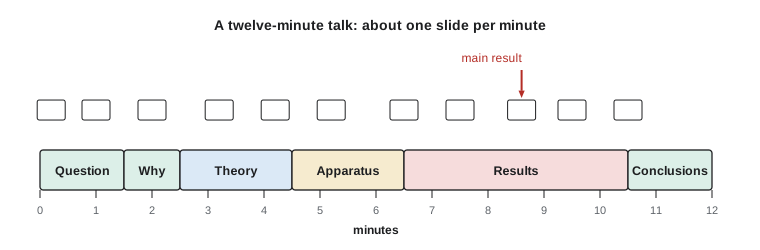
A common guideline is about one slide per minute, but the right number depends on the slides. A slide with one plot and a single message may need ninety seconds; a title slide needs ten. What matters is that each slide has a clear purpose, which is best stated in its title as a sentence rather than a label. A slide titled "Results" tells the audience nothing; one titled "The point-dipole model fails by an amount that grows as the gap shrinks" tells them what to look for in the plot below it. Put as few words on slides as possible, and never read them aloud; the audience reads faster than you speak and will stop listening. Make plots larger and simpler than in the thesis: thicker lines, larger labels, fewer curves, and an explanation of the axes every time a new plot appears.
slides = [   # (title, seconds planned)
    ("Title: eddy-current drag on a falling magnet", 20),
    ("A magnet falls slowly through a copper pipe", 50),
    ("Why it matters: models of magnetic braking", 60),
    ("Point dipole versus a finite magnet", 70),
    ("Apparatus: light gates and five pipes", 60),
    ("Calibrating the moment: a 1.5 mm surprise", 60),
    ("Results I: point dipole fails by 17 to 37 per 100", 80),
    ("Results II: the failure follows the gap", 60),
    ("Results III: finite magnet agrees to 2.7 per 100", 70),
    ("Results IV: a cold pipe slows the magnet", 50),
    ("Conclusions and next steps", 60),
]
limit = 12*60
total = sum(s for _, s in slides)
print(f"{len(slides)} slides, {total//60} min {total%60:02d} s planned, limit {limit//60} min")
t = 0
for title, s in slides:
    t += s
    flag = "  <- main result" if "agrees" in title else ""
    print(f"  {t//60:2d}:{t%60:02d}  {title}{flag}")
words_per_min = 140
print(f"script length for a {words_per_min} words per minute pace: about {total/60*words_per_min:.0f} words")11 slides, 10 min 40 s planned, limit 12 min 0:20 Title: eddy-current drag on a falling magnet 1:10 A magnet falls slowly through a copper pipe 2:10 Why it matters: models of magnetic braking 3:20 Point dipole versus a finite magnet 4:20 Apparatus: light gates and five pipes 5:20 Calibrating the moment: a 1.5 mm surprise 6:40 Results I: point dipole fails by 17 to 37 per 100 7:40 Results II: the failure follows the gap 8:50 Results III: finite magnet agrees to 2.7 per 100 <- main result 9:40 Results IV: a cold pipe slows the magnet 10:40 Conclusions and next steps script length for a 140 words per minute pace: about 1493 words
Delivering the talk
Rehearse aloud, standing, with a timer, at least three times, and at least once in front of people who will tell you honestly what was unclear. The first rehearsal is always too long; cut material rather than speaking faster. Know the first two minutes nearly by heart, since nerves are worst at the start, and know how you will finish. Speak to the audience, not to the screen; point at the feature on a plot that you are talking about; and pause after showing a key result so that people have time to look at it. If you run short of time, skip a slide deliberately rather than rushing through all of them. Most conference sessions have a chair who will stop you at the time limit, and the result you did not reach is the one nobody hears.
Questions after a talk are an opportunity, not an ambush. Listen to the whole question, repeat or rephrase it so the audience hears it, and answer the question that was asked, briefly. If you do not know, say so and say how you would find out: "I haven't tested that, but the code could estimate it by changing the magnet's length". If a question reveals a genuine problem, acknowledge it. Preparing a few backup slides for likely questions, such as the full uncertainty budget or the derivation of a key formula, lets you answer precisely without cluttering the main talk.
Designing a poster
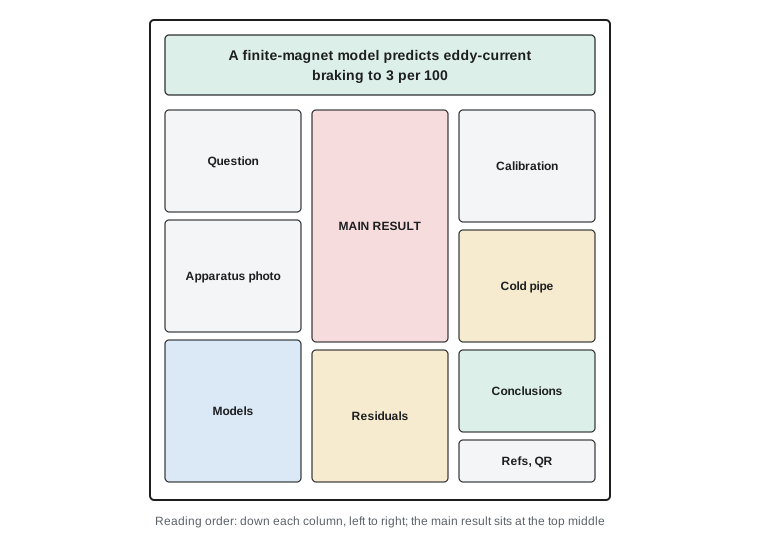
A poster is read, or more often glanced at, by people walking past in a crowded hall. It must attract attention from several metres away, communicate its main point in about thirty seconds, and support a five-minute conversation with someone who stops. That means a large, informative title that states the result, a layout with a clear reading order, usually in columns from top left to bottom right, large figures, and few words. A useful target is fewer than 800 words in total, with body text readable from two metres, which for a standard poster means at least 24 point. Put the main result where the eye falls first, near the top centre, and make sure a passer-by who reads only the title and the largest figure takes away the message.
sections = {   # section: words of text
    "title": 14, "question": 90, "models": 120, "apparatus and calibration": 110,
    "main result caption": 60, "residuals caption": 40, "cold pipe": 80,
    "conclusions": 70, "references and acknowledgements": 60,
}
words = sum(sections.values())
print(f"total words: {words} (target under 800)")
reading_time = words/200*60
print(f"time to read every word at 200 words per minute: {reading_time:.0f} s")
print("largest sections:", sorted(sections, key=sections.get, reverse=True)[:3])
view_m = 2.0
min_cap = view_m/0.33              # rough legibility rule: 1 mm of letter height per 0.33 m of distance
print(f"readable from {view_m} m: letter height at least about {min_cap:.0f} mm, roughly 24 point or larger")total words: 644 (target under 800) time to read every word at 200 words per minute: 193 s largest sections: ['models', 'apparatus and calibration', 'question'] readable from 2.0 m: letter height at least about 6 mm, roughly 24 point or larger
At the session, stand beside the poster, not in front of it, and have a two-minute spoken summary ready for anyone who stops: the question, the method in a sentence, the main figure and the conclusion. Let the visitor guide the conversation after that; some will want the physics, some the apparatus, some your future plans. Bring printed copies of the abstract or a link to the thesis and data. Many of the most useful conversations in a research career begin at posters, and a visitor who asks a hard question is often the person most worth talking to.
The oral defence
The oral defence, or oral examination, usually follows the thesis talk. It typically lasts thirty to sixty minutes with the supervisor and one or two examiners, and its purpose is to establish that you understand your work, its foundations and its limitations, and that the thesis is your own. Examiners will have read the thesis and will have marked passages to ask about. Expect questions at several levels: about the basic physics behind your project, such as why a moving magnet induces currents and why they oppose the motion; about specific steps, such as how the uncertainty in the moment was estimated; about choices, such as why ten drops per pipe and not twenty; about limitations and alternatives, such as what would change with a rectangular magnet; and about the broader context, such as where eddy-current braking is used in practice.
Preparation is straightforward but must be thorough. Reread the thesis as an examiner would, marking every claim you would want to challenge, and prepare an answer for each. Make sure you can derive every key equation without notes and explain every figure. Know your uncertainty budget and which term dominates. List the weaknesses of your work honestly; examiners respect a student who identifies a limitation before they do. Ask your supervisor or classmates to hold a mock defence. During the examination, take a moment to think before answering, use the board for derivations, and say clearly when you are unsure. "I don't know, but here is how I would approach it" is a much better answer than a confident guess. Examiners are not trying to fail you; they are trying to find the edges of your understanding, and showing that you know where those edges are is a sign of mastery.
Worked problem
Answering a hard question
An examiner asks Maya: your finite-magnet model assumes uniform magnetization. Real magnets are not uniform near their edges. How much could that matter?
Show solution
- Acknowledge the assumption: yes, the model treats the magnet as uniformly magnetized, represented as surface currents.
- Reason about the effect: the drag depends on the radial field near the wall, which is set mostly by the magnetization near the ends and edges of the magnet, so nonuniformity there could change the drag.
- Give a scale: her calibration fitted the on-axis field from 40 to 120 mm with the uniform model and found residuals consistent with noise, so any nonuniformity has little effect on the far field; the near-field effect is not tested by that calibration.
- Say how to test it: map the field near the magnet's surface with the Hall probe, or measure the drag with magnets of different aspect ratio, and compare with the model.
Answer: A strong answer accepts the assumption, explains which part of the field matters, says what the existing data do and do not constrain, and proposes a test.
Common mistakes
MistakeTrying to fit the whole thesis into a twelve-minute talk.
InsteadChoose one main message and about three supporting results; leave the rest for questions and backup slides.
MistakeSlide titles that are labels rather than statements.
InsteadWrite each title as the sentence the slide demonstrates.
MistakeReading slides aloud or speaking to the screen.
InsteadKeep words on slides minimal, talk to the audience and point to the feature you mean.
MistakeA poster that is a thesis printed small.
InsteadUse a result-stating title, a dominant figure, under 800 words and large type.
MistakeBluffing in the defence.
InsteadSay what you know, what you do not, and how you would find out.
Summary and key terms
- A short talk carries one main message and about three supporting results, with time divided among motivation, method, results and conclusions.
- Use sentence titles, minimal text, large simple plots, and rehearse aloud with a timer; answer questions briefly and honestly.
- A poster needs a result-stating title, a clear reading order, a dominant main figure, fewer than about 800 words and type readable from two metres.
- The oral defence tests understanding at several levels: basic physics, specific steps, choices, limitations and context.
- Prepare by rereading as an examiner, deriving key results without notes, knowing the uncertainty budget, listing weaknesses and holding a mock defence.
- Sentence title
- A slide title stating the point the slide demonstrates.
- Backup slide
- A slide prepared for likely questions but not shown in the main talk.
- Reading order
- The path a viewer follows through a poster, usually column by column.
- Oral defence
- An examination in which the student answers questions about the thesis.
- Mock defence
- A practice examination with supervisor or peers.
Practice problems
Work each problem on paper first, then reveal the answer to check.
Write a sentence title for Maya’s calibration slide.
Show answer
For example: A 1.5 mm sensor offset made the first moment calibration 7 per 100 too low.
In the timing code, at what minute does the main result appear, and is that sensible?
Show answer
At the end of minute 9 or so, after the other results; it would be stronger to show it earlier in the results section and repeat it at the end.
Your poster has 1,400 words. Name two cuts.
Show answer
Replace the derivation with a single key equation and a reference to the thesis; shorten the methods to a labelled diagram with a caption.
An examiner asks a question you cannot answer. What should you say?
Show answer
That you do not know, then how you would reason about it or test it.
Give one backup slide you would prepare.
Show answer
The full uncertainty budget, or the derivation of the point-dipole drag formula.
Lesson quiz · 5 questions
Score 60% or more to complete this lesson.
Create a free account to save your progress, take quizzes and earn a certificate.