
PHYS-420 · Lesson 8 of 12 · 23 min
Nuclear astrophysics and applications: nucleosynthesis, medical isotopes and dating
▶ Video coming soon A video version of this lesson is on the way.
Nuclear physics reaches far beyond the laboratory. It explains why the Sun shines, how stars live and die, and where every element heavier than hydrogen came from. The same physics, put to work on Earth, lets doctors image the working brain and treat cancer, lets archaeologists date a hearth, and lets geologists date the Earth. This lesson brings these together: first the nuclear physics of stars and the origin of the elements, then the medical and dating applications that use radioactive isotopes every day. PHYS-430 introduced the stellar side; here we look at the nuclear reactions themselves.
Why stars shine
The Sun radiates \(3.83 \times 10^{26}\) W and has done so for 4.6 billion years. No chemical fuel could last a fraction of that time, and gravitational contraction, the Kelvin–Helmholtz mechanism, would supply only about 30 million years. Arthur Eddington suggested in 1920 that the Sun fuses hydrogen into helium, using Francis Aston's new measurement that four hydrogen atoms are heavier than one helium atom by about 0.7 parts in 100. The program computes this precisely: \(4\,{}^1\mathrm H \to {}^4\mathrm{He}\) releases 26.73 MeV, 0.0071 of the rest energy. Converting that fraction of its mass to energy, the Sun turns about 4.3 million tonnes of mass into light every second.
The proton-proton chain
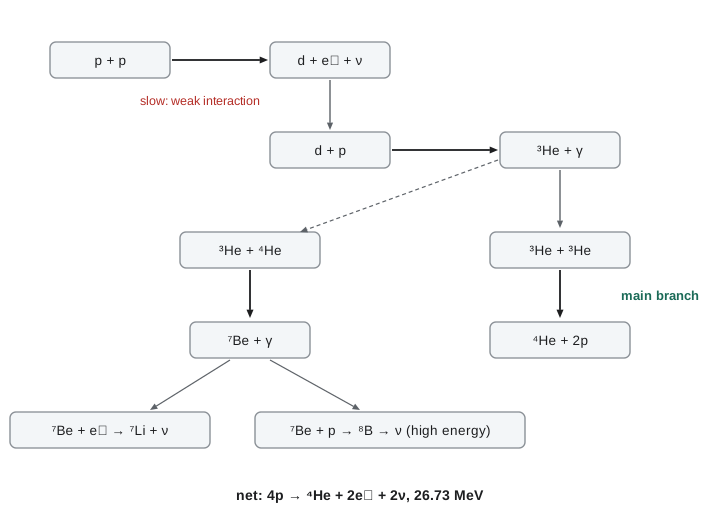
Hans Bethe worked out in 1938 and 1939 how hydrogen burns. In stars like the Sun, the main path is the pp chain. Its first step,
is extraordinarily slow, because two protons must tunnel through their Coulomb barrier and, during the brief moment they are close, one of them must change into a neutron by the weak interaction. A given proton in the Sun's core waits on average about 10 billion years for this reaction, which is why the Sun lives so long. The deuteron then quickly captures another proton, \(d + p \to {}^3\mathrm{He} + \gamma\), and two helium-3 nuclei fuse, \({}^3\mathrm{He} + {}^3\mathrm{He} \to {}^4\mathrm{He} + 2p\). Side branches through beryllium-7 and boron-8 produce higher-energy neutrinos. In stars more massive than about 1.3 solar masses, the hotter core favours the CNO cycle, proposed independently by Bethe and by Carl Friedrich von Weizsäcker, in which carbon, nitrogen and oxygen act as catalysts for the same net reaction.
Solar neutrinos
Each conversion of four protons to helium releases two neutrinos, so the Sun's luminosity fixes the neutrino production rate. The program finds about \(1.8 \times 10^{38}\) neutrinos per second, and a flux at Earth of about \(6.5 \times 10^{10}\) per square centimetre per second, passing through your body day and night. Raymond Davis's chlorine experiment in the Homestake mine in South Dakota, running from the late 1960s, saw only about a third of the predicted rate: the solar neutrino problem. In 2001 and 2002 the Sudbury Neutrino Observatory, 2 km underground in a nickel mine near Sudbury, Ontario, resolved it. SNO used 1,000 tonnes of heavy water, which let it measure both electron neutrinos alone and all three neutrino types together. The total matched the solar model; the electron-type flux was only about a third. The missing neutrinos had changed type on the way. Arthur McDonald of Queen's University shared the 2015 Nobel Prize for this discovery of neutrino oscillations, the subject of lesson 12. SNOLAB, its successor, is now one of the deepest and cleanest underground laboratories in the world.
Making the elements
The lightest elements come from the first few minutes after the Big Bang. As the universe cooled through about \(10^9\) K, neutrons and protons combined into deuterium and then helium-4, leaving about one helium nucleus for every twelve hydrogen nuclei, about a quarter of the mass, plus traces of deuterium, helium-3 and lithium-7. Nothing heavier formed in quantity, because there is no stable nucleus with \(A = 5\) or \(A = 8\) to step through.
Stars bridge the gap. When a star's core runs out of hydrogen, it contracts and heats to about \(10^8\) K, where three helium nuclei combine into carbon by the triple-alpha process: two alphas form beryllium-8, which lives only \(10^{-16}\) s, and occasionally a third alpha arrives in time, passing through the Hoyle state of carbon-12 that we met in lesson 6. Carbon then captures alphas to make oxygen. More massive stars go on to burn carbon, neon, oxygen and silicon in successively hotter, faster stages, building up nuclei toward iron, at the peak of the binding-energy curve. Beyond iron, fusion absorbs energy instead of releasing it, so the core of a massive star collapses, producing a supernova and a neutron star or black hole.
Elements heavier than iron are made by neutron capture, which faces no Coulomb barrier. In the slow s-process, in red giant stars, a nucleus captures a neutron every few years and has time to beta-decay back toward stability between captures, so the s-process follows the valley of stability. In the rapid r-process, in an environment flooded with neutrons, nuclei capture many neutrons in seconds and are driven far to the neutron-rich side before beta-decaying back. Its abundance peaks fall near \(A = 80\), 130 and 195, where magic neutron numbers 50, 82 and 126 slow the flow. In August 2017 the merger of two neutron stars, GW170817, was seen in gravitational waves and then in light; the glow of its kilonova showed the signature of freshly made heavy elements, establishing neutron-star mergers as a major r-process site. Much of the gold and platinum on Earth was probably made this way.
Radiometric dating
Radioactive decay is a clock that runs at a fixed rate whatever the temperature, pressure or chemistry. If a sample started with \(N_0\) parent nuclei and now has \(N\), its age is \(t = \lambda^{-1}\ln(N_0/N)\). The challenge is knowing \(N_0\). For radiocarbon, Willard Libby's method (1949, Nobel Prize 1960), cosmic-ray neutrons in the upper atmosphere make carbon-14 by \({}^{14}\mathrm N(n, p){}^{14}\mathrm C\) at a steady rate. Living things take up carbon-14 along with ordinary carbon and maintain the atmospheric ratio, about 1.2 parts per trillion, with an activity of about 0.23 Bq per gram of carbon. When an organism dies, uptake stops and the carbon-14 decays with a half-life of 5,730 years. The program converts measured activity fractions to ages: half the modern activity means 5,730 years, a twentieth about 25,000 years. Calibration against tree rings and other records corrects for past changes in production, and accelerator mass spectrometry, which counts carbon-14 atoms directly instead of waiting for decays, extends the method to about 50,000 years with milligram samples.
For older samples, longer-lived parents are used, with a trick that removes the need to know \(N_0\): if parent \(P\) decays to stable daughter \(D\), then \(D = D_0 + P(e^{\lambda t} - 1)\). Measuring several minerals from the same rock, which started with the same isotopic ratio of the daughter but different parent concentrations, gives points on a straight line, an isochron, whose slope gives the age. Rubidium-strontium (half-life 49 billion years), potassium-argon, and especially uranium-lead dating in zircon crystals, which combine two independent decay chains as a cross-check, have dated meteorites to 4.567 billion years, the age of the solar system.
Nuclear medicine: imaging
Diagnostic nuclear medicine attaches a radioactive isotope to a molecule that goes where the doctor wants to look, and detects the emitted radiation from outside the body. Technetium-99m, from the generator of lesson 4, is used in tens of millions of single-photon scans a year; its 140 keV gamma ray escapes the body easily and is ideal for gamma cameras. Positron emission tomography, PET, uses positron emitters such as fluorine-18, made with the cyclotron reaction of lesson 6. The positron travels about a millimetre, annihilates with an electron, and produces two 511 keV photons emitted back to back. A ring of detectors records the two photons in coincidence and so locates the annihilation on the line between the detectors. Collecting millions of such lines reconstructs a three-dimensional image. Fluorodeoxyglucose, a glucose analogue labelled with fluorine-18, accumulates in tissues that use a lot of glucose, such as active brain regions and many tumours, which makes PET one of the most important tools in cancer care.
The 110-minute half-life of fluorine-18 is a practical constraint: the program shows that about half the activity is lost in two hours of transport and uptake, so PET centres need a cyclotron nearby. Modern scanners also measure the difference in arrival times of the two photons; a timing resolution of 300 ps locates the annihilation along the line to within about 4.5 cm, which reduces image noise.
# Nuclear astrophysics and applications: the Sun's pp chain, radiocarbon dating and PET imaging
import math
u, me = 931.494, 0.51100
m_H, m_He4 = 1.007825, 4.002603           # atomic masses
Q_pp = (4 * m_H - m_He4) * u              # atomic masses already include the electrons that annihilate
print(f"4 H -> He-4 releases {Q_pp:.2f} MeV ({(4 * m_H - m_He4) / (4 * m_H):.4f} of the rest energy)")
L_sun, AU, MeV = 3.828e26, 1.496e11, 1.602e-13
nu_rate = 2 * L_sun / ((Q_pp - 0.53) * MeV)   # two neutrinos per He-4; about 0.53 MeV leaves with the neutrinos
print(f"solar neutrinos produced: {nu_rate:.2e} per s; flux at Earth {nu_rate / (4 * math.pi * AU ** 2) / 1e4:.2e} per cm^2 per s")
mass_rate = L_sun / (2.998e8) ** 2
print(f"the Sun converts {mass_rate / 1e9:.2f} million tonnes of mass to energy each second")
print()
# radiocarbon: C-14 half-life 5730 y; modern activity about 0.226 Bq per g of carbon
T14 = 5730; lam = math.log(2) / T14
for frac in (0.9, 0.5, 0.25, 0.05):
    print(f"  sample at {frac:.2f} of modern C-14 activity: age {-math.log(frac) / lam:8.0f} years")
print()
# PET: F-18 (109.8 min) decays by positron emission; annihilation gives two 511 keV photons back to back
T18 = 109.8
print(f"annihilation photon energy m_e c^2 = {me * 1000:.0f} keV")
for t in (0, 60, 120, 240):
    print(f"  F-18 dose left after {t:3d} min transport and uptake: {0.5 ** (t / T18):.3f} of the starting activity")
# coincidence timing: a 300 ps time difference localizes the annihilation along the line of response
for dt in (600, 300, 100):
print(f" time-of-flight resolution {dt} ps -> position along the line {2.998e8 * dt * 1e-12 / 2 * 100:.1f} cm")4 H -> He-4 releases 26.73 MeV (0.0071 of the rest energy) solar neutrinos produced: 1.82e+38 per s; flux at Earth 6.49e+10 per cm^2 per s the Sun converts 4.26 million tonnes of mass to energy each second sample at 0.90 of modern C-14 activity: age 871 years sample at 0.50 of modern C-14 activity: age 5730 years sample at 0.25 of modern C-14 activity: age 11460 years sample at 0.05 of modern C-14 activity: age 24765 years annihilation photon energy m_e c^2 = 511 keV F-18 dose left after 0 min transport and uptake: 1.000 of the starting activity F-18 dose left after 60 min transport and uptake: 0.685 of the starting activity F-18 dose left after 120 min transport and uptake: 0.469 of the starting activity F-18 dose left after 240 min transport and uptake: 0.220 of the starting activity time-of-flight resolution 600 ps -> position along the line 9.0 cm time-of-flight resolution 300 ps -> position along the line 4.5 cm time-of-flight resolution 100 ps -> position along the line 1.5 cm
Nuclear medicine: therapy
Radiation can also destroy tissue on purpose. External beams of gamma rays from cobalt-60, or X-rays from linear accelerators, treat about half of all cancer patients. The world's first cobalt-60 cancer treatments were given in Canada in the autumn of 1951, in London, Ontario, and in Saskatoon, where the machine was designed by Harold Johns. Proton therapy uses the Bragg peak: a proton deposits most of its energy just before it stops, so the dose can be concentrated at the depth of a tumour while sparing tissue in front and behind. TRIUMF in Vancouver began treating eye melanomas with protons in 1995». Targeted radionuclide therapy attaches a beta or alpha emitter to a molecule that seeks out cancer cells. Lutetium-177 (half-life 6.6 days), attached to molecules that bind prostate cancer or neuroendocrine tumour cells, delivers its short-range beta radiation directly to the cancer; Bruce Power began producing it in a CANDU power reactor in 2022, the first such production in a commercial power reactor.
Other applications are everywhere once you look. Smoke detectors contain a few kilobecquerels of americium-241, whose alpha particles ionize the air between two electrodes; smoke reduces the current and sounds the alarm. Neutron activation analysis identifies trace elements by the gamma rays they emit after neutron capture. Radioactive tracers measure groundwater flow, industrial mixing and wear in engines. Food irradiation with cobalt-60 gamma rays reduces spoilage and pathogens. And radioisotope thermoelectric generators, powered by the decay heat of plutonium-238, have run spacecraft from Voyager to the Perseverance rover, where sunlight is too weak or unreliable.
Worked problem
Dating a bone
A bone sample has a carbon-14 activity of 0.050 Bq per gram of carbon, against 0.226 Bq per gram for modern carbon. Estimate its age, ignoring calibration.
Show solution
- Fraction remaining: \(0.050/0.226 = 0.221\).
- Decay constant: \(\lambda = \ln 2/5730 = 1.21 \times 10^{-4}\ \text{y}^{-1}\).
- Age: \(t = -\ln(0.221)/\lambda = 1.509/1.21 \times 10^{-4} = 12{,}500\) years.
- Calibration with tree rings and other records would adjust this by a few hundred years.
Answer: About 12,500 radiocarbon years, a little over two half-lives.
Common mistakes
MistakeThinking the Sun's slow burning is due to a low temperature.
InsteadIt is due to the weak interaction in the first pp-chain step, which makes each proton wait billions of years.
MistakeExpecting fusion in stars to build elements beyond iron.
InsteadBeyond iron fusion absorbs energy; heavier elements are made by neutron capture in the s- and r-processes.
MistakeUsing radiocarbon to date rocks millions of years old.
InsteadAfter about 50,000 years too little C-14 remains; use long-lived parents such as uranium or rubidium.
MistakeThinking PET detects positrons directly.
InsteadIt detects the two back-to-back 511 keV annihilation photons in coincidence.
MistakeAssuming the solar neutrino deficit meant the solar model was wrong.
InsteadSNO showed the total flux was right; electron neutrinos had changed into other types.
Summary and key terms
- Hydrogen burning, \(4p \to {}^4\mathrm{He}\), releases 26.73 MeV; the slow weak first step of the pp chain sets the Sun's lifetime; heavier stars use the CNO cycle.
- Solar neutrinos, about \(6.5 \times 10^{10}\) cm⁻² s⁻¹ at Earth, revealed neutrino oscillations at SNO.
- Big Bang nucleosynthesis made H, He and traces of Li; stars make elements up to iron; s- and r-process neutron capture make heavier ones, with neutron-star mergers a major r-process site.
- Radiocarbon (5,730 years) dates organic material to about 50,000 years; isochrons with long-lived parents date rocks and meteorites.
- Tc-99m and PET with F-18 image the body; cobalt-60, protons and Lu-177 treat cancer.
- pp chain
- Sequence of reactions converting hydrogen to helium in Sun-like stars.
- r-process
- Rapid neutron capture that makes about half the elements heavier than iron.
- Isochron
- Straight-line plot of daughter against parent abundance whose slope gives a rock's age.
- PET
- Positron emission tomography, imaging with coincident annihilation photons.
- Bragg peak
- The sharp rise in energy deposition just before a charged particle stops.
Practice problems
Work each problem on paper first, then reveal the answer to check.
How many helium nuclei does the Sun make per second?
Show answer
\(3.83 \times 10^{26}/(26.2 \times 1.6 \times 10^{-13}) \approx 9 \times 10^{37}\), half the neutrino rate.
Why is there no stable nucleus with \(A = 5\), and why does it matter?
Show answer
He-5 and Li-5 are unbound; without them, Big Bang nucleosynthesis could not build past helium.
A sample has 0.90 of modern C-14 activity. Using the program, how old is it?
Show answer
About 870 years.
A PET scanner has 200 ps timing resolution. How well does this locate the annihilation along the line?
Show answer
\(c\Delta t/2 = 3.0\) cm.
Why is a 140 keV gamma ray well suited to imaging?
Show answer
It escapes the body with little absorption, yet is easily stopped and detected in a thin crystal.
Which magic numbers cause the r-process abundance peaks?
Show answer
Neutron numbers 50, 82 and 126.
Lesson quiz · 5 questions
Score 60% or more to complete this lesson.
Create a free account to save your progress, take quizzes and earn a certificate.