
PHYS-420 · Lesson 2 of 12 · 21 min
Nuclear properties: size, mass, spin and the nuclear force
▶ Video coming soon A video version of this lesson is on the way.
Before we can model a nucleus we need to know what it looks like: how big it is and how its charge and matter are spread out, what its mass and spin are, and what kind of force holds it together. These are measurable properties, and this lesson shows how each is measured and what the measurements reveal. The answers are surprisingly simple. Nuclei are nearly uniform drops of a single dense fluid with a soft surface; their spins are built from the spins and orbits of their nucleons; and the force between nucleons is strong, short ranged, repulsive at very short distances and dependent on spin.
Measuring size with electron scattering
Rutherford's alpha particles could not see the shape of a nucleus: at a few MeV they never got close enough to touch it. The modern measurements use electrons of a few hundred MeV, which feel only the electromagnetic force and penetrate the nucleus freely. Robert Hofstadter's experiments at Stanford in the 1950s, which earned him the 1961 Nobel Prize, mapped nuclear charge distributions this way. In the first Born approximation of PHYS-373, the cross-section for scattering from an extended charge is the point-charge (Mott) cross-section times the square of a form factor, the Fourier transform of the charge density:
where \(\hbar\mathbf q\) is the momentum transfer, \(q = 2k\sin(\theta/2)\) for an electron of wave number \(k\) scattered through angle \(\theta\), and \(\rho\) is normalized to 1. For a uniform sphere of radius \(R\), the integral gives
which falls from 1 at \(q = 0\) and first reaches zero at \(qR = 4.493\). The measured cross-sections show exactly such diffraction minima, smoothed because the real nuclear edge is not sharp. The angle of the first minimum gives the radius. The program below finds that angle for lead-208 at several electron energies: about 29° at 250 MeV and 14° at 500 MeV. Higher energy probes shorter distances and pushes the pattern to smaller angles, just as optical diffraction does with shorter wavelengths.
The shape of the charge distribution
Fitting many angles and energies gives the full charge distribution. It is well described by the Woods–Saxon (or Fermi) form
with a flat interior of density \(\rho_0\), a half-density radius \(R \approx 1.07A^{1/3}\) fm, and a surface thickness parameter \(a \approx 0.55\) fm. The density falls from 90 to 10 of its central value over \(4.4a \approx 2.4\) fm in every nucleus, light or heavy. The central density is nearly the same for all nuclei, about 0.16 nucleons per cubic fermi, as the program confirms for oxygen, calcium and lead. A heavy nucleus is like a drop of liquid: incompressible, with a constant density and a surface of fixed thickness.
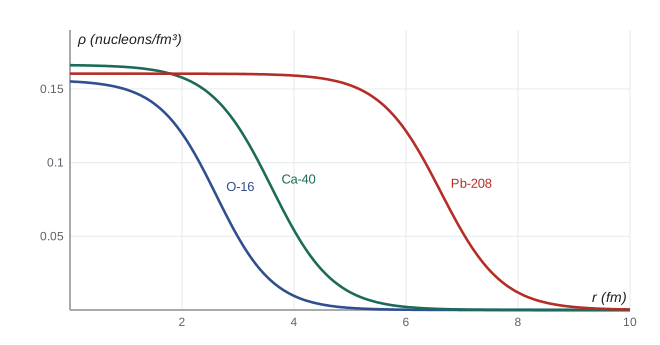
Two common radius conventions should not be confused. The half-density radius in the Woods–Saxon form is about \(1.07A^{1/3}\) fm, while the radius of the equivalent uniform sphere, the one with the same rms radius, is about \(1.2A^{1/3}\) fm. The rms radius itself is \(\sqrt{3/5}\) of the equivalent sphere radius: 5.5 fm for lead-208.
# Nuclear size: Woods-Saxon density, rms radius, and the diffraction minimum in electron scattering
import math
def ws(r, R, a): return 1 / (1 + math.exp((r - R) / a))
def integrate(f, a, b, n=4000):
    h = (b - a) / n
    return h * (0.5 * f(a) + sum(f(a + i * h) for i in range(1, n)) + 0.5 * f(b))
print("nucleus  A    R (fm)  a (fm)  rho0 (1/fm^3)  rms radius (fm)  1.2 A^(1/3)")
for name, A, R, a in (("O-16", 16, 2.61, 0.51), ("Ca-40", 40, 3.60, 0.55), ("Pb-208", 208, 6.62, 0.546)):
    norm = integrate(lambda r: 4 * math.pi * r * r * ws(r, R, a), 0, R + 15 * a)
    rho0 = A / norm
    r2 = integrate(lambda r: 4 * math.pi * r ** 4 * ws(r, R, a), 0, R + 15 * a) / norm
    print(f"  {name:6s} {A:4d}  {R:5.2f}   {a:5.3f}   {rho0:8.4f}       {math.sqrt(r2):6.3f}         {1.2 * A ** (1/3):5.2f}")
print()
# uniform sphere form factor F(q) = 3 (sin x - x cos x)/x^3, x = qR; first zero at x = 4.4934
x0 = 4.4934
hbar_c = 197.327
for E in (250.0, 500.0, 750.0):         # electron energies, MeV
    k = E / hbar_c                      # 1/fm
    R = 1.2 * 208 ** (1 / 3)
    s = x0 / (2 * k * R)                # q = 2 k sin(theta/2)
    th = 2 * math.degrees(math.asin(s)) if s <= 1 else float('nan')
print(f"E = {E:5.0f} MeV electrons on Pb-208 (R = {R:.2f} fm): first diffraction minimum near {th:5.1f} degrees")nucleus A R (fm) a (fm) rho0 (1/fm^3) rms radius (fm) 1.2 A^(1/3) O-16 16 2.61 0.510 0.1560 2.771 3.02 Ca-40 40 3.60 0.550 0.1663 3.458 4.10 Pb-208 208 6.62 0.546 0.1604 5.515 7.11 E = 250 MeV electrons on Pb-208 (R = 7.11 fm): first diffraction minimum near 28.9 degrees E = 500 MeV electrons on Pb-208 (R = 7.11 fm): first diffraction minimum near 14.3 degrees E = 750 MeV electrons on Pb-208 (R = 7.11 fm): first diffraction minimum near 9.5 degrees
Other ways to measure size
Independent methods agree. Muonic atoms, in which a muon replaces an electron, have orbits 207 times smaller than electron orbits; for heavy nuclei the muon's 1s orbit lies partly inside the nucleus, and the shift of its X-ray energies measures the charge radius. Mirror nuclei, pairs such as \({}^{15}\mathrm O\) and \({}^{15}\mathrm N\) with \(Z\) and \(N\) exchanged, differ in mass mainly by the Coulomb energy of one extra proton, \(\Delta E_C = (3/5)(e^2/4\pi\varepsilon_0)(2Z - 1)/R\), so their mass difference gives \(R\). Scattering of alpha particles and neutrons measures the radius of the nuclear force, which is slightly larger because the force extends beyond the matter by about its range. All agree on \(R \approx r_0A^{1/3}\) with \(r_0\) between 1.1 and 1.4 fm depending on what is measured.
A recent puzzle shows how precise these measurements have become. In 2010, a measurement of the Lamb shift in muonic hydrogen gave a proton charge radius of 0.841 fm, while electron scattering and ordinary hydrogen spectroscopy had given 0.877 fm. The "proton radius puzzle" was resolved over the following decade by new electron experiments, including the PRad experiment at Jefferson Lab in 2019, which found the smaller value.
Electron scattering sees only the protons. Where are the neutrons? In heavy nuclei with many more neutrons than protons, theory predicts a thin neutron skin: the neutron distribution extends a little beyond the proton distribution. Measuring it cleanly requires a probe that couples to neutrons through a well-understood force. The PREX experiments at Jefferson Lab used the tiny parity-violating part of electron scattering, which arises from the weak interaction and couples mainly to neutrons, and in 2021 reported a lead-208 neutron skin of about 0.28 fm. The skin thickness constrains how the energy of neutron-rich matter grows with density, which in turn controls the radii of neutron stars, so a measurement on one nucleus in a laboratory informs the structure of stars ten kilometres across.
Mass, spin and moments
Nuclear masses are measured as atomic masses and quoted as mass excesses, \(\Delta = (M - A\ \text{u})c^2\). Spins are measured from hyperfine structure, from the number of lines in atomic spectra, and from magnetic resonance. Every nucleus with even \(Z\) and even \(N\) has ground-state spin 0 and even parity, a clue that like nucleons pair off with opposite angular momenta. Odd-\(A\) nuclei have half-integer spin and odd-odd nuclei integer spin, as expected from adding the half-integer spins and integer orbital angular momenta of nucleons. Parity, the behaviour of the wave function under \(\mathbf r \to -\mathbf r\), is \((-1)^\ell\) for a single nucleon in orbital \(\ell\).
Nuclear magnetic moments are measured in nuclear magnetons, \(\mu_N = e\hbar/2m_p = 3.15 \times 10^{-8}\) eV/T, which is 1836 times smaller than the Bohr magneton. The proton has \(\mu_p = 2.793\mu_N\) and the neutron \(\mu_n = -1.913\mu_N\). A Dirac point particle would have \(1\mu_N\) and zero, so these anomalous values were early evidence that nucleons have internal structure. The large proton moment is what makes magnetic resonance imaging possible: in the 1.5 T magnet of a hospital scanner, hydrogen nuclei precess at 63.9 MHz. Many nuclei are also slightly deformed, with an electric quadrupole moment; the rare earths and actinides are prolate, shaped like rugby balls.
The nucleon-nucleon force
Everything we know about the force between nucleons comes from the deuteron, the only bound two-nucleon system, and from nucleon-nucleon scattering. The deuteron is barely bound, by 2.22 MeV, and has spin 1, so the proton and neutron spins are parallel. There is no bound state with spins antiparallel, and no bound diproton or dineutron, so the force depends on spin. The deuteron has a small quadrupole moment, which means its ground state is mostly \(\ell = 0\) with a few parts in 100 of \(\ell = 2\) mixed in: the force has a tensor part that depends on the angle between the spins and the line joining the nucleons.
Scattering data show that the force is attractive between about 0.8 and 2 fm and strongly repulsive inside about 0.5 fm, the repulsive core that keeps nuclear matter from collapsing. Apart from the Coulomb force it is nearly the same between any two nucleons, \(pp\), \(nn\) or \(np\), in the same quantum state. This charge independence lets us treat the proton and neutron as two states of one particle, the nucleon, distinguished by a quantum number called isospin: \(T_3 = +\tfrac12\) for the proton and \(-\tfrac12\) for the neutron, by the convention used in particle physics. We will meet isospin again in lesson 10 as the first example of a flavour symmetry among quarks.
Yukawa's meson theory
In 1935 Hideki Yukawa proposed that the nuclear force is carried by a massive particle, as the electromagnetic force is carried by the photon. A field whose quanta have mass \(m\) obeys the static equation \((\nabla^2 - \mu^2)\phi = 0\) away from sources, with \(\mu = mc/\hbar\), whose spherically symmetric solution is the Yukawa potential
A range of about 1.4 fm requires \(mc^2 = \hbar c/r_0 \approx 197/1.4 \approx 140\) MeV. The same estimate follows from the uncertainty principle: borrowing energy \(mc^2\) for a time \(\hbar/mc^2\) lets the particle travel at most \(c\hbar/mc^2 = \hbar/mc\). The pion, found in cosmic rays by Cecil Powell's group in 1947, has exactly this mass (139.6 MeV for \(\pi^\pm\), 135.0 MeV for \(\pi^0\)), and Yukawa received the 1949 Nobel Prize. We now know pions are quark-antiquark pairs and the nucleon force is a residue of the strong force between quarks, much as the van der Waals force is a residue of electromagnetism between neutral atoms. But one-pion exchange still correctly describes the long-range part of the nuclear force.
Worked problem
Radius from a diffraction minimum
Electrons of 420 MeV scattered from calcium-40 show their first minimum at \(\theta = 36°\). Estimate the equivalent uniform radius and compare with \(1.2A^{1/3}\).
Show solution
- Wave number: \(k = E/\hbar c = 420/197.3 = 2.13\ \text{fm}^{-1}\).
- Momentum transfer: \(q = 2k\sin 18° = 2(2.13)(0.309) = 1.32\ \text{fm}^{-1}\).
- First zero: \(qR = 4.493\), so \(R = 4.493/1.32 = 3.41\) fm.
- Compare: \(1.2 \times 40^{1/3} = 4.10\) fm. The diffraction estimate is lower because a soft edge moves the first minimum outward in \(q\).
Answer: About 3.4 fm from the simple sharp-sphere formula, against 4.1 fm from the systematic rule; a fit with a Woods–Saxon shape reconciles them.
Common mistakes
MistakeUsing alpha-particle scattering of a few MeV to measure nuclear size.
InsteadLow-energy alphas are kept outside by the Coulomb barrier; size needs electrons of hundreds of MeV or nucleons above the barrier.
MistakeMixing the half-density radius, the equivalent sphere radius and the rms radius.
InsteadThey differ: about \(1.07A^{1/3}\), \(1.2A^{1/3}\) and \(\sqrt{3/5} \times 1.2A^{1/3}\) fm.
MistakeExpecting the neutron to have no magnetic moment because it is neutral.
InsteadIt has \(-1.913\mu_N\), evidence for charged constituents inside it.
MistakeTreating the nuclear force as central and spin independent.
InsteadIt depends on spin and has a tensor part, as the deuteron's spin 1 and quadrupole moment show.
MistakeUsing the photon's zero mass to argue the nuclear force must be long ranged.
InsteadIts carriers, effectively pions, are massive, so the range is about \(\hbar/m_\pi c \approx 1.4\) fm.
Summary and key terms
- Electron scattering measures the charge form factor; its diffraction minima give the radius, with \(qR = 4.49\) for a uniform sphere.
- Nuclear densities follow a Woods–Saxon shape: constant interior near 0.16 fm⁻³ and a surface about 2.4 fm thick.
- Even-even nuclei have spin 0; nucleon magnetic moments are anomalous, showing internal structure.
- The nucleon-nucleon force is short ranged, strongly repulsive inside 0.5 fm, spin dependent with a tensor part, and charge independent.
- Yukawa's massive-carrier theory gives range \(\hbar/mc\); the pion of 140 MeV fits a range of 1.4 fm.
- Form factor
- Fourier transform of the charge density, which multiplies the point-charge cross-section.
- Woods–Saxon distribution
- \(\rho_0/[1 + e^{(r - R)/a}]\), the standard nuclear density shape.
- Nuclear magneton
- \(e\hbar/2m_p\), the unit of nuclear magnetic moments.
- Isospin
- Quantum number treating proton and neutron as two states of the nucleon.
- Yukawa potential
- \(-g^2e^{-r/r_0}/r\), the potential of a massive exchanged particle.
Practice problems
Work each problem on paper first, then reveal the answer to check.
At what angle is the first minimum for 300 MeV electrons on a uniform sphere of radius 5.0 fm?
Show answer
\(k = 1.52\ \text{fm}^{-1}\); \(\sin(\theta/2) = 4.493/(2 \times 1.52 \times 5.0) = 0.296\), so \(\theta = 34°\).
What is the rms radius of a uniform sphere of radius \(R\)?
Show answer
\(\sqrt{3/5}\,R = 0.775R\).
Predict the ground-state spin of \({}^{40}\mathrm{Ca}\).
Show answer
Zero: it is even-even.
Find the range of a force carried by a particle of mass 780 MeV (the \(\omega\) meson).
Show answer
\(197/780 = 0.25\) fm, short enough to contribute to the repulsive core.
At what frequency do protons precess in a 3.0 T magnet, given 42.58 MHz/T?
Show answer
127.7 MHz.
Using the program, how does the central density of lead compare with that of calcium?
Show answer
About 0.160 against 0.166 fm⁻³, the same to within a few parts in 100.
Lesson quiz · 5 questions
Score 60% or more to complete this lesson.
Create a free account to save your progress, take quizzes and earn a certificate.