
PHYS-420 · Lesson 4 of 12 · 22 min
Radioactive decay: alpha, beta and gamma
▶ Video coming soon A video version of this lesson is on the way.
An unstable nucleus can lower its energy in three main ways. It can emit an alpha particle, a helium-4 nucleus, which reduces \(Z\) and \(N\) by 2 each. It can convert a neutron to a proton or a proton to a neutron by beta decay, moving along an isobar toward the valley of stability. Or, if it is left in an excited state, it can drop to a lower state by emitting a gamma ray, a photon, without changing \(Z\) or \(N\). This lesson develops the general law of decay, the mathematics of decay chains, and the physics of alpha and gamma emission. Beta decay, which involves the weak interaction and the neutrino, gets its own lesson next.
The decay law
Radioactive decay is a random process: each nucleus has a constant probability per unit time \(\lambda\) of decaying, independent of its age, of its surroundings and of what the other nuclei are doing. For a large number \(N\) of nuclei, \(dN/dt = -\lambda N\), so
The activity \(\mathcal A\) is measured in becquerels (1 Bq = one decay per second), or in the older curie, \(3.7 \times 10^{10}\) Bq, roughly the activity of a gram of radium. The mean lifetime \(\tau\) is \(1/\ln 2 = 1.443\) times the half-life. A nucleus with several decay modes has a total decay constant that is the sum of the partial ones, \(\lambda = \sum_i\lambda_i\), and the branching ratio for mode \(i\) is \(\lambda_i/\lambda\). Measured half-lives range from about \(10^{-22}\) s for the most unstable resonances to \(2 \times 10^{24}\) years for the double beta decay of tellurium-128, a span of 53 orders of magnitude. Explaining that range is one of the main tasks of nuclear theory.
Decay chains and the Bateman equations
Often the daughter of a decay is itself radioactive. For a chain \(1 \to 2 \to 3 \to \cdots\) with decay constants \(\lambda_1, \lambda_2, \ldots\), the populations obey
For a pure parent at \(t = 0\), Harry Bateman's 1910 solution is
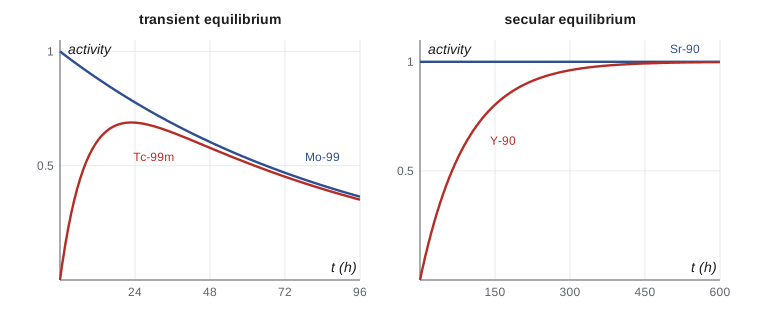
For a parent and one daughter this reduces to \(N_2 = N_1(0)\lambda_1(e^{-\lambda_1t} - e^{-\lambda_2t})/(\lambda_2 - \lambda_1)\). Three regimes follow. If the parent lives much longer than the daughter, \(\lambda_1 \ll \lambda_2\), the daughter activity grows until it equals the parent's, \(\lambda_2N_2 = \lambda_1N_1\): secular equilibrium. Strontium-90 (28.8 years) and its daughter yttrium-90 (64 hours) reach it in a few weeks, as the program shows. If the parent lives somewhat longer, the daughter activity rises above the parent's and then decays in step with it at a fixed ratio \(\lambda_2/(\lambda_2 - \lambda_1)\): transient equilibrium. If the parent lives shorter than the daughter, no equilibrium forms and the daughter eventually decays with its own half-life.
The technetium generator
Transient equilibrium makes possible the most widely used medical isotope. Technetium-99m, a nuclear isomer that emits a 140 keV gamma ray with a 6.0 hour half-life, is used in tens of millions of imaging procedures a year: bone scans, heart perfusion studies, and many more. Its six-hour half-life is long enough to prepare and inject, and short enough to give a low dose, but too short to ship. Instead, hospitals receive generators containing its parent, molybdenum-99 (66 hours), adsorbed on alumina. Technetium, chemically different, is washed out with saline each morning. The program shows the regrowth: the Tc-99m activity peaks about 23 hours after each elution, and approaches a fixed ratio to the Mo-99 activity. Most Mo-99 is made by fission of uranium targets in research reactors. Canada's NRU reactor at Chalk River supplied a large share of the world's Mo-99 for decades, until it stopped production in 2016.
# Radioactive decay: Q-values from masses, and parent-daughter chains (Bateman equations)
import math
u = 931.494
M = {"U-238": 238.050788, "Th-234": 234.043601, "He-4": 4.002603, "Ra-226": 226.025410, "Rn-222": 222.017578,
     "Po-210": 209.982874, "Pb-206": 205.974465, "Co-60": 59.933817, "Ni-60": 59.930786}
print("Alpha-decay Q-values from atomic masses, and the alpha kinetic energy T = Q (A - 4)/A")
for parent, daughter, A in (("U-238", "Th-234", 238), ("Ra-226", "Rn-222", 226), ("Po-210", "Pb-206", 210)):
    Q = (M[parent] - M[daughter] - M["He-4"]) * u
    print(f"  {parent} -> {daughter} + alpha: Q = {Q:.3f} MeV, T_alpha = {Q * (A - 4) / A:.3f} MeV")
Qb = (M["Co-60"] - M["Ni-60"]) * u
print(f"  Co-60 -> Ni-60 beta-minus: Q = {Qb:.3f} MeV (shared by the electron, the antineutrino and the gamma cascade)")
print()
def chain(lams, N0, t):
    """Bateman solution for a chain with initial amounts N0[0] of the parent only."""
    out = []
    for n in range(len(lams)):
        s = 0.0
        for i in range(n + 1):
            prod = 1.0
            for j in range(n + 1):
                if j != i: prod *= lams[j] - lams[i]
            s += math.exp(-lams[i] * t) / prod
        coef = N0
        for j in range(n): coef *= lams[j]
        out.append(coef * s)
    return out
ln2 = math.log(2)
# Mo-99 (65.94 h) -> Tc-99m (6.007 h): transient equilibrium, the hospital technetium generator
lam = [ln2 / 65.94, ln2 / 6.007]
print("Mo-99 -> Tc-99m generator (activities relative to the initial Mo-99 activity; 87.6 of each 100 decays feed Tc-99m)")
for t in (0, 6, 12, 23, 48, 72):
    N = chain(lam, 1.0, t)
    A_mo, A_tc = lam[0] * N[0], 0.876 * lam[1] * N[1]
    print(f"  t = {t:3d} h   Mo-99 {A_mo / lam[0]:.3f}   Tc-99m {A_tc / lam[0]:.3f}   ratio Tc/Mo {A_tc / A_mo:.3f}")
tmax = math.log(lam[1] / lam[0]) / (lam[1] - lam[0])
print(f"  Tc-99m activity peaks {tmax:.1f} h after the generator is eluted")
print()
# Sr-90 (28.8 y) -> Y-90 (64.0 h): secular equilibrium
lam = [ln2 / (28.8 * 365.25 * 24), ln2 / 64.0]
for t in (24, 100, 300, 600):
    N = chain(lam, 1.0, t)
print(f" Sr-90/Y-90 after {t:3d} h: A(Y-90)/A(Sr-90) = {lam[1] * N[1] / (lam[0] * N[0]):.4f}")Alpha-decay Q-values from atomic masses, and the alpha kinetic energy T = Q (A - 4)/A U-238 -> Th-234 + alpha: Q = 4.270 MeV, T_alpha = 4.198 MeV Ra-226 -> Rn-222 + alpha: Q = 4.871 MeV, T_alpha = 4.785 MeV Po-210 -> Pb-206 + alpha: Q = 5.408 MeV, T_alpha = 5.305 MeV Co-60 -> Ni-60 beta-minus: Q = 2.823 MeV (shared by the electron, the antineutrino and the gamma cascade) Mo-99 -> Tc-99m generator (activities relative to the initial Mo-99 activity; 87.6 of each 100 decays feed Tc-99m) t = 0 h Mo-99 1.000 Tc-99m 0.000 ratio Tc/Mo 0.000 t = 6 h Mo-99 0.939 Tc-99m 0.423 ratio Tc/Mo 0.450 t = 12 h Mo-99 0.881 Tc-99m 0.608 ratio Tc/Mo 0.690 t = 23 h Mo-99 0.785 Tc-99m 0.689 ratio Tc/Mo 0.877 t = 48 h Mo-99 0.604 Tc-99m 0.578 ratio Tc/Mo 0.958 t = 72 h Mo-99 0.469 Tc-99m 0.452 ratio Tc/Mo 0.963 Tc-99m activity peaks 22.8 h after the generator is eluted Sr-90/Y-90 after 24 h: A(Y-90)/A(Sr-90) = 0.2289 Sr-90/Y-90 after 100 h: A(Y-90)/A(Sr-90) = 0.6615 Sr-90/Y-90 after 300 h: A(Y-90)/A(Sr-90) = 0.9614 Sr-90/Y-90 after 600 h: A(Y-90)/A(Sr-90) = 0.9987
Natural decay series
Three long decay chains occur in nature, headed by uranium-238 (4.47 billion years), uranium-235 (704 million years) and thorium-232 (14.0 billion years). Each passes through a dozen or more alpha and beta decays and ends at a stable lead isotope: \({}^{206}\mathrm{Pb}\), \({}^{207}\mathrm{Pb}\) and \({}^{208}\mathrm{Pb}\). Because alpha decay changes \(A\) by 4 and beta decay does not change it, all members of a chain have the same \(A\) modulo 4. In old rocks the chains are in secular equilibrium, which is why radium, with a half-life of only 1,600 years, is found in uranium ores, and why radon-222, a gas with a half-life of 3.8 days, seeps from the ground. Radon is the second leading cause of lung cancer in Canada, and Health Canada recommends that homes be tested, with action above 200 Bq/m³. Uranium-lead ratios in zircon crystals give the ages of the oldest minerals on Earth, about 4.4 billion years, from Western Australia; the oldest rocks, at about 4.0 billion years, are the Acasta gneisses in the Northwest Territories.
Alpha decay
Alpha decay \({}^A_Z\mathrm X \to {}^{A-4}_{Z-2}\mathrm Y + {}^4\mathrm{He}\) is possible when its Q-value is positive:
using atomic masses (the electrons balance). Because the alpha particle is so tightly bound, \(Q_\alpha\) is positive for almost all nuclei with \(A\) above about 150, where the binding energy per nucleon is falling. Momentum conservation shares the energy between the alpha particle and the recoiling daughter in inverse proportion to their masses, so the alpha particle carries \(T_\alpha = Q(A - 4)/A\), about 98 parts in 100 of the energy. Alpha particles from a given transition are therefore monoenergetic: the spectrum consists of sharp lines, each corresponding to a final state of the daughter.
The mystery of alpha decay is its range of half-lives. Uranium-238, with \(Q = 4.27\) MeV, lives 4.5 billion years; polonium-212, with \(Q = 8.95\) MeV, lives 0.3 microseconds. A factor of two in energy gives a factor of \(10^{23}\) in lifetime. This is the Geiger–Nuttall law, found empirically in 1911: \(\log t_{1/2}\) is linear in \(Q^{-1/2}\). George Gamow, and independently Ronald Gurney and Edward Condon, explained it in 1928 as quantum tunnelling through the Coulomb barrier, one of the first triumphs of quantum mechanics. PHYS-373 lesson 9 derived the result with the WKB approximation: the transmission probability is \(e^{-2G}\) with Gamow factor \(G \approx \pi Z_Y\alpha\sqrt{2mc^2/Q}\,\) at leading order, so a small change in \(Q\) changes the barrier penetration enormously. The same physics now enters the formation of the alpha particle inside the nucleus, through a preformation factor that varies much less.
Gamma decay and internal conversion
After alpha or beta decay the daughter is often left excited. It de-excites by emitting gamma rays, photons with energies from tens of keV to several MeV, carrying away angular momentum \(L\) in units of \(\hbar\). Transitions are classified as electric (\(EL\)) or magnetic (\(ML\)) multipoles. The selection rules are \(|J_i - J_f| \le L \le J_i + J_f\), with \(L \ge 1\) because the photon has no \(L = 0\) state; electric multipoles change parity if \(L\) is odd and magnetic ones if \(L\) is even. Rates fall steeply with \(L\): roughly a factor of \((kR)^2 \sim 10^{-4}\) to \(10^{-5}\) for each extra unit, where \(k\) is the photon wave number and \(R\) the nuclear radius. So most nuclear gamma transitions are E1, M1 or E2, with lifetimes from femtoseconds to nanoseconds.
When a transition must carry a large angular momentum change at low energy, the lifetime can be long: such a state is a nuclear isomer. Technetium-99m is one: it decays to the ground state of Tc-99 mostly by a 140 keV transition that is retarded by spin selection rules, giving it a six-hour half-life. An excited nucleus can also transfer its energy directly to an atomic electron, which is ejected with the transition energy minus its binding energy: internal conversion. It competes with gamma emission and dominates for low energies and high multipoles. Transitions from a \(0^+\) state to a \(0^+\) ground state cannot emit a single photon at all and proceed only by conversion or by creating an electron-positron pair.
Gamma rays in practice
Gamma-ray lines are fingerprints. A germanium detector, which we will meet in lesson 9, measures them with a resolution of about 2 keV at 1 MeV, enough to identify individual isotopes in an environmental sample, a nuclear waste drum or a medical source. Cobalt-60, made by neutron capture on cobalt-59 in CANDU reactors, decays by beta emission (Q = 2.82 MeV, as the program finds) to an excited state of nickel-60 that emits two gamma rays, 1.173 and 1.332 MeV. These are used to sterilize about 40 parts in 100 of the world's single-use medical devices and to treat cancer. Canada supplies a large fraction of the world's cobalt-60, much of it from Bruce Power and the Pickering station in Ontario.
Worked problem
A Mo-99 generator on Monday morning
A generator holds 20 GBq of Mo-99 when it is eluted at 8 a.m. What Tc-99m activity is available at the next morning's elution, 24 hours later?
Show solution
- Decay constants: \(\lambda_1 = \ln 2/65.94 = 0.01051\ \text{h}^{-1}\), \(\lambda_2 = \ln 2/6.007 = 0.1154\ \text{h}^{-1}\).
- Fraction of Mo-99 decays feeding Tc-99m: 0.876.
- \(\mathcal A_2 = 0.876\,\mathcal A_1(0)\,\frac{\lambda_2}{\lambda_2 - \lambda_1}\big(e^{-\lambda_1t} - e^{-\lambda_2t}\big)\), with \(e^{-0.252} = 0.777\) and \(e^{-2.769} = 0.063\).
- \(\mathcal A_2 = 0.876 \times 20 \times 1.101 \times 0.714 = 13.8\) GBq.
Answer: About 14 GBq of Tc-99m, close to the maximum, which the program shows occurs near 23 hours.
Common mistakes
MistakeThinking a nucleus is more likely to decay because it is old.
InsteadThe decay probability per unit time is constant; nuclei do not wear out.
MistakeForgetting the recoil when computing alpha energies.
Instead\(T_\alpha = Q(A - 4)/A\); the daughter takes about 2 parts in 100.
MistakeTreating secular equilibrium as equal numbers of parent and daughter nuclei.
InsteadIt means equal activities, \(\lambda_1N_1 = \lambda_2N_2\); the long-lived parent is far more numerous.
MistakeAssigning \(L = 0\) to a gamma transition between two \(0^+\) states.
InsteadNo single-photon \(0 \to 0\) transition exists; it proceeds by internal conversion or pair creation.
MistakeUsing nuclear masses for the parent and daughter but an atomic mass for helium-4.
InsteadUse atomic masses for all three; the electrons then balance.
Summary and key terms
- \(N = N_0e^{-\lambda t}\), \(t_{1/2} = \ln 2/\lambda\), \(\tau = 1/\lambda\), activity \(\lambda N\) in becquerels.
- Bateman equations describe chains; secular equilibrium (Sr-90/Y-90) and transient equilibrium (Mo-99/Tc-99m) follow from them.
- Alpha decay is monoenergetic with \(T_\alpha = Q(A - 4)/A\); tunnelling explains the Geiger–Nuttall law.
- Gamma transitions are classified by multipole; rates fall steeply with \(L\), producing isomers such as Tc-99m.
- Internal conversion competes with gamma emission; natural chains from U-238, U-235 and Th-232 end in lead.
- Half-life
- Time for half of a sample to decay, \(\ln 2/\lambda\).
- Becquerel
- One decay per second.
- Secular equilibrium
- Daughter activity equal to that of a much longer-lived parent.
- Nuclear isomer
- A long-lived excited nuclear state.
- Internal conversion
- De-excitation by ejecting an atomic electron instead of emitting a photon.
Practice problems
Work each problem on paper first, then reveal the answer to check.
What fraction of a sample remains after five half-lives?
Show answer
\(2^{-5} = 1/32\), about 3 parts in 100.
Find the activity of 1 g of radium-226 (\(t_{1/2} = 1600\) y).
Show answer
\(N = 6.022 \times 10^{23}/226 = 2.66 \times 10^{21}\); \(\lambda = 1.37 \times 10^{-11}\ \text{s}^{-1}\); \(\mathcal A = 3.66 \times 10^{10}\) Bq, about 1 Ci.
Using the program, what is the Q-value for the alpha decay of Ra-226, and the alpha energy?
Show answer
\(Q = 4.871\) MeV and \(T_\alpha = 4.785\) MeV.
A \(2^+\) state decays to a \(0^+\) ground state. Which multipole dominates?
Show answer
E2: \(L = 2\) is required and parity does not change.
In secular equilibrium, how many Y-90 atoms accompany \(10^{20}\) atoms of Sr-90?
Show answer
\(N_2 = N_1\lambda_1/\lambda_2 = 10^{20} \times 64/(28.8 \times 8766) = 2.5 \times 10^{16}\).
Why do all members of the U-238 series have mass numbers of the form \(4n + 2\)?
Show answer
\(238 = 4 \times 59 + 2\), and alpha decay changes \(A\) by 4 while beta and gamma decay do not change it.
Lesson quiz · 5 questions
Score 60% or more to complete this lesson.
Create a free account to save your progress, take quizzes and earn a certificate.