
PHYS-420 · Lesson 12 of 12 · 24 min
Capstone: the Standard Model, the Higgs boson and beyond
▶ Video coming soon A video version of this lesson is on the way.
Everything in this course fits, with remarkable economy, into a single theory: the Standard Model of particle physics. It describes all known matter with twelve fermions, all known forces except gravity with twelve gauge bosons, and one more particle, the Higgs boson, that gives the others their masses. It has passed every experimental test for half a century, often to many decimal places. Yet it is certainly incomplete: it says nothing about gravity, dark matter or dark energy, and it cannot explain why neutrinos have mass or why the universe contains matter but almost no antimatter. This capstone assembles the Standard Model from the pieces of the earlier lessons, tells the story of the Higgs boson's discovery, and surveys the open questions that drive the field today.
The particles
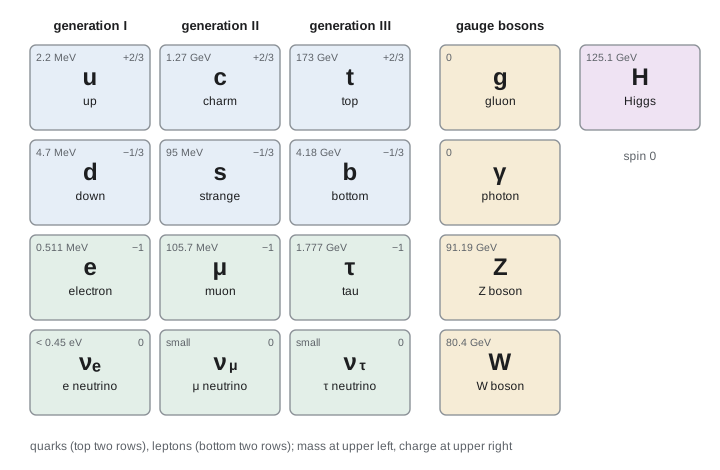
The matter particles are spin-\(\tfrac12\) fermions in three generations. Each generation has an up-type quark (charge \(+\tfrac23\)), a down-type quark (\(-\tfrac13\)), a charged lepton (\(-1\)) and a neutrino (0). The first generation, \(u\), \(d\), \(e\) and \(\nu_e\), makes up ordinary matter. The second (\(c\), \(s\), \(\mu\), \(\nu_\mu\)) and third (\(t\), \(b\), \(\tau\), \(\nu_\tau\)) are heavier copies that decay into the first. Measurements of the \(Z\) boson's width at CERN's LEP collider in 1989 showed that there are exactly three generations with light neutrinos. Each fermion has an antiparticle, and each quark comes in three colours.
The forces are carried by spin-1 gauge bosons: the photon for electromagnetism, the \(W^+\), \(W^-\) and \(Z^0\) for the weak interaction, and eight gluons for the strong interaction. Their existence follows from requiring that the theory be unchanged under local symmetry transformations, the gauge symmetry SU(3) × SU(2) × U(1). SU(3) is the colour symmetry of QCD from lesson 11. SU(2) × U(1) is the electroweak symmetry proposed by Sheldon Glashow in 1961 and completed by Steven Weinberg and Abdus Salam in 1967 and 1968, which unifies the electromagnetic and weak interactions (Nobel Prize 1979). The \(W\) and \(Z\) were discovered at CERN in 1983 by the UA1 and UA2 experiments, at masses of 80.4 and 91.2 GeV, as the theory predicted (Nobel Prize 1984 to Carlo Rubbia and Simon van der Meer).
The Higgs mechanism
Gauge symmetry seemed to forbid mass. A mass term for the \(W\) and \(Z\) breaks the symmetry that makes the theory consistent, and a mass term for a fermion would mix left-handed and right-handed states that, as lesson 5 showed, behave differently under the weak interaction. The resolution, proposed in 1964 by François Englert and Robert Brout, by Peter Higgs, and by Gerald Guralnik, Carl Hagen and Tom Kibble, is spontaneous symmetry breaking. A field, the Higgs field, fills all of space with a nonzero value \(v = 246\) GeV in the vacuum. The laws keep the full symmetry, but the vacuum does not, just as the equations for a ferromagnet are rotationally symmetric while the magnetized iron below its Curie temperature, from PHYS-361, picks a direction.
Particles moving through this background acquire mass. The \(W\) and \(Z\) absorb three of the Higgs field's four components and become massive, while the photon, associated with the unbroken combination, stays massless. Fermions gain masses \(m_f = y_fv/\sqrt2\) through their couplings \(y_f\) to the field, called Yukawa couplings. The top quark's coupling is close to 1; the electron's is about \(3 \times 10^{-6}\). Why the couplings have these values is not explained by the theory, which takes them as inputs. The fourth component of the field remains as a physical particle, the Higgs boson, a spin-0, electrically neutral particle whose couplings to every other particle are proportional to that particle's mass.
Finding the Higgs
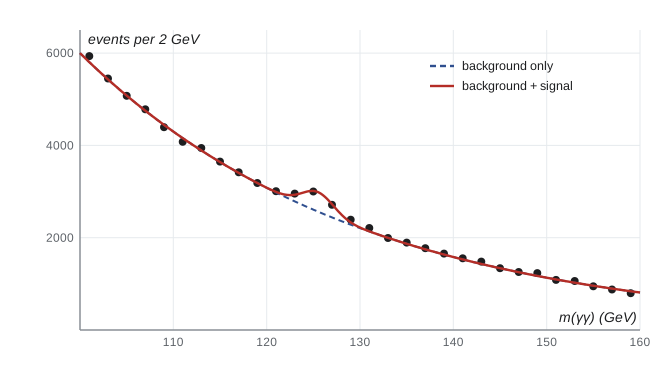
The theory did not predict the Higgs boson's mass, but it did predict how it would be produced and how it would decay at any given mass. At the LHC, Higgs bosons are made mainly by gluon fusion through a loop of top quarks, about one in every \(10^{9}\) or so proton collisions. They decay in about \(10^{-22}\) s, so only their decay products are seen. The clearest signatures are two photons, \(H \to \gamma\gamma\), and four leptons through two \(Z\) bosons, \(H \to ZZ^* \to 4\ell\), because both can be measured precisely against manageable backgrounds. Each event gives an invariant mass, \(M^2c^4 = (\sum E)^2 - (\sum\mathbf p)^2c^2\), the same quantity used for thresholds in lesson 6. Background events spread smoothly over all masses; a new particle shows up as a bump.
# The Standard Model and beyond: invariant mass, a synthetic Higgs diphoton peak and neutrino oscillations
import math, random
def minv(ps):
    E = sum(p[0] for p in ps); px = sum(p[1] for p in ps); py = sum(p[2] for p in ps); pz = sum(p[3] for p in ps)
    return math.sqrt(max(E * E - px * px - py * py - pz * pz, 0.0))
def photon(E, th, ph): return (E, E * math.sin(th) * math.cos(ph), E * math.sin(th) * math.sin(ph), E * math.cos(th))
g1, g2 = photon(70.0, 1.2, 0.3), photon(80.0, 2.1, 3.3)
print(f"two photons of 70 and 80 GeV: invariant mass {minv([g1, g2]):.1f} GeV")
print()
rnd = random.Random(420)
mH, res = 125.1, 1.7                                    # GeV; detector resolution dominates the natural width
def bkg(m): return 3000 * math.exp(-(m - 100) / 30)     # falling diphoton background (events per GeV)
bins = [100 + 2 * k for k in range(30)]                 # 2 GeV bins from 100 to 160
counts = []
for m in bins:
    mu = 2 * bkg(m + 1) + 2 * 900 * math.exp(-0.5 * ((m + 1 - mH) / res) ** 2) / (res * math.sqrt(2 * math.pi))
    counts.append(max(0, round(rnd.gauss(mu, math.sqrt(mu)))))
best = None
for i in range(201):
    m0 = 120 + 0.05 * i
    model = lambda m, s: 2 * bkg(m + 1) + s * 2 * math.exp(-0.5 * ((m + 1 - m0) / res) ** 2) / (res * math.sqrt(2 * math.pi))
    for s in range(500, 1301, 10):
        c2 = sum((c - model(m, s)) ** 2 / max(model(m, s), 1) for m, c in zip(bins, counts))
        if best is None or c2 < best[0]: best = (c2, m0, s)
c2, m0, s = best
c2b = sum((c - 2 * bkg(m + 1)) ** 2 / (2 * bkg(m + 1)) for m, c in zip(bins, counts))
print(f"fit: peak at {m0:.2f} GeV with {s} signal events; chi^2 {c2:.1f} for 30 bins (background only: {c2b:.1f})")
print(f"rough significance sqrt(delta chi^2) = {math.sqrt(c2b - c2):.1f} standard deviations")
print()
# oscillation with two neutrino types: P = sin^2(2 theta) sin^2(1.267 dm^2 [eV^2] L [km] / E [GeV])
dm2, s22 = 2.5e-3, 0.95
for name, L, E in (("T2K (Tokai to Kamioka)", 295, 0.6), ("NOvA (Fermilab to Ash River)", 810, 2.0),
                   ("DUNE (Fermilab to Sanford Lab)", 1300, 2.5)):
    P = s22 * math.sin(1.267 * dm2 * L / E) ** 2
    print(f"  {name:31s} L = {L:6.0f} km, E = {E:5.3f} GeV: muon-type disappearance probability {P:.2f}")
P = 0.085 * math.sin(1.267 * dm2 * 1.6 / 0.004) ** 2     # reactor antineutrinos, the small mixing angle theta_13
print(f"  reactor antineutrinos at 1.6 km, 4 MeV: electron-type disappearance probability {P:.3f}")
Lmax = math.pi / 2 / (1.267 * dm2) * 2.5
print(f"first oscillation maximum for E = 2.5 GeV at L = {Lmax:.0f} km")two photons of 70 and 80 GeV: invariant mass 148.9 GeV fit: peak at 125.50 GeV with 900 signal events; chi^2 20.6 for 30 bins (background only: 124.5) rough significance sqrt(delta chi^2) = 10.2 standard deviations T2K (Tokai to Kamioka) L = 295 km, E = 0.600 GeV: muon-type disappearance probability 0.95 NOvA (Fermilab to Ash River) L = 810 km, E = 2.000 GeV: muon-type disappearance probability 0.87 DUNE (Fermilab to Sanford Lab) L = 1300 km, E = 2.500 GeV: muon-type disappearance probability 0.94 reactor antineutrinos at 1.6 km, 4 MeV: electron-type disappearance probability 0.077 first oscillation maximum for E = 2.5 GeV at L = 1240 km
The program builds a synthetic diphoton spectrum: a falling background, a peak of 900 events with the experimental mass resolution of about 1.7 GeV, and Poisson-like fluctuations. Fitting a peak plus background, it recovers the mass to within half a GeV and finds that adding the peak lowers the chi-squared by about 100, about ten standard deviations in this idealized case. On 4 July 2012, the ATLAS and CMS collaborations announced, each with about five standard deviations, the observation of a new boson near 125 GeV, in just these channels. Englert and Higgs received the 2013 Nobel Prize. Its mass is now measured as \(125.1\) GeV to about 0.1 GeV, and its couplings to the \(W\), \(Z\), top and bottom quarks, tau lepton and muon agree with the Standard Model's prediction, proportional to mass, within present precision of a few to 20 parts in 100.
Neutrino oscillations
In the original Standard Model, neutrinos are massless. Lesson 8 showed that they are not: electron neutrinos from the Sun turn into other types. If the neutrinos with definite masses, \(\nu_1\) and \(\nu_2\), are not the same as those with definite flavour, \(\nu_e\) and \(\nu_\mu\), then a neutrino created as \(\nu_\mu\) is a superposition \(\nu_\mu = -\sin\theta\,\nu_1 + \cos\theta\,\nu_2\). The two mass components travel with slightly different phases, \(e^{-iE_jt/\hbar}\), with \(E_j \approx pc + m_j^2c^4/2pc\). After a distance \(L\), the probability of finding the other flavour is
a result exactly like the two-level oscillations of PHYS-373. Oscillations need both mixing (\(\theta \ne 0\)) and a mass difference (\(\Delta m^2 \ne 0\)), so observing them proves that at least one neutrino has mass. Super-Kamiokande saw atmospheric muon neutrinos disappearing over the length of the Earth in 1998, and SNO saw the solar electron-neutrino conversion in 2001 and 2002; Takaaki Kajita and Arthur McDonald shared the 2015 Nobel Prize. With three flavours, there are three mixing angles, two independent mass differences, about \(7.4 \times 10^{-5}\) and \(2.5 \times 10^{-3}\ \text{eV}^2\), and a phase that can make neutrinos and antineutrinos oscillate differently, a form of CP violation.
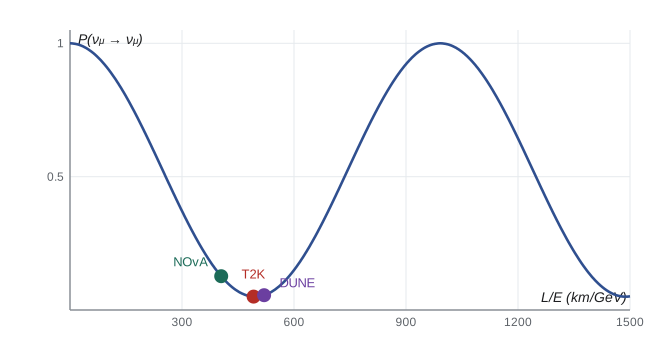
Long-baseline experiments now measure these parameters with accelerator beams. T2K sends neutrinos 295 km from Tokai to Super-Kamiokande and NOvA sends them 810 km from Fermilab to Ash River, Minnesota; the program shows that both sit near the first oscillation maximum for their beam energies. The next generation is larger. The Deep Underground Neutrino Experiment will send neutrinos 1,300 km from Fermilab to detectors 1.5 km underground at the Sanford Underground Research Facility in South Dakota; steel for its far detector began going underground in May 2026, with the facility planned for completion in 2031. Hyper-Kamiokande in Japan, with eight times Super-Kamiokande's volume, has finished excavating its cavern and is scheduled to begin operation in 2028. Their main goals are to determine the ordering of the neutrino masses and to measure CP violation in neutrinos. The absolute masses are still unknown; KATRIN's direct limit is 0.45 eV, and cosmology suggests the sum of all three is below about 0.1 eV.
Precision tests
The Standard Model makes very precise predictions, and precise measurements test it. The electron's magnetic moment anomaly, \(a_e = (g - 2)/2\), agrees between theory and experiment to about one part in \(10^{12}\) of \(g\), the most precise comparison in all of physics. The muon's anomaly is more sensitive to heavy virtual particles, because it scales as \((m_\mu/m_e)^2\). The Fermilab Muon g−2 experiment announced its final result on 3 June 2025, \(a_\mu = 0.001\,165\,920\,705\) with an uncertainty of 127 parts per billion. A long-standing discrepancy with theory, once seen as a hint of new physics, has largely disappeared, because a 2025 theoretical prediction, using lattice QCD for the hardest hadronic contribution, moved close to the measured value; physicists are still studying why the older, data-based method gave a different answer.
Beyond the Standard Model
The open questions are as important as the successes. Dark matter, five times more abundant than ordinary matter by the astronomical evidence of PHYS-430, is not made of any Standard Model particle. Experiments deep underground, including SuperCDMS and PICO at SNOLAB, search for the recoil of a nucleus struck by a passing dark-matter particle; none has yet been seen. The universe contains matter but almost no antimatter, which requires more CP violation than the Standard Model provides. The Higgs boson's mass is unstable against quantum corrections from very heavy particles, the hierarchy problem, which suggests new physics not far above the electroweak scale, though the LHC has found none so far. Gravity has no quantum description consistent with the Standard Model. And dark energy, which is accelerating the expansion of the universe, has no explanation at all.
The strengths of the three gauge couplings, which change with energy as \(\alpha_s\) does in lesson 11, approach one another near \(10^{15}\) to \(10^{16}\) GeV, suggesting that the three forces may be parts of one grand unified interaction. Most grand unified theories predict that protons decay, with lifetimes of perhaps \(10^{34}\) to \(10^{36}\) years, which is why Super-Kamiokande, Hyper-Kamiokande and DUNE watch thousands of tonnes of matter for a single decaying proton. Whether neutrinos are their own antiparticles, Majorana particles, would be revealed by neutrinoless double beta decay, sought by experiments such as SNO+ in Sudbury and nEXO; it would violate lepton number and might explain the matter-antimatter asymmetry. Each of these questions is the target of experiments now running or being built, and the next discovery could come from any of them.
Worked problem
Where to put a neutrino detector
A beam of muon neutrinos has a typical energy of 2.5 GeV. At what distance is the first oscillation maximum for \(\Delta m^2 = 2.5 \times 10^{-3}\ \text{eV}^2\)?
Show solution
- The first maximum needs \(1.267\,\Delta m^2L/E = \pi/2\).
- So \(L = (\pi/2)E/(1.267\,\Delta m^2) = 1.571 \times 2.5/(1.267 \times 2.5 \times 10^{-3})\).
- \(L = 3.93/3.17 \times 10^{-3} = 1240\) km.
- The DUNE baseline of 1,300 km from Fermilab to South Dakota is chosen for this reason.
Answer: About 1,240 km, as the program also finds; DUNE's 1,300 km baseline matches its beam energy.
Common mistakes
MistakeSaying the Higgs boson gives all mass to matter.
InsteadIt gives masses to the W, Z and fundamental fermions; most of the mass of ordinary matter is QCD binding energy inside nucleons.
MistakeThinking a bump in an invariant-mass spectrum is a discovery whatever its size.
InsteadIts significance must be judged against background fluctuations; particle physics uses five standard deviations.
MistakeConcluding from oscillations that neutrino masses are measured.
InsteadOscillations measure mass-squared differences; absolute masses need beta-decay endpoints or cosmology.
MistakeTreating the Standard Model as a complete theory.
InsteadIt omits gravity, dark matter and dark energy and does not explain neutrino masses or the matter-antimatter asymmetry.
MistakeAssuming the muon g−2 discrepancy proved new physics.
InsteadThe 2025 lattice-based prediction largely removed it; the remaining question is a disagreement between theory methods.
Summary and key terms
- Twelve fermions in three generations, twelve gauge bosons of SU(3) × SU(2) × U(1), and the Higgs boson make up the Standard Model.
- Spontaneous symmetry breaking by the Higgs field (\(v = 246\) GeV) gives the W and Z their masses and fermions masses through Yukawa couplings.
- The Higgs boson was discovered on 4 July 2012 as a bump near 125 GeV in diphoton and four-lepton invariant masses.
- Neutrino oscillations, \(P = \sin^22\theta\sin^2(1.267\Delta m^2L/E)\), prove neutrino mass; DUNE and Hyper-Kamiokande will measure mass ordering and CP violation.
- Dark matter, matter-antimatter asymmetry, gravity, dark energy and proton decay remain open questions beyond the Standard Model.
- Generation
- One of three families of quarks and leptons with identical charges and different masses.
- Gauge boson
- Spin-1 carrier of a force required by a local symmetry.
- Higgs mechanism
- Spontaneous symmetry breaking that gives gauge bosons and fermions mass.
- Invariant mass
- \(\sqrt{(\sum E)^2 - (\sum\mathbf p c)^2}/c^2\), the same in every frame.
- Neutrino oscillation
- Periodic change of neutrino flavour caused by mixing and mass differences.
Practice problems
Work each problem on paper first, then reveal the answer to check.
Two photons of 62.5 GeV are emitted back to back. What is their invariant mass?
Show answer
125 GeV: \(M = 2E/c^2\) for back-to-back photons of equal energy.
Why does the Higgs boson decay preferentially to bottom quarks rather than to electrons?
Show answer
Its couplings are proportional to mass, and the bottom quark is about 8,000 times heavier than the electron.
What is the oscillation probability for T2K according to the program?
Show answer
About 0.95 for muon-neutrino disappearance.
How many fundamental fermions (counting colours but not antiparticles) are there?
Show answer
Six quarks × 3 colours = 18, plus 6 leptons = 24.
Why do reactor neutrino experiments at about 1.6 km see a smaller effect than T2K?
Show answer
They see the small mixing angle \(\theta_{13}\), with \(\sin^22\theta_{13} \approx 0.085\), as the program shows.
What evidence shows there are exactly three light neutrino types?
Show answer
The width of the Z boson measured at LEP.
Lesson quiz · 5 questions
Score 60% or more to complete this lesson.
Create a free account to save your progress, take quizzes and earn a certificate.