
PHYS-397 · Lesson 10 of 12 · 21 min
Classic experiments III: interferometry, speed of light and spectroscopy
Light is the physicist's most precise ruler. Because its wavelength is small and well defined, interference lets us measure distances to a small fraction of a micrometre, and because its speed is fixed, timing it turns time into distance. This lesson covers three families of optical measurement that shaped physics: the Michelson interferometer, the measurement of the speed of light from Rømer to the definition of the metre, and the grating spectrometer, which measures wavelengths and so reveals the structure of atoms. PHYS-230 developed the wave optics of interference and diffraction; here we treat the instruments as experiments, with their sources of error and their uncertainties.
The Michelson interferometer
Albert Michelson built his first interferometer in 1881 to detect the motion of the Earth through the ether. Light from a source meets a beam splitter, a partly silvered plate that reflects half the light toward one mirror and transmits half toward another. The two beams return to the beam splitter and recombine on their way to a detector or screen. If the two paths differ in length by \(\Delta\), the beams arrive with a phase difference \(2\pi\Delta/\lambda\), and the detector sees bright light when \(\Delta\) is a whole number of wavelengths and darkness when it is a half-integer number. Moving one mirror a distance \(d\) changes the path difference by \(2d\), because the light travels to the mirror and back, so the number of bright fringes that pass the detector is
Counting fringes as a mirror is moved by a known distance measures the wavelength; moving the mirror while counting fringes of a known wavelength measures the distance. The sensitivity is extraordinary: one fringe corresponds to a mirror movement of half a wavelength, about 0.3 μm for red light, and electronic fringe counting with interpolation reaches a thousandth of a fringe. In 1892 and 1893 Michelson measured the length of the standard metre bar in Paris in terms of the wavelength of the red line of cadmium. His 1887 experiment with Edward Morley, using an interferometer floating on mercury so it could be rotated smoothly, found no shift as large as a hundredth of a fringe where the ether theory predicted four tenths. Michelson became the first American to receive a Nobel Prize in science, in 1907.
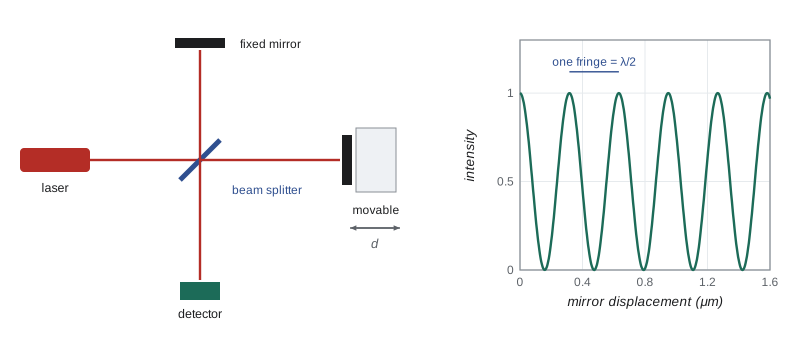
Today interferometers are everywhere. Laser interferometers measure the positions of stages in the machines that make computer chips. Fourier transform spectrometers scan one mirror and compute the spectrum from the resulting interference pattern. And the LIGO detectors in Washington and Louisiana, with arms 4 km long and light bouncing back and forth hundreds of times in each, detected gravitational waves in 2015 by measuring changes in arm length of about \(10^{-18}\) m. The basic geometry is Michelson's.
The uncertainty of a fringe count
Two uncertainties limit \(\lambda = 2d/N\): the uncertainty in the mirror travel and the uncertainty of one fringe in the count. Their fractional contributions add in quadrature. A student apparatus typically drives the mirror with a micrometer through a lever that reduces its motion, so that a micrometer turn of 1 mm moves the mirror by 0.1 mm, with an uncertainty of order half a micrometre. Counting 316 fringes by eye over 0.1 mm gives a fringe-count term of 3 parts in 1000 and a travel term of 5 parts in 1000. The way to improve the result is to count more fringes over a longer travel: the count term falls in proportion, and the travel term falls too if the travel uncertainty does not grow. Systematic errors also enter. If the lever ratio is wrong, every result is wrong by the same factor, so the apparatus should be calibrated with a known wavelength, for example a helium-neon laser at 632.8 nm, before measuring an unknown one.
The speed of light
The first evidence that light takes time to travel came in 1676, when Ole Rømer, working at the Paris Observatory, noticed that eclipses of Jupiter's moon Io came earlier when Earth was approaching Jupiter and later when it was receding. He explained the difference as the time light needed to cross the Earth's orbit, about 22 minutes on his estimate; the modern value is about 16.7 minutes. Christiaan Huygens combined Rømer's estimate with the size of the orbit to get a speed of about \(2.2 \times 10^8\) m/s, the right order of magnitude.
The first laboratory measurement was made by Hippolyte Fizeau in 1849. Light passed through a gap between the teeth of a rotating toothed wheel, travelled 8.6 km to a mirror on a hill near Paris, and returned. At low speeds the returning light passed through the same gap; as the wheel spun faster, the returning light met a tooth and was blocked. The first eclipse occurs when the wheel turns by half a tooth spacing during the round trip: with \(N\) teeth turning at \(f\) revolutions per second, half a tooth spacing takes \(1/(2Nf)\), and the round trip takes \(2L/c\), so
With 720 teeth, Fizeau saw the first eclipse at about 12.6 turns per second, giving about \(3.13 \times 10^8\) m/s, within 5 parts in 100 of the modern value. In 1862 Léon Foucault replaced the wheel with a rotating mirror, which deflected the returning beam by a small angle proportional to the travel time; the method fitted in a laboratory and gave \(2.98 \times 10^8\) m/s. Michelson refined the rotating-mirror method for half a century, using a 35 km path between Mount Wilson and Mount San Antonio in California in 1926, and obtained \(299{,}796 \pm 4\) km/s.
Later methods used microwave cavities and, from the 1970s, lasers whose frequency and wavelength were both measured: \(c = f\lambda\). By 1983 the speed of light was known so well that the metre was redefined as the distance light travels in \(1/299{,}792{,}458\) of a second. Since then \(c\) has had an exact value by definition, and measuring it has become a way of realizing the metre. This is a recurring pattern: once a constant is known better than the standard it would be compared with, it becomes the standard.
The grating spectrometer
A diffraction grating, a plate ruled with many parallel lines a distance \(d\) apart, sends light of wavelength \(\lambda\) into bright orders at angles given by
In a spectrometer, light from a source passes through a narrow slit and a collimating lens, strikes the grating, and is observed through a telescope mounted on a rotating arm with an angle scale read to an arcminute or better. Measuring the angle of each line in first order gives its wavelength. Joseph von Fraunhofer made the first gratings from fine wires in the early 1820s and used them to measure the wavelengths of the dark lines in the solar spectrum that bear his name. The resolving power of a grating, its ability to separate two close wavelengths, is \(\lambda/\Delta\lambda = mN\), where \(N\) is the number of illuminated lines; a 2 cm wide grating with 600 lines per millimetre in first order has a resolving power of 12,000, enough to separate the two yellow sodium lines, 0.6 nm apart.
The classic application is the hydrogen spectrum. Johann Balmer noticed in 1885 that the four visible hydrogen lines fit a simple formula, which Johannes Rydberg generalized in 1888 and Niels Bohr explained in 1913:
Measuring the Balmer wavelengths and fitting \(1/\lambda\) against \(1/4 - 1/n^2\) tests the formula and gives the Rydberg constant for hydrogen. The program does this for simulated angle readings with an uncertainty of 0.02 degrees, after first computing the Michelson wavelength and Fizeau's speed of light.
import math, random
random.seed(397)
# 1. Michelson interferometer: count fringes while one mirror moves a known distance.
d, dd = 100.0e-6, 0.5e-6        # mirror travel 100.0 +/- 0.5 um, in m
N = 316                          # fringes counted, +/- 1
lam = 2*d/N
dlam = lam*math.sqrt((dd/d)**2 + (1/N)**2)
print(f"lambda = 2d/N = {lam*1e9:.1f} +/- {dlam*1e9:.1f} nm (helium-neon laser: 632.8 nm)")
for N2 in (316, 3164):
    print(f"   counting {N2} fringes over {N2*632.8e-9/2*1e3:.3f} mm: fringe-count term {1/N2*1e6:.0f} parts per million")
# 2. Fizeau's toothed wheel (1849): 720 teeth, 8633 m to the mirror, first eclipse at 12.6 turns per second.
L, teeth, f = 8633.0, 720, 12.6
c = 4*L*teeth*f
print(f"Fizeau: c = 4 L N f = {c:.3e} m/s (modern 2.998e8)")
# 3. Grating spectrometer, 600 lines per mm: first-order angles of the hydrogen Balmer lines.
dg = 1e-3/600
R = 1.0967758e7                    # Rydberg constant for hydrogen, in 1/m
meas = []
for n in (3, 4, 5, 6):
    lam_t = 1/(R*(1/4 - 1/n**2))
    th = math.degrees(math.asin(lam_t/dg)) + random.gauss(0, 0.02)   # angle read to 0.02 degrees
    lam_m = dg*math.sin(math.radians(th))
    meas.append((n, lam_m))
    print(f"n = {n}: angle {th:7.3f} degrees -> wavelength {lam_m*1e9:6.1f} nm")
# Fit 1/lambda = R (1/4 - 1/n^2) through the origin.
xs = [1/4 - 1/n**2 for n, _ in meas]; ys = [1/l for _, l in meas]
Rfit = sum(x*y for x, y in zip(xs, ys))/sum(x*x for x in xs)
print(f"fitted Rydberg constant {Rfit:.5e} 1/m (accepted for hydrogen 1.09678e7)")lambda = 2d/N = 632.9 +/- 3.7 nm (helium-neon laser: 632.8 nm) counting 316 fringes over 0.100 mm: fringe-count term 3165 parts per million counting 3164 fringes over 1.001 mm: fringe-count term 316 parts per million Fizeau: c = 4 L N f = 3.133e+08 m/s (modern 2.998e8) n = 3: angle 23.211 degrees -> wavelength 656.9 nm n = 4: angle 16.977 degrees -> wavelength 486.7 nm n = 5: angle 15.100 degrees -> wavelength 434.2 nm n = 6: angle 14.250 degrees -> wavelength 410.3 nm fitted Rydberg constant 1.09651e+07 1/m (accepted for hydrogen 1.09678e7)
The fringe count gives \(632.9 \pm 3.7\) nm, consistent with a helium-neon laser, and the program shows how counting ten times as many fringes over 1 mm reduces the counting term from about 3200 to about 300 parts per million. Fizeau's numbers reproduce his result of \(3.13 \times 10^8\) m/s; its error of about 5 parts in 100 came mainly from judging the moment of eclipse by eye. The four Balmer lines come out at 656.9, 486.7, 434.2 and 410.3 nm, and the fitted Rydberg constant, \(1.0965 \times 10^7\) m\(^{-1}\), agrees with the accepted value for hydrogen to about 2.5 parts in 10,000. Each angle uncertainty of 0.02 degrees contributes a wavelength uncertainty of about 0.5 nm in first order, so the grating constant and the zero of the angle scale must be calibrated, typically with the known lines of a mercury or helium lamp, if the result is to be trusted at this level.
Calibration, again
All three instruments in this lesson need calibration. The interferometer's lever ratio, the spectrometer's grating spacing and angle zero, Fizeau's distance and wheel speed: each converts the raw reading into a physical quantity, and each is a source of systematic error that repetition will not reveal. The standard practice is to measure something known with the same apparatus in the same way, derive the calibration from it, and carry the calibration uncertainty into the result. Calibrate before and after the measurement of the unknown, so that a drift during the run is detected rather than silently built into the answer.
Worked problem
Calibrating a spectrometer
A grating nominally ruled at 600 lines per millimetre puts the 546.07 nm mercury line at 19.15 degrees in first order. An unknown line appears at 21.45 degrees. Find the actual grating spacing and the unknown wavelength.
Show solution
- Grating spacing from the calibration: \(d = \lambda/\sin\theta = 546.07/\sin 19.15° = 546.07/0.3280 = 1664.8\) nm, compared with 1666.7 nm nominal.
- Unknown wavelength: \(\lambda = d\sin 21.45° = 1664.8 \times 0.3657 = 608.8\) nm.
- Using the nominal spacing instead would give \(1666.7 \times 0.3657 = 609.5\) nm, an error of 0.7 nm, or about 1 part in 1000.
- With angles read to 0.02 degrees, the uncertainty in each wavelength is about \(d\cos\theta\,\delta\theta = 1665 \times 0.93 \times 3.5 \times 10^{-4} = 0.5\) nm.
Answer: The calibrated spacing is 1664.8 nm and the unknown line is at \(608.8 \pm 0.5\) nm. Calibrating removes a systematic error comparable to the reading uncertainty.
Common mistakes
MistakeForgetting the factor of two in an interferometer.
InsteadMoving a mirror by d changes the path by 2d, so N = 2d/λ.
MistakeAssuming a micrometer reading is the mirror movement.
InsteadMany interferometers use a reduction lever; calibrate it with a known wavelength.
MistakeUsing the nominal grating spacing without calibration.
InsteadMeasure a known line to find the actual spacing and the zero of the scale.
MistakeTreating Rømer's estimate as a modern measurement.
InsteadIt showed that light has a finite speed; its value was only roughly right.
MistakeMeasuring only one side of a spectrometer's zero order.
InsteadMeasure the angle on both sides and halve the difference to cancel a zero error.
Summary and key terms
- In a Michelson interferometer, moving a mirror by d passes \(N = 2d/\lambda\) fringes.
- The fractional uncertainty combines the travel and the count; count more fringes to improve it.
- Fizeau (1849): \(c = 4LNf\); Foucault (1862) used a rotating mirror; Michelson reached 4 km/s in 1926.
- Since 1983 c is exact and defines the metre.
- A grating gives \(d\sin\theta = m\lambda\) and resolving power \(mN\).
- Balmer lines fit \(1/\lambda = R_H(1/4 - 1/n^2)\); calibrate with known lines before measuring unknowns.
- interferometer
- An instrument that splits and recombines light so that path differences produce fringes.
- fringe
- One cycle of bright and dark in an interference pattern.
- beam splitter
- A partly reflecting surface that divides a beam in two.
- diffraction grating
- A plate with many equally spaced lines that disperses light by wavelength.
- resolving power
- The ratio of a wavelength to the smallest wavelength difference an instrument can separate.
- Rydberg constant
- The constant in the formula for the wavelengths of hydrogen spectral lines.
Practice problems
Work each problem on paper first, then reveal the answer to check.
A Michelson mirror moves 25.0 μm and 79 fringes pass. Find the wavelength.
Show answer
\(\lambda = 2 \times 25.0/79 = 0.633\) μm.
How far must the mirror move to pass 1000 fringes of 589 nm light?
Show answer
\(d = N\lambda/2 = 0.2945\) mm.
Fizeau's wheel had 720 teeth and the mirror was 8633 m away. At what rotation rate would the first eclipse occur for \(c = 2.998 \times 10^8\) m/s?
Show answer
\(f = c/(4LN) = 12.06\) turns per second.
Find the first-order angle of the 656.3 nm hydrogen line for a grating with 300 lines per millimetre.
Show answer
\(\sin\theta = 656.3/3333 = 0.197\), so \(\theta = 11.4\) degrees.
What resolving power is needed to separate the sodium lines at 589.0 and 589.6 nm?
Show answer
\(589/0.6 \approx 1000\).
Why is the speed of light no longer measured?
Show answer
Since 1983 its value is fixed by definition; experiments that once measured c now realize the metre.
Lesson quiz · 5 questions
Score 60% or more to complete this lesson.
Create a free account to save your progress, take quizzes and earn a certificate.