
PHYS-382 · Lesson 8 of 12 · 24 min
Absorption, dispersion and waves in conductors and plasmas
Lesson 7 treated transparent media as if their permittivity were a fixed real number. Real materials absorb some of the light that passes through them, and their response depends on frequency, which is why prisms split white light and why metals are shiny. This lesson extends the plane-wave analysis to conductors, where free charges make the wave number complex and confine fields to a thin skin, and to dispersive media, where a simple model of bound electrons explains the frequency dependence of the index of refraction. It ends with plasmas, such as the ionosphere, which reflect radio waves below a cutoff frequency and pass them above it, and distinguishes the phase and group velocities of a wave.
Waves in conductors
In a conductor with conductivity \(\sigma\), Ohm's law \(\mathbf{J}_f = \sigma\mathbf{E}\) adds a conduction current to the Ampère–Maxwell law: \(\nabla\times\mathbf{B} = \mu\sigma\mathbf{E} + \mu\varepsilon\,\partial\mathbf{E}/\partial t\). Any free charge placed inside dissipates quickly, since the continuity equation with Gauss's law gives \(\partial\rho_f/\partial t = -(\sigma/\varepsilon)\rho_f\), so \(\rho_f\) decays with time constant \(\varepsilon/\sigma\), about \(10^{-19}\) s for copper. Taking the curl of the curl equations as in lesson 6 now gives a wave equation with an extra first-derivative term,
which describes waves that lose energy as they travel. A plane wave \(\tilde{\mathbf{E}}_0e^{i(\tilde{k}z - \omega t)}\) solves it if the wave number is complex,
Then \(e^{i\tilde{k}z} = e^{-\kappa z}e^{ikz}\): the wave oscillates with wavelength \(2\pi/k\) and its amplitude decays over the distance \(d = 1/\kappa\), the skin depth. For a good conductor, where \(\sigma \gg \omega\varepsilon\) as lesson 1 found for metals, the second term dominates and
The fields inside a good conductor are also changed in character. From Faraday's law, \(\tilde{B}_0 = (\tilde{k}/\omega)\tilde{E}_0\), and since \(\tilde{k}\) has equal real and imaginary parts, its phase is 45°: the magnetic field lags the electric field by an eighth of a cycle. And because \(|\tilde{k}|/\omega \gg 1/c\), the magnetic field is far larger relative to \(\mathbf{E}\) than in vacuum; inside a metal, the wave is almost entirely magnetic.
The skin effect and reflection from metals
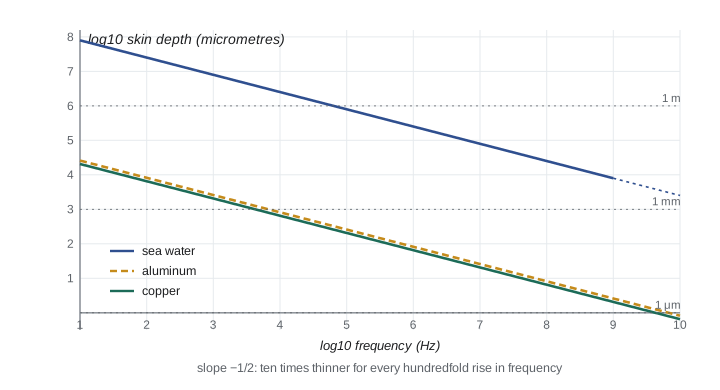
Because fields penetrate only a skin depth, alternating currents crowd toward the surface of a conductor. At 60 Hz the skin depth of copper is about 8 mm, so ordinary household wires are unaffected, but large busbars and high-voltage transmission cables are often made as hollow tubes or many-strand bundles because their centres would carry little current. At 1 MHz the skin depth is 65 \(\mu\)m, and at microwave frequencies it is about a micrometre, so the inside of a waveguide can be a thin silver plating on cheaper metal. The resistance of a conductor at high frequency is that of a layer one skin depth thick: the surface resistance \(R_s = 1/(\sigma d)\) per square, which grows as \(\sqrt{f}\) and sets the losses of cables, cavities and antennas.
Sea water, with \(\sigma \approx 4\) S/m, has a skin depth of about 2.5 m at 10 kHz and 25 cm at 1 MHz. That is why submarines communicate at very low frequencies, between about 3 and 30 kHz, and even then only near the surface, and why ordinary radio is useless underwater. A good conductor also reflects almost all the light that strikes it. The Fresnel equation at normal incidence holds with a complex index, and when \(|\tilde{k}| \gg \omega/c\) the reflection coefficient approaches \(-1\), so \(R \to 1\). This is why metals are shiny, and why a microwave oven's metal walls and door mesh keep the microwaves inside.
Dispersion: a model of bound electrons
In a dielectric the electrons are bound to atoms. A simple and remarkably successful model, due to Hendrik Lorentz, treats each electron as a damped harmonic oscillator with natural frequency \(\omega_0\) and damping rate \(\gamma\), driven by the field: \(m\ddot{x} + m\gamma\dot{x} + m\omega_0^2x = qE_0e^{-i\omega t}\). The steady-state solution gives each electron a dipole moment proportional to the field, and with \(N\) such electrons per unit volume the polarization is \(\tilde{P} = \varepsilon_0\tilde{\chi}_e\tilde{E}\) with a complex, frequency-dependent permittivity,
where the sum allows several kinds of electron with different natural frequencies, weighted by fractions \(f_j\). Away from any resonance the damping can be neglected, \(\tilde{\varepsilon}_r\) is real, and it increases with frequency, so the index of refraction rises toward the blue. This is normal dispersion: blue light bends more than red in a prism, which is why a rainbow has red on the outside. Expanding for \(\omega \ll \omega_j\) gives Cauchy's empirical formula \(n = A + B/\lambda^2\). Near a resonance the imaginary part becomes large, the material absorbs strongly, and \(n\) decreases with frequency over a narrow band, called anomalous dispersion. Glass is transparent in the visible because its electronic resonances lie in the ultraviolet and its vibrational resonances in the infrared, and it absorbs at both ends.
The absorption coefficient is \(2\kappa\), the rate at which intensity falls per unit distance, and the dispersion relation \(\tilde{k} = \sqrt{\tilde{\varepsilon}_r}\,\omega/c\) couples absorption and refraction tightly. The Kramers–Kronig relations, derived in 1926 and 1927 from the requirement that a material cannot respond before it is driven, show that the full frequency dependence of the real part of \(\tilde{\varepsilon}_r\) is fixed by its imaginary part, and conversely. Any material that refracts must absorb somewhere in the spectrum.
Plasmas and the ionosphere
If the electrons are free rather than bound, \(\omega_0 = 0\), and with negligible damping the permittivity becomes
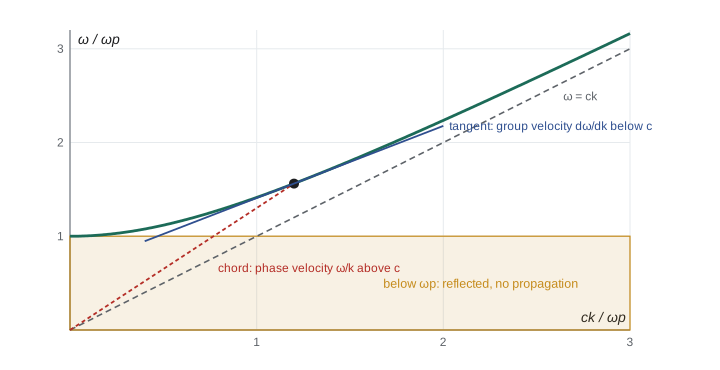
where \(n_e\) is the electron density and \(\omega_p\) is the plasma frequency. The dispersion relation is \(\omega^2 = \omega_p^2 + c^2k^2\). Above the plasma frequency waves propagate, with phase velocity \(v_p = \omega/k\) greater than \(c\) and group velocity \(v_g = d\omega/dk = c\sqrt{1 - \omega_p^2/\omega^2}\) less than \(c\), so that \(v_pv_g = c^2\). Below it, \(k\) is imaginary and the wave is reflected, decaying evanescently into the plasma. A numerical rule is \(f_p \approx 8.98\sqrt{n_e}\) Hz with \(n_e\) in electrons per cubic metre.
The ionosphere, a layer of air between roughly 60 and 1000 km up that is ionized by solar ultraviolet light and X-rays, has electron densities up to about \(10^{12}\) per cubic metre, so its plasma frequency is several megahertz. Shortwave radio below that frequency reflects from it and can travel around the curved Earth, the effect that let Guglielmo Marconi send a signal from Cornwall to Signal Hill in St. John's, Newfoundland, in December 1901. Oliver Heaviside and Arthur Kennelly proposed the conducting layer in 1902, and Edward Appleton demonstrated it directly in 1924, work that earned him the 1947 Nobel Prize. FM, television and satellite signals, at tens of megahertz and above, pass through. The density changes from day to night and with solar activity, and auroral disturbances can black out high-latitude radio, a concern for northern communities and air routes. Metals, with \(n_e \approx 10^{29}\) per cubic metre, have plasma frequencies in the ultraviolet; they reflect visible light and are transparent to hard ultraviolet, as alkali metal films show.
Phase velocity and group velocity
A monochromatic wave carries no information; it has existed forever and will go on forever. A signal is a group of waves with nearby frequencies, and its envelope moves at the group velocity \(v_g = d\omega/dk\), while the crests inside move at the phase velocity \(v_p = \omega/k\). In a medium with normal dispersion the group velocity is less than the phase velocity. Energy and information travel with the group velocity in ordinary media, so the phase velocity in a plasma can exceed \(c\) without any conflict with relativity. Near absorption lines the group velocity can even exceed \(c\) or become negative, but there the pulse is reshaped by absorption and the front of the signal, which travels at \(c\), still carries the first information. PHYS-230 introduced wave packets; the plasma relation makes them concrete.
import math, cmath
eps0 = 8.8541878188e-12; mu0 = 4e-7 * math.pi; c = 2.99792458e8
e, me = 1.602176634e-19, 9.1093837e-31

# 1. Skin depth delta = sqrt(2/(w mu sigma)) for good conductors
for name, sigma in (("copper", 5.96e7), ("aluminum", 3.77e7), ("sea water", 4.0)):
    row = []
    for f in (60.0, 1e4, 1e6, 2.45e9):
        w = 2 * math.pi * f
        row.append(math.sqrt(2 / (w * mu0 * sigma)))
    print(f"{name:10s} skin depth at 60 Hz, 10 kHz, 1 MHz, 2.45 GHz: " + ", ".join(f"{d:.3g} m" for d in row))

# 2. Exact complex wave number in a conductor, compared with the good-conductor limit
sigma, er = 4.0, 80.0          # sea water
for f in (1e3, 1e6, 1e9):
    w = 2 * math.pi * f
    k = w * cmath.sqrt(mu0 * er * eps0 * (1 + 1j * sigma / (w * er * eps0)))
    approx = math.sqrt(w * mu0 * sigma / 2)
    print(f"sea water {f:.0e} Hz: attenuation Im k = {k.imag:.4g} 1/m (good-conductor value {approx:.4g}), "
          f"depth {1 / k.imag:.4g} m")

# 3. Surface resistance of copper, the loss per square of a conductor at high frequency
for f in (1e6, 1e9, 1e10):
    w = 2 * math.pi * f; d = math.sqrt(2 / (w * mu0 * 5.96e7))
    print(f"copper at {f:.0e} Hz: surface resistance {1 / (5.96e7 * d) * 1e3:.3f} mohm per square")

# 4. Plasma frequency of the ionosphere and reflection of radio waves
for ne in (1e10, 1e11, 1e12):
    wp = math.sqrt(ne * e * e / (eps0 * me))
    print(f"electron density {ne:.0e} per m^3: plasma frequency {wp / (2 * math.pi) / 1e6:.2f} MHz")
ne = 1e12; wp = math.sqrt(ne * e * e / (eps0 * me))
for fMHz in (5, 9.5, 15, 100):
    w = 2 * math.pi * fMHz * 1e6
    if w > wp:
        vg = c * math.sqrt(1 - (wp / w) ** 2)
        print(f"{fMHz} MHz passes through: phase speed {c * c / vg / c:.3f} c, group speed {vg / c:.3f} c")
    else:
        kappa = math.sqrt(wp * wp - w * w) / c
print(f"{fMHz} MHz is reflected: field decays in {1 / kappa:.1f} m")copper skin depth at 60 Hz, 10 kHz, 1 MHz, 2.45 GHz: 0.00842 m, 0.000652 m, 6.52e-05 m, 1.32e-06 m aluminum skin depth at 60 Hz, 10 kHz, 1 MHz, 2.45 GHz: 0.0106 m, 0.00082 m, 8.2e-05 m, 1.66e-06 m sea water skin depth at 60 Hz, 10 kHz, 1 MHz, 2.45 GHz: 32.5 m, 2.52 m, 0.252 m, 0.00508 m sea water 1e+03 Hz: attenuation Im k = 0.1257 1/m (good-conductor value 0.1257), depth 7.958 m sea water 1e+06 Hz: attenuation Im k = 3.972 1/m (good-conductor value 3.974), depth 0.2518 m sea water 1e+09 Hz: attenuation Im k = 77.8 1/m (good-conductor value 125.7), depth 0.01285 m copper at 1e+06 Hz: surface resistance 0.257 mohm per square copper at 1e+09 Hz: surface resistance 8.139 mohm per square copper at 1e+10 Hz: surface resistance 25.737 mohm per square electron density 1e+10 per m^3: plasma frequency 0.90 MHz electron density 1e+11 per m^3: plasma frequency 2.84 MHz electron density 1e+12 per m^3: plasma frequency 8.98 MHz 5 MHz is reflected: field decays in 6.4 m 9.5 MHz passes through: phase speed 3.061 c, group speed 0.327 c 15 MHz passes through: phase speed 1.248 c, group speed 0.801 c 100 MHz passes through: phase speed 1.004 c, group speed 0.996 c
The skin depths fall as \(1/\sqrt{f}\): a factor of 10 in depth for every factor of 100 in frequency. For sea water at 1 kHz and 1 MHz the good-conductor formula matches the exact attenuation, but at 1 GHz it overestimates it by more than half, because there \(\omega\varepsilon\) is no longer small compared with \(\sigma\); the 2.45 GHz sea-water entry in the first table is therefore only indicative. The surface resistance of copper rises from a quarter of a milliohm per square at 1 MHz to 26 at 10 GHz. In the ionosphere model, the plasma frequency for \(10^{12}\) electrons per cubic metre is 8.98 MHz. A 5 MHz signal is reflected, its field decaying over about 6 m beyond the turning point, while 15 MHz passes through at a group speed of 0.80 c, and 100 MHz is barely affected. Just above the plasma frequency, at 9.5 MHz, the group speed is a third of \(c\) while the phase speed is three times \(c\), and their product is \(c^2\).
Worked problem
Shortwave reflection
At night the ionosphere's peak electron density falls to about \(2 \times 10^{11}\) per cubic metre. A shortwave station broadcasts at 6.0 MHz. Is its signal reflected straight back if aimed vertically?
Show solution
- Plasma frequency: \(f_p = 8.98\sqrt{2 \times 10^{11}} = 8.98 \times 4.47 \times 10^5 = 4.0\) MHz.
- The signal frequency, 6.0 MHz, exceeds \(f_p\), so a vertical wave passes through the layer.
- A wave striking the layer obliquely at angle \(\theta\) from the vertical is reflected if \(f < f_p/\cos\theta\) (the secant law), since only the vertical component of its wave vector must be reduced to zero.
- For \(f = 6.0\) MHz this requires \(\cos\theta < 0.67\), \(\theta > 48°\): signals sent toward the horizon are reflected and return to Earth hundreds of kilometres away.
Answer: Vertically the signal escapes, but at angles more than about 48° from the vertical it is reflected, which is how shortwave reaches distant listeners.
Common mistakes
MistakeApplying the good-conductor formula \(d = \sqrt{2/\mu\sigma\omega}\) at any frequency.
InsteadIt requires \(\sigma \gg \omega\varepsilon\); check the ratio first, as for sea water at gigahertz frequencies.
MistakeThinking a phase velocity greater than \(c\) violates relativity.
InsteadInformation and energy travel at the group velocity (or the signal front), which do not exceed \(c\) in ordinary media.
MistakeAssuming the index of refraction is the same for all colours.
InsteadDispersion makes \(n\) depend on frequency; in glass it rises toward the blue.
MistakeSaying metals are shiny because they are smooth.
InsteadThey reflect because their free electrons respond strongly; \(|\tilde{k}| \gg \omega/c\) makes \(R \to 1\).
MistakeTreating the ionosphere as a fixed mirror.
InsteadWhether a signal reflects depends on its frequency, its angle and the electron density, which varies with time of day and solar activity.
Summary and key terms
- In a conductor the wave number is complex; fields decay over the skin depth \(d = \sqrt{2/\mu\sigma\omega}\) in a good conductor, and \(\mathbf{B}\) lags \(\mathbf{E}\) by 45°.
- Alternating currents crowd into a surface layer; the surface resistance \(1/(\sigma d)\) grows as \(\sqrt{f}\).
- The Lorentz oscillator model gives a complex \(\tilde{\varepsilon}_r(\omega)\): normal dispersion between resonances, absorption and anomalous dispersion near them.
- A plasma has \(\varepsilon_r = 1 - \omega_p^2/\omega^2\): waves below \(\omega_p\) are reflected, above it they propagate with \(v_pv_g = c^2\).
- Signals travel at the group velocity \(d\omega/dk\); phase velocities above \(c\) are allowed.
- skin depth
- The distance over which a wave's amplitude falls by a factor e inside a conductor.
- surface resistance
- The resistance per square of a conductor at high frequency, 1/(sigma d).
- dispersion
- The dependence of the index of refraction, or wave speed, on frequency.
- anomalous dispersion
- A region near an absorption line where the index decreases with increasing frequency.
- plasma frequency
- The frequency below which a plasma reflects electromagnetic waves.
- group velocity
- The speed d(omega)/dk at which the envelope of a wave group, and its energy, travels.
Practice problems
Work each problem on paper first, then reveal the answer to check.
Find the skin depth of silver (\(\sigma = 6.3 \times 10^7\) S/m) at 10 GHz.
Show answer
\(d = \sqrt{2/(4\pi \times 10^{-7} \times 6.3 \times 10^7 \times 2\pi \times 10^{10})} = 0.63\ \mu\)m.
How long does it take free charge in sea water to dissipate?
Show answer
\(\tau = \varepsilon/\sigma = 80 \times 8.85 \times 10^{-12}/4 = 1.8 \times 10^{-10}\) s.
At what electron density is the plasma frequency 100 MHz?
Show answer
\(n_e = (f/8.98)^2 = (1.11 \times 10^7)^2 = 1.24 \times 10^{14}\) per cubic metre.
For a plasma with \(f_p = 5\) MHz, find the group velocity of a 10 MHz signal.
Show answer
\(v_g = c\sqrt{1 - 0.25} = 0.866c\); the phase velocity is \(1.155c\).
Explain why the inner conductor of a high-frequency coaxial cable can be copper-plated steel.
Show answer
At high frequency the current flows only within a few micrometres of the surface, so a thin copper layer carries it; the steel provides strength.
Using Cauchy's formula \(n = 1.500 + 4200\ \text{nm}^2/\lambda^2\), find the index for red (650 nm) and blue (450 nm) light.
Show answer
Red: \(1.500 + 0.0099 = 1.510\); blue: \(1.500 + 0.0207 = 1.521\). Blue bends more.
Lesson quiz · 5 questions
Score 60% or more to complete this lesson.
Create a free account to save your progress, take quizzes and earn a certificate.